


Posted: 2/23/2012 5:11:13 PM EDT
|
February 26, 2012
First Reading: Genesis 9:8-15 8 Then God said to Noah and to his sons with him, 9 "Behold, I establish my covenant with you and your descendants after you, 10 and with every living creature that is with you, the birds, the cattle, and every beast of the earth with you, as many as came out of the ark. 11 I establish my covenant with you, that never again shall all flesh be cut off by the waters of a flood, and never again shall there be a flood to destroy the earth." 12 And God said, "This is the sign of the covenant which I make between me and you and every living creature that is with you, for all future generations: 13 I set my bow in the cloud, and it shall be a sign of the covenant between me and the earth. 14 When I bring clouds over the earth and the bow is seen in the clouds, 15 I will remember my covenant which is between me and you and every living creature of all flesh; and the waters shall never again become a flood to destroy all flesh. Psalm: Psalm 25:4-9 R. (cf. 10) Your ways, O Lord, are love and truth to those who keep your covenant. Your ways, O LORD, make known to me; teach me your paths, Guide me in your truth and teach me, for you are God my savior. R. Your ways, O Lord, are love and truth to those who keep your covenant. Remember that your compassion, O LORD, and your love are from of old. In your kindness remember me, because of your goodness, O LORD. R. Your ways, O Lord, are love and truth to those who keep your covenant. Good and upright is the LORD, thus he shows sinners the way. He guides the humble to justice, and he teaches the humble his way. R. Your ways, O Lord, are love and truth to those who keep your covenant. Second Reading: 1 Peter 3:18-22 8 For Christ also died for sins once for all, the righteous for the unrighteous, that he might bring us to God, being put to death in the flesh but made alive in the spirit; 19 in which he went and preached to the spirits in prison, 20 who formerly did not obey, when God's patience waited in the days of Noah, during the building of the ark, in which a few, that is, eight persons, were saved through water. 21 Baptism, which corresponds to this, now saves you, not as a removal of dirt from the body but as an appeal to God for a clear conscience, through the resurrection of Jesus Christ, 22 who has gone into heaven and is at the right hand of God, with angels, authorities, and powers subject to him. Gospel: Mark 1:12-15 12 The Spirit immediately drove him out into the wilderness. 13 And he was in the wilderness forty days, tempted by Satan; and he was with the wild beasts; and the angels ministered to him. 14 Now after John was arrested, Jesus came into Galilee, preaching the gospel of God, 15 and saying, "The time is fulfilled, and the kingdom of God is at hand; repent, and believe in the gospel." ++++++++++++++++++++++++++++++++++++++++++++++++++++++++++++++++++ Additional Study Resources Overview of the Gospel: This Sunday’s Gospel reading takes place right after Jesus’ baptism in the Jordan River by John the Baptist (verses 9-11). Somewhat more detailed accounts of this event are given in the other synoptic gospels of Matthew (4:1-11) and Luke (4:1-13). In the same way that Adam was tempted in the garden “among wild beasts” and the children of Israel were tempted in the wilderness, Jesus undergoes a very real temptation by Satan, whose name means “adversary” (1 Peter 5:8, RSV-CE) or “accuser” (Revelation 12:10). Jesus, however, out of love for his Father (Mk 1:11), succeeds where Adam and Israel failed. The arrest of John (verse 14; Matthew 14:1-12) is a key event in the gospels, marking a shift in Jesus’ ministry from Judea, in the south, to the Galilee region of the north. John’s arrest also foreshadows Jesus’ own arrest leading to his trial and crucifixion. “The kingdom of God” refers to God’s sovereign rule over all the nations through Jesus. It is idealized by the Old Testament Davidic kingdom at its height which ruled not only over the twelve tribes of Israel (2 Samuel 5:1-5; Matthew 19:28) but exercised control and influence over gentile (non-Jewish) nations (1 Kings 4:20-21; Matthew 28:18-20). The kingdom that Jesus announces will, through his death on the cross, turn this ideal into a spiritual reality (Ephesians 2:11-22). Questions: In the 2nd reading, what inference does St. Peter draw about baptism from the story of Noah? By what power does he say this is accomplished? What is the significance of the number “forty” in Mark 1:13? What other great events in salvation history revolve around this number (Genesis 7:11-12; Exodus 25:15-18; Numbers 15:26-35; 1 Kings 19:1-8)? What is the common preaching theme of John the Baptist (Mark 1:2-4), Jesus (verse 15), and the first disciples (Acts 2:37-38)? What does it mean to “repent”? Why do you think it is important for us to hear about Jesus’ temptation by Satan in the wilderness? What benefit is it for us to undergo our own temptations (Hebrews 12:3-11; James 1:2-4)? Besides Satan, where do temptations come from (1 John 2:15-17; Romans 7:15-25a)? After his temptation, Jesus was ministered to by angels (verse 13). When we have successfully resisted temptation, are we able to see how God sustains and rewards us? How? Both John the Baptist (Mark 1:6) and Jesus followed practices of self-discipline for religious reasons. What self-disciplining practices do you use for religious reasons? How have they influenced your own “change of heart” (repentance)? |
|
What is the common preaching theme of John the Baptist (Mark 1:2-4), Jesus (verse 15), and the first disciples (Acts 2:37-38)? What does it mean to “repent”?
As we enter Lent 2012, isn't the whole theme "repentance" and belief in The Good News? This is the same as John the Baptist's message: "Repent, for the kingdom of heaven is at hand" (Matthew 3:2). The key is repentance. This, of course, implies our preparation to repent. The time of fulfillment, the "age to come" in Jewish theology has arrived. Messiah has arrived and sins can be forgiven and mankind reconciled with God. In Acts, we see repentance and baptism linked to the gift of the Holy Spirit. 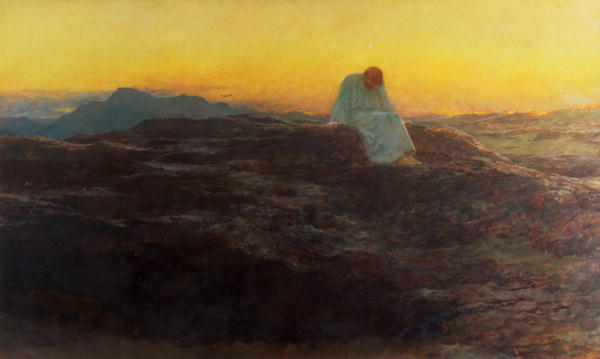
|
|
In the 2nd reading, what inference does St. Peter draw about baptism from the story of Noah? By what power does he say this is accomplished?
EXPLANATION: In the passage from which these five verses are taken, St. Peter is exhorting the newly converted Christians to live according to the Christian faith, no matter what trials they may have to endure because of it. In many places Christians were being persecuted by Gentiles and Jews because of their new faith. They should accept and bear these persecutions willingly, for they know they are not guilty of any crime except that of honoring the true God and his Son, Jesus Christ. Therefore "to suffer for being good you will count as a blessing" (3:4). Peter sets before them the example of the Innocent Christ who was put to death and who accepted his sufferings and torments for our sakes, for our sins. Through his death we have eternal life available to us. We are saved through the waters of baptism (which cleanses us of sin and makes us one with Christ) just as Noah and his family were saved at the time of the deluge.
Christ...for all: Because Christ was God in human nature, the atonement his death made to God was good for all time and for all the sins of all men. righteous: Christ was innocence itself, but he took on himself the sin of the world; he made himself a sin-sacrifice for us. bring us to God: This was the divine purpose of the incarnation: to make all men adopted sons of God and worthy of heaven if they die in the state of grace. made alive...spirit: Christ died on the cross but God raised him from the dead in a glorified body which could never again die. preached...not obey: Peter now refers to the deluge and Noah, for he saw in the waters of the flood, the life-giving waters of baptism. The spirits who did not obey are very probably the "sons of God," the rebellious angels who, according to the deluge story, were the principal cause of the sinfulness which caused the deluge (Gen. 6: 1-4). When Christ had triumphed over death and sin he announced this victory to these rebellious angels who were henceforth subjected to him. God's patience waited: The long interval between God's resolve to send a deluge (Gn. 6 : 7) and the beginning of the flood (Gn. 7: 11), was an opportunity given the sinners to repent, but they did not. few...persons: The few is stressed probably to show the similarity with the Christian Church at this time. The number of Christians in relation to the pagan population, was relatively very small. baptism corresponds: Peter compares the waters of the deluge to the waters of baptism. As Noah was saved in or from the deluge, so Christians are saved in the baptismal water. not...dirt: Probably a reference to circumcision, but it can also mean: the washing in baptism is not for a cleansing of the body but a cleansing, a new form of life for the baptized. appeal...conscience: "A pledge" would seem to be a better translation here (as in J.B.). The baptized pledges himself to live according to the new life which faith in the resurrection of Christ promises him. gone into heaven: Christ the man-God now in his glorified body is in heaven, in the next place of honor after the Father, "at the right hand of God." angels...powers: The reference is to the disobedient spirits, the evil powers, who are now forever subjected to the glorified Christ. In causing his death they brought about their own undoing (see Phil. 2:10; Rom. 8: 38; Col. 2: 10-15, et passim in St. Paul). APPLICATION: "Christ died for sins," for our sins. This is the thought which should dominate every true Christian's mind always, but especially during this Lenten season. The climax and culmination of these forty days during which we are constantly reminded of all God has done for us, comes on Good Friday with the commemoration of the excruciating death of our Savior on the cross. If only men would let the true significance of Good Friday sink into their minds, sin would disappear from our world, true love of God and neighbor would take over. Think of it; God so loved "the world" that is, us that he sent his only begotten Son, to suffer and die in our stead. The Son of God, the Creator and Lord of the universe became man, became one of us, so that he could take our sins on himself and nail them, with himself, to the cross. The innocent Lamb of God elected to take the whole load of all the sins and infidelities of all of us "lost sheep," on his own back, so that we could be set free. Five centuries before that first Good Friday the prophet described the humiliations and sufferings of him who was to come: "He was despised and rejected by men, a man of sorrows and acquainted with grief; surely he has borne our griefs and carried our sorrows . . . he was wounded for our transgressions; he was bruised for our iniquities . . . and with his stripes we are healed. All we, like sheep, have gone astray . . . and the Lord has laid on him the iniquitity of us all. Like a lamb that is led to the slaughter . . . he opened not his mouth. They made his grave with the wicked although he had done no violence and there was no deceit in his mouth. Yet it was the will of the Lord to bruise him . . . he offers his life in atonement" (Is. 53: 3-10). Here we have the first twelve Stations of the Cross described in words, more poignant than any painter ever succeeded in depicting them, for the prophet puts before our minds that it was for us that Jesus suffered his tortures. St. Peter reminds us today to meditate, to think seriously, on this almost incredible act of divine love for us, which moved God to send his own Son on earth as man, to suffer and die so that we might have true, everlasting life. Our finite minds can make no attempt to grasp this mystery of God's love for us, but we have before our eyes, in words and in picture, the terribly real sufferings of the human Jesus. We know the reason for his sufferings, our very real sins. This we can grasp and it is on this we should act. The future life in heaven which God has planned for us from all eternity, must be for us a good so great, so exalted that it is worth all the sufferings and humiliations his incarnate Son had to endure. Surely, then, we should gladly and willingly co-operate with God in procuring for ourselves this marvelous future life. We are Christians. We have been put on the road to heaven by the reception of baptism. We shall get there if we follow Christ as closely as we can during our time on earth. Noah and his family were saved in the deluge because they listened to God's advice and built their Ark. We are being advised today by the inspired writers of the Old and New Testaments to spend this Lent well to turn away from sin, to do daily some little acts of mortification, to meditate often on the one and only thing that really matters––-our attainment of that union with God which is so important that the Son of God suffered and died so that we could have it everlastingly. Catholic Matters |
|
Dying and Rising with Jesus during Lent by Fr. Tommy Lane
What is the most important event in the history of the world? It is the death and resurrection of Jesus. Jesus’ death and resurrection is the “center of gravity” of all time. It is so important that the Easter Vigil on Holy Saturday night celebrating Jesus’ resurrection is the greatest celebration of the Church each year. It is so important a celebration that we spend over six weeks preparing for it, this season of Lent.
We will renew our baptismal promises during the Easter Vigil on Holy Saturday night. Paul says, when writing to the Romans (chapter 6), that when we were baptized we died to our old way of life to live a new way of life. He says that when we were baptized we went into the tomb with Jesus and rose out of the tomb again with Jesus to a new life. The season of Lent is to give us time once again to die to our old sinful ways of life and rise out of the tomb with Jesus to a new way of life so that by the Easter Vigil on Holy Saturday night when we renew our baptismal vows we will also have renewed our lives. So it is a time when we try to control our desires and exercise self-control. The second preface of Lent states, “This great season of grace is your gift to your family to renew us in spirit. You give us strength to purify our hearts, to control our desires, and so to serve you in freedom.” The Gospel today tells us of the time Jesus spent in the desert. Jesus’ forty days in the desert not yielding to sin despite temptation, is our model for overcoming sin during Lent. In the desert Jesus was tempted by Satan to totally wreck his Father’s plan. The three pieces of Scripture that Jesus quoted show him overcoming temptations and submitting to his Father’s plan: “Man does not live on bread alone but on every word that comes from the mouth of God.” “You must not put the Lord your God to the test.” “You must worship the Lord your God and serve him alone.” Jesus submitted to his Father’s will. During Lent let us die to ourselves like Jesus so that the Father’s plan can be accomplished in our lives. During Lent, in order to die to ourselves and rise to new life with Jesus, we make sacrifices and do things we do not normally do. All the “doing” of Lent is to be a symbol of what is meant to be happening inside each of us during Lent, dying to our old sinful way of life and rising to new life with Jesus. The focus of Lent is on renewing our lives in service of the Lord, becoming more like Jesus. Jesus in the desert is our model during Lent, inspiring us to die to ourselves so that the Father’s plan can be accomplished. That is why the Sacrament of Reconciliation is an important part of Lent because as we die to ourselves we realize that we need to come before the Lord confessing the times when we didn’t die to self in order to rise to new life with him. Throughout the centuries, to help us die to ourselves and rise to new life with Jesus during Lent, the Church proposes that we consider taking on ourselves three things during Lent: praying more, fasting from something, and helping the poor. Very often we hear people saying “we are so busy we don’t have time for anything.” During Lent I encourage you to find extra time for prayer. A life lived without prayer can never be a happy life. Remember what Jesus said on one occasion, “What profit would there be for one to gain the whole world and forfeit his life?” (Matt 16:26) In the early Church Christians used to fast two days a week, on Wednesdays and Fridays. We have only two fast days in the year now, Ash Wednesday and Good Friday, but it would be good to be courageous and do fasting of some kind right during Lent or abstaining from something we like. Remember that fasting is a symbol of what is meant to be taking place inside us during Lent, dying to ourselves and rising to new life with Jesus. We all have been given an opportunity to help the poor by donating to the aid agencies of the Church which do so much good helping the underprivileged all over the globe. As we look at different scenes from around the world on our TV sometimes we cannot but say that we have a lot for which to be thankful to God. May this Lent be a time of special grace for each of us. The highpoint of our year is our celebration of the death and resurrection of Jesus during Holy Week and during the next six weeks we also want to prepare for that celebration by dying to sinful ways and rising to new life with Jesus. |
|
WHY LENT?
"You are now saved by a baptismal bath." 1 Peter 3:21
By far the greatest day of your life was the day of your Baptism. On that day, you became a new creation (Gal 6:15), "begotten from above" (Jn 3:3), born again "of water and Spirit" (Jn 3:5). Because of your new nature, you became adoptable into God's family. You became a son or daughter of God (Jn 1:12), a member of Christ's Body (1 Cor 12:12), and a temple of the Holy Spirit (1 Cor 6:19). The Lord made a covenant of love with you (see Gn 9:9). You made a pledge "of an irreproachable conscience through the resurrection of Jesus Christ" (1 Pt 3:21). Original sin was washed away. However, for many Christians, Baptism does not seem the greatest day of their lives, the event at which they received the power to transform the world. This is because Christians are not living their Baptisms. This tragedy is the basis of almost all other tragedies. Therefore, the Church has developed a most ambitious, international program for the renewal of our Baptisms. On Easter Vigil and Easter Sunday, in every Catholic Church in the entire world, all Catholic Christians will be asked to renew their baptismal promises. In order for this to be a true renewal, we prepare for it by forty days of fasting, prayer, and penance. Observe Lent. Then at Easter Mass, commit yourself totally to the Lord. Love Him more deeply than ever before. Renew your baptismal promises and change the world. Prayer: Father, may I never be the same after this Lent. Give me a new springtime in the Holy Spirit. Promise: "This is the time of fulfillment. The reign of God is at hand! Reform your lives and believe in the gospel!" �Mk 1:15 Praise: Praise and honor to You, Lord Jesus! You take us to the desert to speak to our hearts (Hos 2:16). We offer you our lives as a sacrifice of praise (Ps 50:23). |