


Posted: 3/24/2017 11:13:18 AM EDT
|
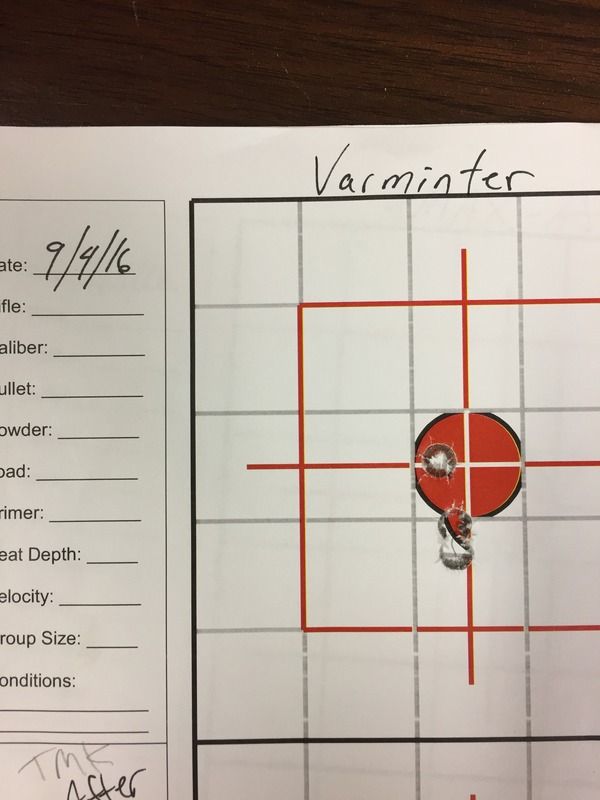
I have had occasional, erratic stringing of loads down and left....
175 TMK - 175 TMK, 42.8 gr R15, Hornady cases 110 Varm - 110 gr Nosler Varmageddon, 50 gr BLC-2, PRVI cases Rifle - Trued Rem 700, 20" varmint contour with AE30 can 

I have a theory of why… I have not always been diligent at cleaning lube off of the cases. I could feel the lube still on these cases, and it would account for why it has happened erratically with other loads. I have cleaned off the remaining loads and will go back and shoot them some more. I need a chronograph! The Labradar is calling my name. Thoughts on the impact of cases with lube still on them? |
|
It is a little difficult to follow what your were trying to accomplish on this range visit. It appears your 175 gr bullet shoots well, and your 110 grain bullet shows a very pronounced tendency to print a diagonal string on the target. Because of the order that you preformed your tests, it appears that it is not a mechanical issue with your rifle. You report that at other times, this 110 grain load has also performed very well.
To test your case lube theory, you should compare the difference between careful cleaning and your normal procedure without changing any other variable. Depending on your procedure, maybe you will find the improvement is not worth the extra effort. I usually rinse my brass after resizing, but that is because I like my hands to feel clean after handling loaded ammo. Another thing to consider is the effects of residue in the barrel from different kinds of powder. It adds another variable if you are intermittently switching between powders. Just like copper fowling, you should give the barrel some shots to reach an equilibrium before expecting it to be extremely consistent. I don't know if anyone has done extensive research on this topic, but there are many competitive shooters that avoid switching powder without cleaning because the accuracy results are sometimes unpredictable. Sorry I don't have a definitive answer. I would certainly be very interested to see what other people say about it. |
|
Quoted:
It is a little difficult to follow what your were trying to accomplish on this range visit. It appears your 175 gr bullet shoots well, and your 110 grain bullet shows a very pronounced tendency to print a diagonal string on the target. Because of the order that you preformed your tests, it appears that it is not a mechanical issue with your rifle. You report that at other times, this 110 grain load has also performed very well. To test your case lube theory, you should compare the difference between careful cleaning and your normal procedure without changing any other variable. Depending on your procedure, maybe you will find the improvement is not worth the extra effort. I usually rinse my brass after resizing, but that is because I like my hands to feel clean after handling loaded ammo. Another thing to consider is the effects of residue in the barrel from different kinds of powder. It adds another variable if you are intermittently switching between powders. Just like copper fowling, you should give the barrel some shots to reach an equilibrium before expecting it to be extremely consistent. I don't know if anyone has done extensive research on this topic, but there are many competitive shooters that avoid switching powder without cleaning because the accuracy results are sometimes unpredictable. Sorry I don't have a definitive answer. I would certainly be very interested to see what other people say about it. As far as what I was trying to occomplish, I have a long range match next week and the groundhogs are starting to come out, so I was trying to get both loads zeroes so I can get after it. |

|
Does this exist with the can off? Do you have to continuously rezero (ie; it's not a short term drift)? Check your crown and can? Time between shots & is it cold to start with?
Perhaps something to do with neck tension on your 110's not being set right and moving while firing...? |
|
Quoted:
Does this exist with the can off? I haven't shot it with the can off, might be something to try. Do you have to continuously rezero (ie; it's not a short term drift)? Nope, same zero for the 175 TMK as last fall, just moved down 0.1 mil and right 0.1 mil Check your crown and can? Both look fine. No indication of baffle strikes. Time between shots & is it cold to start with? I try to keep my shooting to a minute a round. If i shoot a 3 or 5 shot group, I'll wait that long in minutes to shoot the next group. Perhaps something to do with neck tension on your 110's not being set right and moving while firing...? This thought crossed my mind too. On one of the groups, I checked the rounds that were in the magazine while firing. I didn't have a set of calipers at the range, but comparing them to other rounds, they were the same length. I checked the tightness of the can, that has caused me issues before; it was tight. The stinging is so weird. |
|
I was digging through some of my old posts and thought I'd give an update to this.
I believe the issue was a dirty bore. It had been a while since I had cleaned my rifle and I go by the adage of don't clean until your groups suffer. The dirty bore didn't affect my 175 TMK load, but it seemed to adversely affect the 110 Varminter load. I cleaned the rifle and the load went back to grouping well. |