


Posted: 12/22/2015 11:44:16 PM EDT
|
I just received an Icom AH-4 which I will be hooking up to my IC-7410. I plan on using a random wire or possibly connecting to my rain gutter as a radiator. Not ideal I know but no trees and a tower or pole is totally out of the question due to high dollar cranky lawyer abutting my back yard, it must be discrete. I have two ground rods driven nearby to use for counterpoise. Can I just toss the random insulated wire over my roof (wood construction with asphalt shingles) or must it be raised from the actual roofing materials to work? Also if over the roof is feasible do I need to insulate the end of the wire where the copper is exposed when cut? I see no mention of this in the limited instructions that came with the unit. I have been surfing and will avoid the "bad" lengths of random wire.
In time there will be a flagpole or other disguised antenna but for now this has to do to get on the air. |
|
High dollar lawyer, huh?
I had a headache with the wife of one of those once. She was pregnant and I had a sick cat.... Hell, here ya go..... As far as the question goes, the longer the better and don't worry about the bitter end. |

|
Quoted:
Can I just toss the random insulated wire over my roof (wood construction with asphalt shingles) or must it be raised from the actual roofing materials to work? When transmitting, some points along the wire can develop very high voltages - In some cases, high enough to puncture the wire insulation. So, it's possible that you might see some arcing through the insulation, particularly when the roof is wet. Also, moving the wire just a little bit away from anything that might absorb RF can help a lot. The inverse-square law applies here - Laying the wire directly on the absorbing material will cause a lot more loss than moving it just a few inches away. Also if over the roof is feasible do I need to insulate the end of the wire where the copper is exposed when cut? While transmitting, the ends of a random wire can also develop very high voltages - Possibly high enough to make the presence or absence of wire insulation a moot point. If you're supporting the wire by its ends, try to use a decent insulator between the wire end and whatever you're using to support it (i.e., guy wire, string, rope, etc.). |
|
Quoted:
Run radial wires as a counterpoise not just a ground rod. Quoted:
Run radial wires as a counterpoise not just a ground rod. This. Quoted:
While transmitting, the ends of a random wire can also develop very high voltages - Possibly high enough to make the presence or absence of wire insulation a moot point. If you're supporting the wire by its ends, try to use a decent insulator between the wire end and whatever you're using to support it (i.e., guy wire, string, rope, etc.). And this. Potentially other places along the antenna also if it's a half wave or longer. |
|
When I bought this house 6 years ago, I was not an amateur radio licensee so there was no consideration of the issues I might have during operation.
Any counterpoise radials would be on top of concrete deck, so that will not happen. No fence. I am going to try the rain gutter loading as I have about 94' available. It is U shaped with 44' on the South side, 30' on the East and 20' on the West side of the house. There are also 2 10' vertical down spouts. Should make for an interesting propagation pattern to say the least. The gutters are riveted together and the downspouts are screwed on so hopefully there is continuity along the entire length. May be high impedance to RF though. FWIW, the house has an attached 4 car garage which was a major reason for the purchase back then. |
|
Quoted:
Any counterpoise radials would be on top of concrete deck, so that will not happen. Here is the thing. It will happen. You can't just decide there will be no counterpoise. Something will be the counterpoise. The question is whether you have control over what it is. Otherwise it will probably be some combination of the coaxial cable, radio and equipment, house electrical wiring, and maybe the operator. |
|
lay AH-4 in back yard
spread out counterpoise radials get some hamsticks, or fiberglass mast or something to make a vertical radiator work DX I had mine bolted to the back bed of a ford ranger i ran a 102" CB whip for 6-20meters,...and could swap out 40&80m hamsticks it worked better than expected,.....but my TARHEEL works a lot better |
| I did not say there would be no counterpoise and understand that something will take on that function. I just said it will not be a lot of wires spread over a deck that we use regularly. Would you string wires over such an area if it were your home? As I mentioned earlier, eventually there will be some sort of hidden antenna system with proper radials installed but this is not the right time for several reasons. |
|
If you have a Deck, AH-4 and start of random wire can be placed on the deck, radials can be wrapped around the deck and directed to the ground. There is no reason you can not have raised radials! in fact it changes the impedance of the antenna (at 45deg it matches 50 ohm). All you are looking to have is basically a second leg of the dipole and not allow the signal to find its way back to the shack and defeat the AH-4 purpose.
Otherwise a tuner inside the shack with a random wire should work. The principle is that the center conductor will carry the signal to outside where it will attach to the random wire and the shield will act as a radial. You could connect the shield to a wire and lay it anywhere! With this solution however, you have high voltage and current running thru your house effecting lights, and other appliances in the house. |
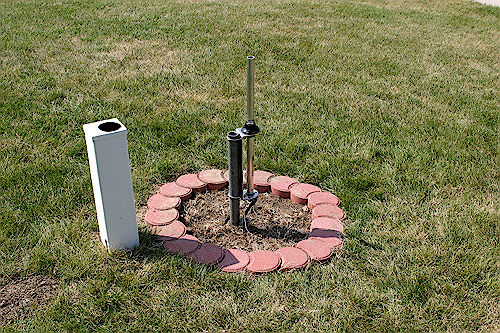
| Yes, HOAville. It sucks for some things but does have a few advantages also. I knew it was the case when we moved in, but as stated above was not a ham at that time. Right now, I am just trying to get some sort of radiator in service before the really cruddy weather begins. I will then have the winter to be on the air and able to plan for a stealth antenna system that will work better. The flagpole type looks promising for now. |
|
Quoted:... The flagpole type looks promising for now. the hustler vertical antennas work very well, and if you take the time to tune them, they are resonant, which means you don't need a lossy tuner 
http://www.hamuniverse.com/kx9dk4btvflagpole.html 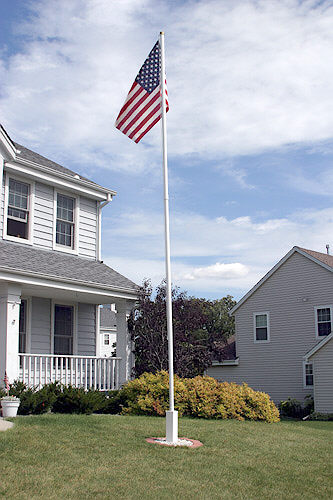
|
|
Quoted:
Rain gutters are going to exhibit the same high voltage nodes along it's length as the wire would. Are you sure you want that high voltage right against the house? Might be OK with low power settings but I wouldn't put 100 watts through it. And the gutter is connected to the roof every several feet with nails. Unless you're willing to re-hang the gutter so that it has several KV of insulation between itself and the roof eaves, it's going to be lossy as all getout in very dry weather - and a dead short to ground in wet weather. |
|
I have an AH4 that I use in my car. It's hooked to a 109" whip. It gets out pretty well, but when I'm stopped and hook it to a lot more wire, it's AMAZING.
I have a 43-ish foot vertical at my dad's house that is tuned by the MFJ version of the ah4, and it's great. Most of my DX has been worked with that antenna. I prefer it over a horizontal dipole. I'd get one of the "random length" pieces of wire, put it in a tree (can even be close to the trunk if you want) and build a ground radial field. |
|
Quoted: When transmitting, some points along the wire can develop very high voltages - In some cases, high enough to puncture the wire insulation. So, it's possible that you might see some arcing through the insulation, particularly when the roof is wet. Also, moving the wire just a little bit away from anything that might absorb RF can help a lot. The inverse-square law applies here - Laying the wire directly on the absorbing material will cause a lot more loss than moving it just a few inches away. While transmitting, the ends of a random wire can also develop very high voltages - Possibly high enough to make the presence or absence of wire insulation a moot point. If you're supporting the wire by its ends, try to use a decent insulator between the wire end and whatever you're using to support it (i.e., guy wire, string, rope, etc.). Quoted: Quoted: Can I just toss the random insulated wire over my roof (wood construction with asphalt shingles) or must it be raised from the actual roofing materials to work? When transmitting, some points along the wire can develop very high voltages - In some cases, high enough to puncture the wire insulation. So, it's possible that you might see some arcing through the insulation, particularly when the roof is wet. Also, moving the wire just a little bit away from anything that might absorb RF can help a lot. The inverse-square law applies here - Laying the wire directly on the absorbing material will cause a lot more loss than moving it just a few inches away. Also if over the roof is feasible do I need to insulate the end of the wire where the copper is exposed when cut? While transmitting, the ends of a random wire can also develop very high voltages - Possibly high enough to make the presence or absence of wire insulation a moot point. If you're supporting the wire by its ends, try to use a decent insulator between the wire end and whatever you're using to support it (i.e., guy wire, string, rope, etc.).  |
|
Quoted:
That's why I tie an overhand knot at the end of the wire...to keep the high voltage from leaking out. If you grease the wire the snow and ice won't stick to it and you have the advantage that the radio waves slip off of it faster so you can make faster QSOs. |
|
Quoted:
I have an AH4 that I use in my car. It's hooked to a 109" whip. It gets out pretty well, but when I'm stopped and hook it to a lot more wire, it's AMAZING. I have a 43-ish foot vertical at my dad's house that is tuned by the MFJ version of the ah4, and it's great. Most of my DX has been worked with that antenna. I prefer it over a horizontal dipole. I'd get one of the "random length" pieces of wire, put it in a tree (can even be close to the trunk if you want) and build a ground radial field. What kind of wire do you use? I also have one but did not understand very well that diagram in the manual. Do you just strap a piece of wire to the end of your 7ft whip and throw it at a tree? |
|
Quoted:
What kind of wire do you use? I also have one but did not understand very well that diagram in the manual. Do you just strap a piece of wire to the end of your 7ft whip and throw it at a tree? Quoted:
Quoted:
I have an AH4 that I use in my car. It's hooked to a 109" whip. It gets out pretty well, but when I'm stopped and hook it to a lot more wire, it's AMAZING. I have a 43-ish foot vertical at my dad's house that is tuned by the MFJ version of the ah4, and it's great. Most of my DX has been worked with that antenna. I prefer it over a horizontal dipole. I'd get one of the "random length" pieces of wire, put it in a tree (can even be close to the trunk if you want) and build a ground radial field. What kind of wire do you use? I also have one but did not understand very well that diagram in the manual. Do you just strap a piece of wire to the end of your 7ft whip and throw it at a tree? That's what I did back when I ran an AH-2 tuner mobile/portable. |
|
Quoted:
That's what I did back when I ran an AH-2 tuner mobile/portable. Quoted:
Quoted:
Quoted:
I have an AH4 that I use in my car. It's hooked to a 109" whip. It gets out pretty well, but when I'm stopped and hook it to a lot more wire, it's AMAZING. I have a 43-ish foot vertical at my dad's house that is tuned by the MFJ version of the ah4, and it's great. Most of my DX has been worked with that antenna. I prefer it over a horizontal dipole. I'd get one of the "random length" pieces of wire, put it in a tree (can even be close to the trunk if you want) and build a ground radial field. What kind of wire do you use? I also have one but did not understand very well that diagram in the manual. Do you just strap a piece of wire to the end of your 7ft whip and throw it at a tree? That's what I did back when I ran an AH-2 tuner mobile/portable. I actually use a piece of 14ga THHN wire, soldered to a medium sized battery clip. Throw it up in a tree, or tie a rope to the end and throw that rope in a tree. |
|
Quoted:
What kind of attic space do you have? Several of us use attic antennas, with pretty good success. Yep - The attic is good, because it allows you to suspend the wire far enough away from the roof and other objects to prevent arcing. Even if your roof material absorbs some of the radiated signal, that's still a lot less than the amount of signal you'll lose if your antenna wire is slowly turning parts of your roof into charcoal... 
|
|
Quoted:
What kind of attic space do you have? Several of us use attic antennas, with pretty good success. I have a fairly steep pitched roof so there is probably plenty of space for an antenna. I have never been up in the attic as I had both knees replaced a couple of years ago. I had some post surgery issues but I am doing well enough now to climb a ladder and explore the area. Have absolutely no idea what is in there but the house is pretty large and the roof is tall. I have been looking at coax routing and there are a couple of possibilities from the shack into the attic. This is likely my best option and I can work on it even if the weather is nasty, which it soon will be. ETA: The house has a hip roof and I just went outside to look and the peak ridge of the roof is 32' in length and the house is 72' so there should be plenty of room for a fair sized attic antenna. This will orient the antenna running North and South so radiation should be primarily East and West which will be best from my locale. |
| I was thinking of using insulated electric fence connector wire for the legs of the antenna. It is rated at 20kv and I can get 100' rolls quite reasonably at local farm supply stores. If I recall correctly the insulation will make the wire appear longer by a slight amount. |
| All you needed to mount a dipole in the attic, are a few lag-screw eyes from HD, and a couple of end insulators. I put one screw eye in the ridge beam to hold the center insulator/balun, and one in a rafter, at each end of the dipole. Then, hang up the dipole with some rope or paracord, just like you would outside. Easy and cheap. I used 14 gauge thhn for the wire. |
|
Quoted:
I was thinking of using insulated electric fence connector wire for the legs of the antenna. It is rated at 20kv and I can get 100' rolls quite reasonably at local farm supply stores. If I recall correctly the insulation will make the wire appear longer by a slight amount. Like Kekoa mentioned, THHN copper wire would be better. Electric fence wire is steel and not as good of a conductor as copper, not to mention steel wire is hard to work with. |
| The wire I was looking at was aluminum but since it will be isolated and inside copper is probably the best choice. Do I still need the balun if I use the AH-4 tuner? I have read you hook one leg of the dipole to the lower terminal and the other to the top connection. Or would I still need a 1 to 1 balun for isolation from RF feedback to the shack? |
| I wouldn't take it to the bank that the autocoupler/random/counterpoise combination will not have appreciable common mode current issues in all cases, in fact I have found the opposite to be true more often than not. Good radials on or in the ground will probably improve the chance of working without RF hassles but a quick install with a couple of wires probably won't do it. I keep a choke coil attached to my SGC all the time, it's easy and does the job. |
|
Re: Radials and the deck, staple the radial wires under the deck and use lots of short radials rather than a few long ones. Tape up or insulate the ends of the radials as the voltage is high there and you don't want arcing or a fire hazard. A loop at the end of the wire of an inch or two in diameter reduces the arcing potential as well. hth 73, Rob |
|
One question. Any of you are using a control cable longer than the one Icom sent with the tuner? They recommend placing it as close as possible to the antenna but that cable only seems to work for cars. For a house it would have to be longer.
Did anyone make a longer one and it's working fine? I'd need one at least two to three times longer. |
|
Quoted:
One question. Any of you are using a control cable longer than the one Icom sent with the tuner? They recommend placing it as close as possible to the antenna but that cable only seems to work for cars. For a house it would have to be longer. Did anyone make a longer one and it's working fine? I'd need one at least two to three times longer. I use my MFJ 996 BRT with 100ft of sprinkler wire. Works fine for what I need. |
|
Quoted:
One question. Any of you are using a control cable longer than the one Icom sent with the tuner? They recommend placing it as close as possible to the antenna but that cable only seems to work for cars. For a house it would have to be longer. Did anyone make a longer one and it's working fine? I'd need one at least two to three times longer. I also used sprinkler wire, no issues. |