


Posted: 7/10/2015 7:03:45 PM EDT
| How do you "zero" the inductance adjustment knobs on an mfj-949d ? The knobs go from zero to 10 but there are no stops on them. So you can just turn the knobs in circles indefinitely. Is this unit broken ? |
|
Quoted:
How do you "zero" the inductance adjustment knobs on an mfj-949d ? The knobs go from zero to 10 but there are no stops on them. So you can just turn the knobs in circles indefinitely. Is this unit broken ? No, it's likely not broken. Take the cover off of it and look at how the mechanism works. There are basically 2 types of inductors used in an antenna tuner. Roller inductors do indeed stop at each end of the adjustment range, and the type I believe your unit has is an air dielectric variable capacitor commonly called a butterfly capacitor.. A variable capacitor uses two series of plates (butterfly shaped), one set that's fixed and another set which turns in relation to the other set.  
As you can see, the center spindle rotates and the other plates are fixed to the body of the unit. The plates don't touch, but rotating the one set puts more or less surface area in proximity to the fixed set. One set is + and the other is -. Their proximity to the other creates magnetic inductance. They are fairly simple and you cant hurt them by turning them. 
|
Take a look at the schematic of the tuner. I can only find a 949B with a quick search, but I'll assume that part is the same as a D. The inductor selector switch on A has minimum inductance, and each step after that raises it until L is maximum. ETA: Fixed. 
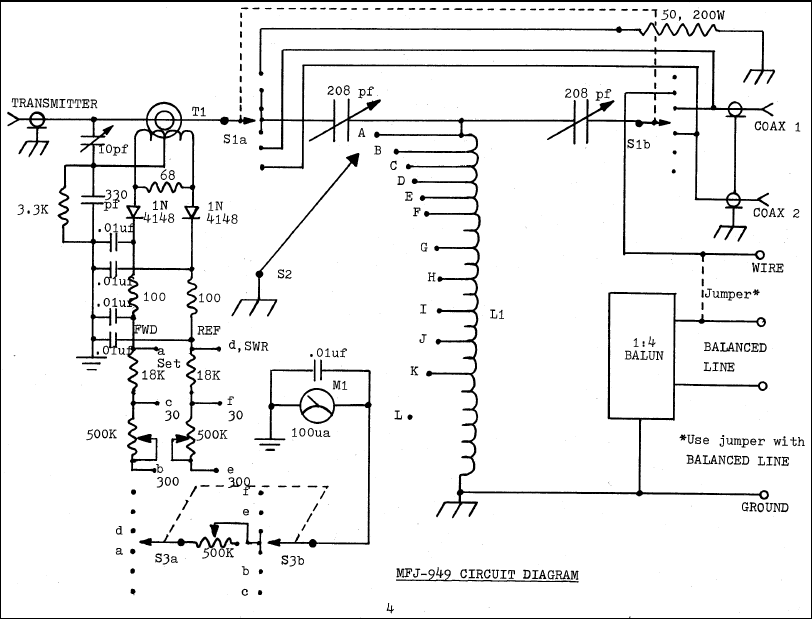
The other two knobs labeled Transmitter and Antenna are variable capacitors like pcsutton described. They are the two 208 pF variable caps. His last two sentences in the next to the last paragraph have me scratching my head though. 
|
|
I have the manual. It don't tell you jack about the knobs. |
|
Quoted:
I have the manual. It don't tell you jack about the knobs. Some knobs have stops that limit travel and some don't. It seems these don't need a stop and don't have it. |
If the tuner looks like this, they are variable CAPACITORS, ( similar to pic that pcsutton posted ) not inductors

as more of the capacitor plates mesh together, the capacitance increases 
from the photos, you can see the inductor is tapped, A thru L. It's in the middle |
|
This is an excellent article on using your T-network tuner.
http://www.arrl.org/files/file/Technology/tis/info/pdf/9501046.pdf You can take what is in this article to the bank. On pages 46 and 47 there are procedures for tuning a variable inductor tuner, and for tapped inductor tuner like the OP's MFJ 949. There is more than one tuning solution that can be found. Some tuning solutions can generate high voltages and cause arcing even when used well below the rated power. If you arrive at a minimum SWR where either of the capacitors is just barely meshed, try switching the inductor to a higher or lower setting and try again. |
|
Quoted:
Is this unit broken ? To install a knob or "zero" as our OP asked is simple. Open the case to get a good visual on the caps. Turn the shaft to fully mesh the plates. You are now at full capacitance of whatever rating the cap is. Install the knob and tighten the setscrew at whatever the scale says is maximum. In this case set the pointer to "10". Close up the case. FWIW: The 0 to 10 markings mean nothing. All they do is give you a reference to return to a setting. For example if on the phone portion of 20m you adjust as per stimpsonjcat instructions and find that the settings are 6 on transmitter, D on inductor, and 4 on antenna ... write those down. Do this for all the bands. Depending on your antenna system and band you may have a different setting every 100khz or so. Make a chart and have it at the tuner. When you switch bands set the unit up with a known good previous setting and all that's left is a tweak of the transmitter and antenna caps for SWR. |