


Posted: 4/6/2015 10:25:35 PM EDT
|
I'm still fuzzy on the whole HF-manpack-underway antenna setup.
I suppose that is due to my still limited experience with antennas. The verticals I have used always required a counterpoise in the form of a long wire (usually two, 180 deg to each other), and elevated off of ground (the ground). So how does, for example, a AN/PRC-150 manpack do HF from 1.6 to 60 MHz? |
|
Quoted:
I'm still fuzzy on the whole HF-manpack-underway antenna setup. I suppose that is due to my still limited experience with antennas. The verticals I have used always required a counterpoise in the form of a long wire (usually two, 180 deg to each other), and elevated off of ground (the ground). So how does, for example, a AN/PRC-150 manpack do HF from 1.6 to 60 MHz? not the answer you'd like but.... not well Most of the time I've run with a 150 it's been stationary with a field expedient or off a vehicle |
|
Quoted:
Ok, that's what I was wondering. Stationary, it's no problem to do an antenna. Heck I've gotten 5-7/5-8 on NVIS out to 300 miles with 10 watts on an extended Buddipole dipole setup for 40m. But that sucker is 27 feet, tip to tip. yep - it's easy to have the wire for a sloping V in your pack and throw it up in a tree real quick |
|
Look at End-Fed dipoles. They are very easy to set up and require no tuner. End-Fedz 10/20/40 is my favorite for portable opps. It takes several minutes (or less) to deploy and it works great.
BuddiPole is my least favorite. It works ok when tuned properly but it's a pain in the arse to tune. I only use it if no other antenna can be used (no trees to support the End-Fed dipole) |
|
The answer to your question is that historically most military manpacks were predominantly used in the field in a stationary role. With either endfeds, dipoles or worst case whips as the desired antenna of choice depending on the distance one needed communicate.
What you are asking about mobile ops were typically done with VHF radios, and actually rather rare for HF use. IF you had to use your HF rig in this role typically you had two choices, one option, and probably the most common one in any sort of wooded country was to use a longish drag wire for receive only type work to receive comms on the move. The wire was actually usually quite short electrically, maybe 1/4 wave on the higher bands and usually way too short on the lower bands in theory, but usually the TX stations were quite strong. Typically the wire was a few meters long. Then if you did receive comms that actually required a response while on the move, then you stopped and set up a real antenna and send a response. Alternately a whip could be used and this was somewhat faster in theory but in practice a 10 foot tall pole tends to attract the wrong sort of attention. For HAM use, most guys use some sort of center loaded vertical if they can to get as much out of a given whip as they can. Also they use a dragging counterpoise, usually about 1/4 WL long, but you have to experiment with that based on the local soil conditions. Also highly recommended is a radio with an A-ATU function that re-tunes the system with each PTT press, as conditions can change wildly and unexpectedly. Also, keep an eye out for powerlines if you are doing this anywhere remotely civilized. |

|
Quoted:
I suppose that this setup is just VHF/UHF even though the -177 goes to 30 MHz http://farm8.staticflickr.com/7697/17078974902_a458cb65b7_c.jpg 30-90mhz is low band VHF land. Think prc77 if you want a historic reference. Also you will see ads with HF packs that look like that but it was seldom done like that in reality. A typical "big" VHF whip is 3-4 ft long, the smallest HF verticals are usually about 10ft. Also as a point of historical curiosity: the main reason power in VHF man packs went up was to compensate for shorter and shittier antennas that were (rightly from a combat troops point of view) demanded by the troops. |
|
Dan if your goal is to run pedestrian mobile with your IC 703, I'd recommend the following.
Get a ALICE frame for it, and somehow mount a CB-pl259 whip mount to it. Get an AT271 spring base adapter and fit it up to the CB mount. This will give your antenna some give which it will need in the wind and if it god forbid hits something. Next, and this is band dependent to a degree. Using your buddipole, take 1 or 2 (I usually just use 1) straight sections, then a BP coil, and then either a AT271 whip or a BP whip on top of that. this is your main radiator, the bigger the better, but size can be a problem. Next attach a ~1/4 WL drag wire for the band you intend on operating on, I use a quick disconnect in case it gets snagged. Then, elevate the thing on a table/chair etc at about the height you will be using it on and hopefully above comparable ground. And using an analyzer get it tuned or close, this will entail adjusting the coil and drag wire lengths. Then put it on your back, and see how that changes things, you should see more capacitance added and the SWR change, if its not too bad hit the tun button on your rig and get to talkin, otherwise change the coil setting a bit (less typically) or change the length of the drag wire. ETA: Having the whip center loaded with the coil will help with overall efficiency of the setup. ETA2: You will attract alot of attention, stop transmitting if people are near you/talking to you. ETA3: Here is a pic of what you want to do minus the AT271 spring base (not needed since I wasn't man portable, but still recomended). 
|
|
Quoted:
30-90mhz is low band VHF land. Think prc77 if you want a historic reference. Also you will see ads with HF packs that look like that but it was seldom done like that in reality. A typical "big" VHF whip is 3-4 ft long, the smallest HF verticals are usually about 10ft. Also as a point of historical curiosity: the main reason power in VHF man packs went up was to compensate for shorter and shittier antennas that were (rightly from a combat troops point of view) demanded by the troops. Quoted:
Quoted:
I suppose that this setup is just VHF/UHF even though the -177 goes to 30 MHz http://farm8.staticflickr.com/7697/17078974902_a458cb65b7_c.jpg 30-90mhz is low band VHF land. Think prc77 if you want a historic reference. Also you will see ads with HF packs that look like that but it was seldom done like that in reality. A typical "big" VHF whip is 3-4 ft long, the smallest HF verticals are usually about 10ft. Also as a point of historical curiosity: the main reason power in VHF man packs went up was to compensate for shorter and shittier antennas that were (rightly from a combat troops point of view) demanded by the troops. for SINCGARS we have two antennas - a 4' tape antenna and a 10' hard folding whip let me dig up pics - but both are for 30-89.975mhz for UHF you get a donkey dick here's part of the 10' 
and a 10' all closed up where it works like crap but still better than the broken tape antenna I had 
I actually can't find one with the tape antenna - here's stock pics: 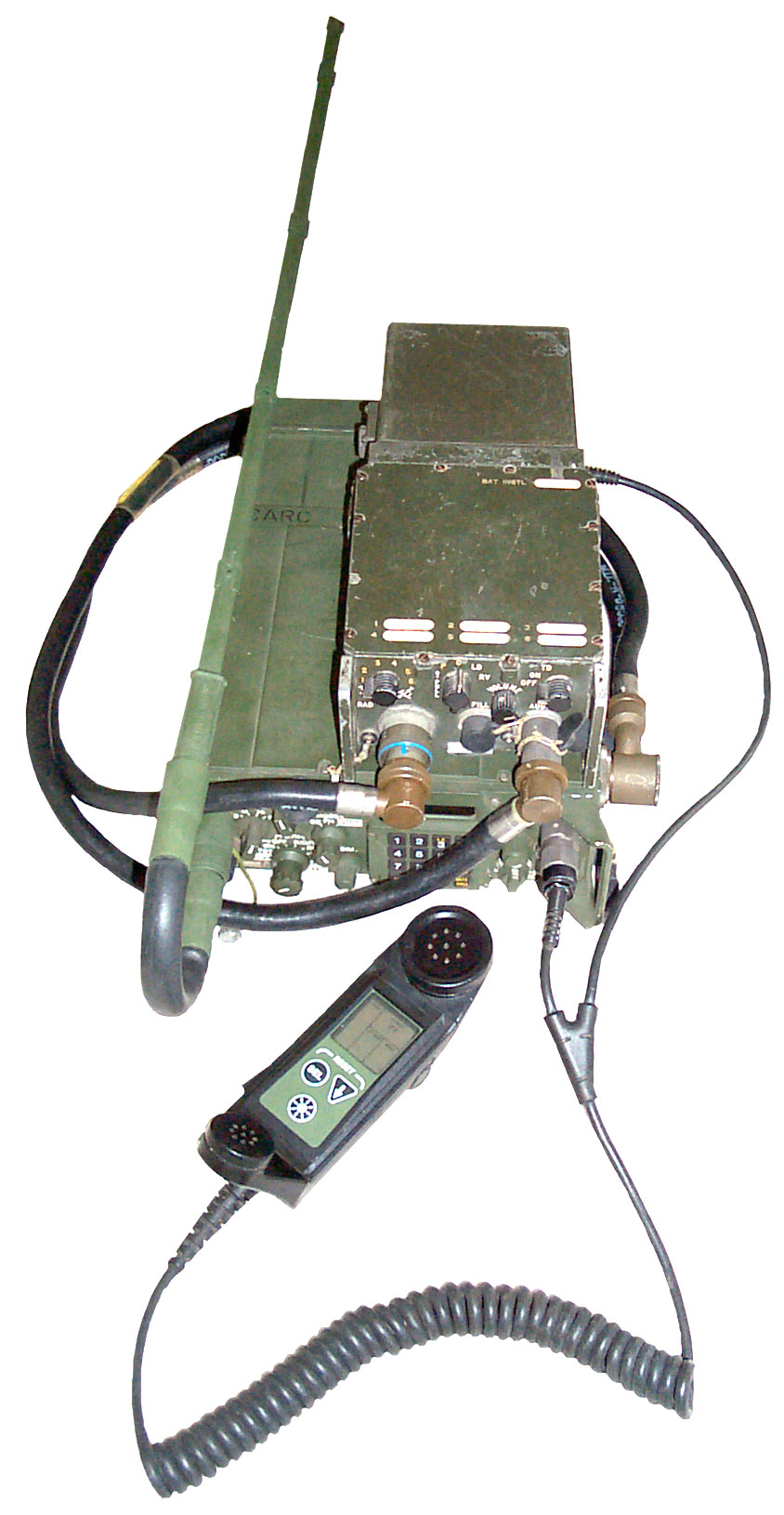
and UHF donkey dick: 
|
|
Quoted:
you probably know better than I - all we knew was long one or short one  Quoted:
Your 10ft is an at271, I forget the 4ft at592 maybe but it's the same as the one used on the prc77 (as was the 271 in a stationary role) you probably know better than I - all we knew was long one or short one I can relate 
|
|
Also, another point of historical note. One of the criteria for the clansman system was that the antenna size was be reduced as signallers could be identified and targeted from long distances by enemies. So the VHF manpacks had to rougly quadruple the power to go from the 10 foot whip (~1/2 wave) of the larkspur radios to the 4 foot whip of the clansman (~1/4 wave) rigs. Later even that wasn't deemed good enough and a 1/8 wave "battle" whip was issued.
Anyhow, for ham use and HF manpacks you want as much metal in the air as you can manage. |
|
Here is a link to my friends manpack setup using a Yaesu FT-857.
He uses an Opek 600 antenna with great success. FT-857 |
|
Quoted:
Here is a link to my friends manpack setup using a Yaesu FT-857. He uses an Opek 600 antenna with great success. FT-857 Looks heavy as sin...
|
|
Quoted:
It looks like a fine setup, but I'm a minimalist when it comes to portable ops. Quoted:
Quoted:
I will have to ask him how much that beast weighs. It looks like a fine setup, but I'm a minimalist when it comes to portable ops. I think the original plan morphed into something unexpected when my friend started this project. However the Opek antenna works surprisingly well and nets him lots of DX. |
|
Quoted:
I think the original plan morphed into something unexpected when my friend started this project. However the Opek antenna works surprisingly well and nets him lots of DX. Quoted:
Quoted:
Quoted:
I will have to ask him how much that beast weighs. It looks like a fine setup, but I'm a minimalist when it comes to portable ops. I think the original plan morphed into something unexpected when my friend started this project. However the Opek antenna works surprisingly well and nets him lots of DX. Yeah the BP vertical works very well with the 897 especially if I elevate it a bit on a picnic table or rock. The nice thing with the BP whip is that I can use shorter elements when ped-mobile and a much longer radiator when stationary. Also nice for when it's windy. Plus I can use it with the std BP components or mil-std ones or a combination. |
|
Quoted:
Yeah the BP vertical works very well with the 897 especially if I elevate it a bit on a picnic table or rock. The nice thing with the BP whip is that I can use shorter elements when ped-mobile and a much longer radiator when stationary. Also nice for when it's windy. Plus I can use it with the std BP components or mil-std ones or a combination. Quoted:
Quoted:
Quoted:
Quoted:
I will have to ask him how much that beast weighs. It looks like a fine setup, but I'm a minimalist when it comes to portable ops. I think the original plan morphed into something unexpected when my friend started this project. However the Opek antenna works surprisingly well and nets him lots of DX. Yeah the BP vertical works very well with the 897 especially if I elevate it a bit on a picnic table or rock. The nice thing with the BP whip is that I can use shorter elements when ped-mobile and a much longer radiator when stationary. Also nice for when it's windy. Plus I can use it with the std BP components or mil-std ones or a combination. My friend has a comfortable pack that the rig fits into, but again I think he got carried away by add this and that to meet his needs. He regularly uses it outside on his back deck when grilling. I think during the summer month his main rig gets minimal use.
|
|
Just for fun, from this thread in GD: http://www.ar15.com/forums/t_1_5/1737538_Cruise__round_the__hood__GoPro_running___.html
Which takes you to this long but interesting video of action in Syria: -bsDP5DznDQ Check out the manpack in use at 14:47. |