


Posted: 10/16/2014 12:52:19 PM EDT
Ack! Knowledge gap alert! 
So this summer we blew some big bucks on new air conditioning. In the main house we replaced the aging and near death 18 year old compressor with a top of the line, 21 SEER rated Carrier. And in the apartment above the garage we put in a modern LG mini-split system. The air is great. The EMI is not  I've been living with it all summer. I can tell by looking at the waterfall display on the Flex when each unit is on and which unit it is . However now that Fall is here I am quickly getting spoiled by the blessed lack of HVAC EMI. I want to take steps this Winter to see if I can mitigate some of this noise before next Spring. I've been living with it all summer. I can tell by looking at the waterfall display on the Flex when each unit is on and which unit it is . However now that Fall is here I am quickly getting spoiled by the blessed lack of HVAC EMI. I want to take steps this Winter to see if I can mitigate some of this noise before next Spring.
First, please allow me to rule out the obvious answer: the compressors are on the back of the house. The OCFD is also stretched along the back of the house. They are not moving and are not going to get farther apart! I am pretty much stuck with this arrangement. Next, let's rule out the "get new start cap's" approach. They are all brand new! So, with those constraints, understand that I am handy with big electrons as well as small ones  If there is some modification or addition I can make to these units to make them electrically quieter, short of turning them off, of course , please post it here. If there is some modification or addition I can make to these units to make them electrically quieter, short of turning them off, of course , please post it here.
Thanks! P.S. a photo of the damn things... 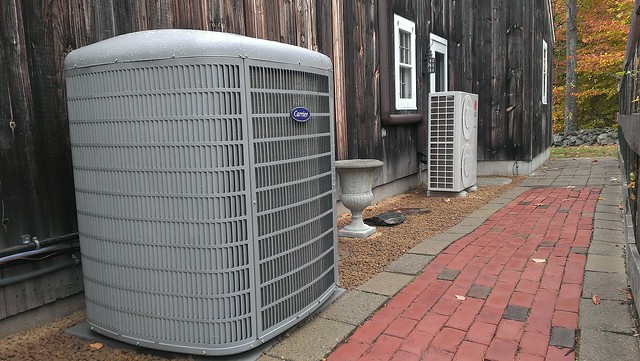
|
|
Did you replace anything inside, like the blower?
My experience is with my 8 year old Goodman furnace which has the variable DC blower. Any time it's moving air I'll get lines on the waterfall. Putting ferrites on the control lines that go out to the thermostat and the outside AC compressor helped a lot but I still have some RFI radiating from the Romex that feeds the furnace. I have a filter for that but haven't put it on yet.
If your RFI is coming from the outside units you can put ferrites on the control lines that go back inside. Have you sniffed for the source using a handheld receiver? |
|
Something like this might help...
http://www.tripplite.com/power-conditioning-center-isobar-displays-hdtvs-home-theater~AV3500PC/ This particular one is $280 from Amazon. |
|
Quoted:
Did you replace anything inside, like the blower? My experience is with my 8 year old Goodman furnace which has the variable DC blower. Any time it's moving air I'll get lines on the waterfall. Quoted:
Did you replace anything inside, like the blower? My experience is with my 8 year old Goodman furnace which has the variable DC blower. Any time it's moving air I'll get lines on the waterfall. Putting ferrites on the control lines that go out to the thermostat and the outside AC compressor helped a lot but I still have some RFI radiating from the Romex that feeds the furnace. I have a filter for that but haven't put it on yet. If your RFI is coming from the outside units you can put ferrites on the control lines that go back inside. Have you sniffed for the source using a handheld receiver? I think I'll order up another bag of large ferrites and add two or four more at the LG compressor and then two up at the mini-split indoor unit for sure. Maybe I'll order up a cheap SWL portable, too. |

|
Quoted:
Do you have a part number reference for that filter? I may want to use that or something similar on the power lines at the entry to the outdoor compressors. I don't have mine handy, it came out of a large UPS we scrapped at work years ago and it's in a box somewhere around here. I think its similar to the one on page 70 of this PDF. There are so many different types, hopefully someone here can suggest the correct one for your application. Then you can just mount it in a weatherproof location. Hotlink doesn't seem to work, sorry. http://www.mouser.com/ds/2/382/EMI_Power_Catalog-34547.pdf |
| Both of those units use Inverter drives to control the speed of the compressors. There is a lot of noise and the frequency will vary a ton. I install systems for a living and had the same issues on my system at home. I went back and traced down a poor ground on my panel box in the home. The joys of the EPA and new technologies. |
|
Quoted:
Both of those units use Inverter drives to control the speed of the compressors. There is a lot of noise and the frequency will vary a ton. I install systems for a living and had the same issues on my system at home. I went back and traced down a poor ground on my panel box in the home. The joys of the EPA and new technologies. Joy.
Any suggestions on how to beat this kind of noise into submission? Both units have good grounds. I will add more ferrites. Maybe add a local ground rod to each one (although I believe that's an NEC violation)? |
|
Quoted:
Both of those units use Inverter drives to control the speed of the compressors. There is a lot of noise and the frequency will vary a ton. I install systems for a living and had the same issues on my system at home. I went back and traced down a poor ground on my panel box in the home. The joys of the EPA and new technologies. For most modern inverters, there is a setting for the carrier frequency...maybe if they have that you could at least pick your poison. Killing it entirely can be tough, as the drives mimic AC using high freq pulsed DC...it's all spikes. You could try a CE rated EMI filter at the drive power input, but that means inside the box so probably nuke your warranty. |
|
Here are a bunch of links from the ARRL, and I recommend that you obtain the third edition of the ARRL RFI Handbook in any event.
In the worst case, if no one else can help, and if you can find him, call up Mike Martin at RFI Services. Life's too short to put up with QRM. |
|
Quoted:
For most modern inverters, there is a setting for the carrier frequency...maybe if they have that you could at least pick your poison. Killing it entirely can be tough, as the drives mimic AC using high freq pulsed DC...it's all spikes. You could try a CE rated EMI filter at the drive power input, but that means inside the box so probably nuke your warranty. Quoted:
Quoted:
Both of those units use Inverter drives to control the speed of the compressors. There is a lot of noise and the frequency will vary a ton. I install systems for a living and had the same issues on my system at home. I went back and traced down a poor ground on my panel box in the home. The joys of the EPA and new technologies. For most modern inverters, there is a setting for the carrier frequency...maybe if they have that you could at least pick your poison. Killing it entirely can be tough, as the drives mimic AC using high freq pulsed DC...it's all spikes. You could try a CE rated EMI filter at the drive power input, but that means inside the box so probably nuke your warranty. Yeah, I think that's where I'm going to wind up a la KwaiChangCain's link above. Thanks. |
|
Quoted:
Yeah, I think that's where I'm going to wind up a la KwaiChangCain's link above. Thanks. OK, just remember if the drives are at fault <snickers> then you want to locate the EMI protection as close to them as you can. You may also want to try adding a line reactor (a big 1:1 transformer) on the drive outputs, they tend to minimize the spike voltages. |
| The carrier might have a setting for capacity control that will keep the drive working above a certain level and not let it dip into the lower Freqs. The brand we rep has this feature. I am not sure that any of the residential mini split systems have this. I don't rep LG. I know that Mitsubishi mini splits don't have that available on the residential systems. But also transmitted on the control wire from the outdoor unit to the indoor head is a dc signal for controlling the indoor fan speed and expansion valve positions. |
|
Quoted:
The carrier might have a setting for capacity control that will keep the drive working above a certain level and not let it dip into the lower Freqs. The brand we rep has this feature. I am not sure that any of the residential mini split systems have this. I don't rep LG. I know that Mitsubishi mini splits don't have that available on the residential systems. But also transmitted on the control wire from the outdoor unit to the indoor head is a dc signal for controlling the indoor fan speed and expansion valve positions. Wow, that is a complex system, and welcome to the forum and AR15.com in general! 
|
|
Are your High pressure and low pressure lines grounded? I'd start there. Then, experiment with grounding the chassis of each unit outside into a ground rod or two.
If there's no dice at that point, might be time to consider a fairday cage for 'em, I've seen designs, no idea how effective that'd be. |
|
Quoted:
Are your High pressure and low pressure lines grounded? I'd start there. Then, experiment with grounding the chassis of each unit outside into a ground rod or two. If there's no dice at that point, might be time to consider a fairday cage for 'em, I've seen designs, no idea how effective that'd be. Your back!
|
|
Quoted:
Are your High pressure and low pressure lines grounded? I'd start there. Then, experiment with grounding the chassis of each unit outside into a ground rod or two. If there's no dice at that point, might be time to consider a fairday cage for 'em, I've seen designs, no idea how effective that'd be. Faraday. |