


Posted: 11/10/2011 7:38:42 AM EDT
| If I get a piece of wire about 540 or so and string it in a huge loop around my property line and hook either end to a 1:4 balun and run a piece of coax into the housewill it work? |
|
I use a loop. 540 feet is about a full wavelength on 160, so you'd be good to go on 160 and lower. If you can, skip the balun/coax and use balanced line. You'll have a lot less loss than coax because you'll have high SWR on your feed line on bands other than 160. Balanced feed line will allow you to lose a lot less power when you have a gross mismatch. 450 ohm line is cheaper than coax too.
For example on 15 meters with a 20:1 mismatch: RG-8, 100 feet long, 20 watts in = 8.5 watts out 450 ohm window line, 100 feet long, 20 watts in = 15 watts out You'll want a wide range tuner, and it should have a 4:1 balun in it if it's a pretty flimsy tuner (like my MFJ 901b that works fine for this) or a 1:1 balun if it's a well built QRO tuner. A horizontal loop is a great bang-for-the-buck all band antenna. edit - for 30 watts, this tuner should work fine: MFJ 904 If you already have a meter you can go even cheaper. |
|
Quoted:
Rig is an IC 718 w/ LDG AT-100 pro II tuner Oh yeah, I was thinking about the 320. You'd still be better off hanging a balun off the back of the LDG and using balanced line. If you want the cadillac of baluns get this beast, or the 4:1 version: balun designs tuner balun |
|
Also if you don't want to run the balanced line into the shack, run a short coax jumper from the tuner to just outside the shack, then put the balun there and connect your balanced line to it. You'll still have some loss in the coax but if it's something really short like a few feet it won't really matter.
|
|
Quoted:
Also if you don't want to run the balanced line into the shack, run a short coax jumper from the tuner to just outside the shack, then put the balun there and connect your balanced line to it. You'll still have some loss in the coax but if it's something really short like a few feet it won't really matter. That is the SCW plan of attack.... |
|
Quoted:
That is the SCW plan of attack.... I was going to do that myself, but I ended up going with a tuner with a built-in balun. It will sit right in front of a window so no big deal. It should be here today btw 
I tried to figure up a worst case scenario for 4 feet of LMR-400 at some ridiculous SWR on 10 meters. If I remember right the worst it could get at 100 watts in was something like 97 watts out. Nothing to worry about as far as I'm concerned. When you get it together post some details and your experience with it. A loop is by no means a perfect antenna, but in my experience it's a very good compromise. |
|
Quoted:
Also if you don't want to run the balanced line into the shack, run a short coax jumper from the tuner to just outside the shack, then put the balun there and connect your balanced line to it. You'll still have some loss in the coax but if it's something really short like a few feet it won't really matter. You can also run an external tuner. A SGC 237/239 right out at the antenna would work fine and you can keep the coax feed. (OP obviously already has his tuner, but if you were doing this from scratch, it'd be a nice setup –– and no balun required.) |
|
Quoted:
Quoted:
That is the SCW plan of attack.... I was going to do that myself, but I ended up going with a tuner with a built-in balun. It will sit right in front of a window so no big deal. It should be here today btw
I tried to figure up a worst case scenario for 4 feet of LMR-400 at some ridiculous SWR on 10 meters. If I remember right the worst it could get at 100 watts in was something like 97 watts out. Nothing to worry about as far as I'm concerned. When you get it together post some details and your experience with it. A loop is by no means a perfect antenna, but in my experience it's a very good compromise. I'm thinking >20' of coax to 4:1 Balun to get it thru the wall, over the heads and outta reach for kids and tractors  to or near peak of barn roof. From there the Twin-lead feeds the Loop. I'm under the impression the loop will offer very good 'ears', meaning it will or should be quiet...? to or near peak of barn roof. From there the Twin-lead feeds the Loop. I'm under the impression the loop will offer very good 'ears', meaning it will or should be quiet...?
|
|
I've heard that quite a lot. I've only compared mine to verticals and dipoles, but it is quieter than anything I've tested it against. The theory I've heard is that most man-made noise is vertically polarized and so the loop doesn't hear it as well. I have no idea if that is what's really going on but it is quiet.
The best thing about the loop is that it's a pretty decent DX antenna (for a wire anyway) on higher frequencies and it's a cloud burner on lower frequencies so you kind of get the best of both worlds. |
|
Here are good writeups on feeding with window line and loops.
http://www.donkeith.com/n4kc/article.php?p=12 http://www.donkeith.com/n4kc/article.php?p=13 You may have read some of Don Keith's short stories on various ham forums, such as The Antenna Party on eHam.net. But he is better known for his submarine warfare novels, War Under the Waves, Final Bearing, The Ice Diaries, and others, and a bio on Bear Bryant. |
|
Quoted:
You can also run an external tuner. A SGC 237/239 right out at the antenna would work fine and you can keep the coax feed. (OP obviously already has his tuner, but if you were doing this from scratch, it'd be a nice setup –– and no balun required.) That's exactly what I used to do before I decided I wanted an amp. I used an SG-230 and it worked great. SGC seems to have designed those tuners expecting someone to be using a too-short antenna and that will allow you to make your loop a little smaller than you would otherwise. While that would be no help at all for your signal on 160 or 80 meters, it will make the pattern a little more consistent on higher frequencies so you get a more omnidirectional pattern. And if you're pressed for space (like me) then it can be just the trick. My 230 will be going into my car for HF mobile now that I'm not using it at home.
|
|
Quoted:
Here are good writeups on feeding with window line and loops. http://www.donkeith.com/n4kc/article.php?p=12 http://www.donkeith.com/n4kc/article.php?p=13 You may have read some of Don Keith's short stories on various ham forums, such as The Antenna Party on eHam.net. But he is better known for his submarine warfare novels, War Under the Waves, Final Bearing, The Ice Diaries, and others, and a bio on Bear Bryant. Caution: Those are the links I was looking for-veurry interesting-thanks AFM! |
|
This is the famous "Super Loop 80", that a lot of the net controls and others of my favorite nets use with great results.
http://web.archive.org/web/20080612065919/www.bloomington.in.us/~wh2t/Super+Loop+Antenna.htm The balun in all cases is a 4:1 current balun. The +/- 30' piece of ladder line is shorted on the bottom, and length can be adjusted. http://members.cox.net/wc4r/superloop.html http://larc.hamgate.net/SuperLoop.htm http://www.radioworks.com/csuperlo.html http://www.iw5edi.com/ham-radio/30/super-loop-antenna While some dimensions vary slightly from one version to the other, the overall length of the loop is about the same. This antenna takes up about the same length as a 75 meter dipole, though you need some height due to the 30' of ladder line hanging down. |
|
Quoted:
This is the famous "Super Loop 80", that a lot of the net controls and others of my favorite nets use with great results. The net control stations for the bunch that I shoot the shit with on 80 almost all run some kind of loop and they're all good and loud. I came to the decision of running a loop on my own, but it does seem to be the recipe for a good signal on 80. 
|
|
Loop feedpoint with window line... simply tie the two ends of your loop to one insulator, leaving a few inches of wire sticking out on each side.
Attach the window line to the insulator with a few big ty-wraps around the insulator and through the "windows" around a solid section between the wires. Twist the loop wires to the window line wires and solder. Done! |
|
Quoted:
Loop feedpoint with window line... simply tie the two ends of your loop to one insulator, leaving a few inches of wire sticking out on each side. Attach the window line to the insulator with a few big ty-wraps around the insulator and through the "windows" around a solid section between the wires. Twist the loop wires to the window line wires and solder. Done! That's what I did at first, and it works fine. Then I used this: 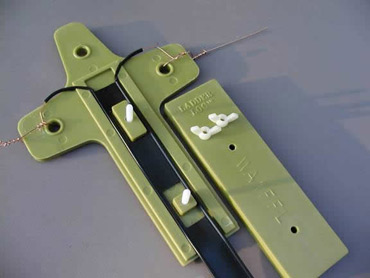
I don't know if it's really any better than cobbling something together, but it's easy. |

|
Quoted:
Quoted:
Loop feedpoint with window line... simply tie the two ends of your loop to one insulator, leaving a few inches of wire sticking out on each side. Attach the window line to the insulator with a few big ty-wraps around the insulator and through the "windows" around a solid section between the wires. Twist the loop wires to the window line wires and solder. Done! That's what I did at first, and it works fine. Then I used this:
I don't know if it's really any better than cobbling something together, but it's easy. That's no fun!!! That's cheating! 
|

|
Quoted:
I've heard that quite a lot. I've only compared mine to verticals and dipoles, but it is quieter than anything I've tested it against. The theory I've heard is that most man-made noise is vertically polarized and so the loop doesn't hear it as well. I have no idea if that is what's really going on but it is quiet. The best thing about the loop is that it's a pretty decent DX antenna (for a wire anyway) on higher frequencies and it's a cloud burner on lower frequencies so you kind of get the best of both worlds. Loops are quieter than a dipole because they are DC grounded. Basically a dead short to an ohm meter. Thankfully, RF doesn't care if it's a dead short.  I have heard also that man made noise is vertically polarized. I don't know for sure if it's true. I have heard also that man made noise is vertically polarized. I don't know for sure if it's true.
|
|
Quoted:
so are the wires on the top insulated from the ones going down to form the triangle? http://larc.hamgate.net/superloopAnt.gif or is it a Loop-meaning they are fed together I think I'm getting it now I have one of these. Mine tunes from 80 to 10m. I have it hung from 2 push up poles. The tuning stub hangs on the ground, so I tied it up to a tree. It still works fine. ETA: I have about 35 bucks invested in mine. You can get the center and end insulators cheap at TSC. I bought a left over piece of ladderline when I bought my reel of coax. The wire was a spool of purple  #14 THHN hookup wire that disappeared from work. #14 THHN hookup wire that disappeared from work.
|
|
They are quiet on recieve because of magnetic induction. There is also a difference in resistance between feediing a loop at a corner or feeding it in the middle of a leg. I haven't messed with loops for a few years, but I do remember those 2 factoids. 'Dr. Ace' used to be the loop guru... http://www.designerweb.net/downloads/80m_Full_Wave_Loop_Antenna.pdf |
|
Thank you AFM for putting those links up. The first time you did about 6 or 12 months ago I started researching the antenna and then started buying parts. I got it hooked up over the weekend and it seems to work very well. I do have a few comments that may help other people with this set up.
First off, don't get solid ladder line. I have replaced / repaired 3 G5RV's that came with solid line and it tends to break with the constant flexing in my windy QTH. For this build I got stranded 450 ladder line. I ran 2.5mm insulated wire for the rest of the antenna and a Balun Designs 4:1 balun. I live in very hilly terrain and the only flat spot is the one I bulldozed to put my house on. As such, the measurements for a fixed triangular design did not work very well for me. In the past I have pulled my dipoles or G5Rv's up at the end insulators. I tried to do the same thing with this design and could not get the antenna up high enough because the diagonals kept pulling the whole antenna down since my lift points are about 100m apart. I ended up running a 5mm dacron line to the center insulator from each lift point and cable tying the antenna wire to the dacron line about 3 meters apart. I then used an electric fence insulator as a pulley to pull the wire to the shape I wanted with messenger lines (2.5mm dacron line) to draw the triangle out or let it in. With this setup, I can adjust the aperture to achieve the widest area for my terrain and put almost no load on the antenna wire. It may be self evident to most people, but I had a hard time with this and spent most of a frustrating Saturday trying to rig it. Even with the antenna 5 meters up, last night I made QSO's into Norway on 15m and S Korea on 12 M. Today after re rigging at about 9m up, I got an NVIS contact about 80 K away over a 1000 meter hill on 40, talked on the nightly net with a lot of good comments about the antenna all over the North Island on 40. A 10m contact into Japan and a 15 M into central Australia. The antenna measures about 1.4 on 3870, 1.5 at 6800, 1.5 at 9800, 1.5 at 13700. With my TS2000 inboard tuner I can tune 80 thru 10. When adjusting the antenna, I never fully understood the bit about the ladder line "shorting on 40 and other bands". I tried trimming both the ladder line and the outer wires and it didn't make much difference. A foot chopped off either produced about the same results. I really didn't want to compromise 80 so I left the rest of the bands a bit long. I ran with the compromise since it seems to work very well and frankly, I just wanted to solder it up and start talking. I hope this will help anyone that is considering this antenna. |
|
Quoted:
Thank you AFM for putting those links up. The first time you did about 6 or 12 months ago I started researching the antenna and then started buying parts. I got it hooked up over the weekend and it seems to work very well. I do have a few comments that may help other people with this set up. First off, don't get solid ladder line. I have replaced / repaired 3 G5RV's that came with solid line and it tends to break with the constant flexing in my windy QTH. For this build I got stranded 450 ladder line. I ran 2.5mm insulated wire for the rest of the antenna and a Balun Designs 4:1 balun. I live in very hilly terrain and the only flat spot is the one I bulldozed to put my house on. As such, the measurements for a fixed triangular design did not work very well for me. In the past I have pulled my dipoles or G5Rv's up at the end insulators. I tried to do the same thing with this design and could not get the antenna up high enough because the diagonals kept pulling the whole antenna down since my lift points are about 100m apart. I ended up running a 5mm dacron line to the center insulator from each lift point and cable tying the antenna wire to the dacron line about 3 meters apart. I then used an electric fence insulator as a pulley to pull the wire to the shape I wanted with messenger lines (2.5mm dacron line) to draw the triangle out or let it in. With this setup, I can adjust the aperture to achieve the widest area for my terrain and put almost no load on the antenna wire. It may be self evident to most people, but I had a hard time with this and spent most of a frustrating Saturday trying to rig it. Even with the antenna 5 meters up, last night I made QSO's into Norway on 15m and S Korea on 12 M. Today after re rigging at about 9m up, I got an NVIS contact about 80 K away over a 1000 meter hill on 40, talked on the nightly net with a lot of good comments about the antenna all over the North Island on 40. A 10m contact into Japan and a 15 M into central Australia. The antenna measures about 1.4 on 3870, 1.5 at 6800, 1.5 at 9800, 1.5 at 13700. With my TS2000 inboard tuner I can tune 80 thru 10. When adjusting the antenna, I never fully understood the bit about the ladder line "shorting on 40 and other bands". I tried trimming both the ladder line and the outer wires and it didn't make much difference. A foot chopped off either produced about the same results. I really didn't want to compromise 80 so I left the rest of the bands a bit long. I ran with the compromise since it seems to work very well and frankly, I just wanted to solder it up and start talking. I hope this will help anyone that is considering this antenna. Are you talking about the Super Loop 80, or just a big horizontal loop? |
|
It is the superloop 80 just like the links. The only difference is it is not straight across on top. It sits slightly on the piss and I used a second set of lines to draw the triangle to the desired dimensions instead of fixing them at set dimensions. The "belly" of the triangle is loose which opens it up a bit.
It did say in the literature that opening the aperture would be better and the triangle as drawn is pretty narrow. I could have put up a big loop for the same effort but I really wanted to try this one out first. Last night on the local net there were three different loops including mine and they were all getting the best reviews from the other stations. All I have to do now is get some more line to get it that last bit higher and fence around the balun / ladderline to keep the HOA from tearing it down like one of them did to my other antenna. |