


Posted: 11/7/2010 1:45:45 PM EDT
|
I currently have a generator but have started thinking about longer term outages where running a generator isn't feasible, can't keep that much gasoline on hand. Is anybody using other systems, ie: battery banks with solar/ wind turbine recharging capabilities? What kind of setup do you have? How easy was it to put together/ install? How much would someone pay for a similar system now?
I did a search but didn't turn up anything. Thanks for your input! 10-7 LEO/ K4HE |
|
Quoted:
What kind of setup do you have? How easy was it to put together/ install? How much would someone pay for a similar system now? you first need to define what your needs are, in terms of power. a battery-based power system is like a checking account. you have power coming in from various places (solar, wind, hydro, etc) which is your "pay", and you have power going out (running your fridge, your comms, etc) which are your "expenses", and you have a finite amount of stored power (this is your "balance"). in life, over the long term your pay HAS TO BE GREATER than your expenses or eventually your balance goes to zero and your checking account is depleted. same with the battery system, except there is no overdraft protection... 
you need to define what your "expenses" are, in terms of power needs. how much power, for how long. until you have a handle on this you can not start to engineer a battery-based (or anything-based, for that matter) power solution. otherwise you will either end up spending a lot of money on something that is gross overkill, or you will end up spending a lot of money on something that doesn't meet your needs. what size generator do you have now? what are you powering with it? is it oversized or undersized? what is the "minimum" power you need to survive on? anyone in the household need power for medical reasons? what is the your maximum expected length of a long term power outage? (note: infinite is a possible answer) ar-jedi |
| This will help determine your energy budget. Home Depot carries it as well. |
|
Alternate power is very difficult/expensive to do on any scale other than a few batteries.
A gallon of gas has a lot of energy in it when compared to other sources of energy. The problem is that in over 100 years we have not found a better way to store or make large amounts of energy for mobile use than gasoline! From my website FuelFrenzy.com Energy Storage - Efficient energy storage is the core problem of future fuels for transportation. 1 BTU = Amount of energy to heat 1 lb of water 1 degree F - About 1 WOOD Match. So How can we store 1 Million BTU ???- This comes from a High School Physics assignment…. Here are a few ways 1 Million Wood Matches 12 Volt Car batteries around 60 Hydrogen - about 3000 cubic feet - high pressure tanks around 20 Natural Gas 1000 Cubic Feet $15 Electricity (not really stored ) 300 KWh Solar Energy - about 2500 sq feet at noon, on a clear day for 1 hour. I should also add at the equator Dynamite 200 lbs Big Macs (Dried and burned) 450 Wood about 160 lbs - Pound for Pound wood having more energy than dynamite does not sound correct. dynamite releases all it's energy in a microsecond. Wood takes a few hours. Coal 80 lbs Gasoline 8 gallons Uranium about 0.2 Grams So you see the problem with gasoline and cars. In over 100 years we have not found a better way to store large amounts of energy for mobile use than gasoline! |
|
Quoted:
What exactly do you want to power? At a minimum I'm looking powering the HF rig, IC-7000 @ 100 watts out for 4 or 5 hours a day, and being able to charge a couple of dual band HTs. From there, price will be the limiting factor. Price might even limit my minimum wishes. Anything I should definitely steer clear from? |
|
Quoted:
what size generator do you have now? what are you powering with it? is it oversized or undersized? what is the "minimum" power you need to survive on? anyone in the household need power for medical reasons? what is the your maximum expected length of a long term power outage? (note: infinite is a possible answer) ar-jedi The generator is 5.5 Kw and can power the heaviest single loads individually (water pump or water heater). Depending on what breakers I trip, I can run single or multiple items including the fridge, microwave, toaster oven, sat. TV, gas fireplace fan, lights, ceiling fans, and all the outlets in these areas are hot also. It covers the basics. If it could run the heat pump that would be great but then we would be looking at a small commercial/ industrial generator. No one is medically dependent upon having power. As long as gasoline is available and the generator doesn't bite the bullet (it's about seven years old without much use beyond firing it up every few months), there is not much of a problem. My concern is when no more fuel is available from an extended outage (more than a week, up to ?). Obviously, the items I can power now would not be able to be powered then. Communications would be the highest priority and we're slowly making preparations in other areas. |
Have been experimenting with this.... 300 W bicicle generator....
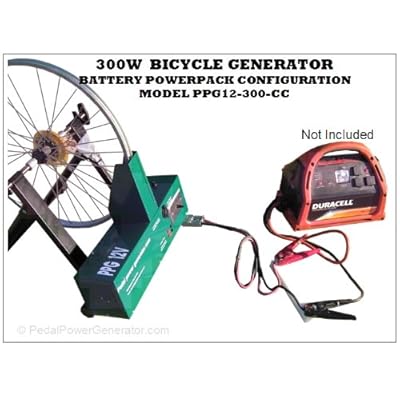
.. Source Linky Thingy .. I have found this resulting in measured success.... there are a few issues you have to address: 1 - Who peddles? no, not me, of course 2 - How do you encourage and motivate the peddler? have tested both possitive and neggative reinforcement... neg is more effective here... Test number 1 - The kids.... ended poorly with much anger and nashing of teeth... on my part... Test number 2 - Me on bike... that ended quickly, I have to run the radio, I can't be on the bike... Test number 3 - Wife on the bike... started poorly but I found that when she slows down, swat her with the news paper... she's good for a few hours... So.... there is hope....
yea... it could happen.... |
|
Well here is an alternate generater source that DOES NOT USE GASOLINE. Propane tanks are much easier to store than gasoline AND this particular generater gives a lot of hours for the amount of propane used.
Check it out it is another alternative. http://www.northerntool.com/shop/tools/product_200383168_20038316 Sarge |
|
Household battery backup system, 600ah. Mobile & portable.
This bank is actually meant to work in collaboration with a generator as a “tag team” system. Basically, during a major power outage (say 3-6 months), you would run your genset for 5-6hrs during the day for example. The battery bank would “take over” once the genset is shut off for the evening say (10-12hrs). Battery power would go much further, the more 12volt appliances you employ (fridge, lights, etc.). 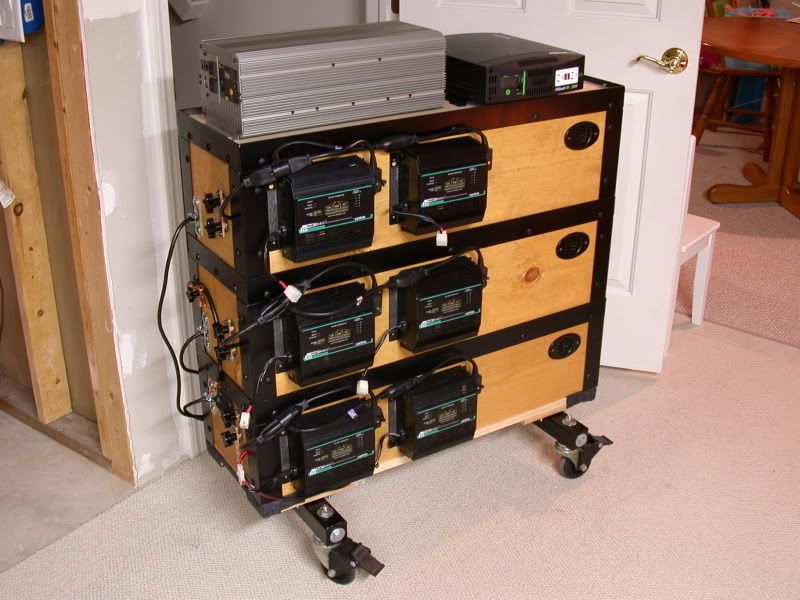
Yamaha tri-fuel genset.....get yourself a few 100lb propane tanks. Propane, under pressure, has a indefinite shelf life (longer than you). Can’t go wrong 
|
|
Quoted:
It is expensive, I understand. But I have talked to a ham in Oregon that had a cabin rigged up with deep cycle batteries charged with solar to power his rig. Yep - Long after most folks have run out of fuel for their generators, the guys with solar installations will still have power. |
|
Quoted:
I currently have a generator but have started thinking about longer term outages where running a generator isn't feasible, can't keep that much gasoline on hand. Is anybody using other systems, ie: battery banks with solar/ wind turbine recharging capabilities? What kind of setup do you have? How easy was it to put together/ install? How much would someone pay for a similar system now? I did a search but didn't turn up anything. Thanks for your input! 10-7 LEO/ K4HE Typing in a shipping container now with 3 Sharp 224 watt panels in series, an Outback charge controller, 2 Surette 6CS17ps flooded batteries and a Xantrex inverter, backed up with a Honda 2000 watt genny and a Vector 2/10/20/40 amp charger.. Cost–– Panel's, latest prices are about 650 each Outback, about 550 Batteries about 900 each Inverter, about 250 This is a system that has about a 500 A-H capacity to 50% discharge, The panels can replace easily 2500 watt-hrs per day. |
|
Quoted:
At a minimum I'm looking powering the HF rig, IC-7000 @ 100 watts out for 4 or 5 hours a day, and being able to charge a couple of dual band HTs. From there, price will be the limiting factor. Price might even limit my minimum wishes. Anything I should definitely steer clear from? During such a situation, no electricity from the power grid, no fuel for your generator, you intend to operate your 7000 at 100 watts output for 4 or 5 hours a day? Wouldn't you be concerned with other things occupying your time... groceries, washing clothes, chopping firewood, and taking care of a hundred chores that used to be fast and easy when you had easy power? |
|
Quoted:
Quoted:
At a minimum I'm looking powering the HF rig, IC-7000 @ 100 watts out for 4 or 5 hours a day, and being able to charge a couple of dual band HTs. From there, price will be the limiting factor. Price might even limit my minimum wishes. Anything I should definitely steer clear from? During such a situation, no electricity from the power grid, no fuel for your generator, you intend to operate your 7000 at 100 watts output for 4 or 5 hours a day? Wouldn't you be concerned with other things occupying your time... groceries, washing clothes, chopping firewood, and taking care of a hundred chores that used to be fast and easy when you had easy power? It would be to keep in touch with anyone who is out doing such activities, as well as getting any information in or out as needed since normal lines of communication could be interrupted. |
|
Quoted:
Will that power a pump in a well? different wells have different characteristics, in terms of depth (head) and volume of water flow. a shallow well (defined as less than 30 feet, the deepest you can draw the water up from) with a jet pump located at the top could be powered by a small generator. a deep well (defined as greater than 30 feet but could be in fact many hundreds of feet down), which by definition requires a submersible pump in the hole, would require a far, far larger generator. additionally, shallow well pumps are generally 120Vac, whereas deep well pumps can be 120Vac or 240Vac, with 240Vac being the norm once the depth has exceeded about 100 feet or so. not all generators (especially the tiny efficient inverter type generators such as the model shown above in this thread) produce 240Vac, so this is a VERY important factor in selection of an appropriate generator. moreover, inverter-type generators generally have less motor starting ability due to reduced mechanical inertia –– this is an important consideration the deeper the well is. but in no case can you make an assumption about whether a generator could power *your* well. first, you need to know the startup (inrush) and running (steady state) current draws before you do anything. these data points can be measured using a clamp-on ammeter from the likes of Fluke (example shown below, and note the INRUSH mode button). once you have these data you can look for an appropriate backup power solution for your well. otherwise you may end up with an underpowered generator (which won't start the well pump, or could even damage the well pump), or you will spend a lot of money initially and waste a lot of gas long term on an oversized generator. ar-jedi 

|
|
Quoted:
Quoted:
Quoted:
At a minimum I'm looking powering the HF rig, IC-7000 @ 100 watts out for 4 or 5 hours a day, and being able to charge a couple of dual band HTs. From there, price will be the limiting factor. Price might even limit my minimum wishes. During such a situation, no electricity from the power grid, no fuel for your generator, you intend to operate your 7000 at 100 watts output for 4 or 5 hours a day? It would be to keep in touch with anyone who is out doing such activities, as well as getting any information in or out as needed since normal lines of communication could be interrupted. let's assume the IC7000 + peripherals (tuner etc) require 2.5A during receive and 25A during transmit. let's assume as well that the duty cycle (RX:TX) for your stated 5 hours of operation is 10%; in other words, out of every hour (=60 minutes) you are transmitting 6 minutes and receiving 54 minutes). duration * duty cycle * current = amp-hours RX: 5H * 0.9 * 2.5A = 11.25 AH TX: 5H * 0.1 * 25A = 12.5 AH ––––––––––––––––––––––––––––––––––––––––- total for 24HR period = 23.75 AH (and the average for the 5H period is 23.75AH/5H = 4.75A) (for comparison, the power required at 20% duty cycle is [10AH + 25AH] = 35AH.) a single Trojan T105 battery, http://www.trojanbattery.com/Products/T-105Plus6V.aspx has the following characteristics: 11A for 20h (~220AH) 25A for 7.5h (~187AH) 37A for 5h (~185AH) 75A for 1.9h (~142AH) as you can see, the battery capacity is a function of load (this is true for any battery technology). the higher the load, the lower the battery capacity. our average load (4.75A) is actually quite low for this size battery; even if we take the highest capacity shown above, 220AH, we should get 220AH/4.75A = 46 hours of operation. at 5 hours per day, that is 9 days total. in reality, this will be somewhat less –– and you don't want to discharge the battery to zero anyway. but figure on getting at least 4 to 5 days out of a fully charged T105 battery setup, and in an real emergency situation as much as a week. is this enough? only you can tell us. i agree with the poster above that 5 hours of operation a day seems like a lot. if you halve that time, you will double your operating interval. ps: keep in mind that the T-105 is a 6V battery; you need two connected in series to drive a 12V inverter or to power 12V loads like your IC7000. using two batteries in series does not double the AH capacity, it simply doubles the output voltage. ar-jedi |
|
Quoted:
Quoted:
It is expensive, I understand. But I have talked to a ham in Oregon that had a cabin rigged up with deep cycle batteries charged with solar to power his rig. Yep - Long after most folks have run out of fuel for their generators, the guys with solar installations will still have power. I have a dozen 100lb tanks full of propane, plus lots of gas. I’m not sure how long natural gas would keep coming in a power outage? In total, I have enough fuel stored for 10-12 months. If utility power is off this long, no one can predict how ugly it would really be. Can you imagine one year no power? The die-off rate would be enormous. |
|
Quoted:
I’m not sure how long natural gas would keep coming in a power outage? define "power outage" ... local, regional, national? a natural gas distribution/pump facility has backup generators powered by (wait for it...) natural gas. if the gas TO the facility is flowing (in other words, there is an upstream station still providing flow) then the gas FROM the facility will be flowing to you. ar-jedi |
|
Jedi & everyone, Help me understand a little bit about powering from battery, and my (perhaps) false assumptions:
Thanks -Slice |
|
Quoted:
Quoted:
At a minimum I'm looking powering the HF rig, IC-7000 @ 100 watts out for 4 or 5 hours a day, and being able to charge a couple of dual band HTs. From there, price will be the limiting factor. Price might even limit my minimum wishes. Anything I should definitely steer clear from? During such a situation, no electricity from the power grid, no fuel for your generator, you intend to operate your 7000 at 100 watts output for 4 or 5 hours a day? Wouldn't you be concerned with other things occupying your time... groceries, washing clothes, chopping firewood, and taking care of a hundred chores that used to be fast and easy when you had easy power? This is correct, not to mention security. Unfortunately, the reality of an extended “grid down” doesn’t provide much security for solar panels. Thugs & “have nots” would be happy to steal or destroy this type of equipment. There was a thread about a guy who discovered a bullet hole through the body of his wind turbine (this was a remote BO cabin). There are simply FAR too many variables and eventualities in this type of scenario. |
|
Quoted:
At what level of discharge will a pair of T105's actually get below 12v output? I know the make power gizwangies (technical term) that will deliver a constant 13.8v from a 12v power source, even as voltage decreases. How useful are these? Or are we below the 50% discharge level of the batteries before something like this is needed? Thanks -Slice According to a chart here, at 50% discharge a battery will be at 12.06 V. |
|
Quoted:
Help me understand a little bit about powering from battery, and my (perhaps) false assumptions: you are on the right track. Quoted:
Most (?) of the radios are actually designed to run on 13.8v, +/-15%, not 12v. correct, with the exceptions mainly being HT's and QRP rigs (e.g. Icom703 and Yaesu FT817). Quoted:
Once below the -15% level, some will either limit output and at some point shutdown or not function that is correct. the FT857 is somewhat problematic in this regard when operating from a gel cell, i was witness to some issues at a field day event. RX was fine, but when you keyed the input voltage sagged below about 11.5Vdc and the radio got "funky" –– weird lights, display garbled, TX output crap. Quoted:
13.8v -15% = 11.73v yes Quoted:
As batteries discharge, voltage decreases. and don't forget temperature. lower temperature, less voltage. the terminal voltage is a function of current draw as well, due to the battery's internal resistance. more load, less voltage, depending on the capacity of the battery. Quoted:
At what level of discharge will a pair of T105's actually get below 12v output? the discharge curve is, naturally, non-linear, and is dependent on load. unfortunately i can't seem to Google-up a set of discharge curves for the T105. one thing to keep in mind is that the "endpoint" from the battery manufacturer's point of view is typically is 10.5Vdc. this is pretty well below most radio's operating voltage. Quoted:
I know the make power gizwangies (technical term) that will deliver a constant 13.8v from a 12v power source, even as voltage decreases. How useful are these? you are speaking of DC/DC converter products that take (say) 9-15Vdc in and output a constant 13.8Vdc. naturally, you don't get something for nothing. there is an inefficiency associated with the DC/DC conversion process. the conversion efficiency will be on the order of 90% with a constant load, high up in the unit's output range. it may be less with a varying load, or with a light load on the unit. any loss due to conversion goes away as heat and is unrecoverable. so, you need to trade off the additional operating time gained by using a step-up converter with the loss associated with the converter itself. i have never found this to be a good tradeoff, but that doesn't mean that these types of converters aren't beneficial in some situations. in general if you are engineering the "system" you simply would spend the money on 10% more battery capacity rather than adding complexity (and a fault group) with the DC/DC converter system. Quoted:
Or are we below the 50% discharge level of the batteries before something like this is needed? this is something that only can be found by testing a given radio with a given battery. as i've written before, a sunny June day is a much better time to experiment with battery run times than during a hurricane/blackout/icestorm/etc. ar-jedi |
|
Quoted:
Quoted:
I’m not sure how long natural gas would keep coming in a power outage? define "power outage" ... local, regional, national? a natural gas distribution/pump facility has backup generators powered by (wait for it...) natural gas. if the gas TO the facility is flowing (in other words, there is an upstream station still providing flow) then the gas FROM the facility will be flowing to you. ar-jedi You know, around here, if you own an interest in a well, you can have them run a line over to your place. The well itself is not powered by anything other than the pressure of the gas coming out of the well. So, you would have a source of power as long as it didn't fill up with water. Most gas wells last about 5 years average. The one closest to me has been going for 10 years. |
|
Quoted: Quoted: Quoted: I’m not sure how long natural gas would keep coming in a power outage? define "power outage" ... local, regional, national? a natural gas distribution/pump facility has backup generators powered by (wait for it...) natural gas. if the gas TO the facility is flowing (in other words, there is an upstream station still providing flow) then the gas FROM the facility will be flowing to you. ar-jedi You know, around here, if you own an interest in a well, you can have them run a line over to your place. The well itself is not powered by anything other than the pressure of the gas coming out of the well. So, you would have a source of power as long as it didn't fill up with water. Most gas wells last about 5 years average. The one closest to me has been going for 10 years. The old 'Producers-88' lease form used to have a clause that allowed the mineral owner to use natural gas produced from their interest in their house and primary out-building, and drip gas for their farm equipment. Over the years a number of dumbasses did something stupid like blowing up their houses/barns/machinery and suing the production companies over it. Now 99.9% of the production companies are scared of litigation/risk and have removed the clause from the Oil & Gas Lease forms. Just shows to go ya......  |
|
Quoted:
Quoted:
At what level of discharge will a pair of T105's actually get below 12v output? I know the make power gizwangies (technical term) that will deliver a constant 13.8v from a 12v power source, even as voltage decreases. How useful are these? Or are we below the 50% discharge level of the batteries before something like this is needed? Thanks -Slice According to a chart here, at 50% discharge a battery will be at 12.06 V. That is a VERY tricky issue to determine by voltage. First the battery has to be 'rested'. temperature affects the numbers, lots of thing affect the measurement. Best to get a temperature compensated refractometer to measure SG for about $30 on eBay. 
|
|
I live in the hurricane belt. When Gustave blew through my house got crushed by a tree and was essientially homeless for a week. This put all the planning I had done previously to the test. The basics still apply.
- If you're in a bad situation. Bug out to where it's not as bad. Even across town to a friends or relatives house is better than staying. We had our 72 hour kits and put them to use. - Food. Between the MREs and what was in the fridge. We had food for two weeks. Covered. - Water. One gallon per person per day. Covered. - Shelter. When the primary shelter goes bad you need an alternative shelter. Here I blew it. Cheap camper or a good tent would have been way better than the collapsed structure I was staying in. - Sanitation. Rigging up a way to get a hot shower can do wonders for your morale. A cold shower after working all day in the rain didn't do much to motivate me to do it again the next day. The city sewer system was stressed and emergency officials asked to limit toilet use. I still remember one line, "Men to the back yard please." So the dog and I were both marking our turf for the next few days. There are several options for solid waste. Google and you'll find one that suits your situation. - Defense. You're on a gun forum. Search. Only if you have the above can you move forward to the nice to have items. - Energy. My generator at the time was a unit from Sams Club. 5.5kw with a Robin engine. Being frugal with the usage during the day (1 hour on, 2 hours off) and running the window unit air conditioner at night I burned 4.5 gallons of gas a day. A 3 day supply isn't enough. Figure on 5 days. You don't want to fight the desparate crowds at the sole gas pump that works. Seen it. Don't want to do that again. Do use a fuel stabilizer. It will save you problems down the road. Propane as a secondary fuel does work. It has it's drawbacks. It has a lower BTU capacity than gasoline and you'll go through more of it. My neighbor has a 10kw generator tied into the natural gas line. The week he ran it cost him $350 just in fuel. He was happy to pay it. The upside is that storage life is as long as the container is good. Conversion units for liquid fuel engines are reasonable in cost. Solar and wind are options but the cost is still up there. One example on this thread of solar power cost $4500. Out of reach for many people. 400w wind turbines start at $500 and go from there. Add in the controllers and batteries and the cost can get considerable. Another angle on generators. Use the minimum needed for the task at hand. Yes there is a time to run the 5kw but often a 2kw will do the job. If you just need to run a window AC unit for example, run the 2kw generator. More fuel efficient. Honda EU2000 while nearly $1000 with the ARRL discount through Mayberrys is well worth the money. - Communications. You've got a HF rig and HTs. Cool. But IMHO I think you're asking a lot. 100w at 4-5 hours a day is a bit much. Consider a QRP rig for HF and stockpile a bunch of AA batteries for the HTs. AR-Jedi has a AA battery pack setup that works to power the HTs. You not interested in having a ragchew with the Assistant Director Undersecretary of Bubble Gum in Upper Ungawstan. You just need to get out to where the bad stuff isn't. Get in, pass the traffic, get out. Trust me, you won't have a lot of free time when the SHTF. A QRP HF rig will do that. Save the energy for use later. |
|
^^^ tons of useful info right there, HankEllis.
Quoted:
You not interested in having a ragchew with the Assistant Director Undersecretary of Bubble Gum in Upper Ungawstan. but the asst director is a "she" and she's HOT! 
Quoted:
You just need to get out to where the bad stuff isn't. Get in, pass the traffic, get out. Trust me, you won't have a lot of free time when the SHTF. A QRP HF rig will do that. Save the energy for use later. this. ar-jedi |
|
Quoted:
Thanks. Nothing like going through a SHTF situation to really focus you on what is really important. As a good friend of mine said, "I don't mind lifes lessons. It's just the cost of tuition can be high."
^^^ tons of useful info right there, HankEllis. Quoted:
You not interested in having a ragchew with the Assistant Director Undersecretary of Bubble Gum in Upper Ungawstan. but the asst director is a "she" and she's HOT! Quoted:
-snip- Trust me, you won't have a lot of free time when the SHTF. -snip- I am not exaggerating when I say I have two weeks of my life I can't account for. It was literally wake up at sunrise. Throw on the same dirty clothes I wore yesterday and the day before that. Get out there and work. Keep the food secure. Keep the water safe. Try to provide some shelter for my wife and I. Try to protect the property from being further damaged. Run off people that didn't need to be there. Find fuel. Get information. Etc, etc, ... etc ...... etc. Until past dark. Finally well past dark when you couldn't hold your head up any longer you went to bed. A damp musky bed and hot with a window AC unit that couldn't keep up. Sleep maybe 4 hours with another 2 hours of tossing and turning and do it again. The first night in a real bed I slept 18 hours. This experience is what got me in ham radio in the first place. The only comm I had was the local TV station late evening news. Cell voice = out of service. Cell text = 4 hours round trip on a good run. Internet = out of service due to no phone line. Land line = out of service due to no phone line. All I could get out of the mass media was that a hurricane hit. Yeah, I got that. There's a tree in my kitchen and it's not Christmas. A 2m rig with a mag mount on the vehicle plus a QRP HF rig with a toss it in a tree antenna will serve you well in a situation like mine. An oh by the way. TV. Note that if your satellite dish gets trashed or cable gets cut you won't have TV. Every station I'm aware still has provisions for off air reception. However not all TVs can receive the new digital signals without a converter. Worth checking it out now before you find out the hard way. |
|
This experience is what got me in ham radio in the first place. The only comm I had was the local TV station late evening news. Cell voice = out of service. Cell text = 4 hours round trip on a good run. Internet = out of service due to no phone line. Land line = out of service due to no phone line. All I could get out of the mass media was that a hurricane hit. Yeah, I got that. There's a tree in my kitchen and it's not Christmas. A 2m rig with a mag mount on the vehicle plus a QRP HF rig with a toss it in a tree antenna will serve you well in a situation like mine.
...this tree could have easily destroyed a wind turbine tower and/or solar array. Just sayin... |
|
Quoted:
The area of the house that the tree destroyed now has the ham shack. The ham shack would have been destroyed. All the antennas are in the attic. Those would have been destroyed too. The obvious place I would have put a solar array would have been on the roof of the carport. Oops that's where the tree went.
...this tree could have easily destroyed a wind turbine tower and/or solar array. Just sayin... The other active ham in my parish (county) is currently off the air because his house was flooded in a storm a couple months ago. Blame the gummit on that one. His gear is OK but is QRT till his house is rebuilt. Currently staying at one of his kids house. He told me he wished he had some sort of go-kit or QRP rig to at least get on the air in a small way. Where I'm going with this is that it can be dead end to spend time, energy, and money on exotic sources of alternative energy for the ham shack to power your base rig. When things go really bad they go bad in a hurry. Small, light, portable, and redundant are the words to keep at the front of your brain when thinking out the SHTF radio. Our OP was looking for an alternative to a gasoline generator for a power outage of over a week. As stated before a propane conversion works. A couple car batteries coupled to a QRP rig that is used sparingly can last a good while. A big solar or wind power array, even if money wasn't an issue, won't be available if you have to bug out or it gets destroyed. My local club operated ARRL Field Day as catagory AB. The AB catagory as defined in the rules, "All contacts must be made using an output power of 5 Watts or less and the power source must be something other than commercial power mains or motor-driven generator (e.g.: batteries, solar cells, water-driven generator)." Hot ticket was deep cycle SLA batteries and a $100 solar panel for recharging. Something to think about when considering alternative power for the shack. Your rigs power consumption. My TS-2000 on RX with a signal uses about 3A. A IC-7200 on RX uses about 2A. The FT-817 uses about 0.5A and on TX uses 2A. The 817 uses less on TX than the TS-2000 does on RX. Which rig am I going to use when energy is at a premium? –––––– Oh, let me pass this on while I have it on my mind. Lights for the house when the power is out. Rather than powering up all those 60w bulbs and putting more strain on the generator, which means more fuel consumption, try this. Christmas tree lights. Pick up a few strands of white lights and string those up throughout the house. It will illuminate the rooms and hallways and use only a fraction of the power regular lightbulbs will. Not my idea but passed on by an old Cajun who's been through many a hurricane. |
|
I've pretty much decided to go with a foldable solar panel (easy to transport and store) and two smaller batteries (will run reduced power on the IC7000). I can be charging one while using the other. Now to save the pennies for a while.
I appreciate all the input, thanks! |
|
Quoted:
Quoted:
What exactly do you want to power? At a minimum I'm looking powering the HF rig, IC-7000 @ 100 watts out for 4 or 5 hours a day, and being able to charge a couple of dual band HTs. From there, price will be the limiting factor. Price might even limit my minimum wishes. Anything I should definitely steer clear from? Simple, Optima 12 Volt Marine Battery and a 12 Volt 20 Watt solar panel - start there, add more solar in the future. |
|
Quoted:
Simple, Optima 12 Volt Marine Battery and a 12 Volt 20 Watt solar panel - start there, add more solar in the future. you will need more solar capacity, otherwise solution will result in being *way* short on power. with a 20W panel, you will be very lucky to put 50-60W of power back into the battery, per bright sunny day. as calculated above in this thread, every hour of radio operation requires about 100W. so you will be net a negative 50W or so, at minimum, per day. while this is extending the interval until the battery is depleted, the solar array is not replenishing enough power for continued long term operation. ar-jedi |