


Posted: 6/10/2016 8:00:25 PM EDT
| My daughter and her husband are looking at buying a house. The house was built in the mid to late 60's. It needs some work, but I am a little concerned about the electrical system. All of the outlets are 2 prong outlets. We didn't pull the cover off of the panel, but the exposed romex in the basement ceiling was all 12-2 wire. I couldn't see any ground wires in any of the open boxes in the basement. I know the service is too small and will likely need upgraded. I'm wondering how big an issue the lack of a ground wire is. There is reasonable access to the entire main floor, the panel and wire could probably be re-done without major demo work- but it's a cost that would have to be considered when trying to assess the house. |

|
Didn't see any aluminum, but good point.
Should have pulled cover of of the panel. Panel had some sort of push button breakers. I didn't recognize the name of the panel. Googled it: pushmatic were of fairly good quality and nothing about them is inherently dangerous or poor design. They can't be upgraded to modern nema codes though. |
|
I second what everyone else is saying.
Replace the receptacles in the kitchen/bath with GFCI receptacles, eventually replace the panel, and rewire in sections as funds allow. Depending on power needs, you may consider adding a sub panel in the kitchen. With the size of modern houses and so many appliances today it can be cheaper to run a single, larger wire back to the main than have everything running there. It might not apply in your case, but it might be something to look into. Also be sure to check on AFCI requirements. I don't know how MT is, but here every time the model code is updated the locals fall hook line and sinker for more arc fault protection. It use to be just bedrooms and now it's nearly everywhere! |
|
I am renting a similar sort of house. It has circuit breakers and bathroom was redone to actually have the 3 prong outlets work right. Rest of house is old 2 prong. What I have been told is that gfci outlets are self grounding. You only need one per circuit. So install that, you will have a ground on that circuit. I do hope some of our experts here correct me if the above is wrong. I got some cheap barely used gfci outlets from someone who changed a bunch out to a different color. I was planning to go ahead and change the rest of the 2 prong outlets I use the most to 3 prong just cause that stupid 2 prong adapter sucks at space saving. I will admit I bought a few grounding rods and some wire and some other odds and ends and can go that route as well, but when I heard the gfci stories and found some similar stories on the net I decided that sounded a whole lot easier. Place I rent is where a friend grew up. Original part of house is ancient. It was added onto time and time again as was common in the old days. So while I came up with odds and ends once I figure out what works buddy will be dang happy as well and while I don't expect cash for compensation or anything we are planning some other upgrades to the house so I benefit anyway. Sorry, figured I might want to explain why I am messing with a place I rent. Even if I buy my own place, I would wind up helping my buddy out here and there with this stuff. |
|
Quoted:
What I have been told is that gfci outlets are self grounding. Quoted:
What I have been told is that gfci outlets are self grounding. no. GFCI's detect a imbalance between hot wire current flow and neutral wire current flow, and then opens the circuit. in layman's terms, the reason there would be an imbalance is because some current is "leaking" and not being delivered to & recovered from the load (say, a toaster). one common cause of such a "current leak" is that there is an electrical path from the hot wire through a person to ground. so, the GFCI protects against this particular situation, and thereby improves electrical safety. https://simple.wikipedia.org/wiki/GFCI Quoted:
I was planning to go ahead and change the rest of the 2 prong outlets I use the most to 3 prong just cause that stupid 2 prong adapter sucks at space saving. no. replace the 2 prong receptacles with GFCI receptacles. ar-jedi 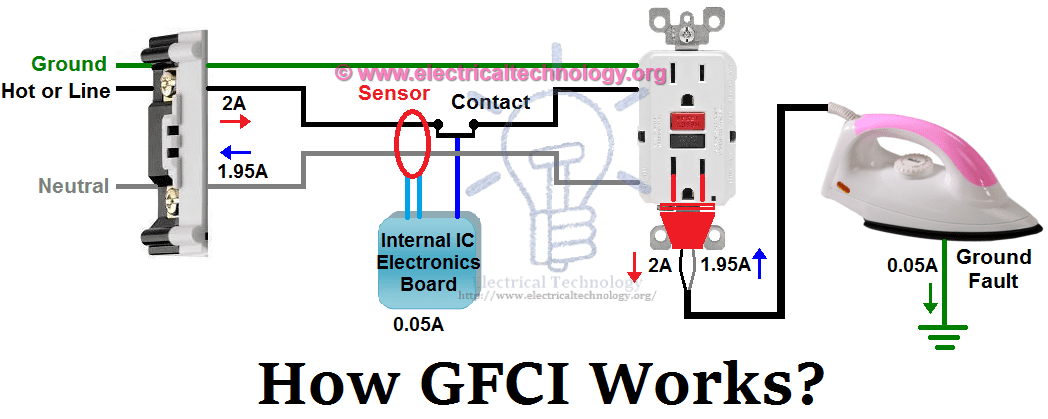
|
|
I think, if I understood correctly, that a GFCI on a 2-wire circuit would protect you if you shorted yourself out to ground because there would be an imbalance between hot and neutral currents.
What it doesn't do though is break if you are part of the circuit. i.e. if you managed to grab the hot wire with one hand and a neutral with the other so the entire circuit is flowing through you. No imbalance in the circuit - no circuit break. I'm not sure I understand why a 3 wire with GFCI would be different. |
|
Well you said romex such 12/2 should have two conductors and a bare ground wire. In older homes you would see more bx cable with has two conductors and the ground in the metal coil sheath.
You probBly should have pulled the covers off a couple outlets. If there is bx or 12/2 or 14/2 then you have a ground. Assuming it was wired right. I grew up in an old 1800s house. We had it all for wiring. Cloth which my dad yanked, bx, and romex. Lots of the old two prong outlets were here and there but back when he did the work there were way more two prong plugs on everything. |
|
Quoted:
I think, if I understood correctly, that a GFCI on a 2-wire circuit would protect you if you shorted yourself out to ground because there would be an imbalance between hot and neutral currents. Quoted:
I think, if I understood correctly, that a GFCI on a 2-wire circuit would protect you if you shorted yourself out to ground because there would be an imbalance between hot and neutral currents. correct. Quoted:
What it doesn't do though is break if you are part of the circuit. i.e. if you managed to grab the hot wire with one hand and a neutral with the other so the entire circuit is flowing through you. No imbalance in the circuit - no circuit break. correct. Quoted:
I'm not sure I understand why a 3 wire with GFCI would be different. having a ground ensures that the exposed metallic parts of a product (example: the case on a PC) do not become "live" in the first place, and if they do the fault current is high enough to trip the circuit breaker. electrical safety is the result of multiple, cumulative factors of risk reduction. ar-jedi |
|
Quoted:
Well you said romex such 12/2 should have two conductors and a bare ground wire. In older homes you would see more bx cable with has two conductors and the ground in the metal coil sheath. You probBly should have pulled the covers off a couple outlets. If there is bx or 12/2 or 14/2 then you have a ground. Assuming it was wired right. I grew up in an old 1800s house. We had it all for wiring. Cloth which my dad yanked, bx, and romex. Lots of the old two prong outlets were here and there but back when he did the work there were way more two prong plugs on everything. the spiral metal shield on old-school BX is not suitable for use as a ground. not only is it made of steel (which has a much higher resistance than copper) but because of the spiral construction it is electrically "long" -- much, much longer than the copper wires that are running inside the spiral. these aspects combine to make a high resistance ground -- which is not what you want at all. because of the above factors it is not difficult at all to create a fault situation where the current is high enough to turn the spiral shield cherry red hot, but not high enough to trip the circuit breaker. what you end up with is an "in wall toaster" -- and a very high probability of a fire. note that "modern BX" is referred to as "AC" (armor clad), but differs in an important way -- AC has an integral internal grounding strip. the spiral metallic shield on "AC" is not used as the EGC (equipment grounding conductor) -- the internal aluminum strip is. ar-jedi |
|
Didn't see any bx. What we saw was typical white jacketed nm cable labelled 12-2.
I didn't realize that there was, or should be, a ground wire present in homes with 2 prong outlets, and the ground would be bonded to the outside of the box. What I didn't see on the exposed boxes we looked at though was the ground wire. I'm wondering if we just missed it, or if the house was wired w/o a ground. Did they make a 2 wire and no ground nm wire in the mid 60s? Also possible bubba has done his own work in the basement using the wrong wire. |
|
Quoted:
I was planning to go ahead and change the rest of the 2 prong outlets I use the most to 3 prong just cause that stupid 2 prong adapter sucks at space saving. no. replace the 2 prong receptacles with GFCI receptacles. ar-jedi AR, What is your rationale for replacing every receptacle with GFCI receptacles? Electricity isn't my trade, but can't you upgrade a few of the receptacles to GFCI and the rest on the load side will have ground fault protection as well? Seems like that would satisfy the NEC and save Biere some time/money in the process. |
|
Quoted:
Didn't see any bx. What we saw was typical white jacketed nm cable labelled 12-2. I didn't realize that there was, or should be, a ground wire present in homes with 2 prong outlets, and the ground would be bonded to the outside of the box. What I didn't see on the exposed boxes we looked at though was the ground wire. I'm wondering if we just missed it, or if the house was wired w/o a ground. Did they make a 2 wire and no ground nm wire in the mid 60s? Also possible bubba has done his own work in the basement using the wrong wire. My house was built in 1947. Some wiring has old cloth style outer insulation and there was some older armored style cable. Neither of these had a ground. However, the house was updated with 200 amp service in the late 80's and they used 12-2 and 14-2 romex cable with an included bare ground wire.. I can't say I've ever heard of romex without a ground, but that doesn't mean much . . . |
|
Sorry for wording of previous post, I had just worked a double and was unwinding before going to bed. Anyway, not replacing every single outlet with gfci. My understand on gfci is that on a circuit for a room you really only need one gfci. It will trip if there is a problem in the circuit. So kitchen gets a gfci. Bathroom gets a gfci. Bedroom gets a gfci. Like that. Now where I worded things poorly is that I also got some 3 prong outlets and plan to go ahead and stick them in other spots on the circuit just because I am sick and tired of 2 prong adapters and I am not cutting a prong off my plugs. I got this stuff as a freebie because someone changed their house decor. They wanted to change colors of rooms and that included the old plug outlets and old gfci that were the wrong color. Nothing wrong with them and not that old. Thank you for the explanations in this thread. I plan to do some actual searches and learning before getting into actually changing stuff out. I even have a big electrical book or 7 around here, some are home improvement handyman sorts of things and one gets into more advanced odds and ends. |
| I would not buy a home that was wired with no grounding conductor. Home inspectors will look for grounding, GFCI outlets, ArcFault breakers. The cost and headache of re-wiring home would be a major issue in the sale price. Upgrading the wiring, the panel, and the service will not be cheap. Also hard wired, interconnected smoke detectors should be present. |
|
Quoted:
the spiral metal shield on old-school BX is not suitable for use as a ground. not only is it made of steel (which has a much higher resistance than copper) but because of the spiral construction it is electrically "long" -- much, much longer than the copper wires that are running inside the spiral. these aspects combine to make a high resistance ground -- which is not what you want at all. because of the above factors it is not difficult at all to create a fault situation where the current is high enough to turn the spiral shield cherry red hot, but not high enough to trip the circuit breaker. what you end up with is an "in wall toaster" -- and a very high probability of a fire. note that "modern BX" is referred to as "AC" (armor clad), but differs in an important way -- AC has an integral internal grounding strip. the spiral metallic shield on "AC" is not used as the EGC (equipment grounding conductor) -- the internal aluminum strip is. ar-jedi Quoted:
Quoted:
Well you said romex such 12/2 should have two conductors and a bare ground wire. In older homes you would see more bx cable with has two conductors and the ground in the metal coil sheath. You probBly should have pulled the covers off a couple outlets. If there is bx or 12/2 or 14/2 then you have a ground. Assuming it was wired right. I grew up in an old 1800s house. We had it all for wiring. Cloth which my dad yanked, bx, and romex. Lots of the old two prong outlets were here and there but back when he did the work there were way more two prong plugs on everything. the spiral metal shield on old-school BX is not suitable for use as a ground. not only is it made of steel (which has a much higher resistance than copper) but because of the spiral construction it is electrically "long" -- much, much longer than the copper wires that are running inside the spiral. these aspects combine to make a high resistance ground -- which is not what you want at all. because of the above factors it is not difficult at all to create a fault situation where the current is high enough to turn the spiral shield cherry red hot, but not high enough to trip the circuit breaker. what you end up with is an "in wall toaster" -- and a very high probability of a fire. note that "modern BX" is referred to as "AC" (armor clad), but differs in an important way -- AC has an integral internal grounding strip. the spiral metallic shield on "AC" is not used as the EGC (equipment grounding conductor) -- the internal aluminum strip is. ar-jedi Good to know, thanks. I never realized their was a difference on the old stuff. I don't like the stuff anyhow. I'd prefer romex in a wall/ceiling and EMT on the wall surface otherwise. |