


[ARCHIVED THREAD] - Chickens (Page 1 of 4)
Posted: 7/2/2011 12:00:14 AM EDT
|
Looking to start keeping some chickens so i have a few questions.
What is the best laying hen? What is the best chicken for meat? Can you keep them together? Also if i wanted to breed them how does that work as far as can any male be with any female or what? |
|
I don't know personally, but my aunt and uncle have a lot of experience with poultry. They have a web store that has some links to information that you don't have to pay for.
http://www.back40books.com/get_list_1037.htm |
|
Been fooling with them a long time.
I no longer keep "dual purpose" birds. Specialization man, that's the future! 
We have Red Stars for eggs and raise purpose-bred broiler chicks for meat. 6.5 weeks and they're GONE! That said, I would go with RI Reds, or Dominiques if you want to go all Arfcom and "Get Both" meat and eggs. Any rooster will breed any hen, size permitting, (we have a very short, VERY frustrated banty rooster in w/15+ hens ).
Results are usually meh at best. I'd go straight line, old school breed if you want both eggs and the occasional bird for the table. I am also partial to Buff Orpingtons, but that's more sentimental than practical. |
|
Here's a good starting point:
Chickens - Jackie Clay/BHM article Also a good thread over in the SF: Chickens 101 by Mrs BozemanMT |
|
I raise New Hampshire Reds and Araucanas (the ones that lay green and blue eggs), also have a few Buff Orpingtons in the mix.
The Reds are good producers of brown eggs. The Araucanas aren't stellar producers, but they sure pay their freight. I sell eggs, and the tourists around here go batshit insane if there are two or three green eggs in their dozen. I sell the regular brown eggs to the locals for $3 a dozen but the tourists will pay $5.50 for a mixed dozen of brown, green and white eggs. 
I slaughter excess Red and Araucana roosters and eat them, but I also raise some Cornish Crosses specifically for meat. There is a HUGE difference. Birds from egg-laying breeds will take a lot longer to mature, and their carcass weights will be much lower. Most of them are OK foragers and will be pretty happy if they can free range a bit and eat bugs. Some breeds are good setters. The Cornish Crosses are bred to do exactly one thing - eat. They don't move a lot, except to go between food, and water. No foraging for them. The plus is, they get to slaughter weight much faster and the carcasses will be much heavier. If you're keeping chickens to breed, keep egg layers only. The Cornish Crosses are not reliable breeders. It's the equivalent of two 500 lb. people trying to have sex, things just don't fit together right. |
|
RIR are a great dual purpose bird, i keep them, as an egglayers but know they can become a meat bird if needed. You need to start with a good bird raised for that and not just a bird from anybody. Look at the adults of what your buying if possible.
I also keep wyanodetts (brown eggs), and EE's (blue, green and olive eggs ) as a standard around here. the wyanodetts can be a dual purpose but they dont lay as well as the RIR but they have a lot of neat color Varities. this year i also got some barred rocks (brown eggs), and silver Leghorns for some white eggs also. There a different color of the production egg chicken. Edit some pics 


These are the RIR they were my last set of them, The ones i have now are little and i dont have any pics, They were great egg layers and were good growers. I found them buy asking around on a local chicken board for who had the best in the area of this type. 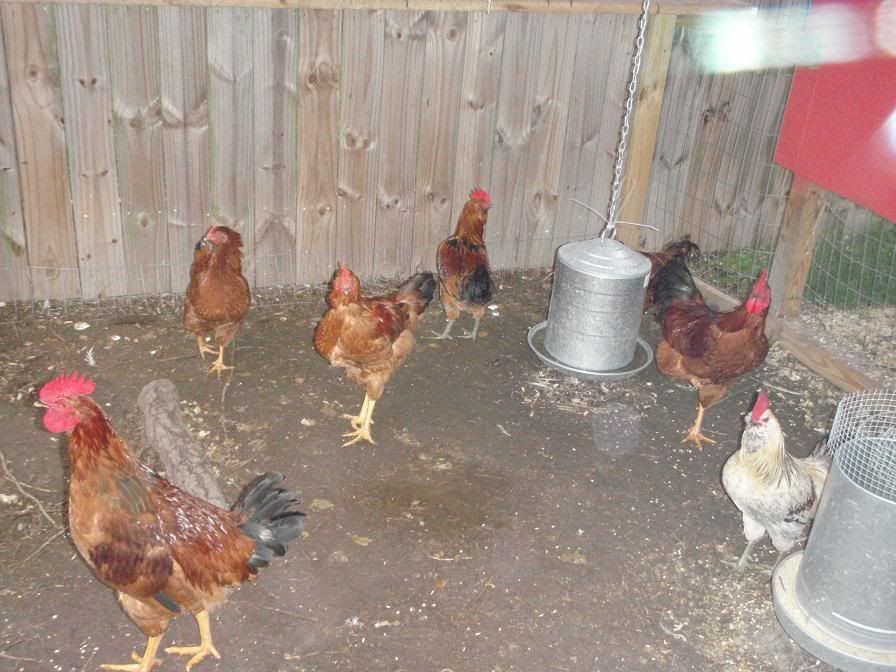
|
|
this is teh arfcom of chickens www.backyardchickens.com Chickens are easy to keep, and you don't need a rooster. I have 8 but would like to get rid of a couple. I got extra this time because the last time I had too many roosters. I let mine freerange in my yard, which is relativly large for the suburbs. I would rather confine them to the pen longer but like I said, I have too many. You really have to protect any plants you like, they will eat anything. The like to scratch in the mulch and edgeing. But they also eat a lot of bugs and their poop makes my compost majical! I keep mine in a 10x10 dog kennel that has a tarp on the top. I use leaves and debris for the litter inside, and put it in my compost heap when I change it out. Here it was last year. It pretty much looks teh same but I added another tarp over the top.  Here is my garden earlier in the season. This is the first year I used my majic chicken compost.  THe tomatoes continued to grow like a mutant life form. Here they are starting to cover the patio table. They succeeded in totally covering it but I've started pruning and removing some of the plants. I'm only leaving ones with what looks like good tomatoes on the vines.  I have 1 dark braham, 3 black sex links, 2 jersy giants, and one little banty. Asside from the banty, they are large duel purpose birds. I get one nice brown egg from buffy the brahma a day. My others should start laying at any time. |
|
Quoted:
thanx for the info guys please keep it coming. Also is the only dif in a brown egg and white egg the color? Yep. An egg is an egg is an egg, shell color doesn't matter. What makes a lot of difference is what the chickies eat and what conditions they're kept in. If you give them good food and sunshine and room to exercise, you will have eggs that have visibly deeper-colored yolks that are much more nutritious than store-bought eggs. There is just no comparing a store egg from a battery-raised chicken, with an egg from a chicken kept under decent conditions. |
I turned a pole barn in to a coop this spring. I currently have two breeds of chickens maturing side by side. Red Star Layers, 25 of them, and 10 Broilers. There is about a month's difference in their ages. They were separated for about week, but once I found the Red Stars in the same cage (open top) as the Broilers, I decided to let them all just run together.


TRG |
|
Quoted:
I turned a pole barn in to a coop this spring. I currently have two breeds of chickens maturing side by side. Red Star Layers, 25 of them, and 10 Broilers. There is about a month's difference in their ages. They were separated for about week, but once I found the Red Stars in the same cage (open top) as the Broilers, I decided to let them all just run together. http://i671.photobucket.com/albums/vv71/TheRedGoat/d1-1.jpg http://i671.photobucket.com/albums/vv71/TheRedGoat/d2-1.jpg http://i671.photobucket.com/albums/vv71/TheRedGoat/d3.jpg http://i671.photobucket.com/albums/vv71/TheRedGoat/d4.jpg TRG If those broilers are Cornish crosses, you may eventually run into problems with the Red Stars getting enough to eat. The Cornish crosses live to eat... they'll grow stupendously fast, and will crowd smaller chickens away from the feeders. They're very docile and good-natured, but they're damn serious about their food.
|
|
Quoted:
Quoted:
I turned a pole barn in to a coop this spring. I currently have two breeds of chickens maturing side by side. Red Star Layers, 25 of them, and 10 Broilers. There is about a month's difference in their ages. They were separated for about week, but once I found the Red Stars in the same cage (open top) as the Broilers, I decided to let them all just run together. http://i671.photobucket.com/albums/vv71/TheRedGoat/d1-1.jpg http://i671.photobucket.com/albums/vv71/TheRedGoat/d2-1.jpg http://i671.photobucket.com/albums/vv71/TheRedGoat/d3.jpg http://i671.photobucket.com/albums/vv71/TheRedGoat/d4.jpg TRG If those broilers are Cornish crosses, you may eventually run into problems with the Red Stars getting enough to eat. The Cornish crosses live to eat... they'll grow stupendously fast, and will crowd smaller chickens away from the feeders. They're very docile and good-natured, but they're damn serious about their food. I think they are crosses. FUGGIT gave them to me. I don't know the breed. I appreciate the advice about them being voracious eaters. My hens are getting 1-2 watermelons per day, 5-6 ears of dried/fresh corn, table scraps, and there are two feeders in the pen. The hanging bucket is the 'maggot feeder' as well. If there is an issue with a lack of feed being available, I will remove the broilers. TRG |
|
Quoted:
Quoted:
thanx for the info guys please keep it coming. Also is the only dif in a brown egg and white egg the color? Yep. An egg is an egg is an egg, shell color doesn't matter. What makes a lot of difference is what the chickies eat and what conditions they're kept in. If you give them good food and sunshine and room to exercise, you will have eggs that have visibly deeper-colored yolks that are much more nutritious than store-bought eggs. There is just no comparing a store egg from a battery-raised chicken, with an egg from a chicken kept under decent conditions. +1. We feed our chickens organic feed, along with a few handfuls of mealworms and whatever they peck at in the yard. Our yolks are a real rich orange color. Store bought yolks look like a yellow/grey. I didn't think it would make much of a difference...until i saw it first hand. |
| Cornish Cross for meat (my thread). White leghorns are most efficient layers. |
| We have black barred rocks. They're fairly docile and we get decent egg production out of them. We feed them standard feed plus any non-meat scraps from the kitchen or garden. My kids also spend a lot of time catching and feeding them grubs, grasshoppers, etc. We haven't butchered any yet and I imagine it will be very difficult since my wife considers them pets. |
|
I just started running Buff Orpingtons(4) in my backyard.
Good birds, very friendly and are suppose to be good egg producers. Mine are just 3 months old right now. Go to Backyardchickens.com for good information. My buffs at 3 months are as large as basketballs and just as orange. When I come home from work I have to walk past their run and they meet me clucking like they are glad to see me. Right now I have trained them to get on their outdoor perch so I can look them over for problems. Heck they even like to be petted like a dog or cat. |
|
Quoted:
Quoted:
If there is an issue with a lack of feed being available, I will remove the broilers. TRG If that's convenient, fine, but if it's not, just put in a couple extra feeders. yeah, it may not even be that much of a problem with only 10 of the broilers in there. We usually do 50 at a time, and when they see you coming with a bucket of feed... well, it's not something you want to do in flip-flops, if you value your toenails. |
|
Assuming my Red Stars begin producing, at their peak, I will be staring at 12-24 eggs per day.
I know I can cold pickle some in vinegar, but what else can I do to store them? Dehydrate? Canning? How do you all establish your 'market' for selling eggs? Where do you get your egg cartons? What percentage of your customers return the cartons? Pricing? I work at a small college, and I *think* I can sell a dozen eggs for 3.00 a dozen. (more or less). I am curious what others have done to market their eggs? TRG |
|
Quoted:
I know I can cold pickle some in vinegar, but what else can I do to store them? Dehydrate? Canning? How do you all establish your 'market' for selling eggs? Where do you get your egg cartons? What percentage of your customers return the cartons? Pricing? You can freeze eggs, so I'm told. Separate the yolks from the whites and freeze them separate. We spent about $60 at www.eggcartons.com several years ago and are still working through them. I don't like our eggs going out in commercial cartons wit another producer's name on them. Gift some folks with eggs....some of them will become customers. Most of the folks Mrs. Feral sells to return the cartons. As far as pricing goes......check the price on free-range eggs at your local yuppie supermarket and then charge at least that.
|
|
There are a lot of "how to dehydrate eggs" threads out there on the 'net if you Google around a little bit, but many reputable sources say "don't do it". I choose to err on the side of caution and don't try to preserve eggs; they are way too susceptible to bacterial contamination. My own take on it is: why bother?. The best way to store eggs is inside a chicken! Chickens are a fundamental part of my self-reliance/survival strategy, and I'm hoping they'll be around as long as I am if the wheels come off this bus. So... fresh eggs. And eggs->baby chicks -> more chickens -> more eggs. IMHO, being able to produce food is just as, if not more, important that knowing how to store it.
We sell maybe 10 dozen/week, mainly to keep them from going to waste. Only advertising has been word of mouth, and we could easily sell twice or three times as many if we wanted to... there's actually quite a demand. We charge $1/dozen, which sounds cheap, but this is a rural area and prices are lower. That being said, I could probably get $2/dz for them if I wanted to, but again we're not really into it to make a killing... just trying to keep very good food from going to waste. We bought a box of commercial, blank cartons, I think from FarmTek. But virtually everybody we sell to, and a lot of folks we don't, have proven to be more than willing to save up cartons and bring them to us. We've got more than we can use, but I don't have the heart to tell 'em to quit. 
|
|
Quoted:
Dehydrate? Canning? How do you all establish your 'market' for selling eggs? Where do you get your egg cartons? What percentage of your customers return the cartons? Pricing? I work at a small college, and I *think* I can sell a dozen eggs for 3.00 a dozen. (more or less). I am curious what others have done to market their eggs? TRG You can dehydrate eggs. I have posted the instructions, though I don't remember which thread it was in. You can also freeze them and pickle them. Don't know if it's legal where you live, but here, what I did was take a dozen eggs down to a little independent grocery store that caters to the tourist crowd. They took one look and said they would buy as many as I could bring them. I bought clear egg cartons so the tourists could see the different colors of the shells. I would bring 15-20 dozen in on Friday and they would be gone by Saturday morning. |
|
Quoted:
We have black barred rocks. They're fairly docile and we get decent egg production out of them. We feed them standard feed plus any non-meat scraps from the kitchen or garden. Go ahead and feed them any meat scraps that are not chicken. Chickens are omnivores, they like meat, and the extra protein is good for them. |
|
Quoted:
We spent about $60 at www.eggcartons.com several years ago and are still working through them. I don't like our eggs going out in commercial cartons wit another producer's name on them. You can find reusable egg containers at Wal Mart in the camping section, or similar store. The red and yellow ones are GTG, avoid the grey ones. They are a PITA to open. FWIW... we checked craigslist, and locally, organic fed free range go for $2.50 a doz or so. I've got a few regular customers....just stuck a sign on my front lawn. |
|
Quoted:
Go ahead and feed them any meat scraps that are not chicken. Chickens are omnivores, they like meat, and the extra protein is good for them. Why can't you feed them left over cooked chicken?[/quote] Same reason you ought not feed cows ground-up cow. That's a good way to pass along some nasty diseases. |
|
Quoted:
Quoted:
Go ahead and feed them any meat scraps that are not chicken. Chickens are omnivores, they like meat, and the extra protein is good for them.[ Why can't you feed them left over cooked chicken? Same reason you ought not feed cows ground-up cow. That's a good way to pass along some nasty diseases. When I was investigating my maggot feeder, some sites said 'no dead chickens' others said the opposite. I am going to avoid feeding mine uncooked chicken, but if it is cooked...it should be GTG, right? TRG |
|
Quoted:
Quoted:
Quoted:
Go ahead and feed them any meat scraps that are not chicken. Chickens are omnivores, they like meat, and the extra protein is good for them.[ Why can't you feed them left over cooked chicken? Same reason you ought not feed cows ground-up cow. That's a good way to pass along some nasty diseases. When I was investigating my maggot feeder, some sites said 'no dead chickens' others said the opposite. I am going to avoid feeding mine uncooked chicken, but if it is cooked...it should be GTG, right? TRG Eh, you'd significantly lower the risk by feeding them cooked meat. Still, I'm not thrilled by the idea. I know the prions that cause mad cow disease cannot be killed by conventional cooking. I don't know enough about avian disease-carrying organisms to definitively say whether or not feeding them cooked chicken is horribly risky... but just to be on the safe side, I'm feeding all my chicken scraps to the dogs. |
|
Quoted:
Quoted:
Quoted:
Quoted:
Go ahead and feed them any meat scraps that are not chicken. Chickens are omnivores, they like meat, and the extra protein is good for them.[ Why can't you feed them left over cooked chicken? Same reason you ought not feed cows ground-up cow. That's a good way to pass along some nasty diseases. When I was investigating my maggot feeder, some sites said 'no dead chickens' others said the opposite. I am going to avoid feeding mine uncooked chicken, but if it is cooked...it should be GTG, right? TRG Eh, you'd significantly lower the risk by feeding them cooked meat. Still, I'm not thrilled by the idea. I know the prions that cause mad cow disease cannot be killed by conventional cooking. I don't know enough about avian disease-carrying organisms to definitively say whether or not feeding them cooked chicken is horribly risky... but just to be on the safe side, I'm feeding all my chicken scraps to the dogs. +1 |
|
Quoted:
Quoted:
Quoted:
what kind of food should be given?
I think I might make something this weekend Make? TRG I might make a chicken coop and buy some chickens Gotcha. Thought you meant make a feed. I like having the hens, but, if it was not for the almost 'automatic' nature of my coop it would be too high maintenance. I can see how a homestead could easily be a 24 hour operation. TRG |
|
Quoted:
I can see how a homestead could easily be a 24 hour operation. TRG It is. As to the question of what sort of feed should be given, it depends on age and breed. If you have egg-layers, ask at the feed store for chick crumble. Some feed companies make a high-protein crumble or mash specifically for meat breeds, so if that's available, and you get meat birds, that's a better choice. For older egg-layer breeds, layer pellets work fine. Meat birds, you want meat-bird pellets. Add in any garden waste or kitchen scraps, like TRG's watermelons, that you might have, and you're good to go. They won't eat citrus, but most other things they will devour with great glee. |
|
Quoted:
Quoted:
I can see how a homestead could easily be a 24 hour operation. TRG It is. As to the question of what sort of feed should be given, it depends on age and breed. If you have egg-layers, ask at the feed store for chick crumble. Some feed companies make a high-protein crumble or mash specifically for meat breeds, so if that's available, and you get meat birds, that's a better choice. For older egg-layer breeds, layer pellets work fine. Meat birds, you want meat-bird pellets. Add in any garden waste or kitchen scraps, like TRG's watermelons, that you might have, and you're good to go. They won't eat citrus, but most other things they will devour with great glee. My Red Stars will not touch squash. They love corn. The broilers love squash, and will pass up corn. TRG |


|
Quoted:
http://i645.photobucket.com/albums/uu172/bluefire_smoke/2011-07-07201856.jpg just got them today 6 in total http://i645.photobucket.com/albums/uu172/bluefire_smoke/2011-07-07201913.jpg You need to get their water and feed up off the ground. They will still step in it, but, you can reduce the transmission of colon disease if you reduce the amount of fecal material in their water. Mine were innoculated before they were mailed to me, and I fed them the 'medicated' chick starter for the first two weeks. Out of 36 chicks that I have received this summer, I have only lost one, and that was to exposure, not disease. It got trapped/isolated overnight and I think it panicked/shocked itself to death. I credit this disease rate of '0%' to clean water and medicated feed while they were young. TRG |
|
Quoted: Quoted: http://i645.photobucket.com/albums/uu172/bluefire_smoke/2011-07-07201856.jpg just got them today 6 in total http://i645.photobucket.com/albums/uu172/bluefire_smoke/2011-07-07201913.jpg You need to get their water and feed up off the ground. They will still step in it, but, you can reduce the transmission of colon disease if you reduce the amount of fecal material in their water. Mine were innoculated before they were mailed to me, and I fed them the 'medicated' chick starter for the first two weeks. Out of 36 chicks that I have received this summer, I have only lost one, and that was to exposure, not disease. It got trapped/isolated overnight and I think it panicked/shocked itself to death. I credit this disease rate of '0%' to clean water and medicated feed while they were young. TRG okay thanks |
|
Here is a pic of the eggs I have accumulated at this moment. I do eat them but not everyday. I have 7 hens, not sure how many are laying but I think 5. My little banty has been broody and hasn't layed in a long time. 5 of them hatched this spring and have just started laying. One hen from the first batch started laying this spring. I'm actually going to get rid of 2 of them which will bring me to 4 large hens and a banty.  The marks are where I wrote the dates on them. They are various shades of brown. I got a super duper big one that I'm dying to eat!! The last super duper big one had 2 yolks! I think it's my black sex link, Robin, that's laying those. I think they are an anomaly, most of the eggs are rather small. |
|
honestly chickens are stupid easy lol. i built a A frame coup with a run under it. it holds there water and feed. i have 2 roosters and 6 hens. 4 golden comets and 2 easter eggers. i let them free range all day and lock them up at night when they head in. i do live in the country but they haven't really left my yard yet. they go over in my one neighbors yard but just on the other side of the fence. my big EE just started laying and her green eggs are great and really give people a chuckle as they don't believe me when i tell them lol.
the one down side to chickens is all the shit they produce which causes mass breeding for flies and they are annoying. my daughter loves them and chases them all over. cool to see so many folks with them and prepared if something happens. 6 eggs (or a lot more for some of you farmers lol) a day is a huge boost to your staples. |
|
We've had RiR's for 2 years now and we've had 5 to 8 eggs every day - out of an average of 8 hens. Got some Dominiques, but the dogs went crazy and killed every last one of them.
The RiR's have proven themselves to be very hardy. Went through the winter in N. Ga mountains without additional heat. They forage for the most part, we supply a bit of feed and crushed oyster shell, but that's it. Very easy breed to keep. We ate 1 of them when we had them for a month or so...haven't done so again Absolutely nasty meat...the ones we have are definitely more geared towards laying than broiling.
And if you every consider Turkeys, just forget about it. We got 15 and we have 2 left. Most of them died off within a month. Very difficult to raise them and dumb as hell. I saw one commit turkey-cide! |
|
Mine are still not roosting in the 'roost' side of their pen. There is a light in it, they move in/out during the day, but they are still not going inside to sleep overnight.
They are eight weeks old this weekend. I killed my first broiler yesterday. It weighed 2.5lbs, dressed. It was four weeks old. Making dumplings from him/her today. The others get another month to get fatter. TRG |
|
I have been experimenting with different breeds for 4 years now and feel I have a decent grasp on things. In my experience Leghorns are laying machines, I get an egg a day out of every one of them. I have noticed though that the leghorns don't forage much. They hit the feeder hard. For free range hens I like 3 breeds.
1. Buff Orpingtons. I get decent numbers of eggs out of them and they are the most docile of all my hens, though they do NOT like to be handled. 2. Barred Rock. These hens would make a decent dual purpose bird, they get big enough to eat but it takes a long time for them to get there. The lay about as good as the buff orps, and they are decent foragers. 3. Naked necks. They get to be about as big as the barred rocks, maybe even a bit faster. They are the quickest to mature to laying age, they lay pretty much as much as the barred rocks and buff orps, and they are VERY good foragers. I think they hardly ever hit the feeder during the summer time. As a matter of fact as soon as you get your box of chicks home from the post office and put them into their brooder the naked necks immediately begin patrolling the box looking at the ground for things to eat (a laser pointer can be very entertaining), while the rest of the birds are looking around all shell shocked from being shaken up in transit. They are also very tough birds. they don't tend to be very skiddish. As a matter of fact I have to be careful around them not to step on them. Unlike the other birds that tend to scatter when you walk by them the naked necks run up to you to beg for treats. Amerecaunas are fun birds as they lay pretty well, and they lay eggs that are teal, blue, green, and pink. |
|
Quoted:
http://i645.photobucket.com/albums/uu172/bluefire_smoke/2011-07-07201856.jpg just got them today 6 in total http://i645.photobucket.com/albums/uu172/bluefire_smoke/2011-07-07201913.jpg Get them some bedding material too, like pine shavings. Hardware cloth is not good - they can snag their feet and break their legs. I know you are thinking their poop will fall through, but chickens are not rabbits - just change the bedding every couple weeks. They will also stay warmer. |
|
Quoted:
Quoted:
http://i645.photobucket.com/albums/uu172/bluefire_smoke/2011-07-07201856.jpg just got them today 6 in total http://i645.photobucket.com/albums/uu172/bluefire_smoke/2011-07-07201913.jpg Get them some bedding material too, like pine shavings. Hardware cloth is not good - they can snag their feet and break their legs. I know you are thinking their poop will fall through, but chickens are not rabbits - just change the bedding every couple weeks. They will also stay warmer. +1 Just add a little pine shavings every couple of days to cover up the poo. you can go for quite a while before you have to change the bedding. |
|
Quoted:
I have been experimenting with different breeds for 4 years now and feel I have a decent grasp on things. In my experience Leghorns are laying machines, I get an egg a day out of every one of them. I have noticed though that the leghorns don't forage much. They hit the feeder hard. For free range hens I like 3 breeds. 1. Buff Orpingtons. I get decent numbers of eggs out of them and they are the most docile of all my hens, though they do NOT like to be handled. 2. Barred Rock. These hens would make a decent dual purpose bird, they get big enough to eat but it takes a long time for them to get there. The lay about as good as the buff orps, and they are decent foragers. 3. Naked necks. They get to be about as big as the barred rocks, maybe even a bit faster. They are the quickest to mature to laying age, they lay pretty much as much as the barred rocks and buff orps, and they are VERY good foragers. I think they hardly ever hit the feeder during the summer time. As a matter of fact as soon as you get your box of chicks home from the post office and put them into their brooder the naked necks immediately begin patrolling the box looking at the ground for things to eat (a laser pointer can be very entertaining), while the rest of the birds are looking around all shell shocked from being shaken up in transit. They are also very tough birds. they don't tend to be very skiddish. As a matter of fact I have to be careful around them not to step on them. Unlike the other birds that tend to scatter when you walk by them the naked necks run up to you to beg for treats. Amerecaunas are fun birds as they lay pretty well, and they lay eggs that are teal, blue, green, and pink. The colored eggs sell REALLY well for those interested in that aspect. As do really dark brown ones... we raise some Penedesenca's and a couple of other heirloom breeds just 'cause they lay such dark brown eggs. People love 'em. |
|
Quoted: Been fooling with them a long time. I no longer keep "dual purpose" birds. Specialization man, that's the future! We have Red Stars for eggs and raise purpose-bred broiler chicks for meat. 6.5 weeks and they're GONE! That said, I would go with RI Reds, or Dominiques if you want to go all Arfcom and "Get Both" meat and eggs. Any rooster will breed any hen, size permitting, (we have a very short, VERY frustrated banty rooster in w/15+ hens ).Results are usually meh at best. I'd go straight line, old school breed if you want both eggs and the occasional bird for the table. I am also partial to Buff Orpingtons, but that's more sentimental than practical. If you want the utmost in efficiency and can afford the food, yep, special breeds are your best bet. Cornish cross for meat has impressed me. Barred Rocks do a decent bit at egg production. I've gone the other way. I like a low maintenence, multi purpose bird. Rhode Island Reds for me. (Barred Rocks do a good job, too) They're not the fastest growing for meat and you'll only get about an egg every 30 hours or so on average. But they're a hardy bird. The roosters can be mean as hell, but if you get a good one, they help protect the hens. Another thing about the older breeds: If you want a self sustaining flock, you'll want a breed that is closer to being wild. That's because you want your hens to go broody. Now that's not good for egg production, but it's good for bird production if you don't want to have to mess with incubators, etc. Also, if you have a rooster among your hens, you're going to get some fertile eggs. Now, they eat just the same, but if you're selling any of them, people will throw a fit over a little blood in an egg. Not to mention that you'll sometimes get a blood speck, even if you don't have a rooster.Be careful of letting kids around a big Red with an attitude. They can do serious damage, and quick. Not joking. If you have a garden and free range chickens, you'll have to protect one from the other. Specifically your tomatoes. They won't eat "A" tomatoe. They eat some of EVERY tomatoe. They love them. If you've got the gumption, a chicken tractor is useful, if you only want a handful of birds. Impractical for more than a few, though. You'll want about 8-12 hens per rooster, if you want chicks. Any less than that and your rooster will screw the hens to death. If you just want eggs, don't get a rooster. They're a pain in the butt. Storey has some good books on the subject. They've served me well. Good luck. |

