


[ARCHIVED THREAD] - Underground Caching (Page 1 of 2)
Posted: 5/20/2016 11:27:20 PM EDT

A buried Monovault 130s is about 28" deep and 10" diameter and costs $90. It will hold 3-4 AR-15s (with optics detached) and a bunch of ammo. Some caching tips: 1. Don't put all your eggs in one basket. One cache is a start two or more are better. 2. A good place to cache things is public property like a city, state, or national park of large enough size to find an obscure location. Private property or non-park property can see sudden development when you're not looking. Park your vehicle far enough away to not lead someone to your location. 3. The location must be above the waterline and somewhere where erosion won't expose your tube. Choose very carefully only after looking around the area. 4. In areas where it freezes you have to dig down below the freeze line or make preparations so that your tube doesn't frost heave. 5. A pre-made solution like the above Monovault is good but so is some schedule 40 PVC, a bit of glue and some end caps will work too. Use desiccant to prior to sealing the tube to minimize moisture. Batteries should be removed from optic and stored isolated from rest of the cache. If you change altitude greatly from where you sealed your tube the change in air pressure could be an issue. 6. Make sure what you bury you can find later. A simple trick is to use two prominent boulders or trees, run paracord between the two twice, tie a knot at the halfway point and then use that knot as the apex of the triangle. 
7. You want to disturb the area as little as possible. Place a tarp out to collect your diggings. A post hole digger is a great tool. 8. Save the topsoil in a dedicated bucket to put back. In many areas the topsoil will be a different color than that of what lays underneath. 9. Take the soil dug with the post hole digger and dispose of it in some place distant enough to not indicated a recent dig. Dropping the spoil in a creek or in a gully away from your location will hide some of the tell. 10. Once the hole is dug drop your prepared tube into it and replace the topsoil down on top of it. In many state and national parks medal detectors are illegal. You can salt the area with some old rusty nails or other metal to confuse detectors. 11. Pack the soil firmly as there will be more settling come the first rain if you don't. Coming back after a few days of rain to check on the spot is a good idea. 12. Drop grass/straw/twigs to blend the freshly dug ground with the nearby area. Plant grass or flowers if placing the cache in your own yard. While walking to your dig have a cover story if found by civilians something like "I'm out here to bury my dog", "I'm out digging for nightcrawlers", if in your own yard you're "planting a new tree" or "looking for a leaking pipe". Enjoy your gardening. 
(PS: If you take photos of your work for goodness sake don't leave your GPS on and don't include anything in the background that might lead someone to the area) |

| Personally I think putting a cache on some random property that you don't control is a bad idea. Put it on your own property if possible, even better would be to put it inside a dirt floor building. Easy to find, will stay dry and deep enough it's protected from fire. |
| There's only 2 reasons anyone would find your stash with a metal detector. 1.) A hobbyist is looking for coins and artifacts and stumbles across it. Hobbyist metal detector people look in historical areas and high traffic areas exclusively. Avoid both. 2.) Someone is looking for your stash. This will probably be around your house, farm or property. If you bury metal objects next to concrete with rebar in it, like a footing or slab, it will cover the signal and will not get moved. Another good cover signal that won't get moved is metal fencing with metal post. It will make it impossible to detect anything under the fence. |
|
Quoted:
Personally I think putting a cache on some random property that you don't control is a bad idea. Put it on your own property if possible, even better would be to put it inside a dirt floor building. Easy to find, will stay dry and deep enough it's protected from fire. Get both? If you're caching material there's two people you don't want finding it - thieves and the government (thieves). At a summer cabin or hunting lodge caching valuables nearby but hidden underground can be a safer choice than leaving them inside where a thief would have the time to find them. If the thrill of having a person with a vagina in the office of the Presidency encourages enough folks to vote for the anti-Christ there are things folks might want to temporarily hide from an un-Constitutional government. If you're got the first people in mind having it on your property where it's inside your fence line and protected by your dogs ... great. But if you're hiding something from the government for (whatever reason) they have highly experienced folks who play adult hide-n-seek professionally and they might not be as easy to fool. That's where a remote cache comes in handy. Idealy it's property that's not going to see the front end of a D4 without you knowing it - your parents garden is better than along some random roadside but can still tie back to you. My area is blessed with hundreds of thousands of acres of state and federally protected land which allows one to find a place that's not tied back to the cache owner and at the same time highly unlikely to see development. The digging is the easy part ... the planing is the hard part. I've had caches in three other states and have checked on two of the three and so far, so good many years after putting them under. The plastic, aluminum and steel of the AR-15 makes for a very good weapon to cache and if I pass before recovering my caches I'm reasonably certain 100 years from now my caches if discovered would be in good shape still. |
|
Quoted:
There's only 2 reasons anyone would find your stash with a metal detector. 1.) A hobbyist is looking for coins and artifacts and stumbles across it. Hobbyist metal detector people look in historical areas and high traffic areas exclusively. Avoid both. 2.) Someone is looking for your stash. This will probably be around your house, farm or property. If you bury metal objects next to concrete with rebar in it, like a footing or slab, it will cover the signal and will not get moved. Another good cover signal that won't get moved is metal fencing with metal post. It will make it impossible to detect anything under the fence.
Note the wooden boards slightly showing in one photo ... hiding details of such a metal object. |
|
One thing to consider in selecting a site is the possibility/probability of a erosion or even a mud slide exposing the cache. We do get a lot of soil movement in SoCal.
Another thing to consider, based on the discussion of "not being tied to the cache", is finger prints, DNA residues and just plain old serial number traceability on the firearms. |
|
Last time this shit took off on ARF it was 99-2000.
Shit was actually getting buried and then somebody posted pics of tbeir spot being developed into a shopping mall. Their spot had the excavation leavings on top of their cache making it effectively under an 8 foot tall mound of dirt. Choose wisely indeed. |
|
Quoted:
The knotted paracord is a neat idea......but where does one store it for "someday"? You dont store shit. The distance between the two markers sets your string length. Walk to that tree and back with the line. Could be 20 feet could be 200 feet. Take your length of string that is double the distance between and tie a knot at half way point. Go to the apex of your triangle and be within 3-4 feet of your container/cache. Bigger and more permanent the objects and the more likely you are to have your item be easy to find. |
|
Regarding rebar/concrete slabs.
I know precisely how deep my concrete is around my recently constructed garage. Footing is about 12-18 inches below the soil. Trying to come in at an angle with a post hole digger so as to try to get a container under the foundation would be pretty damn difficult. But renting a little ditch witch style tractor with an auger bit to make a perfectly round hole at a 45 degree angle wouldnt take much time. Now whether you take any comfort in playing gopher under the foundation of your property is another matter. But if you could slip a heavy schedule 80+ pipe in there with good compaction around it you would probably be just fine. But a 12-16 inch diameter hole is pretty damn big. Then getting to the container again would prove about equally as difficult unless you were to leave it a bit long and end cap the container close to the surface, the dead air space of a PVC container shouldnt matter much. Given you might have a 5 foot tube, 3 of feet of it under the slab and 2 feet out of the slab closer to the surface, tying a rope to your items might be a good idea. |
|
Quoted:
The knotted paracord is a neat idea......but where does one store it for "someday"? Anywhere you want ... the string is not special ... the distance between two 250 year old trees in a state park that's a quarter million acres in size ... not the triangle of grass in front of the VFW next to the courthouse and police station. 
For me it wasn't trees but two boulders that haven't moved a 10,000 years. Like this little one 25 yards beyond my rifle. 
|
|
I wouldn't put my only AR "out there" nor one of the first handful or two that I own.
The sun will be a cold glowing ember by the time 50,000 soldiers dedicated to the mission 365 days a year sweep the millions and millions of square acres of land in the parks of SoCal alone. The Joshua Tree National is 1.8 million acres and it's up against the BLM property to the east of it several times it's size. Then there's the Mojave, Yosemite, Death Valley, Palomar Mountain, the Santa Rosa and San Jacinto National Forest, Anza-Borrego, the Cleveland, Los Padres, and Angeles National Forests .... and an equal number of tens of millions of square acres of BLM property. There's 140 years worth of mines, ranches, and bullets out there. During WWII George Patton's and 7 other armies spent weeks out there dropping crap and shooting shit. Finding a needle in a haystack is a piece of cake compared.
|
|
Good thread, thanks.
Couple of tips from placing and pulling over the years. PVC- use actual caps, not "test" caps, not the threaded caps. I know, you read someone's book who probably hasn't actually done this, nor retrieved it 20 years later that said use threaded caps for "ease of removal." The couple of times I've pulled old ones that used threaded caps, they were all trashed from water infiltration. High high desert, perhaps not. Most other places, PLAN FOR IT. Actual caps, glued on. Not the grease trick, PVC glued on. Leave a small space at the end of the tube near one cap that's empty and mark that end with paint or permanent marker. You can always burn a little bit of the cap off, break off with rock, etc. if you lacked any tools or materials to remove cap. Plant your tube HORIZONTAL. Yeah I know, you read some new prepper's book that never placed one nor retrieved it out of a swamp at O dark thirty 20 years later who said "place them vertical so the metal detector won't find it." Well here's news- 1. The metal detector, even a cheap ass one, WILL find it, vertical or horizontal. And most importantly- 2. PVC tubes are MUCH easier and quicker to remove when placed horizontal. A vertical, 3' deep emplacement means a BIG hole having to be dug 10, 20, 30 years later as the soil will have compacted around the tube. It's not always a question of putting a rope around the end and pulling. A horizontal emplacement allows you to FIND IT EASIER also. Trust me, when you go back 10, 20, 30 years later, stuff will have changed, your "foolproof" method of finding it will end up being not so foolproof. Given the expected conditions when we expect to RETRIEVE these, you can figure it will be dark, you will likely be COLD, WET, TIRED, HUNGRY. You might even be being PURSUED. So you can't expect to be able to sit around that position for an hour pulling your gear up out of the tube via a cute little hoist system, or digging to China to free the bottom of the tube. It may literally be that you have to snatch it and keep running. With a vertical emplacement of say a 6 inch PVC tube, you have to hit a six INCH spot perfectly, 10, 20 or 30 years later WHEN things have changed, scenery is different, again potentially COLD, WET, TIRED HUNGRY at O dark thirty. With a horizontal emplacement of say a 6 inch PVC tube 3 foot long, you have to hit a six inch BY 3 FOOT spot. Much easier to find (trust me on this) than the later. I own a metal detector, do you know why I own a metal detector. I bought one specifically to find a vertical cache I dropped 15 years previous. I was WITHIN 2 FEET of the tube, but almost only works with hand grenades right??? Some general stuff- 1. Never put anything personalized in there. Big reason not to go ape crap with personalizing weapons also. You never know who might accidently dig it up. 2. Never put anything in you aren't willing to lose. Great Grandpappy's Colt that "won the west" shouldn't be in there. 3. I always put a knife in, some cord, firestarter, doesn't matter what the nature of the cache is. 4. For retrieval you can/should keep materials in your packs to cut the tube. Hard to keep a sawzall in your pack and a hacksaw blade half wrapped in duct tape will suck, but it might be your only option. They do make small hand saws for cutting PVC and I've seen guys use string to cut SMALL PVC, but I don't know how it works on larger PVC. 5. EXPECT and plan for threads to be stuck, water to be IN the container and the container to be "sucked into" or locked into the soil. I've pulled a fair amount of tubes, none of them came all that easy.... 6. An E-tool, hacksaw cached in the area might be helpful, close enough but not too close. I'm always surprised to find shovels, etc. in the woods in areas where people have not worked in five or more years. They are typically in workable condition. A shovel with the blade sprayed with car undercoating, synthetic handle (no rot) tied around a branch of a nearby tree might be a lifesaver. Bottom line, everyone talks theory about placing, the often overlooked aspect is PULLING the cache later. Put as much planning and thought into that as the placement and you'll do well. |
|
I'm wondering what the chemical reaction from off gasing pvc glue and cleaner would do to metals.
Similar to this thread. https://www.ar15.com/archive/topic.html?b=10&f=17&t=665037 |
I have an invention 
That might be practical and would be easy to design/build... A 'Pinger' to be buried at or near the cache that would 'listen' for an acoustic code for many years, I have had surplus lithium batteries of the military type from the 1980's that still are capable of outputting a sizable % of original capacity. The Pinger would wake up periodically with a super low power microcontroller/preamp listening for a coded acoustic signal. The user would pound on the ground with his foot or a bar and send a simple 'acoustic' code, unlike natural signatures, thunder, aircraft, geo-movements, animals etc. Some false alerts are acceptable considering battery life. The Pinger would respond with a short acoustic 'vibration'. The user would need a sensor to detect that vibration [easy/inexpensive to build] and when detected would send another code to confirm and then the Pinger could continue the vibration for say a minute [conserving battery] allowing the user to find it. Of course with GPS and a pointed rod to probe with, something like a pinger might have few application... |
|
Quoted: I have an invention That might be practical and would be easy to design/build... A 'Pinger' to be buried at or near the cache that would 'listen' for an acoustic code for many years, I have had surplus lithium batteries of the military type from the 1980's that still are capable of outputting a sizable % of original capacity. The Pinger would wake up periodically with a super low power microcontroller/preamp listening for a coded acoustic signal. The user would pound on the ground with his foot or a bar and send a simple 'acoustic' code, unlike natural signatures, thunder, aircraft, geo-movements, animals etc. Some false alerts are acceptable considering battery life. The Pinger would respond with a short acoustic 'vibration'. The user would need a sensor to detect that vibration [easy/inexpensive to build] and when detected would send another code to confirm and then the Pinger could continue the vibration for say a minute [conserving battery] allowing the user to find it. Of course with GPS and a pointed rod to probe with, something like a pinger might have few application... Use key fob technology. Start sweeping the area with a device that will activate the key fob chip and tell you where it is. |
|
I was thinking of doing that at a county wilderness park that I hike in.
The county workers have controlled burn's every year and it has a high water table. There are also all kinds of wild hogs in the area and they can dig a good two feet down. I had made a emergency shelter there last year out of downed limbs, something to get in if it rains. I just threw some plastic over the limbs and covered it in leaves and pine straw. When I went back to look at it this year they had burned the area and the shelter was gone. So I would not rush out to put anything of value in this area. |
|
I spoke with an older gentleman who had a "bunch" of silver coins that he buried several feet under in a heavy duty yellow plastic antifreeze bottle 30 years ago. Said it took him weeks of digging to hit the right spot again with his shovel. Apparently measuring "paces" from a fixed point is not so helpful if your stride has changed over a few decades, lol.
Plus the bottle had cracked/leaked along the seam.
|
|
Find someplace where there's a lot of concrete construction, like a highway, away from prying eyes. Take a pick axe or something similar and dig a hole out of part of it. Place container with guns and ammo inside hole, cement over it and try to make the job look professional on the surface, like a repair job.
Walk away. Wait 40 years after rise of totalitarian state, have kids dig it up. They won't know what hit em. |
|
Quoted: If you think it's time to bury, it's probably past time to use it.  To put it another way: Freedom isn't won with a buried gun.  Burying gold, now that's a different story! OP good post! |
|
Quoted:
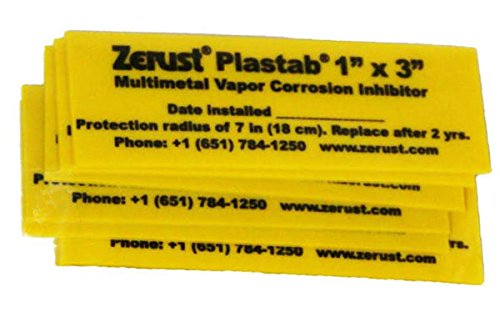
Zerust Rust Prevention Plastabs are nice additions in rust prone areas. They emit a rust prevention vapor over time. $8.50 for a set of 10. http://ecx.images-amazon.com/images/I/41r1J%2BbYHLL.jpg Do these really work? How do they work? I've never heard of them, will have to research some, look neat. Could be useful for lots of stuff in humid environs. |
|
Quoted: Zerust Rust Prevention Plastabs are nice additions in rust prone areas. They emit a rust prevention vapor over time. $8.50 for a set of 10. http://ecx.images-amazon.com/images/I/41r1J%2BbYHLL.jpg |
|
A less expensive alternative to Zerust tabs is camphor blocks. I learned about this when I got into hobby machining with a small lathe and mill that I have in a non-climate controlled shop. It's an old machinist's trick to put a block of camphor in a toolbox to prevent the tools (hand tools, lathe bits, end mills, etc.) inside from rusting. The solid camphor sublimates, turning into a corrosion inhibit gas that leaves a light film on the tools. It's been working for me for a couple years. You can get camphor in the form of old fashioned mothballs, or in block form from places like Amazon or eBay. |
|
Quoted: A less expensive alternative to Zerust tabs is camphor blocks. I learned about this when I got into hobby machining with a small lathe and mill that I have in a non-climate controlled shop. It's an old machinist's trick to put a block of camphor in a toolbox to prevent the tools (hand tools, lathe bits, end mills, etc.) inside from rusting. The solid camphor sublimates, turning into a corrosion inhibit gas that leaves a light film on the tools. It's been working for me for a couple years. You can get camphor in the form of old fashioned mothballs, or in block form from places like Amazon or eBay. Mothballs are naphthalene, not the same thing as camphor. These days a lot of mothballs use dicholorbenzene, and I wouldn't use any chlorinated compound for anti-corrosion. |
|
Quoted:
Have some access to lots of property at high elevation. Problem is it's covered with snow 4 months out of the year. Depending on where you live, you may simply have to deal with the snow. An obvious problem in such an area is how to store, retrieve, and re-store items without leaving a giant beacon pointing right at it. |
|
Quoted:
Last time this shit took off on ARF it was 99-2000. Shit was actually getting buried and then somebody posted pics of tbeir spot being developed into a shopping mall. Their spot had the excavation leavings on top of their cache making it effectively under an 8 foot tall mound of dirt. Choose wisely indeed. Link to this? I don't recall this thread and was around as a lurker before I actually joined. |
|
how about using a septic tank for storage? not one filled with poo... ( although that would probably be a awesome place to hide something)... I mean a new one, sealed and buried. you could access it thru the hatch, and have a reasonably large storage area. or maybe a plastic cistern.. they can be buried and are a lot cheaper than a septic tank, and still offer a largish space.
obviously you probably cant go hauling a septic tank onto public lands to bury. I was thinking more along the lines of on your own property. I have also seen 5 gallon buckets used, 55 gallon drums with the removable top, burial tubes from cheaper than dirt. id advise anything like a gun or ammo, to be sealed several times, oiled, vac sealed, vac sealed again with moisture / air absorbing pack, then sealed inside a barrel. I would not want to hide anything on someone elses land if at all possible.... unless you were sure it would not be molested. your back yard, under a shed? probably safe from everything except the most through searches, under a above ground pool? probably safe... ..a farms back 40?? probably safe. on a 100,000 acre chunk of public land? probably safe. 100 yards behind Walmart? you might find a dollar store parked on it 2 years down the road. the guys who claim if its time to bury them.. its time to use them, also are the guys who say, " what will you do with a ton of ammo? how can you take it with you if you bug out? to both sets of people.... you don't. you store supplies, weapons, ammo, and food... to PREVENT hostile forces from discovering it and stealing it. you use what you need and hide the rest, to be removed when you need it. its secure storage.. nothing else. its a savings account. |
|
Quoted: how about using a septic tank for storage? not one filled with poo... ( although that would probably be a awesome place to hide something)... I mean a new one, sealed and buried. you could access it thru the hatch, and have a reasonably large storage area. or maybe a plastic cistern.. they can be buried and are a lot cheaper than a septic tank, and still offer a largish space. obviously you probably cant go hauling a septic tank onto public lands to bury. I was thinking more along the lines of on your own property. I have also seen 5 gallon buckets used, 55 gallon drums with the removable top, burial tubes from cheaper than dirt. id advise anything like a gun or ammo, to be sealed several times, oiled, vac sealed, vac sealed again with moisture / air absorbing pack, then sealed inside a barrel. I would not want to hide anything on someone elses land if at all possible.... unless you were sure it would not be molested. your back yard, under a shed? probably safe from everything except the most through searches, under a above ground pool? probably safe... ..a farms back 40?? probably safe. on a 100,000 acre chunk of public land? probably safe. 100 yards behind Walmart? you might find a dollar store parked on it 2 years down the road. the guys who claim if its time to bury them.. its time to use them, also are the guys who say, " what will you do with a ton of ammo? how can you take it with you if you bug out? to both sets of people.... you don't. you store supplies, weapons, ammo, and food... to PREVENT hostile forces from discovering it and stealing it. you use what you need and hide the rest, to be removed when you need it. its secure storage.. nothing else. its a savings account. (note: I am looking for one for a cache that will be opened often, so hatch entrance may not matter to you.) |
|
Quoted: I have thought about the septic tank idea as well. I have not found a poly one that has a hatch bigger than 20 inches. Thats just not practical for me to climb into due to my shoulder width. With depths reaching several feet, gonna need long ass arms. I'm sure a custom concrete one could be made, but the price skyrockets as does the ability to buy and transport in the back of a pickup. (note: I am looking for one for a cache that will be opened often, so hatch entrance may not matter to you.) Quoted: Quoted: how about using a septic tank for storage? not one filled with poo... ( although that would probably be a awesome place to hide something)... I mean a new one, sealed and buried. you could access it thru the hatch, and have a reasonably large storage area. or maybe a plastic cistern.. they can be buried and are a lot cheaper than a septic tank, and still offer a largish space. obviously you probably cant go hauling a septic tank onto public lands to bury. I was thinking more along the lines of on your own property. I have also seen 5 gallon buckets used, 55 gallon drums with the removable top, burial tubes from cheaper than dirt. id advise anything like a gun or ammo, to be sealed several times, oiled, vac sealed, vac sealed again with moisture / air absorbing pack, then sealed inside a barrel. I would not want to hide anything on someone elses land if at all possible.... unless you were sure it would not be molested. your back yard, under a shed? probably safe from everything except the most through searches, under a above ground pool? probably safe... ..a farms back 40?? probably safe. on a 100,000 acre chunk of public land? probably safe. 100 yards behind Walmart? you might find a dollar store parked on it 2 years down the road. the guys who claim if its time to bury them.. its time to use them, also are the guys who say, " what will you do with a ton of ammo? how can you take it with you if you bug out? to both sets of people.... you don't. you store supplies, weapons, ammo, and food... to PREVENT hostile forces from discovering it and stealing it. you use what you need and hide the rest, to be removed when you need it. its secure storage.. nothing else. its a savings account. (note: I am looking for one for a cache that will be opened often, so hatch entrance may not matter to you.) |
|
Any competent detectorist can notch out steel/iron and still get good signals on non ferrous metals... so if you're burying steel stuff, you're likely ok there (even then, bb's won't sound the same as a larger piece of steel...) but if you're burying aluminum or brass... not so much.
(My girlfriend is a metal detectorist) |
|
Awesome info!
If we (you, I, etc...) were to bury a rifle that is serialized and registered to said person and all the sudden law changes and gov (state or fed, state most likely) is looking for it and it's maybe say buried in another state, what would a likely outcome be? Do I say gee,what happened to that rifle? What type of situation are we looking at? I'm not worried about anyone finding it. But it may "re-appear" on the grid later down the road. WSS |