


[ARCHIVED THREAD] - Home Solar Installation. (Page 1 of 2)
Posted: 8/22/2015 9:36:02 PM EDT
|
Several people have IM'ed me asking to document my solar installation that I had done this summer.
The Math behind the Science The primary reason that I wanted to go solar was to save money rather than saving the planet. The power here is pretty reliable but still I have a pair of portable gasoline fed generators - an 8500 watt and a 2000 watt. I wanted a grid-tied system with mono-crystal panels and was interested in going with micro-inverters if possible. The advantage of micro-inverters is they don't degrade as much if shaded, an array using them is easier and cheaper to expand, and if one inverter fails the rest continue to produce power. The disadvantage is they are more expensive than a single larger inverter mounted near ground level. I researched and found three top rated solar system installers who were licensed, bonded, and insured. When the first company came by we had to pull my power usage from the local provider Southern California Edison. Their web site was down and I've been on paperless billing since 2003 so I had to pull a 12 year old bill to get my account number. The SoCal Edison customer service representative gave me the number of kilowatts used per month as well as my monthly bill. I noticed that despite going all LED and fluorescent lights, upgrading my AC unit to a very efficient two speed compressor/variable speed fan unit, and upgrading my major appliances I used about 12% more power in 2015 than I did 12 years ago. My bill went from $50 to over $200 in those 12 years. Over the last 12 months my average power use was 11,160 kilowatt hours (WH) per month or 930 KWH a month. My average bill was $205 or about $2460 a year. My average delivered cost per kilowatt hour was $0.22 - this is the number I'm using for pay-off calculations. 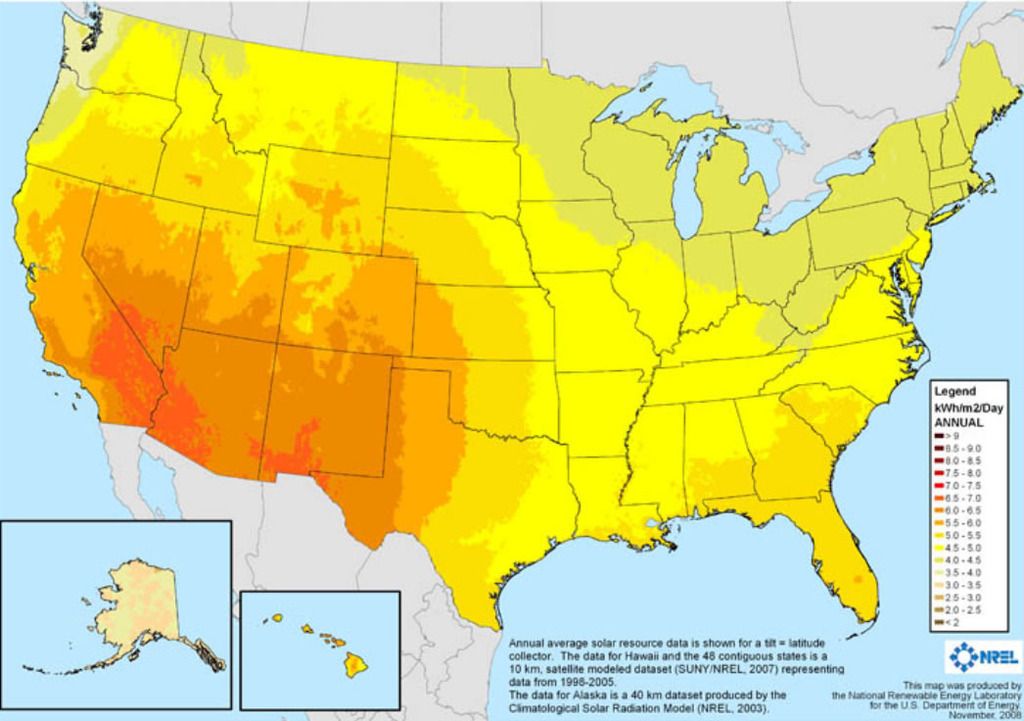
Using a chart the solar system salesmen showed me that my area of Southern California could expect 5.5 to 6.5 solar hours per day. The sun shines more than 6.5 hours but since the panels would be stationary the sun didn't directly shine down upon them mean a loss of some of the light. We used 6 hours as a good number but I'll get more than that in the summer when power demand is higher due to the air conditioner and lower in the winter time. My home faces due south and the roof is sloped at 22 degrees which are both nearly ideal favoring the collection of power in the summer a bit more than the winter. The math isn't that hard. 6 solar hours a day times 30 days in the month is 180 hours to collect power. 930 KWH divided by 180 hours is 5.16 kilowatts. In theory that sized array would zero my grid tie system out. The panels are 280 watt so that means about 18 panels. And in a perfect world I would feed into the power grid exactly what I pulled out. There are some fine points on the math - the conversion of the solar power from the panel into AC isn't perfect so there are some losses. An average efficiency numbers for systems run 75 to 85%. My system has been doing about 83% so far. Locally there are four tiers of electrical power with tiers one and two being fairly cheap and tiers three and four much higher. Tier one is $0.15, tier two is $0.19, tier three is $0.25 and tier four is $0.31 a kilowatt hour. The local power company has put in "smart meters" which will allow them to day part billing with rates of $0.11, $0.26, and $0.35 per kilowatt hour for super off-peak, off-peak, and on-peak pricing. They haven't yet implemented that but it's just a stroke of a pen away from happening. Ideally I want to take the cheap tier one power and stay out of tiers three and four at all costs. When the other two companies representatives came by I provided the array size of 5 KW and simply asked probing questions on their warranty period, panel type, panel build location, inverter type, and asked them how long they'd been in business and how big the company was. I took the three bids and took the middle one who happened to offer a 25 year parts and labor guarantee, used micro-inverters, US made mono-crystal panels, and required zero down and no payment until I was 100% satisfied with the job. The initial wait was 7 weeks for the local city to approve the engineering plans and permits. Because of local building code I required an $1800 upgrade to my electrical power panel. The upgraded panel put physical space between the array’s breaker and the homes. The electrician put in new modern breakers replacing my 1980’s models. The total bill with parts, labor, and permits was just under $27,000. There's currently a federal tax rebate of 30% so I'll get $8100 back from my taxes next year leaving a system cost of $18900. My power bill should be zero or very close to zero so I'll figure a savings of about $2400 a year meaning the array will pay for itself before its 8 years old. If the cost of power goes up in the next 8 years like it has over the last 12 the array will pay off sooner. 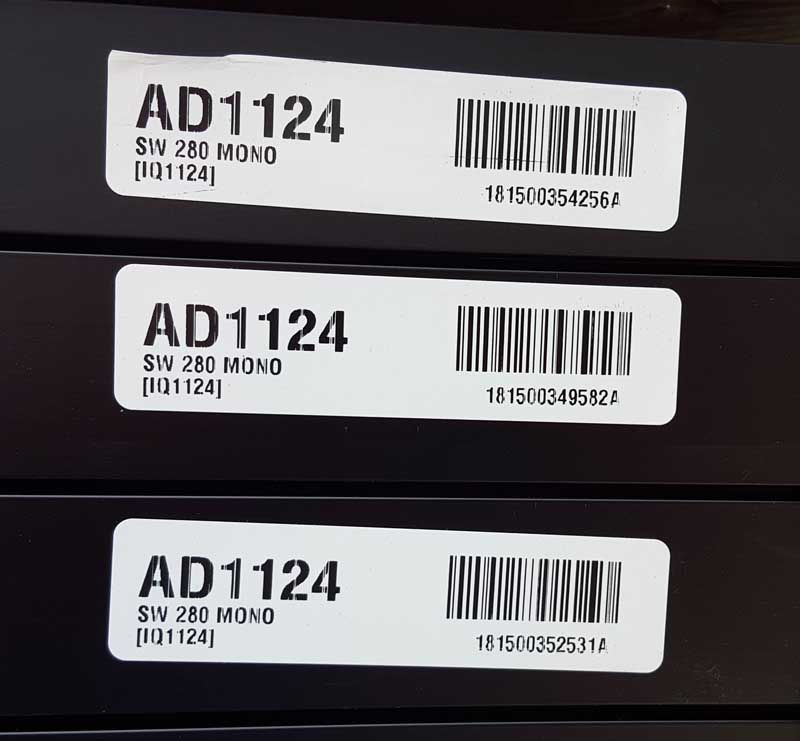
The panels are 280 watts each and are US made (Oregon). With a normal home improvement the county assessor raises the assessed tax value of your home so the following year there's a matching increase in the real estate taxes. California law prohibits that from occurring for a solar panel installation. I put $27,000 into my home and the panels ought to increase the value of the home about $20,000 but unlike say a brand-new kitchen the solar array is going to make electrical power every day "paying" it's keep. Typical mono-crystal solar arrays are rated to retain 80% of their output even after 20 years. My grid is expandable by adding more panels and microinverters. The Build I had a big tree that I had to have removed as it shaded the future home of the lower of the two arrays. 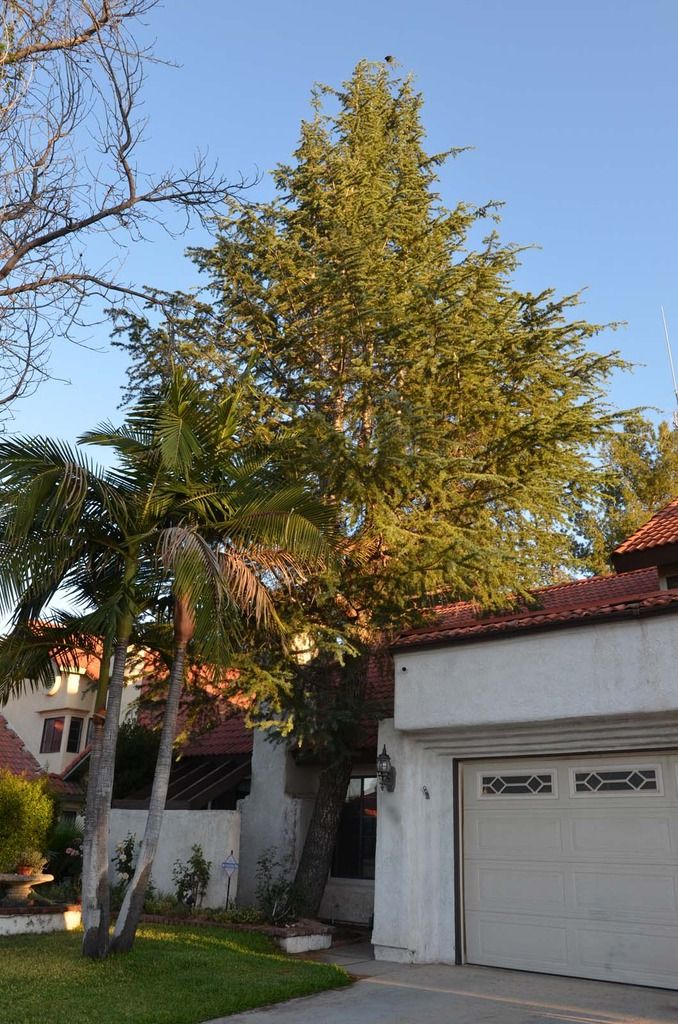
(above) Had to cut this tree out which wasn't easy because of it's location. 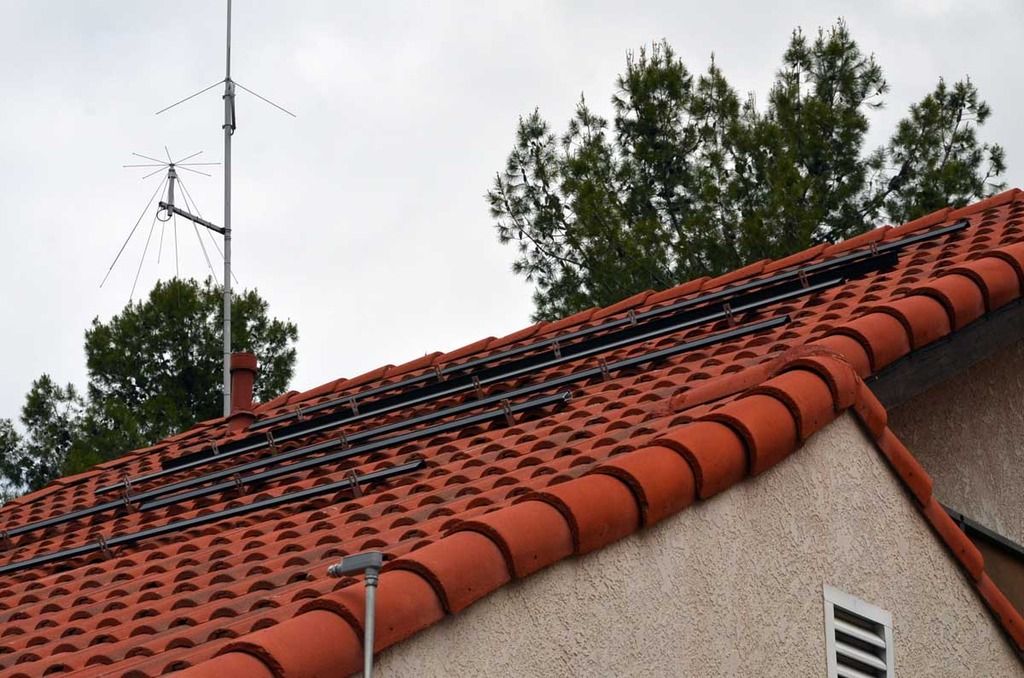
On the day of installation a team of three men arrived. Two were focused on mounting and the third on wiring. A pair of electrical panels were mounted to the wall next to my existing power panel and a conduit was run up the wall and to the two portions of the array. The concrete roof tiles were lifted, a series of mounting brackets were screwed into place, and rails were mounted to those brackets. Finally the 18 two hundred and eighty watt panels and 18 microinverters were mounted. The panels and microinverters came pre-wired and simply plugged into each other. 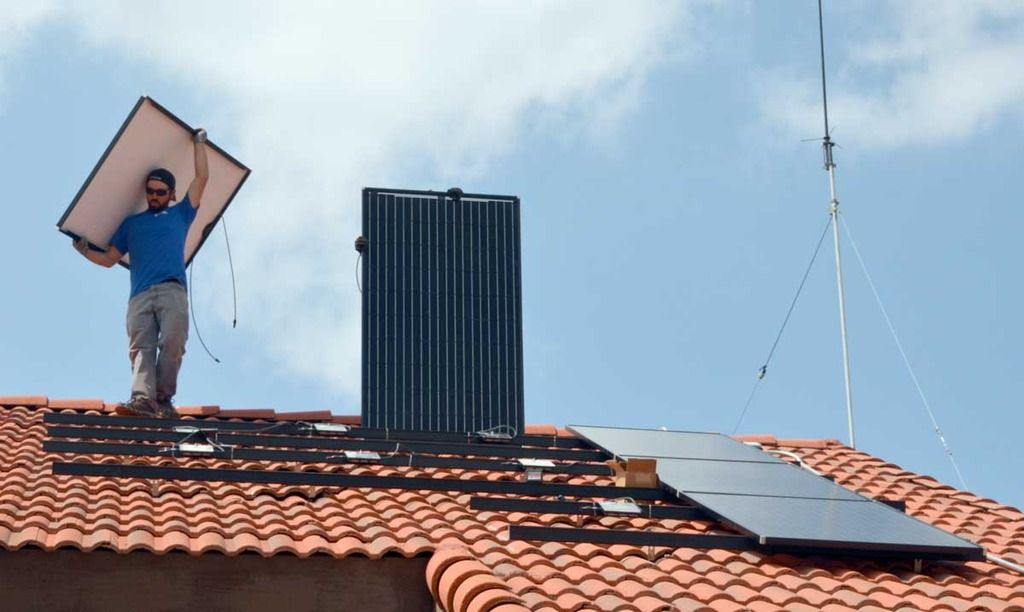
(above) The brand of microinverters I went with have a built-in monitoring system which will allow me to monitor the array's health and output from a computer or cell phone. 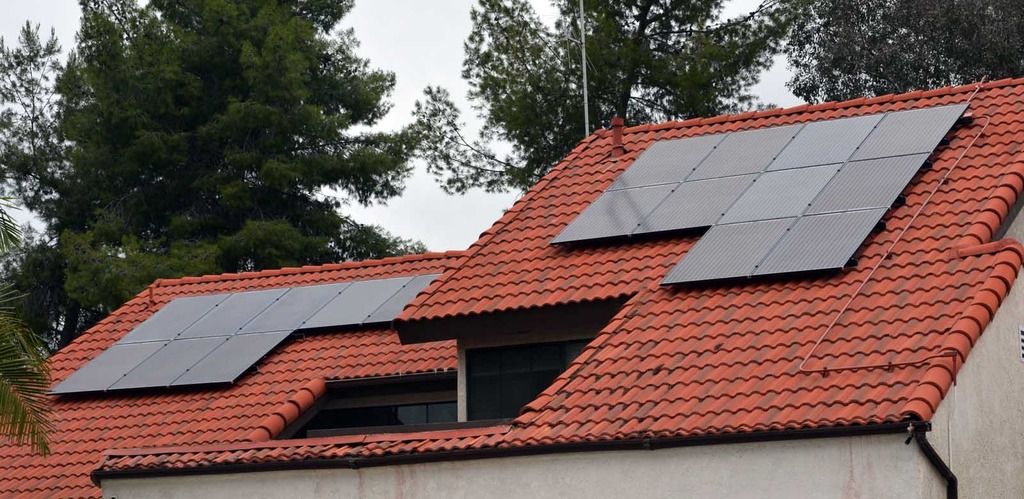
(above) The look on the house is very nice. The panels and mounting rails are a high-tech looking black. The company painted the power boxes and conduit to match the side of my house and the roof tiles. The panels put a great portion of my roof in the shade meaning the summer sun will not heat that part of the house up as much as before. 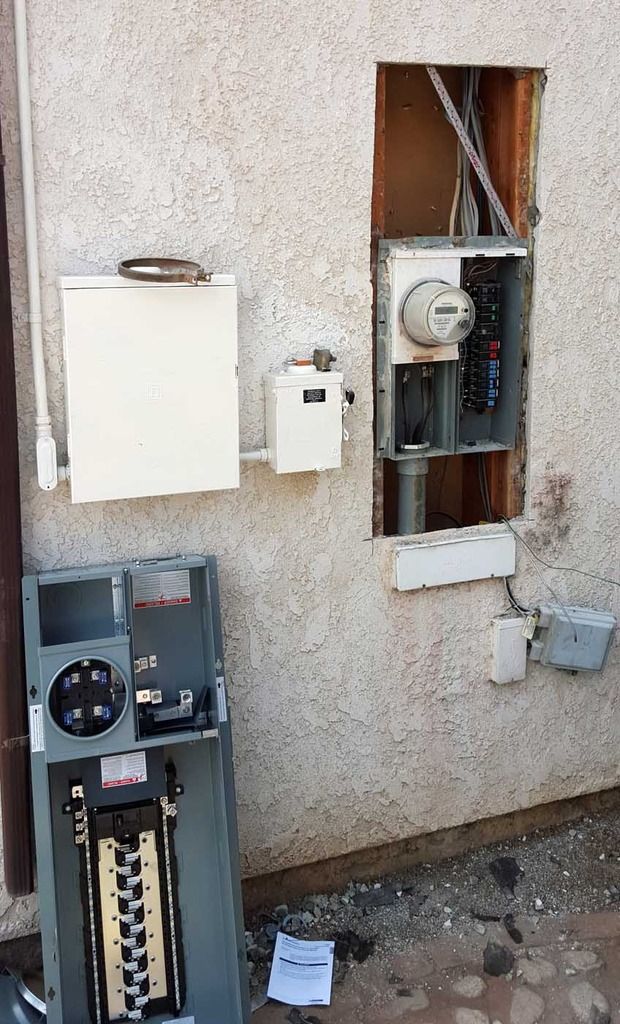
(above) The old fuse box still in place with the new one ready to be installed. I had to call Southern California Edison to have them unlock the electrical power meter and the solar power company to returned to finish the panel upgrade and run the wires through the conduits to fire the array up. The solar company submitted the engineering diagrams and permits to the local power company to get my Customer-Owner Generation System connected to their grid. The system has been running for a few weeks now and we’ve had one cloudy day and couple of days with an early morning fog. Overall I’m generating about 29 KW per day. The results 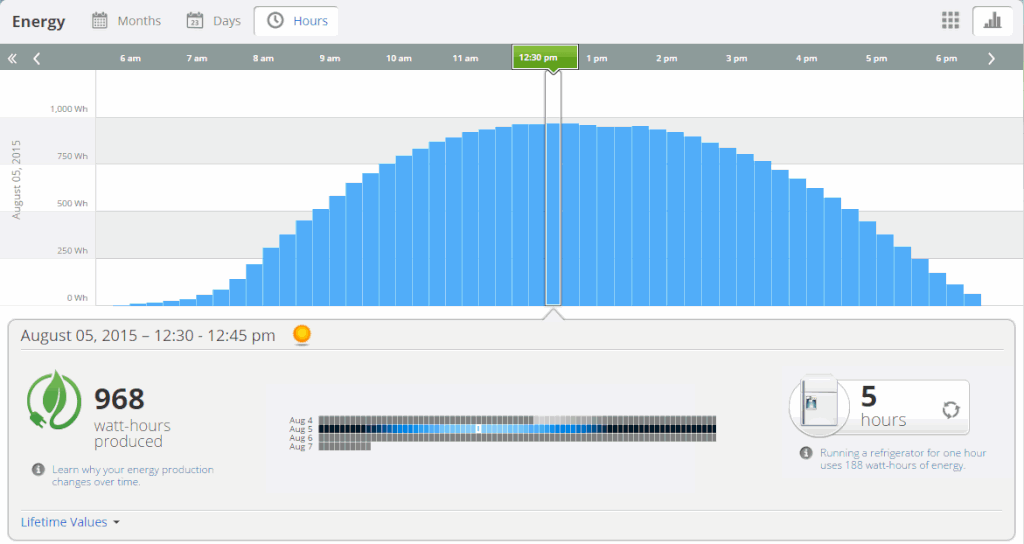
(above) A sunny day showing a nice smooth power production. 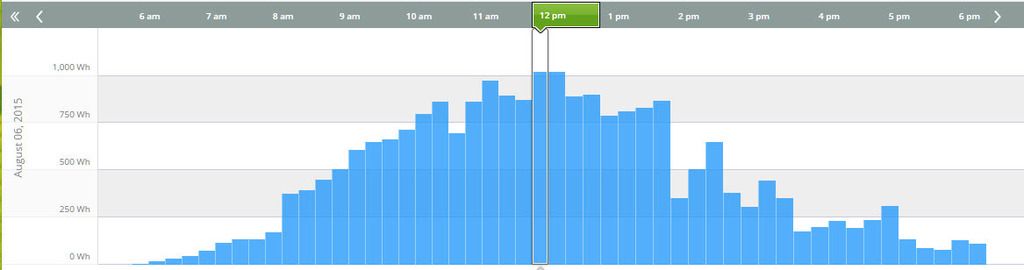
(above) A cloudy day with periods of heavy clouds blocking the sun. During the day the meter runs backwards – even on hot days where the AC is running hard. In the evenings following the sunset I draw power back out of the grid. So far the balance looks like its slightly in favor of the power company and I’m burning about a dollar’s worth of power where in past years I was burning more than seven dollars’ worth. Once the summer heat breaks and the AC takes a break I expect the balance to tip into my favor more. 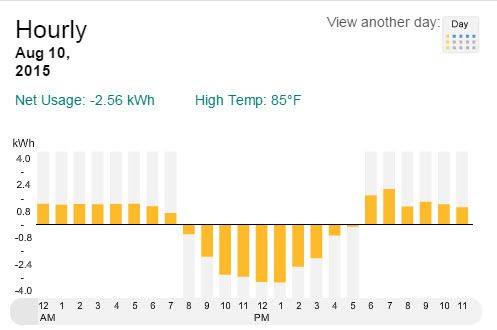
(above) The power is being drawn out of the grid when above the line and being put into the grid when below the line. 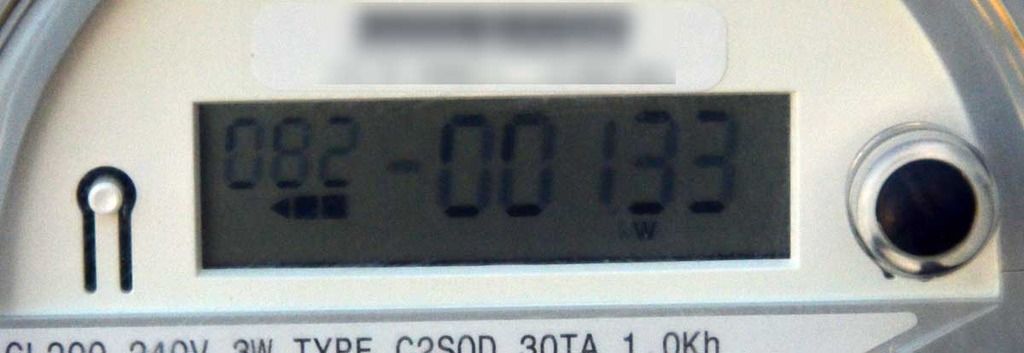
(above) The meter running backwards sending 1.33 KW into the grid even with the AC on. The micro-inverters connect to the Internet reporting their health and use to the manufacturer. In theory the installer will inform me if something goes wrong with one of the panels. I’ve been checking the system every day. The inverters feed their production information to a password protected web site that allows me to check production on a PC or my smart phone. 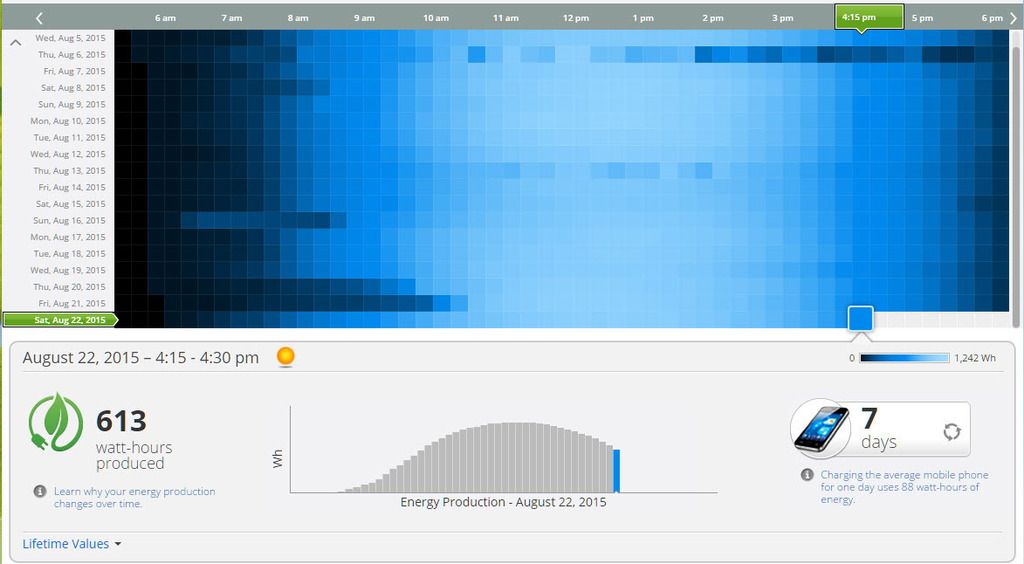
(above) The summary grid with harder blue being lower outputs and lighter blue being higher output hours. You can see the clouds from August 6th and 13th and the fog on the 16th, 20th, and 21st. 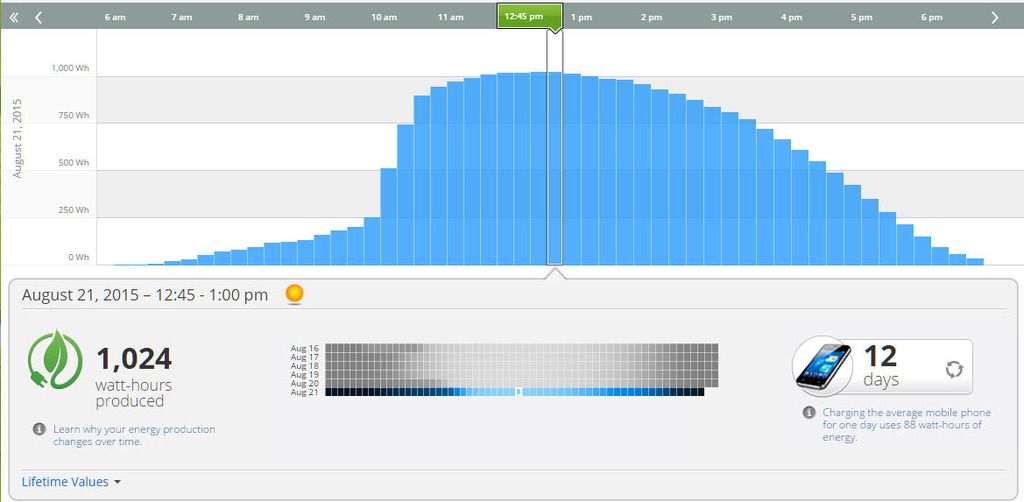
(above) One of the foggy days where the morning fog didn’t break until 10 AM. Each bar represents 15 minutes worth of production. The highlighted period is 12:45 PM where the array produced 1.024 KW. That's a bit more than 4 KW/hr so +80% efficiency. So far in 17.5 days I've generated 534 KW worth about $117. I haven't seen a power bill but the way they work is that power company will let my account slide adding and subtracting power until the end of the year where they zero everything out and I will have to cut them a check for the balance. Survival Use So here's the rub. In the event that the power grid goes out the micro-inverters sense that and stop making power. Otherwise the 5 KW array on my roof would attempt to provide power back into the grid to feed the closest few hundred homes. That's not possible and they would fail. I spent 24 years in the Navy and retired as a Master Chief Electricians Mate and understand power. Don't try this unless you know what the hell you're doing. You'll damage your equipment for certain and possibly hurt someone working on the grid if you do this wrong. In the event of a grid failure I would pull the breaker connecting my home to the grid. I would next fire up my 14 KW UPS and feed AC power into my building - the array's micro-inverters would see this and assume that the grid was back on and start making power again. The power produced would feed the USP charging system ... and minus the losses I'm making power. Additionally I have the two generators which could do the same thing while making a bunch of noise. |
|
Nice system and write up Paul
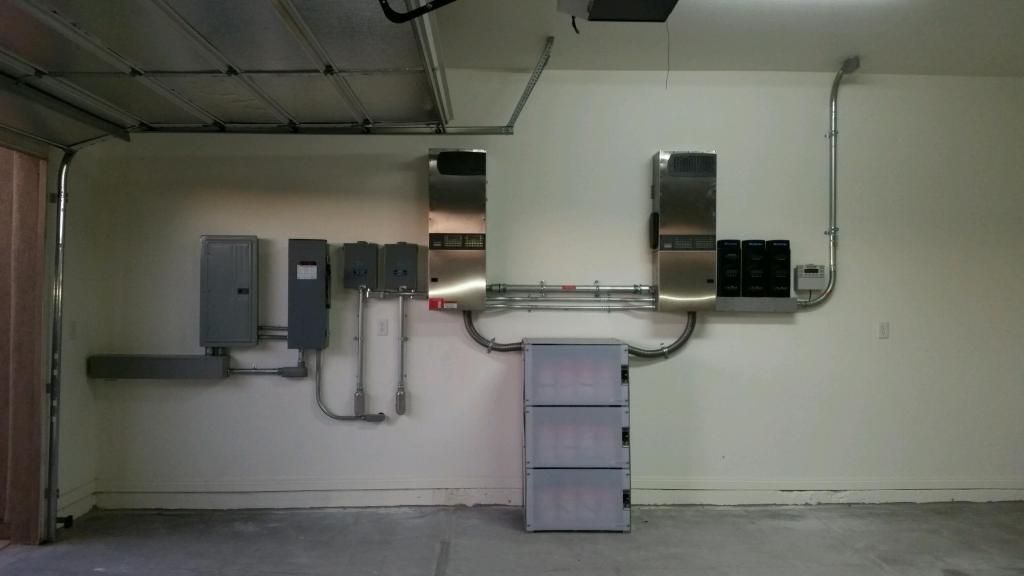
I put in a PV system this year at my home in central AZ. I went with an Outback system using two Radian GS8048 inverters, 3 FLEXmax 80 charge controllers, a Mate 3 system controller, 12 EnergyCell 220GH AGM batteries (~30kwh capacity) and 30 Solarworld 275W panels flat mounted on my roof (8.25KW). This system has produced between 1000 - 1300 kwh per month since March of this year, more than I use so I'm a net producer. Peak output in full noon sun is ~7kw. The inverters can put out 16kw continuous/ 32kw peak power, enough to run anything in the house including the central air. I can also hook my gen set into the inverters as a secondary source of power. The inverters can be set to limit the draw from the generator to match the output (or less if desired) for running the house loads or battery charging. This was not a cheap system because of the battery back up and the over sized inverters. I wanted backup power and the over sized inverters allows them to run at a max of 50% load most of the time thereby extending their service life and adding redundancy should an inverter fail. 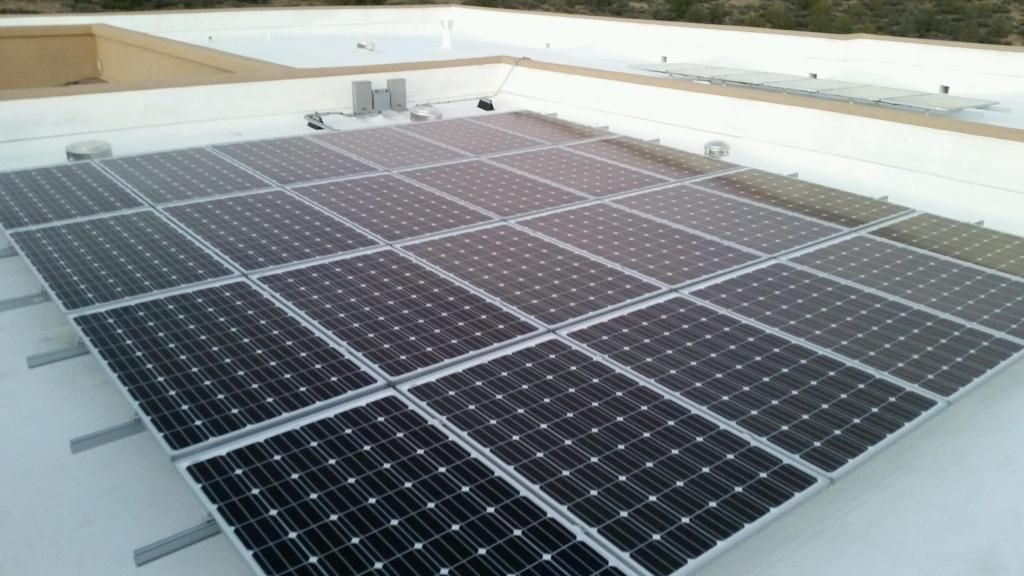
|
|
Quoted:
My wife wants to do this. How does the structure attach to the roof? There's a 6" or so square pad that screws to the roof. The installers lifted the tiles above, put down some tar, and then screwed each pad. There's a piece that sticks up to which the rails are then mounted to. The installers spend a bit of time leveling the rails and cutting the ends off. How the panels attached to the roof was part of the engineering plans spec'ing out how many mounts, how many screws, and how long and big the screws were. 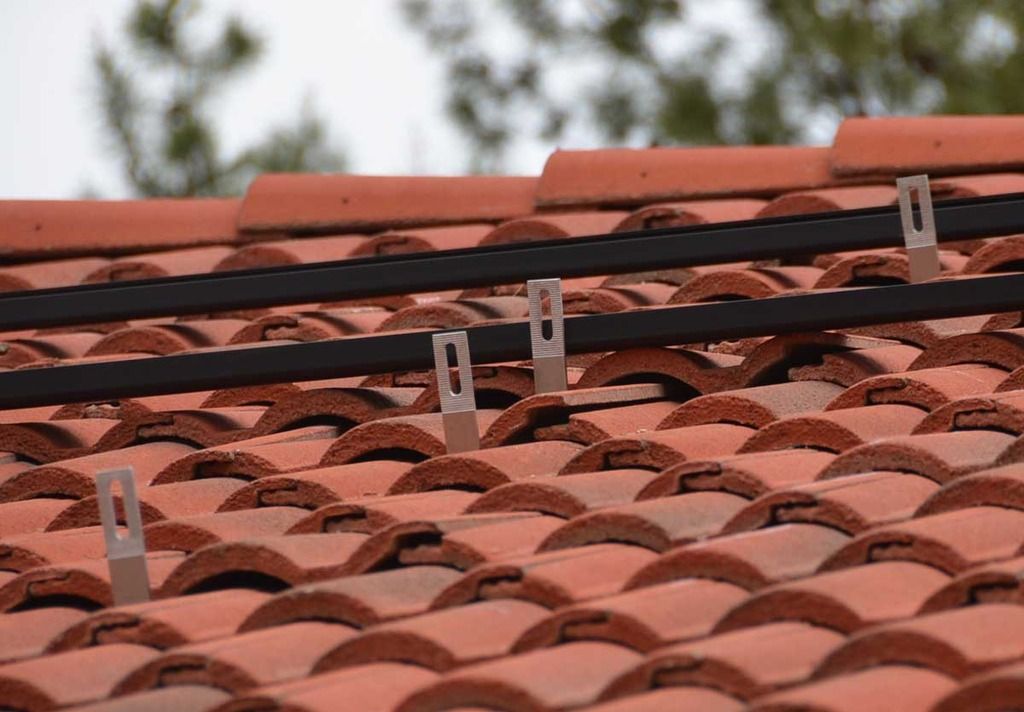
|
|
Paul I'd be very interested in the inverter/charger setup you have for the UPS. Solaredge DC optimizers and grid-tie inverter here, so possibly a similar approach as you if I added a UPS system. I'd like the ability to tie in a generator as well for additional capacity with the grid down. I'd appreciate any details you feel comfortable providing on your system.
My plan for the future has been a forklift battery and an inverter/charger, but I wasn't 100% on the "off label" approach to convincing the panels to turn on. Edit: I've looked at the Magnum Power solution, figured I'd be able to power all house loads except the A/C, possibly using a standalone unit or a couple window units to keep the first floor cool. Generator+solar would let me run one house AC unit if needed. |
|
Quoted: I used about 12% more power in 2015 than I did 12 years ago. [...] The panels are 280 watt so that means about 18 panels. [...] Finally the 18 two hundred and eighty watt panels and 18 microinverters were mounted. [...] |
|
Quoted:
Paul, from your calculations you estimated that you would need 18 panels to meet your current usage, and then you had them install 18. Did you think about having them install a couple extra while they were already there just so you could get ahead of future increases in your power usage? Would it be cheap enough to do it in the future even when the federal tax credit expires? I did did price a 20 and 22 panel systems. The bitch here is that the power company is in the business in selling power ... but not buying it meaning any extra panels installed would go to waste as the local company won't buy it from me. There are a couple bills before the CA legislature one pro, and one con for solar panel owners. The one pro bill is to have the power companies statewide be mandated to buy surplus power from residential providers. The one bad bill would have solar system owners pay $15 a month in a minimum charge for grid access - there's a 20 year grandfather provision in the bill currently but until it passes you can never be sure. I'll let the system fly for few more months before looking at adding more panels. The company said that additional panels would be about $1000 each installed and there's room for five more without too much effort. |
|
Quoted:
My wife wants to do this. How does the structure attach to the roof? The key is we put lags into trusses/rafters and make sure that the flashing is properly lined up. If done well, it actually strengthens the roof and is probably more waterproof than any other roof penetration you have. There's a video on this company's website that shows some of what goes on with tile roofs and solar. Tile roofing is definitely more of a PITA for us to install on than a composite shingle roof. A lot of us spec Quickmount flashing for our installs. Permitting departments are very concerned about roof integrity after the install and require a lot of details in the permit submittals about what products will be used. As I like to tell my students, it's not rocket science. Paul... Inverters are pretty frequency sensitive. A requirement of UL 1741. They probably won't come on if you trying to fool them with the generators. Every time a load switches on/off, you'd see an output shift on the generator... so would the microinverters. The UPS may work. It depends how clean the inverter phase is... I've seen some pretty crappy 60Hz out of UPS systems. You'd probably be better off AC coupling with an off-grid inverter sometime down the road. |
|
Quoted:
Paul... Inverters are pretty frequency sensitive. A requirement of UL 1741. They probably won't come on if you trying to fool them with the generators. Every time a load switches on/off, you'd see an output shift on the generator... so would the microinverters. The UPS may work. It depends how clean the inverter phase is... I've seen some pretty crappy 60Hz out of UPS systems. You'd probably be better off AC coupling with an off-grid inverter sometime down the road. Thanks. We haven't gotten to the point where I start hacking the system. 
|
|
Quoted:
Thanks. We haven't gotten to the point where I start hacking the system.
Quoted:
Quoted:
Paul... Inverters are pretty frequency sensitive. A requirement of UL 1741. They probably won't come on if you trying to fool them with the generators. Every time a load switches on/off, you'd see an output shift on the generator... so would the microinverters. The UPS may work. It depends how clean the inverter phase is... I've seen some pretty crappy 60Hz out of UPS systems. You'd probably be better off AC coupling with an off-grid inverter sometime down the road. Thanks. We haven't gotten to the point where I start hacking the system.
Not that I've ever tried to fool a grid-tied inverter [cough cough], but some of the inverter based generators put out pretty clean AC, even during a significant load change. The issue comes when the loads are a lot less than the power being generated. The solar system will try to backfeed the generator. That could get expensive depending upon how the generator output changes when loads drop off-line. If the generator voltage climbs, it may be enough to trigger a shutdown of the inverter(s). But I'm not sure I'd want to risk the health of my generator on that. In any case, if I were inclined to experiment I'd make sure that the generator was at least as large as the inverter(s) nameplate output. And I'd make sure my minimum load was at least 80% of the same. Not that I would ever advocate trying to fool a grid-tied inverter. But I won't tell if you don't.... |
|
Quoted:
Not that I've ever tried to fool a grid-tied inverter [cough cough], but some of the inverter based generators put out pretty clean AC, even during a significant load change. The issue comes when the loads are a lot less than the power being generated. The solar system will try to backfeed the generator. That could get expensive depending upon how the generator output changes when loads drop off-line. If the generator voltage climbs, it may be enough to trigger a shutdown of the inverter(s). But I'm not sure I'd want to risk the health of my generator on that. In any case, if I were inclined to experiment I'd make sure that the generator was at least as large as the inverter(s) nameplate output. And I'd make sure my minimum load was at least 80% of the same. Not that I would ever advocate trying to fool a grid-tied inverter. But I won't tell if you don't.... Quoted:
Quoted:
Quoted:
Paul... Inverters are pretty frequency sensitive. A requirement of UL 1741. They probably won't come on if you trying to fool them with the generators. Every time a load switches on/off, you'd see an output shift on the generator... so would the microinverters. The UPS may work. It depends how clean the inverter phase is... I've seen some pretty crappy 60Hz out of UPS systems. You'd probably be better off AC coupling with an off-grid inverter sometime down the road. Thanks. We haven't gotten to the point where I start hacking the system.
Not that I've ever tried to fool a grid-tied inverter [cough cough], but some of the inverter based generators put out pretty clean AC, even during a significant load change. The issue comes when the loads are a lot less than the power being generated. The solar system will try to backfeed the generator. That could get expensive depending upon how the generator output changes when loads drop off-line. If the generator voltage climbs, it may be enough to trigger a shutdown of the inverter(s). But I'm not sure I'd want to risk the health of my generator on that. In any case, if I were inclined to experiment I'd make sure that the generator was at least as large as the inverter(s) nameplate output. And I'd make sure my minimum load was at least 80% of the same. Not that I would ever advocate trying to fool a grid-tied inverter. But I won't tell if you don't.... Question for you. My Outback inverters work in both grid tied and backup mode. I assume they do this by load matching demand in backup mode but put out 100% when pushing to the grid? Second question, strictly grid tied inverters do not need batteries to operate. As I understand it the dual grid/backup inverts must have a substantial battery bank hooked up to smooth out the DC load ripple. Can you explain how the two inverters differ electronically? I wish I had a nice block diagram to compare these two inverter types. |
|
Quoted:
Question for you. My Outback inverters work in both grid tied and backup mode. I assume they do this by load matching demand in backup mode but put out 100% when pushing to the grid? Quoted:
Question for you. My Outback inverters work in both grid tied and backup mode. I assume they do this by load matching demand in backup mode but put out 100% when pushing to the grid? Depends on which Outback you have and how you have the thing configured. But typically, yes. If the batteries are full and the critical load panel isn't using any power, all array power will push to the grid side of the inverter/charger. But energy from the array goes first to the battery, second to critical load, third to non-critical load and finally to the grid in the default configuration. But you can also set it up the system for peak load shaving and any other number of things where it will use the array and what's in the batteries to push power to the grid for something like a peak feed-in. It gets pretty damn complicated. Second question, strictly grid tied inverters do not need batteries to operate. As I understand it the dual grid/backup inverts must have a substantial battery bank hooked up to smooth out the DC load ripple. Can you explain how the two inverters differ electronically? By DC Load Ripple I'm assuming you mean the ripple back-fed into the DC side from the H-bridge (or equivalent) of the inverter making AC? Ripple is an issue on grid-tied inverters too. But a minor one. Ripple is mostly controlled through capacitors... Though a big battery could be treated as a capacitor. Most off-grid capable inverters are transformer based. So it's difficult to isolate the ripple. New grid-tied only inverters are more likely to be transformerless. Frankly, I don't know if that's cured the ripple or made it worse. I've not put an o-scope on the DC side of one of those. The battery bank size is more a function of load profile and autonomy requirements. Yes, there are minimum battery bank sizes, but that typically has more to do with the charging side than inverting side. I think the minimum battery size on an Outback is about 100Ah (don't quote me). That's not a lot of energy stored. In a 48V system, that gives you less than 2.5kWh of useful energy since we try not to cycle lead acid batteries below 50% Depth of Discharge. The last couple of off-grid systems I had to design had banks in the 2500 - 3000Ah range. But we're seeing more and move battery-backed grid-tied systems using AC coupling. In those systems, a grid-tied inverter is connected to a critical load panel. A second inverter that's grid-interactive, but battery powered is also connected to the critical load panel. It fools the grid-tied inverter into thinking it's tied to the grid. The advantage is that most of the power to the critical load panel is free of the losses associated with batteries, charge controllers and lower voltage PV strings. The downside is that it's more expensive to implement than a system like yours. Block diagram: 
I wish I had a nice block diagram to compare these two inverter types. Well, here's a block diagram for an ABB grid-tied transformerless inverter: 
Note the lack of transformer. I couldn't quickly find an equivalent block diagram for an off-grid inverter. Until a few years ago, most inverters in the States were transformer based. The only real difference between grid-tied and off-grid was the range of DC input voltages the inverter worked with. You could, in theory, wire up a battery bank to something like 250 - 300Vdc and run most grid-tied inverters. You just wouldn't have the "charge from the grid" function like you see in your Outback system. And the Code has all kinds of (somewhat painful) rules about battery banks of 50Vdc or over, which is why we tend to stick to 48V battery banks in the States. As the price of PV modules has dropped the last few years (wholesale has dropped more than 75% since 2009), off-grid systems have gone from being battery heavy to being module heavy. That usually works well because the load profile at night is typically a lot lower than during the day... but not always. So PV arrays are sized to power everything and charge the batteries during the day. Still battery-based solar is a very small part of the business. I do dozens of grid-tied system designs for every one off-grid system design. I haven't had an off-grid project yet this month - though I'm told one is coming later this week. |
|
Thanks dog for the explanation.
When I first decided to instal solar I considered the micro inverter panels but quickly decided against them once the problem of backup power was realized. Then came the choice of type and size of the battery stack needed to allow the inverters to push full output to the grid. I quickly found a lot of opinions were you need a lot of battery capacity to equalize the ripple current link1 link2associated with pushing grid power. After discussion with the Outback rep I went with the Outback AGM batteries. They are working nicely and even in the July heat with full sun on the panels the batteries stayed at room temp (~80F). Hopefully I can get 10 years out of them. |
|
Quoted:
Thanks dog for the explanation. When I first decided to instal solar I considered the micro inverter panels but quickly decided against them once the problem of backup power was realized. Then came the choice of type and size of the battery stack needed to allow the inverters to push full output to the grid. I quickly found a lot of opinions were you need a lot of battery capacity to equalize the ripple current link1 link2associated with pushing grid power. After discussion with the Outback rep I went with the Outback AGM batteries. They are working nicely and even in the July heat with full sun on the panels the batteries stayed at room temp (~80F). Hopefully I can get 10 years out of them. There is some good information and some not so good information in those links. Looks to me like only one person was talking about AC ripple. And I remember that guy. I stopped following that forum some years ago because of several arm-chair solar pros and a really bad shipping experience by the company who hosts it. The information on the Outback forum will always be of higher quality. Now the idea that a battery bank would be discharged quickly, recharged, then discharged again in a repeating cycle because the bank is "too small" is not the definition of ripple.... It's poor design. That a big battery bank is more immune to ripple than a small one only occurs when the battery bank is woefully undersized for the charging capacity. Your bank is not more susceptible to ripple than a battery bank twice its size. It's like a guy trying to fill a pool from a bucket. House size or Olympic size it doesn't really matter. No effect. One of those plastic kiddie pools is another story. But the assumption that a 4kW inverter will always operate at full power means there was another design issue. Someone undersized their system. Someone panned the idea of load analysis earlier. And that's simply a bad idea. Guessing on an off-grid system is a wonderful to either spend way too much money or sit around in the dark a lot. It's gotten to the point that I won't take work for an off-grid system without at least a list of loads. And in most cases where I turned them down and they've designed it themselves, they've come back for help (either to me or a colleague). When it comes to strings of batteries, I do try to minimize the number of parallel strings. Proper charging becomes problematic since more parallel strings makes it tough to balance all the impedances., It leads to early failure in one of the strings... which only drags down the rest of them. In an engineered solution like you have, I'm less concerned about three strings. But in a battery bank assembled on-site using OTS components, I never design with more than two strings. And I really prefer one long string of 2V cells over multiple strings of higher voltage cells. I absolutely refuse to design a system with 4 or more parallel strings. Good job on controlling the bank temperature. Between that and high average state of charge, 10 years could be very feasible. I'm on 5 years for my solar charged RV batteries, and they don't get nearly the love you're giving yours. But every once in a while, give your batteries a workout. Batteries that don't occasionally go through a 25% discharge get fat, dumb and lazy. Cheers, B |
|
We met with the solar guy yesterday evening. A few take aways.
When we designed the house, we thought that we designed a large enough space on the roof to fit the solar panels. We were wrong. Each panel is roughly 18 square feet. We can only fit about 20 panels facing south, and the rest will need to go west. We need 35 panels. I figured we would be seeing the lowest bill in the winter... we were wrong, our lowest bill will be from mid march to October. With us going electric heat vs. Natural gas, combined with the amount, or lack thereof, in the winter... we won't be able to produce what we use. Because of the price, we are signing away our renewable energy credits to the solar company. Currently, ERCOT doesn't allow them to be sold outside of the state so this right now doesn't matter. And frankly, I had no idea what a REC was until last night. So I don't think this bothers me as much. We will be getting 20% installation because it is a new home build, and they will be able to come in a pre wire making it much less difficult on their part. The idea of being able to produce energy when the grid is down is out the window. When the grid is down, so are we. Obvious safety reasons. There are some advantages I never thought about with the Panels, for example: What ever part the of the house is one will be about 5 degree's cooler than the rest of the house during mid day due to the panels providing shade to the roof. That will come in hand in Texas, but right now the panels will be over the garage, Which won't be cooled with AC. It would be nice if it were right over the living room. Price is a little cheaper than we anticipated. We were quoted $25,000, but it is looking like it will be closer to $22,000. Combine that with a 30% tax credit and a $1,000 incentive check from the power company, Net cost will be about $14,500. So our initial ROI would take about 10 years give or take. Right now, my wife is 50/50 and I am about 75/25 for it. instead of looking at is as free energy (nothings free), look at is as looking in your rate at about .05 cents vs .11 cents that it is currently and rising every year. |
|
I'm running into a similar issue on for the solar panels & micro-inverters (MI). When I was sold the system, the sales person was made aware of an existing backup generator that was previously installed. I was told that the system designer would take that into account and that the solar panels would generate power as long as the sun was out.
When they came out to do the wiring, the electrician brought to my attention that the MI's need to have power from the Utility to produce power (controls and self islanding so that it doesn't back feed the utility for safety reasons). If the generator is running, the MI's would sense that and backfeed the generator and cause damage to the generator. They also touted the Tesla Powerwall which is not in production yet. From what I can see it looks like they need to be wired directly to the panels before the MI's. Does anyone know of a way to create a hybrid system without running two systems in parallel (Generator and Solar)? |
|
Quoted:We need 35 panels. 
OMG ... well pump, swimming pool pump, and five teenagers? 
I have 2300 sq.ft. 1985 home that has only fair insulation and 18 panels is perfect. My bill from yesterday where it hit just 85 degrees ... 400 watts worth of power I had to buy which is less than a nickle's worth. In the last 30 days I've generated about 920 KW or bit more than 30 KW per day. |
|
Quoted:Does anyone know of a way to create a hybrid system without running two systems in parallel (Generator and Solar)? My little 14KW UPS will do that. 1. Pull the main breaker from the panel and "red tag" lock it out. 2. Connect the UPS 5KW inverter into the AC of the building. 3. The solar panels will sense the inverter and fire up. 4. The solar panels 4KW will feed the AC to DC power supplies back feeding the UPS. -- I haven't tried this yet. An earlier post stated that the micro-inverters were frequency sensitive. I have an oscilloscope and a frequency counter so I can run test. I have a big bulky 5 KW inverter and a tiny 400 watt pure sine wave to play with. If in the last 15 years we had lost power for more than the two times for less than two hours combined time I'd be more aggressive with the testing. My city has there own series of generators separate of the CA grid. They can connect into the grid and buy power or generate their own price depending. |
|
Nice solar system you got there.
Regarding your plan for grid down. You may want to do a little more research. A while back I looked into it and found that simply firing up a quality 60hz pure sine wave generator to trick the micro inverters to turn on isn't the whole piece of the puzzle... something about the micro inverters feeding all that AC back to the generator with nowhere to go can cause problems. The solution was something they were calling "AC Coupling" but it was in its infancy (this was several years ago so maybe there are solutions available now). Cheers. |
|
Quoted:Regarding your plan for grid down. You may want to do a little more research. A while back I looked into it and found that simply firing up a quality 60hz pure sine wave generator to trick the micro inverters to turn on isn't the whole piece of the puzzle... something about the micro inverters feeding all that AC back to the generator with nowhere to go can cause problems. The solution was something they were calling "AC Coupling" but it was in its infancy (this was several years ago so maybe there are solutions available now). Rancher |
Screw you guys. 
Quoted:
I used 865 last December but 1300 in August. 
I draw 1 KW every hour just cruising on a freezer, refridgerator, and my UPS system charging. Quoted:
Quoted:
Interesting. I used 650kwh in December, you use a bunch o power. I used 865 last December but 1300 in August.
I draw 1 KW every hour just cruising on a freezer, refridgerator, and my UPS system charging. 
I would love to get into solar to help offset our electrical costs, but we don't have enough southern facing surface and I think we would need too many panels / too big of an installation to make it worthwhile. I would really like to do it at our planned retirement cabin, but our land is on the north side of our little mountain.
|
|
Quoted:
I would love to get into solar to help offset our electrical costs, but we don't have enough southern facing surface and I think we would need too many panels / too big of an installation to make it worthwhile. As I've posted (maybe in another thread), trying to offset full consumption with solar is not really a good idea unless you have excellent net metering (most people don't). And biasing an array so that it faces westerly is commonly done to shift the peak solar production to more closely match the peak consumption - something that's especially important when an array is sized to offset the most consumption. I've done lots of layouts and designs using west facing roof planes. As long as the roof pitch isn't ridiculously steep, it works. And with a lot of the new inverters, power optimizers or micro-inverters, it's nothing to have modules facing different directions. So use south and west facing roof planes. In fact, I can't remember the last time I did a residential project that didn't us at least two directions. |
|
Quoted:
As I've posted (maybe in another thread), trying to offset full consumption with solar is not really a good idea unless you have excellent net metering (most people don't). And biasing an array so that it faces westerly is commonly done to shift the peak solar production to more closely match the peak consumption - something that's especially important when an array is sized to offset the most consumption. I've done lots of layouts and designs using west facing roof planes. As long as the roof pitch isn't ridiculously steep, it works. And with a lot of the new inverters, power optimizers or micro-inverters, it's nothing to have modules facing different directions. So use south and west facing roof planes. In fact, I can't remember the last time I did a residential project that didn't us at least two directions. Quoted:
Quoted:
I would love to get into solar to help offset our electrical costs, but we don't have enough southern facing surface and I think we would need too many panels / too big of an installation to make it worthwhile. As I've posted (maybe in another thread), trying to offset full consumption with solar is not really a good idea unless you have excellent net metering (most people don't). And biasing an array so that it faces westerly is commonly done to shift the peak solar production to more closely match the peak consumption - something that's especially important when an array is sized to offset the most consumption. I've done lots of layouts and designs using west facing roof planes. As long as the roof pitch isn't ridiculously steep, it works. And with a lot of the new inverters, power optimizers or micro-inverters, it's nothing to have modules facing different directions. So use south and west facing roof planes. In fact, I can't remember the last time I did a residential project that didn't us at least two directions. I guess I should have said "offset some of our electrical costs", but I appreciate the info. We really don't want to be in this house any longer than we have to (about 12 years), and I'm guessing we could only recoup a portion of our investment in that time. I suppose I should take a look at our HOA rules first and see if it is expressly forbidden. |
|
Quoted:
I guess I should have said "offset some of our electrical costs", but I appreciate the info. We really don't want to be in this house any longer than we have to (about 12 years), and I'm guessing we could only recoup a portion of our investment in that time. I suppose I should take a look at our HOA rules first and see if it is expressly forbidden. Quoted:
Quoted:
Quoted:
I would love to get into solar to help offset our electrical costs, but we don't have enough southern facing surface and I think we would need too many panels / too big of an installation to make it worthwhile. As I've posted (maybe in another thread), trying to offset full consumption with solar is not really a good idea unless you have excellent net metering (most people don't). And biasing an array so that it faces westerly is commonly done to shift the peak solar production to more closely match the peak consumption - something that's especially important when an array is sized to offset the most consumption. I've done lots of layouts and designs using west facing roof planes. As long as the roof pitch isn't ridiculously steep, it works. And with a lot of the new inverters, power optimizers or micro-inverters, it's nothing to have modules facing different directions. So use south and west facing roof planes. In fact, I can't remember the last time I did a residential project that didn't us at least two directions. I guess I should have said "offset some of our electrical costs", but I appreciate the info. We really don't want to be in this house any longer than we have to (about 12 years), and I'm guessing we could only recoup a portion of our investment in that time. I suppose I should take a look at our HOA rules first and see if it is expressly forbidden. No worries. Solar isn't for everyone. Even though I'm in the business, I try to be honest about all the pros and cons. More than once, I've talked someone out of it. Yeah, I know, weird... But if someone installs it then isn't satisfied, it's bad for business. Solar does add to resale value, just like anything else that lowers the utility bills... But installing solar just before you move out would be a lot like installing a pool just before you moved out. Probably not a good investment. Of course, we've been "getting ready to move" for about 5 years now. NM is pretty pro-solar. I suspect that there's a law that limits the ability of the HOA to prohibit solar in an established neighborhood. Doesn't me they won't be a total PITA to deal with - but they will lose. If you've not done everything you can for energy efficiency, go that route first. Much quicker payback. Cheers, B |
|
Quoted:
No worries. Solar isn't for everyone. Even though I'm in the business, I try to be honest about all the pros and cons. More than once, I've talked someone out of it. Yeah, I know, weird... But if someone installs it then isn't satisfied, it's bad for business. Solar does add to resale value, just like anything else that lowers the utility bills... But installing solar just before you move out would be a lot like installing a pool just before you moved out. Probably not a good investment. Of course, we've been "getting ready to move" for about 5 years now. NM is pretty pro-solar. I suspect that there's a law that limits the ability of the HOA to prohibit solar in an established neighborhood. Doesn't me they won't be a total PITA to deal with - but they will lose. If you've not done everything you can for energy efficiency, go that route first. Much quicker payback. Cheers, B Quoted:
Quoted:
Quoted:
Quoted:
I would love to get into solar to help offset our electrical costs, but we don't have enough southern facing surface and I think we would need too many panels / too big of an installation to make it worthwhile. As I've posted (maybe in another thread), trying to offset full consumption with solar is not really a good idea unless you have excellent net metering (most people don't). And biasing an array so that it faces westerly is commonly done to shift the peak solar production to more closely match the peak consumption - something that's especially important when an array is sized to offset the most consumption. I've done lots of layouts and designs using west facing roof planes. As long as the roof pitch isn't ridiculously steep, it works. And with a lot of the new inverters, power optimizers or micro-inverters, it's nothing to have modules facing different directions. So use south and west facing roof planes. In fact, I can't remember the last time I did a residential project that didn't us at least two directions. I guess I should have said "offset some of our electrical costs", but I appreciate the info. We really don't want to be in this house any longer than we have to (about 12 years), and I'm guessing we could only recoup a portion of our investment in that time. I suppose I should take a look at our HOA rules first and see if it is expressly forbidden. No worries. Solar isn't for everyone. Even though I'm in the business, I try to be honest about all the pros and cons. More than once, I've talked someone out of it. Yeah, I know, weird... But if someone installs it then isn't satisfied, it's bad for business. Solar does add to resale value, just like anything else that lowers the utility bills... But installing solar just before you move out would be a lot like installing a pool just before you moved out. Probably not a good investment. Of course, we've been "getting ready to move" for about 5 years now. NM is pretty pro-solar. I suspect that there's a law that limits the ability of the HOA to prohibit solar in an established neighborhood. Doesn't me they won't be a total PITA to deal with - but they will lose. If you've not done everything you can for energy efficiency, go that route first. Much quicker payback. Cheers, B Dog what part of Texas are working in? |
|
Quoted:
Dog what part of Texas are working in? I live in Dallas County. Most of my clients are on the west coast or in central Texas. When I get bored or need some time in the field to maintain my certification, I pay them a visit. Otherwise, I crank out drawings from the house. |
|
Quoted:
NM is pretty pro-solar. I suspect that there's a law that limits the ability of the HOA to prohibit solar in an established neighborhood. Doesn't me they won't be a total PITA to deal with - but they will lose. Rancher |
|
Quoted:
AZ has laws that void HOA restrictions on either solar electric, or hot water. Rancher Quoted:
Quoted:
NM is pretty pro-solar. I suspect that there's a law that limits the ability of the HOA to prohibit solar in an established neighborhood. Doesn't me they won't be a total PITA to deal with - but they will lose. Rancher Unfortunately, AHJ's can still inflict conditions on installations, like no arrays facing the street. So if you've got a huge roof plane facing the street and south, your municipality is giving you the shaft. That's a problem in Allen, TX. |
|
Quoted:
No worries. Solar isn't for everyone. Even though I'm in the business, I try to be honest about all the pros and cons. More than once, I've talked someone out of it. Yeah, I know, weird... But if someone installs it then isn't satisfied, it's bad for business. Solar does add to resale value, just like anything else that lowers the utility bills... But installing solar just before you move out would be a lot like installing a pool just before you moved out. Probably not a good investment. Of course, we've been "getting ready to move" for about 5 years now. NM is pretty pro-solar. I suspect that there's a law that limits the ability of the HOA to prohibit solar in an established neighborhood. Doesn't me they won't be a total PITA to deal with - but they will lose. If you've not done everything you can for energy efficiency, go that route first. Much quicker payback. Cheers, B I just noticed my state has disappeared, but I'm in GA - not NM - and I don't think we're particularly pro-solar. I don't know that I've seen it anywhere within a 10-20 mile radius of my house. |
|
Quoted:
I just noticed my state has disappeared, but I'm in GA - not NM - and I don't think we're particularly pro-solar. I don't know that I've seen it anywhere within a 10-20 mile radius of my house. Not sure why I thought you were in NM... Yeah, GA is only about #40 in solar in the USA (per NREL). No clue why - I've not researched it. You might find out more here if you're curious. Link is to SEIA - Solar Energy Industries Association. Pretty legit data. Checking PV Watts, irradiation (sunlight energy) in the Atlanta area is about 20% less than here in Dallas. That's significant. Not a deal killer, just something to be aware of. |
|
Quoted:
Not sure why I thought you were in NM... Yeah, GA is only about #40 in solar in the USA (per NREL). No clue why - I've not researched it. You might find out more here if you're curious. Link is to SEIA - Solar Energy Industries Association. Pretty legit data. Checking PV Watts, irradiation (sunlight energy) in the Atlanta area is about 20% less than here in Dallas. That's significant. Not a deal killer, just something to be aware of. Quoted:
Quoted:
I just noticed my state has disappeared, but I'm in GA - not NM - and I don't think we're particularly pro-solar. I don't know that I've seen it anywhere within a 10-20 mile radius of my house. Not sure why I thought you were in NM... Yeah, GA is only about #40 in solar in the USA (per NREL). No clue why - I've not researched it. You might find out more here if you're curious. Link is to SEIA - Solar Energy Industries Association. Pretty legit data. Checking PV Watts, irradiation (sunlight energy) in the Atlanta area is about 20% less than here in Dallas. That's significant. Not a deal killer, just something to be aware of. Interesting link. Some tidbits from it:

|
|
Quoted:
Interesting link. Some tidbits from it: https://scontent-atl3-1.xx.fbcdn.net/hphotos-xpt1/v/t1.0-9/1962679_10152302580041810_624808945_n.png?oh=ae4027a84d4a0b2d21cca1414665f230&oe=566DDAE5 Quoted:
Quoted:
Quoted:
I just noticed my state has disappeared, but I'm in GA - not NM - and I don't think we're particularly pro-solar. I don't know that I've seen it anywhere within a 10-20 mile radius of my house. Not sure why I thought you were in NM... Yeah, GA is only about #40 in solar in the USA (per NREL). No clue why - I've not researched it. You might find out more here if you're curious. Link is to SEIA - Solar Energy Industries Association. Pretty legit data. Checking PV Watts, irradiation (sunlight energy) in the Atlanta area is about 20% less than here in Dallas. That's significant. Not a deal killer, just something to be aware of. Interesting link. Some tidbits from it:
https://scontent-atl3-1.xx.fbcdn.net/hphotos-xpt1/v/t1.0-9/1962679_10152302580041810_624808945_n.png?oh=ae4027a84d4a0b2d21cca1414665f230&oe=566DDAE5 Anyone can make a shit sandwich sound good with enough graphics and such. ;-) But I'd trust NREL numbers over SEIA number most days. |
|
Quoted:
Got my first power bill with solar ... in the middle of a Southern California summer with the AC set at 76/78 ... $3.93. Some people pay a hundred times that much. Or more. When our upstairs AC was not working right in '11, we had one bill that passed $700. |
|
Quoted:
Unfortunately, AHJ's can still inflict conditions on installations, like no arrays facing the street. So if you've got a huge roof plane facing the street and south, your municipality is giving you the shaft. That's a problem in Allen, TX. Quoted:
Quoted:
Quoted:
NM is pretty pro-solar. I suspect that there's a law that limits the ability of the HOA to prohibit solar in an established neighborhood. Doesn't me they won't be a total PITA to deal with - but they will lose. Rancher Unfortunately, AHJ's can still inflict conditions on installations, like no arrays facing the street. So if you've got a huge roof plane facing the street and south, your municipality is giving you the shaft. That's a problem in Allen, TX. Move if your state cannot outlaw it. Rancher |
|
Quoted:
Again, NO HOA can restrict solar. Move if your state cannot outlaw it. Rancher Quoted:
Quoted:
Quoted:
Quoted:
NM is pretty pro-solar. I suspect that there's a law that limits the ability of the HOA to prohibit solar in an established neighborhood. Doesn't me they won't be a total PITA to deal with - but they will lose. Rancher Unfortunately, AHJ's can still inflict conditions on installations, like no arrays facing the street. So if you've got a huge roof plane facing the street and south, your municipality is giving you the shaft. That's a problem in Allen, TX. Move if your state cannot outlaw it. Rancher I wasn't saying an HOA could. But the Authority Having Jurisdiction, also known as city permitting, can. |
|
Quoted:I wasn't saying an HOA could. But the Authority Having Jurisdiction, also known as city permitting, can.
Rancher |