


Posted: 12/15/2013 5:41:10 AM EDT
|
As requested from Raf, I've consolidated a few thoughts and would appreciate some of the hives' thoughts as my experience isn't the end-all-be-all. I have a wide range of experience in different environments, but many here have much deeper knowledge based on you living longer in those different environments. I didn't get into primitive means of making water potable, so that's a gap I've purposely left out.
So, some thoughts a few links from the past I've made or participated in: Water, one of the top essentials we all need and one that we can’t go without for more than a few days without serious degradation to our health and performance. Water sources and access are two significant areas everyone must address when planning a trip or bug-out/home route. Sure, we can carry water, but it’s often the heaviest item in the pack weighing in at 8.3 pounds per gallon. Most experts recommend two-three quarts/liters per day, but that doesn’t take into account the weather conditions, high/low humidity, wind-effects, elevation, physical exertion or even that some people have higher levels of perspiration. Of course, most who have any interest in outdoor activities know the effect of dehydration regardless of cold or hot weather climates. The need for our body to thermo-regulate is highly dependent on our hydration levels. Now, there are a few ways to address water needs. Nobody has invented freeze-dried water yet, but the reality is balancing between water necessities such as your food preparations, hygiene and of course direct hydration are a big challenge. If you don’t have access to water, you’re food choices must be more “ready to eat” which often means heavier food weights. Certain foods require more water to digest such as high-protein foods. If you’re in an area or you have a hiking/bug-out route that includes several water sources, that makes planning easier and also allows you to drop your food weight by including more instant/freeze-dried foods which are often lighter. When backpacking during the summer in central Texas, I was hauling as much as 2-3 gallons as the family pack mule...not fun and very difficult of anything involving significant distance or rough trails. So, with natural water sources most require some form of treatment or filtering to make potable. I don’t want to delve into the world of heavy-water or highly contaminated water for this piece, but that is also a reality that can’t be neglected. Part of your planning should take into account your location, chemical plants, farm land, urban area run-off, and what's really up-stream from your route or location. I would hazard a guess that the majority of water-borne illness is more often associated with pathogenic microorganisms, and that is the highest probability threat we can affect. We all acknowledge that the best water sources are from running water sources, but we don’t always have that luxury. Standing water sources often have the most bugs, so treatment is much more essential. Even the most pristine water sources are not immune to bad bugs. I’ve seen animal feces and even dead critters up-stream from crystal clear waterfalls. One frequented backpacking area we enjoy is a remote little river that has clear and great-tasting (after filtering of course) water. One morning sipping my morning cup of Joe, a large, 50-60 pound beaver lumbered down from the low falls and plopped into a pool of water right by our camp…beaver-fever anyone? I once contracted some form of intestinal disruption after a canoe-trip to Canada. It was just severe diarrhea for a couple of weeks, but if contracted when in the bush, it could be debilitating and even deadly. Collecting water is another challenge I personally faced on our last long AT hiking trip. Several “springs” were marked on the map, but most were very small trickles. If you can’t submerge your water container or hold it under a small waterfall or drip off the side of a rock wall, you need a means to collect water. I used a small bottom-half of a water bottle to scoop water up from a very small water source and then transport to my “squeeze bags” to filter. Some water sources are just hard to access. Having a straw filter or small pot with 550-cord gives you option to get water from hard-access areas. Don’t neglect to “pre-filter” water heavy with detritus or debris; this will save your filter in the long run and make your chemical treatments much more effective. Coming full circle to now discuss water from a procurement, carrying, boiling/treatment and filtering aspect, there are several methods which are highly dependent on your location, water sources, activities, etc. The first goal is to address how to store and carry water. Hydration bladders have been very popular and great for on-the-move hydration. The only downside with soft water containers is they are more prone to ruptures, leaks and punctures. Even though I do use a hydration bladder, it’s not my only water container. Additionally, I know many backpackers like the "in-line" water filters. This does make some actions easier, but I try to avoid putting contaminated water in my water containers and cleaning a water bladder in the field sucks. I do have a Sawyer gravity bag and the squeeze bags designated as "gray water only" I also have a collapsible folding bucket from Sea-to Summit (an awesome product I highly recommend for transporting or storing water at camp) that stores larger amounts of non-potable water at camp. For backpacking I love the lighter weight and compact-size (when empty) of soft water bottles like Platypus, Nalgene, MSR Dromedary bags, etc. Some are more robust like the Dromedary bags, but don’t put all your eggs in one basket. My favorite filter is the Sawyer capillary-type filters and they have both heavy-duty gravity bags and some real light “squeeze” bags. I always pack an extra squeeze bag as we’ve had a couple leaks at the welded seams. You can do field repair with duct tape, but they will eventually fail. I only put water in my soft/collapsible water containers as they can be a PITA to keep clean. Even after long trips or durations of storing water, I use a bleach/chlorine-dioxide treatment to keep free of mold. I’ve been fortunate, but these containers need as much or more attention as hard containers. So, with hydration bladders, soft/collapsible containers, I can expand my water carrying capacity or reduce weight if I have more water sources along my route. Still, I highly recommend a hard water container for long-term use. Polycarbonate water bottles, canteens, metal water bottles, etc. are prudent insurance. Having a single-wall metal water bottle can do double duty by both transporting water and as a boiling container to purify water. If you go with a non-metal hard water canteen/bottle, don’t neglect the need for a metal pot or cup to boil water to make potable water. Canteen cups or nesting cups are great space savers. Most backpackers rely on a small cooking pot to boil water; the bottom line, is that you need to transport and make water potable and you should have multiple means to accomplish this critical task. I’ve long used the acronym P.A.C.E when planning communications for tactical operations and it works equally well for some "essentials" planning like water. It’s just an approach to ensure you have a backup plan. Water is one of those essentials that should be have multiple means to access and make potable. Primary Alternate Contingency Emergency My primary means of making water potable is using a Sawyer filter. My alternate means is often boiling which is used for rehydrating meals or making coffee, tea or hot-cocoa. My contingency is part of my water-system which involves using Aqua Mira’s purification drop system. Water purification tablets are excellent for emergency water treatment; having a water bottle or container makes it much easier. Pocket filters are also a good emergency device and be carried in a pocket, or small pouch on the body. These filters are often the straw-filter types that don’t rely on a container, but I would make all efforts to have some form of metal nesting mug/cup or bottle on my person. Without a container, you are restricted from venturing too far from your water sources and in some environments that can turn deadly quickly. Opinions on filters vary but at the end of the day, a filter is a good part of your kit. Filters can make non-potable water drinkable immediately. Chemical treatments can take anywhere from 30 minutes to an hour to make potable. I’ve never used the UV treatment method, but I do know the key is having as clear of water as possible; just another consideration of “pre-filtration” be it from using a bandana, letting water sit for a while or just scooping out the larger debris. Filters that use activated charcoal are said to be somewhat affective against chemicals but more importantly they can help make your water taste a little better if your water source are affected by heavy sulfur or funky swamp smells. Most pump filters are pretty robust, but do require mechanical operations to filter water. They are often more reliable in cold weather as opposed to the gravity or squeeze filters that use a capillary filter system. For my location, I like the Sawyer filter systems which use force or gravity to filter water. I’ve been able to use them in a variety of ways; very functional for my needs. I’ve done a couple of posts: Backpacking Filters Water Bladder Filter Connections Filter connections Sawyer Squeeze Filter Gravity Filters Deployment Kit - Water Purification Frontier Pro Water Filter My current backpacking water set up: 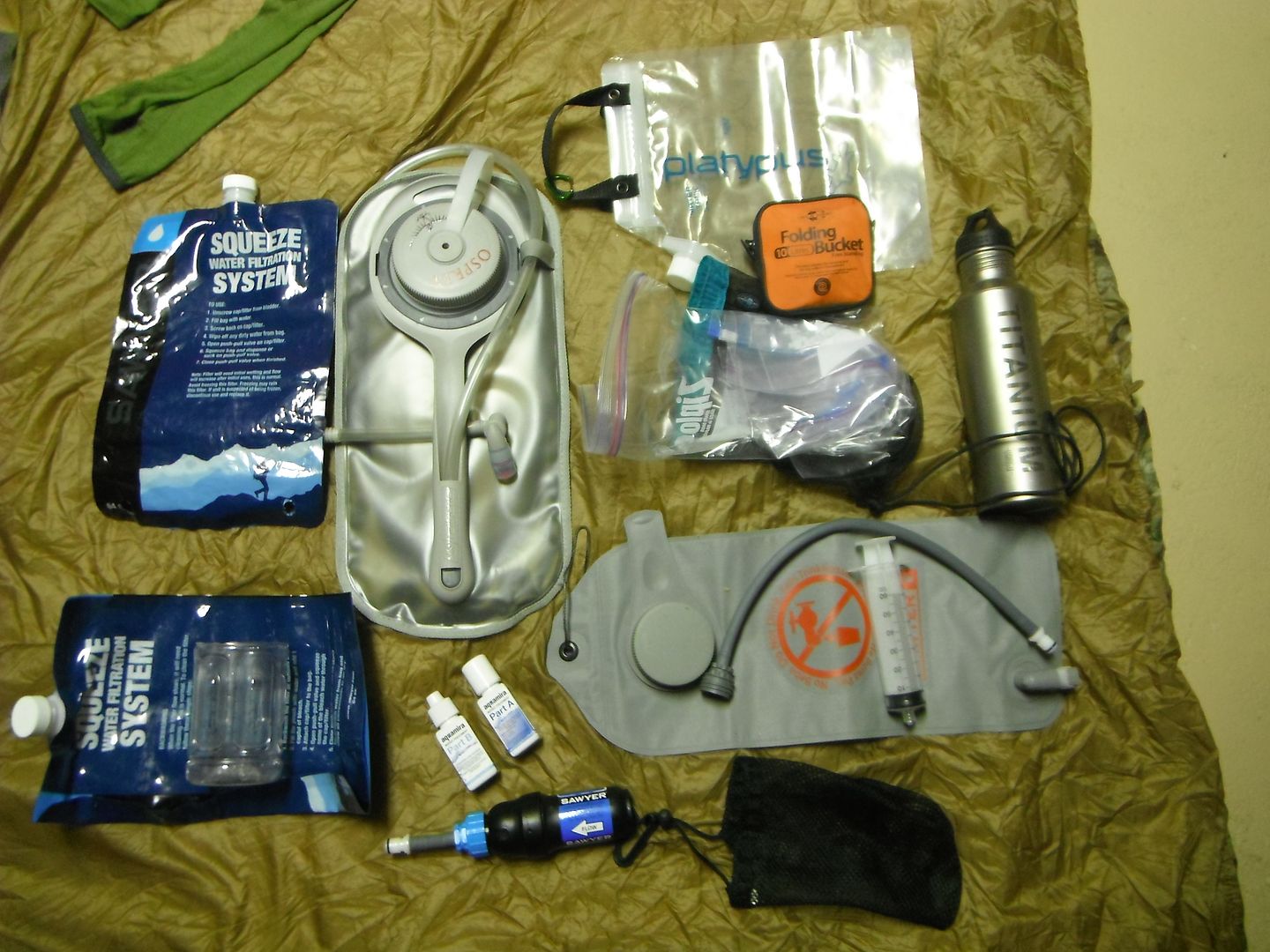
Hydration bladder for the pack; storage water bladders, a couple squeeze water bladders and the Sawyer gravity bag. The Sawyer Squeeze filter (soon to be replaced by the Sawyer Mini) with connectors to my hydration bladder and set up a gravity filter system and the backup Aqua Mira purification mixture system. I also have a metal (titanium) water bottle and the collapsible 10-liter water bucket. In my HPG kit bag, it have a dozen Micropur purification tablets. I make look "over-thought" or complicated, but it works extremely well for me and continues to be an evolution for my current environment and activities. Please add any additional information or links to make a more comprehensive source regarding "water" as a necessity... ROCK6 |
| excellent write up... you might consider addition of some electrolyte-glucose replacement... I've been using a recipe from the internet for pistol matches during the brutal summer heat we've had this year... very cheap and is titrated for the 1/2 liter water bottles....supposedly duplicates the Gatoraid values, but I have not done my own calculations |
|
Quoted:
excellent write up... you might consider addition of some electrolyte-glucose replacement... I've been using a recipe from the internet for pistol matches during the brutal summer heat we've had this year... very cheap and is titrated for the 1/2 liter water bottles....supposedly duplicates the Gatoraid values, but I have not done my own calculations That's an excellent point! I cheat...not really true electrolyte replacements, but I include the E'mergen-C drink packets as they're small and if the water is funky, they help mask with flavor. During the winter it's less of an issue as our food covers the majority of loss; however the summer's here are deceptively brutal on fluid loss. Excessive sweating really depletes you and the electrolyte intake is essential. ROCK6 |