


Posted: 8/15/2010 3:22:44 PM EDT
| Are yall keeping this stuff in your car? The can says not to store above 120 degrees and I know it gets to 145-150 inside vehicles here during the summer. My wife may not be too happy with me if that crap blows all over her car but whats the point of it if you can't keep it in the car where it may be needed? |
|
its printed on the can for legal liability reasons.
check out the myth busters episode where they tested aerosol cans in a car, they heated the car to 300 degree's before the cans started to fail. I keep a few large cans of fixaflat in the truck box, had some a couple years old sitting in a metal box in 100 degree heat (probably 120 in the truck box). |
|
Quoted:
its printed on the can for legal liability reasons. check out the myth busters episode where they tested aerosol cans in a car, they heated the car to 300 degree's before the cans started to fail. I keep a few large cans of fixaflat in the truck box, had some a couple years old sitting in a metal box in 100 degree heat (probably 120 in the truck box). Similar to the one where they heated up a car to make biscuit containers explode. I keep a can in a car with no spare tire and it is old as hell now. |
|
Quoted:
Quoted:
its printed on the can for legal liability reasons. check out the myth busters episode where they tested aerosol cans in a car, they heated the car to 300 degree's before the cans started to fail. I keep a few large cans of fixaflat in the truck box, had some a couple years old sitting in a metal box in 100 degree heat (probably 120 in the truck box). Similar to the one where they heated up a car to make biscuit containers explode. I keep a can in a car with no spare tire and it is old as hell now. Had a can in my Jeep that was 5-6 years old. An instructor at a shoooting class had a fast leak in a tire, we were tired at the end of the day so I offered him the can as a quick fix. Worked just fine. |

|
Quoted:
My fix a flat worked fine recently after 2-3yrs of 100+ summers and -20 in the winters. YMMV. I had some in the truck box of the dually for several years. Opressive FL heat , frigid upper Ny winters. It worked just fine. (BTW it takes 2 cans for a truck tire!!!!!) |
|
Quoted:
Quoted:
fix a flat was an epic fail on my jeep just sprayed out the hole and all over the wheel well... I use a plug kit now... i use fix a flay to find the hole then use a plug kit to seal it up again not a bad idea but judging by the size of the bolt that I was able to find it pretty easily. But that fix a flat is great for small holes... slow leaks... but... anything sizable definitely going with the plug kit |
| I used a can about 2 weeks ago––large piece of sheet-style metal 2" wide by 3" long went into the tire. Fix a flat worked for about an hour before it started to fail. I t was enough to get me home without having to change a tire on the highway and driving through a bad neighborhood. It was a catastrophic tire injury that could not be fixed by plugging. |
|
Quoted:
Quoted:
I keep a hole puncture repair tool kit and an air compressor. A lot more permanent. Ive got those too but no way would I expect my wife to be able to handle that which is what led me to the fixaflat. Has anyone tried the tire slime? I use slime instead of fix a flat. I am pretty sure there is more slime than air in one of the tires on my riding mower too  . .
|
|
No, I don't keep it anywhere.
That stuff had a use 20 years ago but its been replaced by Slime. It freezes, loses pressure, and gums your ties so bad a lot of tire shops won't work on the tire. Slime takes a little bit more to use it but has none of the problems of Fix a Flat. You can pick up a small Slime kit with pump for $20. Tj |
|
Slime makes a compressor / slime fill kit now. Nice little package that easily fits under the seat.
http://www.slime.com/category_4_Smart-Spairs.html ETA a pack of tire plugs is like 10 bux and will get you 20+ plugs. I would strongly recomend taking the misses or even just by yourself over to a tire shop and pick up a busted up non fixable or tire to practice with. The more tread the better IMHO. Just screw a couple screws into it and practice getting them out and plugging the hole properly. A little practice can go a long way. 
|
|
I have had bad luck with fix-a-flat going bad (no pressure). Either from heat or cold.
As someone else mentioned, I use a plug kit & compressor.. The best, highest quality I have found.. http://www.safetyseal.com/store/tire.htm Andy.. |
|
Quoted: I agree that slime is better than fix a flat but some of us simply dont have room for an onboard compressor. When i've used fix a flat I haven't had any issues with tire sensors or with fixing the tire with plugging later on. YMMV. In arfcom fashion get both. Slime now sells a kit that includes a 12v (cig lighter) tire-inflator-type compressor. About 20 bucks... |
|
Got 40 years in the retail tire business, I have seen the result of all the things mentioned above. Fix-A Flat is designed to get you somewhere to properly repair the tire or replace if non-repairable.
In the old days, they used a propane propellant in the cans, highly flammable and possibly explosive. I have not personally witnessed a problem with the explosive part, but as a precaution I have my people pull the core and let the air/propellant out just to be safe. Fix-A-Flat if left in the tire can cause imbalance of the tire and resulting irregular wear, vibration, and corrosive damage to the wheel. Alloy wheels in particular. Left in the tire for a long period it may form a semi-solid and roll around inside, again imbalance. Tire plugs should also be considered a temporary repair, if you don't have a serviceable spare, etc. The problem with plugs, you don't get to see the interior of the tire. You may be missing things like a foreign object that completely penetrated the body of the tire and rolling around inside. Also, it is not unusual for there to be damage to the inner liner that you won't know about without inspection. Damage to include angular damage to the inner liner, splitting, rim cut to the sidewall. I realize that it may not always be possible for one reason or the other to properly repair a puncture, perhaps the tire is near the end of it's service life, not able to purchase a new tire at the time, whatever the reason. The proper way to repair a radial passenger or light truck tire is a patch plug from the inside. The injury must be cleaned, buffed, tire cement, patch plug seals the injury from the inside out, balance and back on. Anyhow, that is the professional point of view, based on a LOT of experience, of course it is up to you how to handle the situation. I carry a fully inflated spare and a heavy duty jack and 4 way lug wrench. I recently had open heart surgery so now I might call one of my three sons, they live nearby and are auto service techs, to come over and put my spare on for me. I can probably get away with that for some time... 
|
|
Quoted: So, aside from the properly checked and inflated spare, would it be fair to say that a slime kit with pump coupled with a patch plug kit would be about as good as someone could do?Got 40 years in the retail tire business, I have seen the result of all the things mentioned above. Fix-A Flat is designed to get you somewhere to properly repair the tire or replace if non-repairable. In the old days, they used a propane propellant in the cans, highly flammable and possibly explosive. I have not personally witnessed a problem with the explosive part, but as a precaution I have my people pull the core and let the air/propellant out just to be safe. Fix-A-Flat if left in the tire can cause imbalance of the tire and resulting irregular wear, vibration, and corrosive damage to the wheel. Alloy wheels in particular. Left in the tire for a long period it may form a semi-solid and roll around inside, again imbalance. Tire plugs should also be considered a temporary repair, if you don't have a serviceable spare, etc. The problem with plugs, you don't get to see the interior of the tire. You may be missing things like a foreign object that completely penetrated the body of the tire and rolling around inside. Also, it is not unusual for there to be damage to the inner liner that you won't know about without inspection. Damage to include angular damage to the inner liner, splitting, rim cut to the sidewall. I realize that it may not always be possible for one reason or the other to properly repair a puncture, perhaps the tire is near the end of it's service life, not able to purchase a new tire at the time, whatever the reason. The proper way to repair a radial passenger or light truck tire is a patch plug from the inside. The injury must be cleaned, buffed, tire cement, patch plug seals the injury from the inside out, balance and back on. Anyhow, that is the professional point of view, based on a LOT of experience, of course it is up to you how to handle the situation. I carry a fully inflated spare and a heavy duty jack and 4 way lug wrench. I recently had open heart surgery so now I might call one of my three sons, they live nearby and are auto service techs, to come over and put my spare on for me. I can probably get away with that for some time... Replacing a tire on my car forces all four to be replaced (differentials) so a partially worn tire that can't be patched means a bit of cash. |
|
Quoted:
Quoted:
So, aside from the properly checked and inflated spare, would it be fair to say that a slime kit with pump coupled with a patch plug kit would be about as good as someone could do?
Got 40 years in the retail tire business, I have seen the result of all the things mentioned above. Fix-A Flat is designed to get you somewhere to properly repair the tire or replace if non-repairable. In the old days, they used a propane propellant in the cans, highly flammable and possibly explosive. I have not personally witnessed a problem with the explosive part, but as a precaution I have my people pull the core and let the air/propellant out just to be safe. Fix-A-Flat if left in the tire can cause imbalance of the tire and resulting irregular wear, vibration, and corrosive damage to the wheel. Alloy wheels in particular. Left in the tire for a long period it may form a semi-solid and roll around inside, again imbalance. Tire plugs should also be considered a temporary repair, if you don't have a serviceable spare, etc. The problem with plugs, you don't get to see the interior of the tire. You may be missing things like a foreign object that completely penetrated the body of the tire and rolling around inside. Also, it is not unusual for there to be damage to the inner liner that you won't know about without inspection. Damage to include angular damage to the inner liner, splitting, rim cut to the sidewall. I realize that it may not always be possible for one reason or the other to properly repair a puncture, perhaps the tire is near the end of it's service life, not able to purchase a new tire at the time, whatever the reason. The proper way to repair a radial passenger or light truck tire is a patch plug from the inside. The injury must be cleaned, buffed, tire cement, patch plug seals the injury from the inside out, balance and back on. Anyhow, that is the professional point of view, based on a LOT of experience, of course it is up to you how to handle the situation. I carry a fully inflated spare and a heavy duty jack and 4 way lug wrench. I recently had open heart surgery so now I might call one of my three sons, they live nearby and are auto service techs, to come over and put my spare on for me. I can probably get away with that for some time...
Replacing a tire on my car forces all four to be replaced (differentials) so a partially worn tire that can't be patched means a bit of cash. True, AWD vehicles a little different situation, do what you need to, then when you get the time, take it to somebody like me and get it properly repaired so you don't have to buy the set prematurely. About $15-$20 well spent in your particular example. Patch plugs do not come in kits, they are usually, if not always not used except at a repair facility. You need air buffer, skiv, reamer, etc., to do them properly. Sorry to be long winded, I have been a member for a long time, rarely post unless I feel I have something to contribute. The thing is, I have seen the results from improper repairs, just trying to share the experience, might help someone decide what to do in their particular situation. |
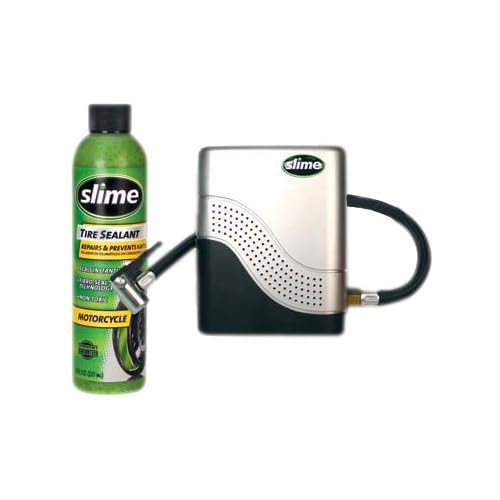
I have the little slime compressor and will say it is a great little compact compressor for Motorcycles and ATVs. You can get buy once a while using it for a car tire but you don't wan to use it to fill large truck tires. You will be there a long time and unless you let it cool down you'll burn it up. 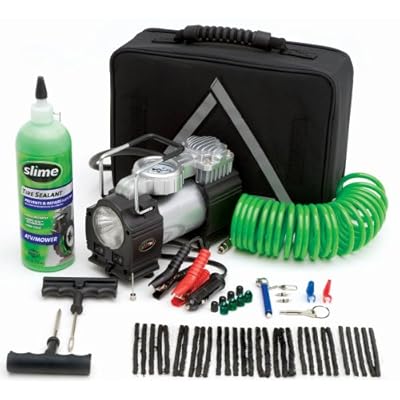
They do make a much larger compressor for car and truck tires. 
All that said if you have the money a Vair compressor is more durable, quicker, and better constructed. |
| The Viair's start around $65-$80. I would imagine that particular model would be about the equivilant to the slime models. Sure you can spend much more on the one in your pic. Its nice but not in my league to put in each mode of transportion. But thats just me. |
|
Quoted:
The Viair's start around $65-$80. I would imagine that particular model would be about the equivilant to the slime models. Sure you can spend much more on the one in your pic. Its nice but not in my league to put in each mode of transportion. But thats just me. The one I pictured is $150. Like I said if you have the money |
|
Quoted:
No, I don't keep it anywhere. That stuff had a use 20 years ago but its been replaced by Slime. It freezes, loses pressure, and gums your ties so bad a lot of tire shops won't work on the tire. Slime takes a little bit more to use it but has none of the problems of Fix a Flat. You can pick up a small Slime kit with pump for $20. Tj Exactly this. Slime works better too in my experiance. |
|
For folks with awd, anyone tried 5 tire rotation stuff? I have read of people doing it and this uses the spare tire in your rotation but my spare is on a rim different from the 4 on the ground so I doubt I will do it. But anyway you would have a better chance at getting the life out of your tires if you did kill one and had to buy a new one that one could just live as a spare and not be used in the rotation until you replaced the 4 worn tires and could start your 5 tire rotation back up again. I did finally buy myself some tires, had a screw in a tire again and felt too lazy to patch it at work after working a double. I aired the tire up and drove on it and for whatever reason the leak slowed down to where the tire would hold air again after being driven about 40 miles. Before it would leak all the air out, then leak down most of the way but not flat and then it would hold 35psi with no leakage. I currently have an invertor and a small 100 dollar air compressor I got used for 35 bucks in the car. The invertor runs it fine and it is a big enough compressor I don't spend all day airing up the tires but I consider it small enough to leave in the vehicle when feeling lazy. I have tire pressure sensors and won't risk putting slime or fix a flat through them, 55 bucks for one sensor since I broke one before I got my new tires and wanted it replaced while they had things apart. As far as the girlfriend or wife or whatever not wanting to know how to take care of their vehicle, I understand this because I get called to help out females in my family now and then but I still shake my head that they would rather wait for someone to come do it instead of doing it themselves. I get into an error loop on this subject, broke up with a few gals over the years because of similar things. I have tire plugs and bought the heavy duty plug installer and I consider them temporary because the tire should be inspected and patched when you have time. But I consider a plug a better fix than slime or fix a flat for me since I have the tpms sensors. |