


[ARCHIVED THREAD] - Survival Snaring Guide (Page 1 of 2)
Posted: 3/17/2010 9:01:18 AM EDT
|
I keep getting requests for snaring instructions. This is my first attempt at a basic guide to snaring. Hopefully as I get motivated I will add more to this guide as snaring is a huge topic and there is a lot I can cover. Please ask questions in this thread. It will help me cover topics I may not have been clear on, have taken for granted and let me know how to improve future guides.
Some general notes: - Snares are cheap. The more you have out the better. - Gang set a good location. If you have a good trail or location set lots of snares. - Hunting requires time and valuable calories. Your snare is out there working for you 24/7. - Small game animals are less predictable then furbearers. Be patient. - Check your snares regularly. Normally every 24 hours. When left for excessive time, leg caught small animals may chew off their leg once they have lost sensation in their leg. This can be avoided by dispatch snaring, good snare placement and regular checks. - Hunting and edible plant gathering is dependent on innumerable uncontrollable factors. The snareman never goes hungry. - Improvise and field craft in survival situations. Be creative. 


|
| Hello, I'd first like to say thank you for your time and insight. I'd like to know if you made your snares or if you purchased them, if so where? I've made some of my own in the past but I see yours have a retention device and spring to keep it snug once it's on. I haven't been successful in my snaring attempts yet but I will stay tuned for more info. |
|
Hello!
I've done a little snaring in my day, and been quite successful. However, its always been for little critter like squirrels and rabbits. What species are you trying to snare with the set up in this pics? I'm confused. That trail is big and deep (almost looks man made!). It seems like it would take a fairly large, heavy and hard footed creature to wear a trail that deep. I've seen plenty of deer trails that looked like that. I'm set up snares on a lot of woodchuck and rabbit runs, but they are all more disturbances in the vegetation and leaves than any sort of compacted soil trail. The snares you set up look to be maybe a foot in diameter, but almost on the ground. You cannot be snaring rabbits and the like with a loop that big. And the loop is too close to the ground for any sorta medium sized critter like a coyote. What sorta animal are you trying for ???? Fro |
|
Quoted:
What sorta animal are you trying for ???? Fro WOLVERNES!!!!! (Actually, have NO idea, but saw AK as the OP's locale, and always wanted to shout that, even if just virtually!) I've been switching over to snares here on my line the last few years, mostly for beaver, and must say, carrying a dozen or so a mile beats the heck out of lugging 4 or 5 330s! Still heavy coming out though! 
|
|
I make all my own snares but I dont recommend it unless you are making a couple hundred snares. I keep running the numbers on my calculator and the price difference between purchasing them ready made and purchasing the parts is only a 1-2$ or so a dozen. When you put the time factor into consideration it just isnt worth it until making enough that it is worth your time.
That trail is a deer trail around a water source which is why it is so developed. I wasnt trying to snare anything in the photo - just get off my butt and make a snare guide for here. I have snares for sale in the classified section under Survival Equipment and the past few sales people have been asking me for snaring instructions. The loop size in the photo would work for coon or possum. It is too low to the ground for a neck catch of anything else but you would still snare a leg or body with such a low/big loop. It was only a demo photo. ** edit - for coyote I prefer a 12" loop, 10" off the ground. In a SHTF scenario I would target dogs as an easy food source. I'll do a snare construction one next by request. Thanks for asking; that is one of the topics that I totally took for granted. |
|
Cool thread!
OP, do you ever use conibears? I couldn't agree with you more on targeting dogs in SHTF scenario. I'd target them immediately, along with cats. If I could trap those out quickly, I'd corner that supply before other people would get around to thinking about it. And, I could sit on my emergency chow a while longer and not deplete it. 110's are too small, but I know for a fact that 220's will catch large domestic cats (and smaller dogs, plus coons and possums). I would think that 330's would be required for bigger dogs. In a complete civilization ending, survival situation, I'd try to snare deer too. I've heard of a way to trap turkeys too, but have never tried it. You dig a long trench that the turkeys have to walk in, and can't fly out of––-narrow. Keep feeding them out of that trench for a while until they get used to it. Have some sheets of plywood or pallets right next to the trench, and keep them there from the start. When you think that you can catch them, pull the sheets/pallets across the top of the entry/exit. Like I said, I don't know if this would work, as I've never seen it in person or tried it. |
|
Snares work more like a noose - the animal hits them and the lock tightens down and doesnt let up. If they run or fight the snare it will get even tighter as they pull against it. A good snare will work fast and humane. They also can be set up in non lethal configurations so the animal doesnt choke itself out.
Conibears would be a great idea in a SHTF! I never thought of that. A 330 would definitely work for all dogs and a 220 for smaller dogs and cats. That is a good idea... save your food source while you chow down on all the loose pets. Remember New Orleans and all the loose pets running around? Here is the next round of photos. Photos of the different equipment needed to build snares: 


Ferrules need to be designed for the cable size that you use. They are very specific. 

|


|
Quoted:
The Final Product: The Four different snares that I personally make. There are lots of different snare locks and configurations but I stick to the best of everything. http://i261.photobucket.com/albums/ii54/littlbigd/Snaring%20Guide/BKPL1374.jpg GREAT POST!!!!!!! |
|
You can reuse your locks, springs, whammies and washer.
You are not suppose to ever reuse your snare cable but if you are survival snaring.... Ebay in the Animal Traps section always has stuff for sale. This weekend I'll try to get a DIY post up for those that dont have manufactured snare parts. |

|
At least the snaring info will come from someone who has actually done it.
I am amazed at all the survival books and "experts" who tell you to put out a snare (or some other kind of trap), but never tell you that if you put out 20 you are lucky to get one critter. Having all the books and experts telling me how the critters were just going to jump into the snares when they see them, it was a major shock to me talking with a guy that actually used them a few years back. |


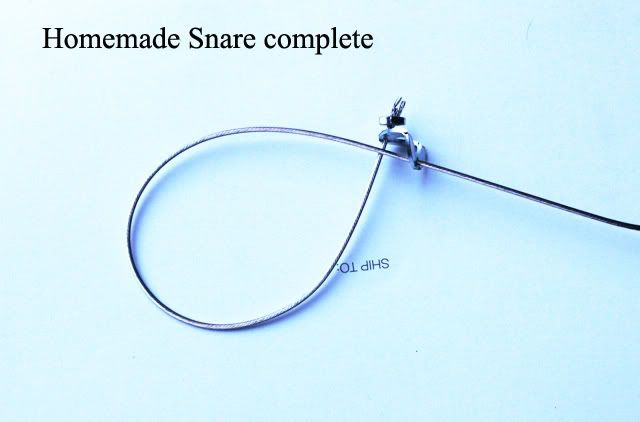
|
Quoted:
How to make a homemade snare: http://i261.photobucket.com/albums/ii54/littlbigd/BKPL1399.jpg http://i261.photobucket.com/albums/ii54/littlbigd/BKPL1400.jpg http://i261.photobucket.com/albums/ii54/littlbigd/BKPL1394.jpg http://i261.photobucket.com/albums/ii54/littlbigd/BKPL1396.jpg http://i261.photobucket.com/albums/ii54/littlbigd/BKPL1397.jpg http://i261.photobucket.com/albums/ii54/littlbigd/BKPL1411.jpg Interesting. What size is that wire, and what size are those holes in the washer? |
|
1/16" cable cause that is what I use. Bigger wire just needs a bigger hole and washer.
Hole in the washer size - no idea. Whatever drill bit size I had. It wont matter - just compare the drill bit size to the diameter of the wire you are using. Expand the hole if necessary (that's what I ended up doing in the photo) I would never use these cause I buy snare components but it's a good project if you never snared before and want to try. |
|
Quoted:
How to make a homemade snare: http://i261.photobucket.com/albums/ii54/littlbigd/BKPL1399.jpg http://i261.photobucket.com/albums/ii54/littlbigd/BKPL1400.jpg http://i261.photobucket.com/albums/ii54/littlbigd/BKPL1394.jpg http://i261.photobucket.com/albums/ii54/littlbigd/BKPL1396.jpg http://i261.photobucket.com/albums/ii54/littlbigd/BKPL1397.jpg http://i261.photobucket.com/albums/ii54/littlbigd/BKPL1411.jpg I just built this one today, it works great. Thanks! |
|
Treating your snares (removing the shine and oil):
As you guys get into snaring you'll notice that your snares have oil on them and a bit of a shine. The larger your snare locks are, plus dispatch springs, the more metal that is on your snare that can be seen. Tips on how to treat your snare. You can: - Boil them in water. This makes them a flat dull grey color. Removes the oil. - Leave them outside for a week or two. Does as above. - Once the oil has been removed from them touch up the snare locks with spray paint. Brown or Green. Leave outside to airdry until paint smell is gone. - Spray paint the entire snare. - If snaring in snow just spray the bottom loop white. As soon as you spray paint the entire snare white sure enough there will be a thaw and your snares will stick out like a sore thumb. - Spray painting your snares a natural color, leaving them to dry so the paint smell is removed, makes them LETHAL! |
|
Why do you have a choke spring on the first pictured snare when the lock is relaxing?
Animals see in black and white therefore you should spray paint your snares a color in between like tan NOT green or brown. A light coat of spray paint is what you want or the snare will not function properly. I dont know where your getting your supplies but it is usually more than half the price to make your own. I have snared over a thousand furbearers if your wondering. |
|
Quoted: Contribute. Don't sharp shoot. Despite the temptation it is beneath you to drag another thread down. It is the web LBD. Everyone knows more, does it better,faster,sub MOA,but no one ever wants to be "1st" to do the how to's. Hell my how to gut/dress a deer step by step picture process got plenty of " we do it this -a-way down here" or " you should do it like this.." replies. I just laughed it off and asked a few where all of their how to threads were.........ive yet to see one. that said long ago i made a thread about making your own snare kits for small game ( tree rats,rabbits etc) for a BOB. I made them from 60-80lb stainless braided coated off shore fishing wire,with 150lb ferrule and 150lb swivels. Lotta folks told me they'd never even hold a 2lb tree rat. I found that hard to believe as i've had the same kit hold 50+ lb fish off shore.They were cheap to make, so i made 20-30 of them,shoved them in an old altoids tin and shoved them in my BOB.Figured the time /energy saved making field expedient ones justified me putting the kit together.( ETA: i didnt know jack about snares at the time...just went and did it) I keep about 2-3 doz. snares on hand( large ones like your using for yotes/deer) and about a 1/2 doz 110's and a few #4-6 leg holds. bailing/tie wire for anchor points and as snare supports if not enough brush is around. I also keep 2-3 rolls of "camo" snare wire in my trapping tote. Everything in it has been treated like you posted. Baking soda, boil, and sat outside. Or sprayed down with scent killing sprays ( gloves,carry bag etc). Ive tried my hand at it, but nto been as presistant as i should be. Anyway Great thread, a BTT. Dont let the Internet "experts" piss ya off, just search their handle and laugh when you dont find jack. here's a pic of the ones from 5-6 years ago that folks laughed at me for posting about. so now folks can laugh at my old kit........   Which has evolved to my current " trapping" kit, which is still evolving and growing.  again thanks for the how to. |
|
Great thread, thank you for putting this info together.
Is it possible to snare a armadillo? What would be the best set up for this? Gene ETA: I have a dillo problem in my backyard. he travels the same path, I just never know what time he comes and goes. I've tried a game cam, but he always shows up at a different time. (my original plan was to find out what he comes in, show up a little before hand and pop with a 22). |
|
I don't have much experience with squirrels, but I'd figure they'd run right through a 6" loop. I do know that the "lean a stick against a tree and put your snares on that" trick works like a mofo.
The fun part about snares is that you just never know what you're going to get. Could be a big fat rat, could be a rabbit, possum, skunk (damn, what a PITA), coon, bird, cat, badger, or whatever.... |


|
One thing not mentioned... snares are small and easily lost. If you're in an area where you have little problem with someone else coming along and running your traps, you should probably mark your locations.
Also, secure your traps well. You'd be surprised how strong a little critter is when he's trapped. Showing up in the morning only to find a disturbed spot where your trap used to be is a real pisser. Nothing like running your traps and finding out what kind of weird stuff you caught.... I've snared snakes, birds, skunks (the worst), badgers, and all kinds of other stuff. Foot-catching something big when you expect to trap something little (provided it doesn't take your snare with it) is always an adventure, especially when you don't happen to have a gun on you (beating a badger or coyote to death with a stick is interesting). Successful trapping is all about finding the right spot, getting plenty of traps in the location, and not disturbing the area (scent, etc.) too much in the process. Game trails (especially where they go under fences and such) are generally very productive. Varmints (coyotes, bobcats, foxes) are the most challenging, because they tend to be the smartest and most easily spooked (in fact, I've never caught a fox or bobcat in a snare, only in regular catch traps... I've only caught a coyote once –– when I was a kid –– and it was a damned mess because I didn't have a rifle with me). Also, it's interesting when you catch something only to find that some other critter came along and raided your trap for you afterward.... I'm nowhere near uber-trapper status, but I've definitely run a lot of traps over the years, and to me it's a lot like fishing.... it takes patience and a little legwork to find the right places, but when you score it's great. |