


[ARCHIVED THREAD] - Homebrew Field Telephone (Updated) (Page 1 of 2)
Posted: 1/11/2011 7:52:51 PM EDT
|
I have been a fan of wired telecom for quite some time (at least for semi-permanent sites). Yes, it can be
tapped or disrupted if someone gains physical access to the wires. However, you gain near complete radio silence as part of the bargain. As part of my preps, I wanted to get a robust wired telecom system in place. Homebrew intercom systems are trivially easy to put together. However, without careful design, they lack the robustness I am looking for. There really isn't any reason why I should put that much effort into it when Ma Bell's engineers have done most of the work for me. Below is a first stab at a homebrew field telephone using the hybrid and handset from a POTS phone: 
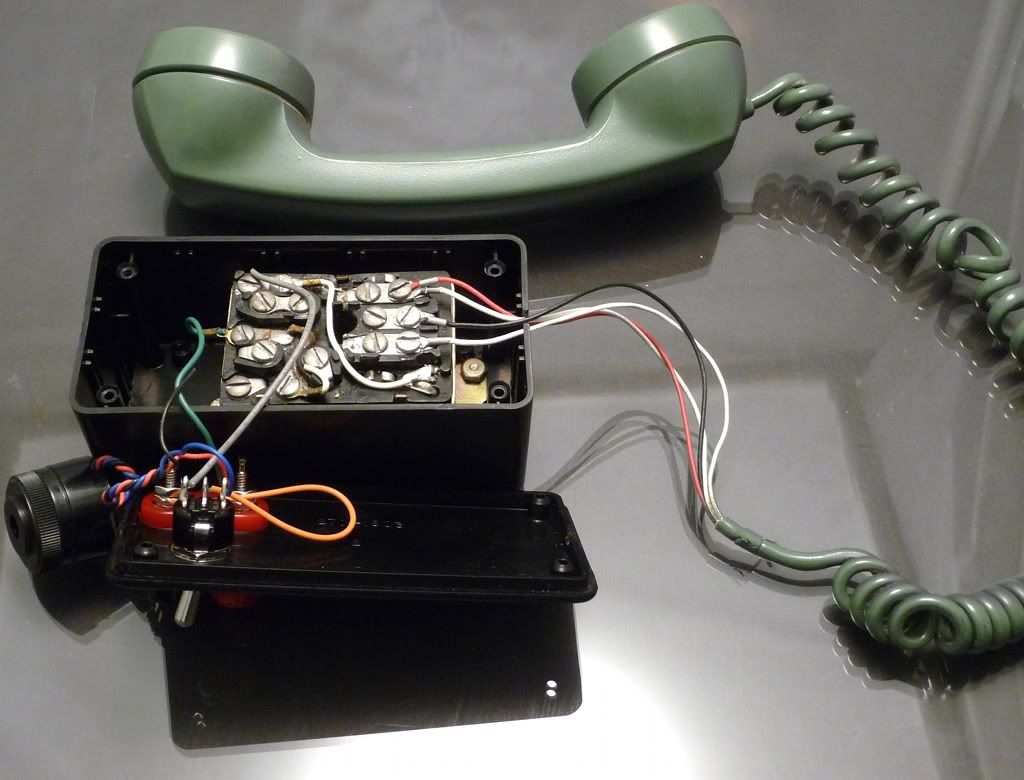

A TA-312 it isn't. A side benefit of using a pre-made hybrid is that this phone is still compatible with the public telephone system. Ring (red) goes to the red post and Tip (green) to the black. Obviously, you won't be dialing with it unless you use a DTMF generator of some sort (or simulate pulse dialing - which I can do - but it is a pain). It fits in a .30 cal ammo can very nicely with room to spare for a battery pack and accessories. If you want to build something similar, will need a donor phone (around $12 on eBay). Discard everything except the hybrid and handset: 
I cringed a bit at parting out this particular phone. It was from the mid 1950's and still worked. Check out the named exchange in the phone number: 
I rattle canned the cord and handset to something not quite so bright. I have an rotary dial avocado colored desk-set on hand, but it is much too nice to part out. You will also need a suitable enclosure. The above is a Radio Shack project box. I quit using them around 20 years ago and would prefer a nice Bud box instead. I might use a Bud box for future builds, but this was good enough for a proof of concept. In reality, the ammo can provides all the protection the plastic enclosure needs. You will need a SPDT switch to switch the phone between off-hook / on-hook. You will need an audible or visible signaling device. I used a pulsing piezo buzzer in this instance. Its operating voltage is 3V - 24V which allows a fair amount of flexibility in supply voltage. It is entirely too loud (running off of 9V) until you screw down the lid. I should probably add a switch to disable it altogether. Or, change the current switch to a SPTT. The last time I did something like this, I used alligator clips. I used binding posts this time and a set of alligator clips can be thrown into the kit as an option. You will also need a schematic so that you can properly replace the old hookswitch with your SPDT. This phone was a Stromberg-Carlson 500 series - very similar to the Western Electric 500 (and built from WE's patent, I believe). The schematic for the SC 500: 
So, this is cool and all that, but is it worth the trouble? Not really, unless you need the compact size. If you want easy, mod a wall phone for the piezo ringer (which I will have to cover in another post) and stick it in a .50 cal ammo can. I used to carry something like this with me all the time (30 years ago): 
Even easier: Watch eBay for an older Harris buttset (like a TS-22). If you try, can pick them up for less than $40: 
|

|
Quoted:
How do you know how to hook up that hybrid? Where do the batteries go? Where does the string hook on? I have been playing with phones since I was 10. The batteries go either in: a. A battery pack stored with the phone. b. A battery pack with the phone at the other end of the loop. c. A battery pack at a pseudo switchboard. |
| Right now I am sitting in my office waiting to go 'play with phones'. I use two or three different Harris models TS-22ALO and whatnot. I also have a orange 'toner' that I use for generating a tone on the line I'm working on, but it also will provide 9v of talk battery if the switch is thrown the other direction. I will try to post pics, schematics if I can of the toner. A 'butt-set' as we call them, can be rigged up out of practically any phone laying around. For ease of use, I would mod a RJ11 jack into that box so any corded phone could be plugged into it, in case the original went bad. Also, just a FYI- the polarity TIP and RING doesn't matter-at least not in anything I have worked on, except one finicky old Rockwell 56k modem. |
|
Quoted:
Right now I am sitting in my office waiting to go 'play with phones'. I use two or three different Harris models TS-22ALO and whatnot. I also have a orange 'toner' that I use for generating a tone on the line I'm working on, but it also will provide 9v of talk battery if the switch is thrown the other direction. I will try to post pics, schematics if I can of the toner. A 'butt-set' as we call them, can be rigged up out of practically any phone laying around. For ease of use, I would mod a RJ11 jack into that box so any corded phone could be plugged into it, in case the original went bad. Also, just a FYI- the polarity TIP and RING doesn't matter-at least not in anything I have worked on, except one finicky old Rockwell 56k modem. I no longer have a butt-set of my own. I still have a toner and probe as they are too handy not to have. An RJ11 would be handy, but an RJ11 plug with alligator clips will suffice if I wanted to piggyback a regular phone on it. An RJ22 for the handset would be nice, but potentially harder to make watertight. Tip and Ring hasn't mattered in many years with POTS equipment. However, this isn't really POTS - each phone may have its own battery power supply. Best results will be obtained with a consistent hookup plan. 
|
|
Quoted:
I don't know very much about phones. I do have a couple tests sets though. Can these just be hooked up end to end and work, or is there more to it than that? if you have a pair of buttinski test sets (Harris Mean Green TSxx or similar) you can communicate between them via a pair of wires with sufficient battery voltage (DC) applied between the two wires. what is sufficient is dependent on the test set employed and the length/gauge of the wires, but can be as little as 5 or 6 volts. try it out with a lantern battery or similar. ar-jedi |
|
Quoted:
I cringed a bit at parting out this particular phone. It was from the mid 1950's and still worked. Check out the named exchange in the phone number: http://i252.photobucket.com/albums/hh20/ignaci787/Parts2b.jpg I wonder how many kids realize that's why the letters are next to the numbers on phones |
|
Quoted:
I wonder how many kids realize that's why the letters are next to the numbers on phones i'd be surprised if they knew how to operate a rotary (pulse dial) set! ar-jedi ps: today's bellhead trivia question: why is the nominal POTS loop voltage -48Vdc (negative 48Vdc)? 
|
|
Quoted:
Quoted:
I wonder how many kids realize that's why the letters are next to the numbers on phones i'd be surprised if they knew how to operate a rotary (pulse dial) set! ar-jedi ps: today's bellhead trivia question: why is the nominal POTS loop voltage -48Vdc (negative 48Vdc)?
I have always heard it was to prevent some corrosion, so I even had to look it up-turns out I was correct 
-48v pots Oh and to stay on topic, here is a little quick and dirty link for you DIY'ers. You read this and you'll know about 60% of what I know-about phone line that is 
POTS-DIY Ya'll don't go reading this and thinking about getting my job- 
|
|
Quoted:
Can you post specifics of how you wired up the battery and how the ringer circuit works? Years ago Poptronix posted plans for a "phone line simulator" which I built and used as a loopback adapter between two modems for transferring files between machines. This is a bit rough as I don't have any actual schematic capture software on this machine. 
I used a metal polyester for the cap and a plain-lane 1/2 Watt carbon for the resistor. The values are not super critical, but you do want to stay mindful of the loop current. At the moment, signaling is one-way. When someone picks up the base unit, the unit in the photos chirps until the switch is flipped into the talk position. Obviously this is suboptimal and I will need to add two-way signaling. How to do that is the question. I don't like the zener diode method that has been presented (in another thread) as it restricts the operating voltage window too much. That leaves: 1. Three wires (instead of a pair) with the third being used for signaling. Nope, not going to do that. 2. Polarity reversal. This is so very tempting if you are only going to have a simple network. However, it requires each node to have its own power supply. I still haven't ruled it out. I could do polarity reversal signaling from the base to the remote nodes and continuity (current sensing) signaling from the nodes to the base. 3. Current sensing. This is the route I am leaning toward - with either a solid state relay or a miniature mechanical relay. It will be a couple of weeks before I have time to try that. Forget that. I think polarity reversal is the optimum solution. |
|
One of the more interesting 'how to' posts lately.
When I was a kid back in the 80's and doing the whole phreaking thing we used to nick those buttsets out of repair vans that had the doors left open while the tech was working on site. 'Course we also used to dumpster dive behind the phone building for printouts with useful info on them as well. Ah, those were the days.... |
 blue boxes, and black boxes, and beige boxes-oh, my!
|
I am short on sleep this week and it is starting to show. I *knew* I had a method worked out
in my head to do two-way signal with nothing fancy added. However, nothing I came up with this morning looked right. I must be more awake now as it finally came to me: 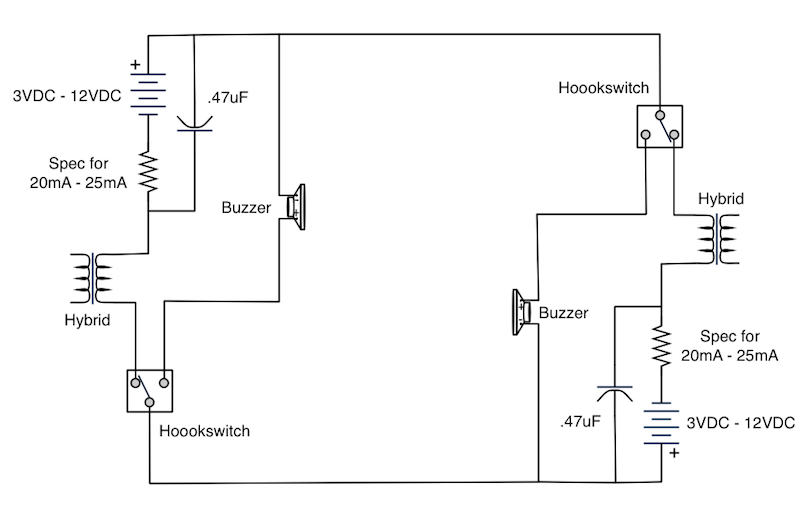
This can be done to a traditional wall phone just by adding the buzzer, resistor, cap, and battery pack. You can use the existing hookswitch. When both phones are on-hook nothing happens. As soon as one goes off-hook, current flows and sounds the buzzer on the other phone until it also goes off-hook. I still like the polarity reversal idea better as it would allow for easy addition of extensions and also allow one to easily do a distinctive ring to signal which station you wanted to pick up. |
|
Quoted: I am short on sleep this week and it is starting to show. I *knew* I had a method worked out in my head to do two-way signal with nothing fancy added. However, nothing I came up with this morning looked right. I must be more awake now as it finally came to me: http://i252.photobucket.com/albums/hh20/ignaci787/Sch2.png This can be done to a traditional wall phone just by adding the buzzer, resistor, cap, and battery pack. You can use the existing hookswitch. When both phones are on-hook nothing happens. As soon as one goes off-hook, current flows and sounds the buzzer on the other phone until it also goes off-hook. I still like the polarity reversal idea better as it would allow for easy addition of extensions and also allow one to easily do a distinctive ring to signal which station you wanted to pick up. What it the transformer looking device marked "Hybrid" all about? |
|
Quoted:
What it the transformer looking device marked "Hybrid" all about? http://en.wikipedia.org/wiki/Telephone_hybrid http://www.google.com/search?q=telephone+hybrid+circuit ar-jedi |
|
Quoted:
Quoted:
I am short on sleep this week and it is starting to show. I *knew* I had a method worked out in my head to do two-way signal with nothing fancy added. However, nothing I came up with this morning looked right. I must be more awake now as it finally came to me: http://i252.photobucket.com/albums/hh20/ignaci787/Sch2.png This can be done to a traditional wall phone just by adding the buzzer, resistor, cap, and battery pack. You can use the existing hookswitch. When both phones are on-hook nothing happens. As soon as one goes off-hook, current flows and sounds the buzzer on the other phone until it also goes off-hook. I still like the polarity reversal idea better as it would allow for easy addition of extensions and also allow one to easily do a distinctive ring to signal which station you wanted to pick up. What it the transformer looking device marked "Hybrid" all about? The phone. |
|
Quoted:
What it the transformer looking device marked "Hybrid" all about? Yeah, what everybody else said. My apologies for using a generic transformer symbol for the telephone hybrid core - it was the closest thing I could come up with in the limited drawing software I have at hand today. Where the circuits connect is actually the L1 and L2 terminals on the hybrid. |
|
This may not make much sense, but here goes:
When multiple phones are connected in series, pushing the momentary DPDT of one phone causes the buzzers of the remaining phones to sound (assuming your battery pack has enough voltage to overcome the multiple .7V from the diodes): 
|
|
I never got in to it that far, but I did build a lot of my own shit from 're-purposed' parts I found from 'dumpster-diving' and whatnot. I built my own 'butt-set' from on old cricket phone and some schematics of an actual butt-set. I guess you could say working for the telco was a step to honesty for me. That link I posted earlier had a lot of good of good links to some of the stuff we are discussing in this thread. Soooo...meanwhile-back to your regularly scheduled topic-sorry for the hijack.
|
|
OST for building one of these later! In high school I used to modify phones for my own 'special' purposes, and I've never really given it much thought over the years –– Until this thread! I think I'm going to wire up a set of these phones! Thanks for posting the schematic!!! 
|
|
Some of you old school bellheads and network geeks may get a kick out of this. Back in 2006 when I started upgrading the voice and data network at my company I discovered that all of the voice lines were punched into BIX blocks...
...not 66, not 110, but freaking BIX! 
Yuck: 
Now back to our regularly scheduled program
|
|
Yeah, BIX sucks. 66 is what I have the most experience with, but just about all of my side work has been 110. If I didn't think that some .gov agency was reading all of this, I'd do a primer on how to wire your phone and your neighbor's phone up together using a ringdown box and the telco's cable(post EOTW, of course). When all the dust settles and the ammo has been counted and beans rationed out, people will want to communicate with thos close by. Chances are, you and your neighbors have working phone pair going to both of your houses. Instead of laying out field wire...why not use the existing connections that are already there. SOmething to think about for those of you already in the know. The rest of ya...I may have to do a write-up and post anon
|
|
Quoted:
Some of you old school bellheads and network geeks may get a kick out of this. Back in 2006 when I started upgrading the voice and data network at my company I discovered that all of the voice lines were punched into BIX blocks. way, way back when i started at AT&T BL my officemate was about 87 years old and would tell me scary stories about BIX blocks, and how 66 type and 110 type were so superior... are you him? 
ar-jedi |
|
Quoted: If I didn't think that some .gov agency was reading all of this, I'd do a primer on how to wire your phone and your neighbor's phone up together using a ringdown box and the telco's cable(post EOTW, of course). When all the dust settles and the ammo has been counted and beans rationed out, people will want to communicate with thos close by. Chances are, you and your neighbors have working phone pair going to both of your houses. Instead of laying out field wire...why not use the existing connections that are already there. SOmething to think about for those of you already in the know. The rest of ya...I may have to do a write-up and post anon I'd love to see that writeup. Most of my neighbors have pairs going to the house unused (most have just gone to cell phones, or voip). |
|
I was cheap and installed a surplus -forget the brand, seems like it started w/ a 'D'- phone switch and used those kinds of blocks to punch down the circuits. Worked fine and saved me thousands and I was able to troubleshoot as needed from time to time. Worked well with a lot of options and call logging so I could see what was going on from time to time as was needed. 
Then when I was a kid, there was the 4 inch dia plexiglass plastic cylinder 3 inches long with a rotary dial taped onto one end, a carbon mike in a disk in the other, an earphone from a portable radio, and some clip leads. Leading to much fun... |
|
Did you guys know you can dial a phone by intermittantly making/breaking the 2 wire phone connection?
I.e, make break it ten times quickly to get the operator, tell her your TT pad ain't working, would she dial the # for you?
NC push button works fine for this. |
|
I have manually pulse dialed with the switch hook many, many times. I tried it a few weeks ago to see if I still had my
timing down. I nailed the desired phone number on the first try and amazed our kids. The things I used to do with phones... I just don't see anything good in posting them on an open forum. I will say that there was a dead guy who ended up with a lot of long distance charges on his account in the early days of BBS's. 
|
|
Quoted: I have manually pulse dialed with the switch hook many, many times. I tried it a few weeks ago to see if I still had my timing down. I nailed the desired phone number on the first try and amazed our kids. The things I used to do with phones... I just don't see anything good in posting them on an open forum. I will say that there was a dead guy who ended up with a lot of long distance charges on his account in the early days of BBS's. "I heard of a guy who..." "One time, I read a story on the Internet in which..." "I've never done it but have been told you can...'
|

|
Quoted: Quoted: If I didn't think that some .gov agency was reading all of this, I'd do a primer on how to wire your phone and your neighbor's phone up together using a ringdown box and the telco's cable(post EOTW, of course). When all the dust settles and the ammo has been counted and beans rationed out, people will want to communicate with thos close by. Chances are, you and your neighbors have working phone pair going to both of your houses. Instead of laying out field wire...why not use the existing connections that are already there. SOmething to think about for those of you already in the know. The rest of ya...I may have to do a write-up and post anon I'd love to see that writeup. Most of my neighbors have pairs going to the house unused (most have just gone to cell phones, or voip). ++100000 If you write it up - you can always Email it to me!
|