


Posted: 11/10/2012 6:53:51 PM EDT
|
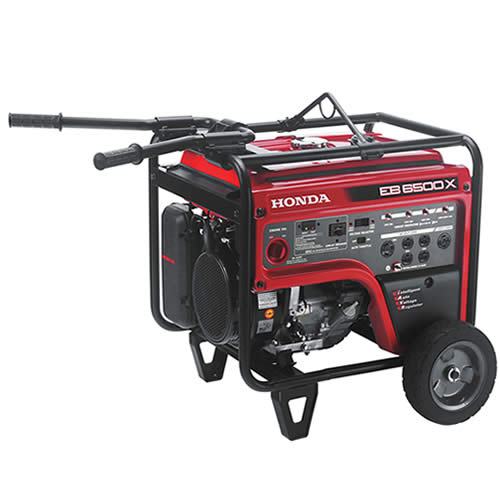
I need some help//advise ...i was given an older model Honda eb 6500 generator... it has some issues... the motor runs but will not idle down, the generator doesn't seem to be putting out any power. so does anyone here have any experience with this type of generator ? I don't know where to start in trying to test this thing... im not sure how much it would cost to fix but i don't have a dime in it yet.. so im willing to spend a little money if i need to buy parts.
parts missing or broken are ... Gas tank and all hardware related to it, Air filter cover and all internal parts for air filter, ( filter, gaskets, cover) |
|
Instructions on how to "flash the field"
(Explanation: Most portable generators rely on a small amount of residual magnetism always being present in the steel laminations of the rotor and stator. This magnetism induces a small voltage when the generator is first started, which in turn produces more magnetism in the laminations, which in turn generates more voltage, until the generator quickly builds up full AC output voltage. Occasionally, there isn't enough residual magnetism to get the process started - in which case no voltage is produced when the generator engine is started. Fixing this problem involves applying an external voltage to the generator windings (i.e., "flashing the field") in order to re-magnetize them.) If you succeed in getting the generator to produce power again, the engine might start idling-down normally, because the idle-down circuit usually measures AC power demand in determining when to idle down. ETA: Congratulations on getting your feebie! An EB6500 for free - in just about kind of condition - is one hell of a score! 
|
|
Quoted:
Instructions on how to "flash the field" (Explanation: Most portable generators rely on a small amount of residual magnetism always being present in the steel laminations of the rotor and stator. This magnetism induces a small voltage when the generator is first started, which in turn produces more magnetism in the laminations, which in turn generates more voltage, until the generator quickly builds up full AC output voltage. Occasionally, there isn't enough residual magnetism to get the process started - in which case no voltage is produced when the generator engine is started. Fixing this problem involves applying an external voltage to the generator windings (i.e., "flashing the field") in order to re-magnetize them.) If you succeed in getting the generator to produce power again, the engine might start idling-down normally, because the idle-down circuit usually measures AC power demand in determining when to idle down. ETA: Congratulations on getting your feebie! An EB6500 for free - in just about kind of condition - is one hell of a score!
http://www.electricgeneratorsdirect.com/product-images/EB6500_500.jpg That is interesting... I will defiantly give that a try. |
|
Quoted:
Instructions on how to "flash the field" (Explanation: Most portable generators rely on a small amount of residual magnetism always being present in the steel laminations of the rotor and stator. This magnetism induces a small voltage when the generator is first started, which in turn produces more magnetism in the laminations, which in turn generates more voltage, until the generator quickly builds up full AC output voltage. Occasionally, there isn't enough residual magnetism to get the process started - in which case no voltage is produced when the generator engine is started. Fixing this problem involves applying an external voltage to the generator windings (i.e., "flashing the field") in order to re-magnetize them.) If you succeed in getting the generator to produce power again, the engine might start idling-down normally, because the idle-down circuit usually measures AC power demand in determining when to idle down. ETA: Congratulations on getting your feebie! An EB6500 for free - in just about kind of condition - is one hell of a score!
http://www.electricgeneratorsdirect.com/product-images/EB6500_500.jpg Yes your right.. it is one hell of a score.... I dont know how long the thing had been sitting outside in my friends junk pile but it didnt have any cover over it or the carb and i know for a fact that it went through atleast a couple rain storms.... brought it home.. made a make shift gas tank, and cranked it over.... fired and ran with no tinkering at all. now if we can get it to generate power ill be one happy guy. |
|
Quoted:
Quoted:
Instructions on how to "flash the field" (Explanation: Most portable generators rely on a small amount of residual magnetism always being present in the steel laminations of the rotor and stator. This magnetism induces a small voltage when the generator is first started, which in turn produces more magnetism in the laminations, which in turn generates more voltage, until the generator quickly builds up full AC output voltage. Occasionally, there isn't enough residual magnetism to get the process started - in which case no voltage is produced when the generator engine is started. Fixing this problem involves applying an external voltage to the generator windings (i.e., "flashing the field") in order to re-magnetize them.) If you succeed in getting the generator to produce power again, the engine might start idling-down normally, because the idle-down circuit usually measures AC power demand in determining when to idle down. ETA: Congratulations on getting your feebie! An EB6500 for free - in just about kind of condition - is one hell of a score!
http://www.electricgeneratorsdirect.com/product-images/EB6500_500.jpg That is interesting... I will defiantly give that a try. It happens a lot more often than you might think. Keep us updated! |
| Flashing the field certainly could be the problem. I'd also check the brushes and commutator or slip ring condition. I've had a couple instances where simply cleaning the commutator solved the problem. You might have worn out brushes. Or could be a bad stator wire, or worse a bad winding. I'm not familiar with the wiring layout of a Honda and it's hard to accurately diagnose on the internet. The ones I work on are usually large generators on tugboats or our 3 and 5 meg steam powered generators where I work. Principles are the same though. If you can access the winding leads take a multimeter and verify you have continuity on your windings. If any of them read "open" or have no continuity then you have a broken, burnt or disconnected winding lead. Depending on which, repairing it could vary from simple to expensive and maybe needing stator or rotor replacement. Hopefully something simple and cheap like brushes or disconnected wire. Good luck. |
|
Quoted:
I don't think they use brushes and commutators in AC generators any more. Thats for DC generators . Remind me not to call you to work on my generator.... 
Honda EB6500X Schematic |
|
Quoted:
I don't think they use brushes and commutators in AC generators any more. Thats for DC generators . Commutators are pretty rare on modern portable generators, but slip rings and brushes are still often used to excite the "Field Windings" on the rotor. The brushes don't carry any huge amount of current, and the rings don't have any segments in them (like commutators), so they're quite reliable - not much different from the arrangement on a car alternator. Example: 
|