


Posted: 10/31/2005 5:59:17 PM EDT
|
I've had my Nikon D70 for a little over a month and I think it may be time to move up to a new lens. Currently I have a 18-70mm 3.5-4.5 lens. One of my biggest caveats being the aperture can only be control via the control knobs on the camera body itself. I miss being able to control the aperture easily on the lens itself. Another big beef being the lens seems pretty weak in the macro category. Maybe I'm asking too much of it, but I can never seem to get close enough with my lens to capture as much of the subject as I want, even at the max of 70mm. The last problem is I am unable to zoom in to distant objects as much as I desire. Even at 70mm it feels like I'm only seeing what my eyes currently are seeing, with no added magnification with the lens. Two lenses have caught my eyes as of late. The first is the Tokina 100mm f/2.8 AT-X Macro Autofocus Lens. 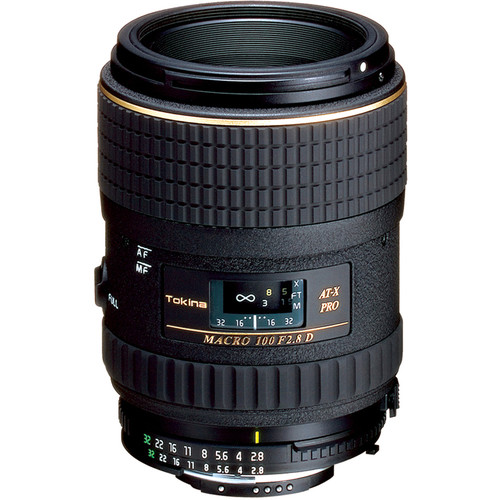 Popular Photography just reviewed it in their latest issue and was very impressed with it. One feature boasted about this lens is that it is "a macro lens capable of life-sized (1:1) reproduction at 11.8" (30 cm)". What does this mean? The next lens looks to be an all-in-one solution from Tamron. And is their Telephoto 70-300mm f/4.0-5.6 LD Macro Autofocus Lens.  The slower aperture is a concern for action shots, but it does boast a macro option. Is this just a gimmick that doesn't compare with a dedicated macro lens like the Tokina? Also, I see that the price on this lens is significanly cheaper than anything else I've looked at, and is around $150. Is it just going to end up being pretty junky? Sorry for the long explanation. What do y'all think? |
Believe it or not my original post mentioned three lenses. The first two already shown and that exact Sigma as my "dream" choice that I probably couldn't afford. I've been salivating after one of those for a while. It's a big old lens, but I don't mind lugging some heft around. Does it have any kind of a macro capability or it that really not needed when you can zoom in to 200mm at an object? |
It's not listed as a macro lens, but I imagine you could get some good close ups with the 200mm multiplied by your 1.5 crop factor. |
Does zooming into the 200mm maximum make camera shake a problem? Sorry to pelt you with questions RikWriter  . .
|
Depends on how steady your hands are.  Really though, it shouldn't be too much of a problem. Really though, it shouldn't be too much of a problem.
No big deal. Happy to help---though I wish I'd manage to talk you into a Canon...
|
In hindsight I wish I had spent that little extra for the 20D. The expanded ISO range of the 20D never appealed to me before, neither did the lower noise, cause I never thought there'd be a need for 1600 ISO, much less 3200. Now I wish I had gone for the 20D. Either way, I still like my D70. 
|
|
Remember that you have to multiply the focal lengths by 1.5 to account for the fact that these are full-frame (i.e., 35mm) lenses, and the sensor in the D70 is smaller. A 200mm lens on a D70 is like a 300mm lens on a film camera. And because this is a relatively slow lens, you WILL have camera shake problems anywhere near max zoom unless you are using a tripod. -Troy |
|
Try some extension tubes for macro. Cheap. www.amazon.com/gp/product/B0000BZLVL/103-2780073-3055002?v=glance&n=502394&s=photo&v=glance |
Which lens are we talking about? Because the Sigma that I suggested is NOT a slow lens. |
|
I picked up a 70-300 Quantaray for my Minolta 5d. It has a macro function built in and it does work well. There are some great telephoto lenses out there that I will be picking up as soon as I can afford it. This is an example of what the Quantaray can do:  Consider what you will be shooting and get a lens that works in that range. I chose this one as I never know the conditions and wanted something with a wide range. I hardly ever use the 18-70mm that came with the camera now. Doc |
The camera shake concern is from the 70-300 5.6, not the Sigma 70-200 2.8, right? |
Much more of a concern with the 5.6 than the 2.8, but at high zoom, you still need to be able to hold the camera pretty steady. Obviously, if you have more light to work with, you'll be able to get the picture fast enough. In a low-light situation, your shutter is going to be open longer, so shake is more of a problem. That's why the light transmission and aperture size of a lens is so important: a lens with better light transmission will let you use a higher shutter speed in lower light. And remember that for most purposes, anything short of total daylight or a brightly-lit studio is "low light." -Troy |