


Posted: 9/17/2010 12:35:11 AM EDT
|
Screw the Partial Test Ban Treaty! Bring back Project Orion!!!
Later studies indicate that the top cruise velocity that can theoretically be achieved by a thermonuclear Orion starship is about 8% to 10% of the speed of light (0.08-0.1c).[1] An atomic (fission) Orion can achieve perhaps 3%-5% of the speed of light. A nuclear pulse drive starship powered by matter-antimatter pulse units would be theoretically capable of obtaining a velocity between 50% to 80% of the speed of light.
At 0.1c, Orion thermonuclear starships would require a flight time of at least 44 years to reach Alpha Centauri, not counting time needed to reach that speed (about 36 days at constant acceleration of 1g or 9.8 m/s2). At 0.1c, an Orion starship would require 100 years to travel 10 light years. The late astronomer Carl Sagan suggested that this would be an excellent use for current stockpiles of nuclear weapons.[10] Beautiful... Only 44 years to Alpha Centauri!!! Only 44 years!!!!!!! How could we not attempt this!?! |

|
Quoted: Screw the Partial Test Ban Treaty! Bring back Project Orion!!! Later studies indicate that the top cruise velocity that can theoretically be achieved by a thermonuclear Orion starship is about 8% to 10% of the speed of light (0.08-0.1c).[1] An atomic (fission) Orion can achieve perhaps 3%-5% of the speed of light. A nuclear pulse drive starship powered by matter-antimatter pulse units would be theoretically capable of obtaining a velocity between 50% to 80% of the speed of light. At 0.1c, Orion thermonuclear starships would require a flight time of at least 44 years to reach Alpha Centauri, not counting time needed to reach that speed (about 36 days at constant acceleration of 1g or 9.8 m/s2). At 0.1c, an Orion starship would require 100 years to travel 10 light years. The late astronomer Carl Sagan suggested that this would be an excellent use for current stockpiles of nuclear weapons.[10] Beautiful... Only 44 years to Alpha Centauri!!! Only 44 years!!!!!!! How could we not attempt this!?! and almost 44 years yo hear back on what it found  |
|
Quoted:
Quoted:
Screw the Partial Test Ban Treaty! Bring back Project Orion!!! Later studies indicate that the top cruise velocity that can theoretically be achieved by a thermonuclear Orion starship is about 8% to 10% of the speed of light (0.08-0.1c).[1] An atomic (fission) Orion can achieve perhaps 3%-5% of the speed of light. A nuclear pulse drive starship powered by matter-antimatter pulse units would be theoretically capable of obtaining a velocity between 50% to 80% of the speed of light.
At 0.1c, Orion thermonuclear starships would require a flight time of at least 44 years to reach Alpha Centauri, not counting time needed to reach that speed (about 36 days at constant acceleration of 1g or 9.8 m/s2). At 0.1c, an Orion starship would require 100 years to travel 10 light years. The late astronomer Carl Sagan suggested that this would be an excellent use for current stockpiles of nuclear weapons.[10] Beautiful... Only 44 years to Alpha Centauri!!! Only 44 years!!!!!!! How could we not attempt this!?! and almost 44 years yo hear back on what it found
Um... no, more like 4.4 years. |

|
Quoted: Quoted: Quoted: Screw the Partial Test Ban Treaty! Bring back Project Orion!!! Later studies indicate that the top cruise velocity that can theoretically be achieved by a thermonuclear Orion starship is about 8% to 10% of the speed of light (0.08-0.1c).[1] An atomic (fission) Orion can achieve perhaps 3%-5% of the speed of light. A nuclear pulse drive starship powered by matter-antimatter pulse units would be theoretically capable of obtaining a velocity between 50% to 80% of the speed of light. At 0.1c, Orion thermonuclear starships would require a flight time of at least 44 years to reach Alpha Centauri, not counting time needed to reach that speed (about 36 days at constant acceleration of 1g or 9.8 m/s2). At 0.1c, an Orion starship would require 100 years to travel 10 light years. The late astronomer Carl Sagan suggested that this would be an excellent use for current stockpiles of nuclear weapons.[10] Beautiful... Only 44 years to Alpha Centauri!!! Only 44 years!!!!!!! How could we not attempt this!?! and almost 44 years yo hear back on what it found Um... no, more like 4.4 years. oops  RIF that was at .1 RIF that was at .1 |
They need to bring back nuclear powered space propulsion, not nuclear bomb powered. The Russians have already started work on their own project. We shelved our's years ago.  http://en.wikipedia.org/wiki/Nuclear_thermal_rocket http://en.wikipedia.org/wiki/NERVA |

|
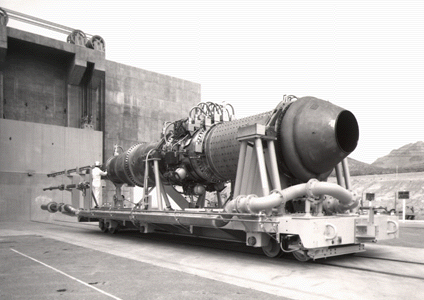
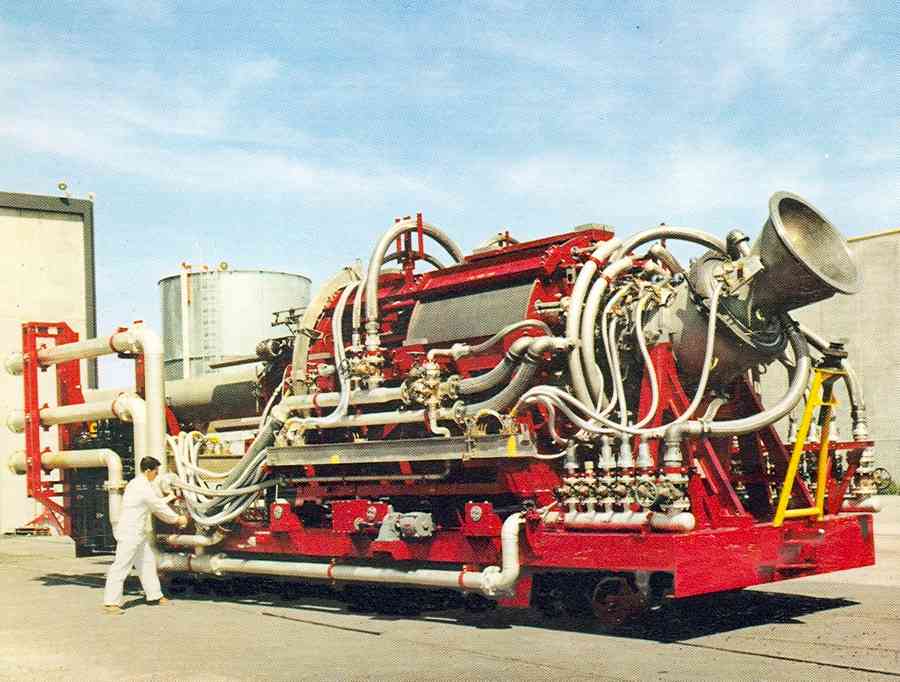
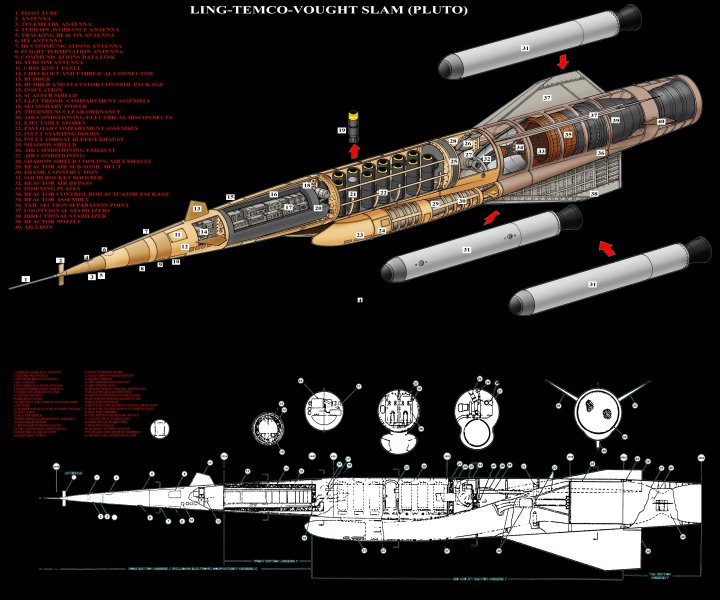
Quoted: Hell, bring back PROJECT PLUTO... http://www.thelivingmoon.com/47brotherthebig/04images/general/project_pluto_web.gif http://www.flatrock.org.nz/topics/info_and_tech/assets/tory_IIA.jpg http://up-ship.com/blog/wp-content/uploads/2008/06/pluto-promo1.jpg Just out of curiosity, is it necessary to have an "aerodynamic" shape to spacecraft? Wouldn't a big ass box hold more crap and be just as efficient? |
|
80% of the speed of light you could get places in one life time and back again relatively easily. i assume you would not go for that speed until clear or the meteor belt or had a way to clear the highway. at the speed of light it takes like what 5 seconds to reach the moon? So just getting the ship to impulse up speed would make getting to mars take a couple of hours? Hell at that rate things could really advance. Doesn't mars have some form of atmosphere and doesn't it rotate similar to earth on a "daily basis"? |
|
Quoted:
Quoted:
Hell, bring back PROJECT PLUTO... http://www.thelivingmoon.com/47brotherthebig/04images/general/project_pluto_web.gif http://www.flatrock.org.nz/topics/info_and_tech/assets/tory_IIA.jpg http://up-ship.com/blog/wp-content/uploads/2008/06/pluto-promo1.jpg Just out of curiosity, is it necessary to have an "aerodynamic" shape to spacecraft? Wouldn't a big ass box hold more crap and be just as efficient? In space aerodynamics should play little role. It's getting out of (and hopefully back into) our atmosphere that's the catch. |
|
Quoted:
I would be all for it. Hell, forget Alpha Centauri, we could explore every planet in this solar system in just a few years with Orion. Yep, Solar System first. We can send a probe to Alpha Centauri in the meantime. That priority of course changes quickly if we can find another Earthlike planet in that system with Kepler. If we find any Earthlike planets within a 10 light year radius, it's going to be a game changer in terms of exploration priorities. I can't imagine humanity finding another Earth and not gearing up to send atleast a probe to check it out. |
|
Quoted: exactly. there is no reason not to diversify where we live. with future communication technologies there is no reason we would not be able to stay in touch with relay stations etc sending the signal. I assume once out of our atmosphere a strong laser could go very far with little loss in signal?Quoted: I would be all for it. Hell, forget Alpha Centauri, we could explore every planet in this solar system in just a few years with Orion. Yep, Solar System first. We can send a probe to Alpha Centauri in the meantime. That priority of course changes quickly if we can find another Earthlike planet in that system with Kepler. If we find any Earthlike planets within a 10 light year radius, it's going to be a game changer in terms of exploration priorities. I can't imagine humanity finding another Earth and not gearing up to send atleast a probe to check it out. |
|
Quoted: Screw the Partial Test Ban Treaty! Bring back Project Orion!!! Later studies indicate that the top cruise velocity that can theoretically be achieved by a thermonuclear Orion starship is about 8% to 10% of the speed of light (0.08-0.1c).[1] An atomic (fission) Orion can achieve perhaps 3%-5% of the speed of light. A nuclear pulse drive starship powered by matter-antimatter pulse units would be theoretically capable of obtaining a velocity between 50% to 80% of the speed of light. At 0.1c, Orion thermonuclear starships would require a flight time of at least 44 years to reach Alpha Centauri, not counting time needed to reach that speed (about 36 days at constant acceleration of 1g or 9.8 m/s2). At 0.1c, an Orion starship would require 100 years to travel 10 light years. The late astronomer Carl Sagan suggested that this would be an excellent use for current stockpiles of nuclear weapons.[10] Beautiful... Only 44 years to Alpha Centauri!!! Only 44 years!!!!!!! How could we not attempt this!?! You gonna go? Send a group of 20 year olds, they reach AC when they're 64 years old, would have to had kids and grandkids to pilot it on the return flight back to earth. Why send them all the way out there if there's just a star and a 2 gas giants? We need to find the closest habitable earth-like planet, which might be 200 light years away, but then you're talking about a travel time as much as 2000 years! Cryogenics would be a field we should figure out way before any long ass space missions.
|
|
Quoted:
Quoted:
Hell, bring back PROJECT PLUTO... http://www.thelivingmoon.com/47brotherthebig/04images/general/project_pluto_web.gif http://www.flatrock.org.nz/topics/info_and_tech/assets/tory_IIA.jpg http://up-ship.com/blog/wp-content/uploads/2008/06/pluto-promo1.jpg Just out of curiosity, is it necessary to have an "aerodynamic" shape to spacecraft? Wouldn't a big ass box hold more crap and be just as efficient? That wasn't a design for a spacecraft, that is a robotic bomber that would fly at Mach 3 on the deck, dispensing sunshine in one megaton units along it's flight path. |
|
Quoted:
Quoted:
Quoted:
Hell, bring back PROJECT PLUTO... http://www.thelivingmoon.com/47brotherthebig/04images/general/project_pluto_web.gif http://www.flatrock.org.nz/topics/info_and_tech/assets/tory_IIA.jpg http://up-ship.com/blog/wp-content/uploads/2008/06/pluto-promo1.jpg Just out of curiosity, is it necessary to have an "aerodynamic" shape to spacecraft? Wouldn't a big ass box hold more crap and be just as efficient? In space aerodynamics should play little role. It's getting out of (and hopefully back into) our atmosphere that's the catch. Project Pluto is one of those "Gonzo INSANE" weapons systems proposed during the Cold War. It's not a spaceship. It's an unmanned supersonic nuclear ramjet bomber that needs no fuel, it just sucks in air, and makes it so hot that it's then shot out the back as thrust. In the poster above, you can see the nuclear bomb bay in the midsection. The three rockets alongside it are the solid fuel boosters that would get it up to ramjet speed. Downside was that it left a trail of fallout in it's wake from the superhot fission products running in the reactor.  So the design team just decided this was a "feature", and that once the bombs were used up, the Pluto would do low passes over more enemy targets to contaminate them on purpose, then finally crash itself into one last target as a dirty bomb. So the design team just decided this was a "feature", and that once the bombs were used up, the Pluto would do low passes over more enemy targets to contaminate them on purpose, then finally crash itself into one last target as a dirty bomb.
The made a prototype engine and tested it, but the project never got farther than that. I think it holds the world record as the ultimate "Fuck You!" weapon design, ever.  Except maybe that Soviet design of an automated supertanker fusion bomb, full of Lithium Deturide, that was to cruise the ocean and be a "final solution" to make sure if during WWIII Communism was defeated, it would go off automatically, and then kill everyone in the world with the fallout. Except maybe that Soviet design of an automated supertanker fusion bomb, full of Lithium Deturide, that was to cruise the ocean and be a "final solution" to make sure if during WWIII Communism was defeated, it would go off automatically, and then kill everyone in the world with the fallout.
|
|
Quoted:
Quoted:
I would be all for it. Hell, forget Alpha Centauri, we could explore every planet in this solar system in just a few years with Orion. Not to mention the big moons (Titan, etc.) Mine the rest of the solar system, it's for the children!  "ALL THESE WORLDS ARE YOURS EXCEPT EUROPA. ATTEMPT NO LANDINGS THERE." |

|
Quoted:
Quoted:
Quoted:
Hell, bring back PROJECT PLUTO... http://www.thelivingmoon.com/47brotherthebig/04images/general/project_pluto_web.gif http://www.flatrock.org.nz/topics/info_and_tech/assets/tory_IIA.jpg http://up-ship.com/blog/wp-content/uploads/2008/06/pluto-promo1.jpg Just out of curiosity, is it necessary to have an "aerodynamic" shape to spacecraft? Wouldn't a big ass box hold more crap and be just as efficient? That wasn't a design for a spacecraft, that is a robotic bomber that would fly at Mach 3 on the deck, dispensing sunshine in one megaton units along it's flight path. 

|
|
Quoted: Quoted: Quoted: Quoted: Hell, bring back PROJECT PLUTO... http://www.thelivingmoon.com/47brotherthebig/04images/general/project_pluto_web.gif http://www.flatrock.org.nz/topics/info_and_tech/assets/tory_IIA.jpg http://up-ship.com/blog/wp-content/uploads/2008/06/pluto-promo1.jpg Just out of curiosity, is it necessary to have an "aerodynamic" shape to spacecraft? Wouldn't a big ass box hold more crap and be just as efficient? That wasn't a design for a spacecraft, that is a robotic bomber that would fly at Mach 3 on the deck, dispensing sunshine in one megaton units along it's flight path. http://img831.imageshack.us/img831/9263/slam4.jpg http://img801.imageshack.us/img801/8437/slam2.jpg I don't suppose I meant expressly for that. But look at all of the SciFi designs. They're all aerodynamic. Why? |
|
Quoted:
I didn't see anything in the calculations about decelerating. half of the trip would be spent decelerating... this would increase the the travel time, unless you just wanted to do a fly-by Thats the thing about these advanced forms of spaceflight. You're going just too fast to decelerate the way we do now, such as aerobraking. You'd have to spend a long time accelerating, only a short time at your maximum speed, but then years decelerating. Now, if we just sent a fly-by probe to Alpha Centauri we wouldn't really need to decelerate that much as it can just keep on going afterward. It also wouldn't have to be safe for humans, so that takes a lot of the acceleration/deceleration complexity out of the picture. I say lets send the Fly-By now! We'll get back the information and glorious pictures within my lifetime! Can you believe that!?! Within a lifetime!!!!! Thats not even mentioning how awesome it would be to have a man-made probe traveling at near-relativistic speeds. |
|
Quoted:
I didn't see anything in the calculations about decelerating. half of the trip would be spent decelerating... this would increase the the travel time, unless you just wanted to do a fly-by In reality, the first trip would be a robotic one, and it probably would be a fly-by. |
|
Quoted:
I don't suppose I meant expressly for that. But look at all of the SciFi designs. They're all aerodynamic. Why? As you get closer to the speed of light, mass increases, thus the interstellar medium becomes denser relative to the ship and streamlining might be necessary. |

|
I went to KSC last month... just seeing that place now is depressing. What used to be the utmost pride of America with the most intelligent people we had now looks practically dead.
It is unbelievably saddening to go to that area knowing that when I was a kid the Space shuttle was the absolute shit and the pride I had. The things we were taught in school about space etc. Hell even before that, knowing that we sent people to the moon from that very location... Now.... pretty much dead, and a year from now even more so. I would love to see us use our brains and going to the moon and beyond... unfortunately I don't see it happening anytime with this administration. The saddest part is that after the moon we pretty much stopped trying to go further. The things we could have done in those past 40 years and the resources and intelligence we wasted. It makes me want to cry. The only escape we have from this planet is to know that there is so much more out there then we could ever imagine - that the dreams we had as children of space can be reality. |
|
Quoted:
Quoted:
I don't suppose I meant expressly for that. But look at all of the SciFi designs. They're all aerodynamic. Why? As you get closer to the speed of light, mass increases, thus the interstellar medium becomes denser relative to the ship and streamlining might be necessary. It's not friction in the atmospheric sense. And being "pointy" won't do you much good. The thin interstellar hydrogen that you do hit at relativistic speeds acts like cosmic rays. Which might actually be so energetic they zip right through people without harming them at all! However, they'll strike the ship's hull, interior structures, equipment, and set off secondary showers of slower radiation that will be quite lethal over time. And much rarer, but the occasional dust grain, or micrometeoroid would impact with the force of a nuclear bomb at those speeds. You either have to emit your own shield of gas or plasma and magnetic fields that's big enough to shove the interstellar medium aside, which takes lots of power. And if it's "connected" to your ship by magnetic fields, such a system may actually act like a brake on your velocity. Recent math indicates the interstellar ramjet idea is unworkable.) or you need to make a disposable shield of waste rock from asteroids, or ice from the Sun's comets in the Kupier Belt or Oort Cloud, and push it up to speed, then let it drift a few million miles in front of you clearing the way. Then when it's time to decelerate, you just let it go off on it's way, and make a new shield from local star system resources when it's time to return, or go on your next trip etc. In terms of Sci-Fi starships, the ISV design for ferrying troops and supplies in "Avatar" to the Alpha Centauri system was pretty factual in terms of being based on semi-realistic science. (other than the "unobtanium"superconductor itself used in it's engine from Pandora) It was a long strung out design so it used as little mass as possible, actually flying under tension with the engines pulling from ahead, and that way the unmanned engine systems and the radiation shield that protected the crew pod from the engines did double duty as a interstellar erosion/radiation shield too. It also had massive heat radiators to get rid of the waste heat from it's anti-matter engines. Other honorable mentions for realistic and/or semi-realistic space craft designs in movies are the Discovery from 2001: A Space Odyssey. It's long strung-out design kept the reactors and engines as far away as possible from the spherical crew pod at the front. Downsides to the design were no radiators, or visible source of fuel. Although Arthur C. Clarke did include them in his description of the Discovery in the book version of 2001. Another somewhat realistic design was the "Valley Forge" from Silent Running. It essentialy looked like a long TV broadcast antenna with lots of pods and equipment hung from it's length. The model/design was also reused in Battlestar Galactica as the "Agro Ship" on which the fleet grew it's food. Less realistic, but still not aerodynamic were the Nostromo in Alien and the U.S.C.M. Sulaco in Aliens. Even Star Trek had lots of non-streamlined designs. It looks silly now, but the original design of the Enterprise at least tried to represent the more realistic "Pod and Strut" look of realistic spacecraft designs, and to their credit, many of the designs of ships in the other series were not aerodynamic either. (although some were) |