


[ARCHIVED THREAD] - Federal Reserve is losing the ability to control interest rates - per Phil Gramm (Page 2 of 2)
|
Quoted:
Ponzi scheme right there. |
|
Quoted:
The last recession ended about ten years ago. Why do you think the Fed waited until Trump was elected to raise rates? Please enlighten us. Quoted:
Quoted:
The Fed lost the ability to control interest rates under Obama because they were practically 0 to help fix the last recession. Now that things have gotten better they are moving back to normal. There is no grand conspiracy against Trump. |
|
Quoted:
To be fair to drunken sailors, they generally stop pissing away money when they run out of it. Congress? Not so much. Quoted:
Quoted:
Quoted:
There's a reason every Fed Chair from Greenspan on has said the same thing over and over to .gov: 'YOU HAVE TO GET YOUR DEBT UNDER CONTROL' you can't keep printing money to pay for debt without either removing the value of the dollar or raising rates. Congress? Not so much. I can't even keep track of all the various something-for-nothing schemes going on between local/state/fed. Our economy is a high rise of cards. |
|
Quoted:
That's the only weird part, given the scale of the QE I would have bet that there would be much more inflation by now...that's probably a bad thing, or something in the system has changed and we haven't caught on yet.  |
|
Quoted:
Interesting perspective from Phil Graham. Basically the Fed is sticking the current economy with bills from the Obama days. The Fed bought bonds under the "quantitative easing" program during the Obama administration. Now the Fed is raising interest rates, while simultaneously flooding the market with those bonds at lower prices. The only reason the bonds are worth less is because the Fed is raising interest rates. https://www.cnbc.com/2019/01/02/the-fed-is-losing-its-ability-to-control-interest-rates-former-senate-banking-chief-says.html |
|
Quoted:
He called the stock market a bubble. Then went on to claim the ramp up. That is the problem and they will hang him with it. https://www.AR15.Com/media/mediaFiles/200878/DEzj6n3XUAE9tqa_jpg-793934.JPG https://www.AR15.Com/media/mediaFiles/200878/tumblr_pa6i4lbBhs1we4t2no1_640_png-793935.JPG |

|
Quoted: Why was it unreasonable and unhealthy? We have seen incredible growth for an abnormally long period of time. For the past two years everyone here has been giving Trump the credit for the market performing so well. We wouldn't have had that if the fed had raised rates and dumped their bonds sooner. So which is it? You can't praise Trump for one side of the coin and then blame the fed for the other whenever it suits your narrative. If their goal was to tank Trump why did they wait so long into his presidency? He might not even be in the White House by the time we really feel the change. This is nothing more than an attempt to move toward a more rational and healthy economy. The closer we get to that the better off we will be when another recession hits because we will have regained some of the tools for smoothing that recession. In a free market interest rates are based on the supply of savings. As more people start saving money, interest rates naturally go down in order to encourage lending. As lending increases, interest rates naturally rise to encourage savings to back up more lending. There is a healthy balance. When the Fed lowers interest rates artificially, the rate no longer reflects the true state of consumer demand or economic conditions in general. When the rates are artificially lowered, the public has not actually increased their savings or indicated their desire to lower present consumption. These manipulated interest rates encourage the public to make investment decisions that would be unprofitable in normal market conditions. The easy credit deceives businesses into thinking that it is a good time to invest in long term projects. They think that these long term projects will be profitable in the future even though, in reality, the public has given no indication that they have chosen to postpone consumption to free up resources that businesses can devote to these long term projects. The artificially low interest rates create distortions because it encourages the public to save less and consume more, while at the same time, multiple long term projects are being started which require future resources and savings to be profitable. It creates a bubble. When companies get close to completing these projects, they find that the resources necessary, like materials and labor, are not available in sufficient quantities and that the real pool of savings is less than they anticipated. The prices of parts, labor and resources therefore get higher than entrepreneurs expected and business costs rise. Firms then need to borrow more money in order to finance these unanticipated higher costs and the increase in demand for borrowing forces the Fed to play its hand and raise interest rates or suffer from rampant inflation. At this point, reality sets in as many projects cannot be completed because the economy is not wealthy enough to fund them all. The artificially low interest rates misled investors into thinking that it was. The boom that previously existed with a higher standard of living, new construction everywhere and business expansion, is revealed to have malinvestment which must be correct during the subsequent bust. The corrective part of the bust (recession), wipes out the unsustainable investments so that savings can be rebuilt and so future projects can be funded on a sound foundation. Deflation is a necessary part of the corrective part of the bust as it helps liquidate all the debt and rebuild a pool of savings to get the economy going in the future. Instead of enduring a little more pain and having a legitimate recovery, the fed used artificially low interest rates, QE and stimulus to spur the economy and get people back to their same reckless spending habits, which is fueling the next massive bubble. That's why the market screams bloody murder at a modest rate hike. Rates are currently 2.25% during a period of time when the economy is roaring, but the market shits bricks even at the notion of modest hikes because they are so hooked on the cheap credit crack that Obama and Bush's fed was feeding them for the last 10 years. Interest rates historically average around 5%. If Powell were to indicate that he was targeting 5%, how would the market react? A lot of the growth we have experienced over the last several years is not legitimate. Trump was right when he called the economy a "big fat ugly bubble" during the campaign. Thanks to the low rates, consumers are hooked on credit like it's crack. $1.5 trillion in student loans. Over $15 trillion in mortgage debt, which is greater than the peak before the housing bubble burst. Over a trillion in auto loan debt and credit card debt, surpassing previous peaks. Savings rates at record lows. 44% of Americans couldn't even come up with $400 for an emergency. 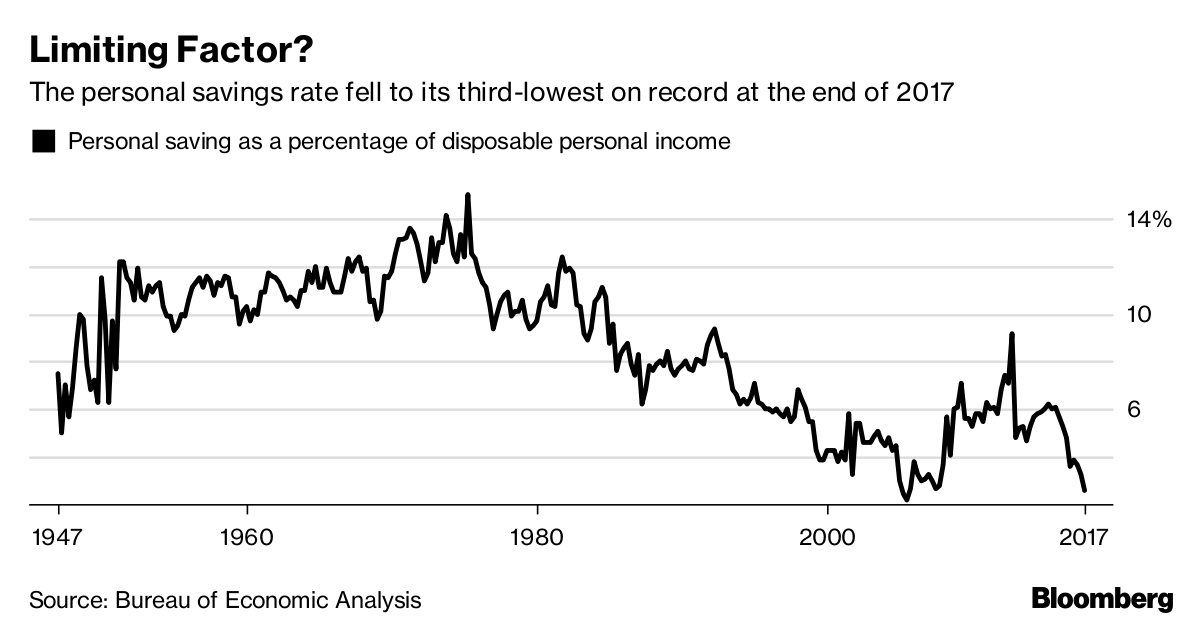
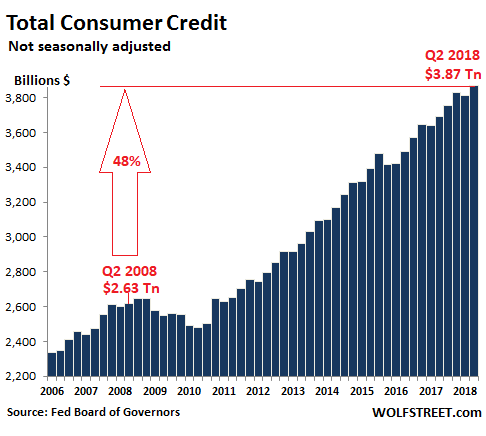
The economy is hot because people are spending. But are people spending because they are genuinely wealthier and have a lot of savings, or are they spending because they are able to make the payments thanks to lower interest rates? As interest rates have fallen, household borrowing has increased dramatically because people feel more comfortable borrowing money. As a result, families have relied more on borrowing than on savings to fuel their consumption. This applies to businesses as well. How many companies are out there that have nary made a profit in a single year, but continue to putter on by promising investors future returns and keep loading up with debt? Is that sustainable? The more interest rates rise, the more expensive it is going to be for households, businesses and the government to borrow, and in many cases, the more expensive it is going to be for them to meet their current obligations. All of this is going to happen at a time when households have very little savings, if any, to fall back on. In many cases they consider their "savings" to be the paper wealth that is currently floating in their 401k's. As interest rates rise, people will realize they can't borrow as much and will rightfully be forced to start saving money, and in many cases default on some obligations that they simply can no longer afford to pay for. As people spend less, companies become less profitable, many go under, people lose their jobs, and the problems compound. We're in a bubble. Let's say you have two friends who both make $150k a year. One friend has a very modest 2012 Camry. He has a no-frills paid off home worth $225k. He has a few million dollars saved, his kids 529 plans are fully funded, if he lost his job tomorrow he could comfortably meet his obligations for the next 15-20 years without work. The other friend just financed a nice brand new $80k Denali for his wife, and he's driving a new 5 series. He lives in a nice new $850k home which is 25 years away from being paid off. He and his wife and kids just got back from an amazing 2 week vacation in Europe. He and his wife have $15k in the bank. If he lost his job tomorrow he'd be in deep shit within a few months. One person is spending more, and appears to be doing better. Regardless of how they appear, what they drive, and how much they are spending, they are NOT as well off as the first person who has been saving and living within their means. Our economy appears to be doing well because people are spending like friend #2. But how sustainable is that? |
|
Quoted:
The Fed doesn't control interest rates. The Fed can charge banks more interest on loans taken to meet reserve requirement. The banks have $1.6 T in excess reserves on deposit with the Fed. No major bank is borrowing to meet reserve requirements. The Fed has "raised interest rates" because the banks which own it want to raise their rates. The Fed is nothing more than providing cover for those banks to fool the uninformed ... with the help of the media. |
|
Quoted: Because we aren't just a money-driven economy any more, we are a credit-driven economy too, so when you talked inflation you need to consider total money supply (money + credit). Even an increase in the money supply like QE can't offset the massive contraction in credit that occurred since 2008, partly because America worked to pay off debt following the crash and partly because credit restrictions tightened, removing huge portions of the population from the credit pool. 0% interest rates only helped businesses and people with good enough credit to quality, exactly the people that don't need credit. There is a whole school of thought that we have actually been fighting deflation for the past decade due to the contraction in the credit supply. The credit explanation doesn't wash...both money supply and credit have expanded...dramatically. I've long had a theory that most of it was buried in the markets...how many trillions of wealth have been sunk into a market that expanded for 10 years? It didn't actually hit the real economy...or most of it didn't. There is a dramatic disconnect between the market and the real economy. Hence why there isn't much inflation in the real economy. |
|
Quoted:
Please tell us what interest rate the Fed raised recently. Please cite the statute or regulation which empowers the Fed to order banks to raise the rates they charge for loans. If you look past the propaganda you are fed every day you just might learn something. Mortgage rates (and any other rates which have gone up) increased because lenders decided to charge more interest. you just won 2019 and it's only the 2nd of January. above exemplifies, 0) complete cluelessness regarding the Fed's recent actions. 1) a misunderstanding of what and how the Fed does what it does 2) tinfoil regarding "the propaganda" 3) the idea that lenders can simply raise mortgage rates because they decide to charge more interest. let's explore the silliness of that last point for a moment. lenders need to have customers -- that is, people or companies to loan money to -- otherwise they would be out of business. to attract these customers, the lender has to offer something that is attractive to the customer. in other words, just like apple has to productize shiny iPhones which sell, a lender has to productize mortgages which sell. in either case, if they fail to productize in a competitive manner, their customers will go elsewhere. that said, there is no technology "moat" in mortgage lending. customers don't engage with a lender because their friends use that lender or that lender will make them look skinnier or because that lender offers millions of songs thru itunes. practically the only way for a lender to differentiate their product is through two parameters: duration and rate. so take two lenders, Spacely Loans and Cogswell Mortgages. these two companies advertise to perspective home purchasers the following: Spacely Loans: 30 years FIXED at 4% APR. Cogswell Mortgages: 30 years FIXED at 7% APR. the reason that Cogswell Mortgage loans are currently at 7% is because Mr Cogswell "decided to charge more interest". ... i hope i don't have to draw you a map from here, but based on what you wrote above it's probably going to be necessary. ar-jedi |
|
Quoted:
Interesting perspective from Phil Graham. Basically the Fed is sticking the current economy with bills from the Obama days. The Fed bought bonds under the "quantitative easing" program during the Obama administration. Now the Fed is raising interest rates, while simultaneously flooding the market with those bonds at lower prices. The only reason the bonds are worth less is because the Fed is raising interest rates. https://www.cnbc.com/2019/01/02/the-fed-is-losing-its-ability-to-control-interest-rates-former-senate-banking-chief-says.html Read the book, Secrets of the Federal Reserve by Eustis Mullins |