


Posted: 6/18/2008 9:47:52 AM EDT
|
www.npr.org/templates/story/story.php?storyId=91582619 Chief Deputy Eddie Ingram is a devout believer in highway traffic stops. His theory is that criminals have to be mobile. They're moving between crimes, they're carrying contraband, and they're bound to slip up. When drivers are stopped for moving violations, they shouldn't be treated simply as speeders — they should be regarded as possible felons. "You get a lot of burglars, rapists, murderers, armed robbery suspects, child molesters when you're out here workin'," Ingram says. "It's not just the drug couriers or the money couriers we recognize; it's everybody." But it's the money couriers who have made Ingram famous in law enforcement circles across the South. He calculates that he and the officers he has supervised have discovered more than $11 million in drug assets in the past 15 years. Much like the rules for treasure hunters, police agencies that make a seizure can keep up to 80 percent of it, and many police agencies have grown to rely on confiscated drug money. "If you get money, God bless America," Ingram says. "It's a wonderful thing. Taking drug money and using it for the good that the taxpayers don't have to pay is the best thing in the world. But that ain't what our sole purpose in life is. If all I wanted to do was get money, I know how to get out there and get all the money I want." The Rainmaker Ingram works for the sheriff's department in Barbour County, Ala., about 77 miles south of Montgomery. His record at sniffing out drug money has made him a valuable addition to every law enforcement agency where he's worked. One federal agent called him "a rainmaker." At lunchtime, you'll most likely find Ingram at Phil's Barbecue in Eufala. "They ain't nothin' bad here, at all," he says. "I eat here about four days a week." He'll be sitting at a table in the back with his husky son, Jesse, who's a new deputy, hunched over a plate of chicken salad with a cup of sweet tea. Father, son and Sheriff Leroy Upshaw push back from the table after lunch, working their toothpicks thoughtfully. "Take the sheriff," he says, motioning to his boss. "If I come in here and bring him $100,000, he gon' be jumping up and down? Absolutely. If I bring him 4 or 5 kilos, is he gon' be jumping up and down? Not as high." The Barbour County Sheriff's Office exemplifies the situation found in many law enforcement agencies, particularly in the South: Many police agencies have grown dependent on confiscated drug money — an outcome specifically discouraged by state and federal laws. Seized assets are supposed to be only a supplement. But Upshaw was blunt. "We're a very poor department. The county commission don't give us much money," he says. "In fact, they don't allow us any money for equipment. So we use seized drug money to buy basic items that should be provided to us, such as bulletproof vests, gun belts, guns. Nine out of 14 cars been bought with drug money." Ingram adds, "I can't think of a county anywhere I've evngram adds, "I can't think of a county anywhere I've ever worked that needed it worse than we do right here … to be honest with you." Stress-induced Indicators Later, Ingram climbs into his white Ford Crown Victoria and heads out onto U.S. Highway 431 — the main north-south thoroughfare through Barbour County. "I look for things that just are different, and there's no one way to explain it, there's no one indicator. I just look for people that try to fit in that make themselves stand out," he says. Without giving away his secrets, here's one thing Ingram looks for: If the speed limit is 65 mph, most people will drive 75 mph. But someone wanted by the law will go 65 or less, and avoid eye contact with a cop who pulls up alongside. Ingram calls them "stress-induced indicators." Ingram has gotten so good at spotting suspicious vehicles that he formed his own training academy in 1998. He figures he's trained 15,000 to 20,000 officers, some of whom now run their own seminars. After the classroom portion of the training, Ingram takes his students out on the highway for hands-on experience. If they make a stop and find hidden currency, the Barbour County Sheriff's Office gets to keep 40 percent. The Drug Enforcement Administration frowns on this arrangement — one agent in Birmingham called it "mercenary." Ingram asserts it's perfectly legal and that other highway interdiction trainers across the South do it, too. "That's a pretty questionable practice. It's not piracy, we're not flying the Jolly Roger here, but it's at best privateering," says Jack Killorin, the Atlanta-based chairman of the Domestic Highway Enforcement Project, which is part of the White House drug czar's office. 'They Can Kiss My Tail' Controversy has sometimes shadowed Ingram. Earlier this decade, when he was a captain on the highway interdiction team at the Villa Rica Police Department in Georgia, on Interstate 20 about 30 miles west of Atlanta, there were complaints of racial profiling. The Justice Department investigated, found problems and appointed a monitor to oversee improvements. When asked about this, and about his reputation for pushing the envelope of highway interdiction, Ingram bridles. "If anybody faults me getting out here and trying to make a difference, they can kiss my tail," he says. "And I don't care who it is. I raised my children. That boy you met this morning? His mother's dead on account of drugs. I hate drugs, I put three of my first cousins and my brother-in-law in prison, and I'll put yours in prison." He then tells the story of his ex-wife, Cynthia. According to him, she became a meth addict and died in a drug-related accident in 1998, after they had divorced. The next year, his friend and mentor, Capt. Robbie Bishop, was shot and killed during a highway interdiction stop in Villa Rica. "I was always dedicated, more or less," Ingram says, "but [those deaths] really focused me on what needs to be done out here." Ingram is cruising Highway 431 looking for smugglers when a call comes in for a backup to a traffic stop. He guns his Crown Victoria and flies past an antiques store, a public library and a VFW post, coming to a stop in front of a church marquee that reads, "Jesus is coming soon." A thin woman in a polka-dot blouse and jeans, holding a baby, stands beside a dented sedan. The sheriff is interviewing her, while her glowering husband stands nearby. "I ain't had nothin' to drink but one beer at 6 p.m. — four, five hours ago. You can gimme a Breathalyzer or whatever," she says, indignantly. Ingram crawls into the back seat and with a swift, practiced technique searches the seat cushion, the baby carrier and the floorboard. The driver holds her infant on her hip and rolls her eyes. "I don't even do crack cocaine, that's crazy!" she protests. When Ingram doesn't find any drugs, he smiles and tells her, "Have a good day. … Don't drink no more." "OK, I won't, I promise," she answers with relief, as she climbs back into her car. Then Ingram drives back toward his favorite spot on the grassy median, where he'll sit and wait, to see what the highway brings him. 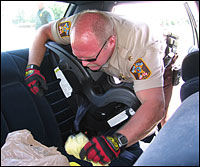 Always Think Forfeiture  I almost went off the road yesterday when I heard this part 
 Yeah when I'm cruising through East Buttfuck and a deputy pulls up and gives me the fish eye I'm really going to stare him down. Yeah when I'm cruising through East Buttfuck and a deputy pulls up and gives me the fish eye I'm really going to stare him down. 
|
Nothing like telling all the drug dealers you took money from, precisely when and where you eat lunch every day. 
|
| You see, I have no issue with this. Growing up in Austin where cops had little to do, I got hassled all the time. All I would have to do to stop that was drive down 71 to Houston where the cops had real jobs and as a normal-looking, law-abiding, polite guy I was completely ignored. People like that cop ignore me. |
|
This is a good one too www.npr.org/templates/story/story.php?storyId=91555835 he law states that authorities can confiscate your money without ever charging you with a crime, as long as they can prove it's tied to illegal activity — but sometimes it happens even when they can't. Jim Wells County in the southern tip of Texas, named for a 19th century political boss, has one of the most successful and aggressive highway interdiction programs in the state. In the past four years, authorities have seized more than $1.5 million, primarily off of U.S. Highway 281 — a prime smuggling route for drugs going north and money coming south. "We've been working southbounders for the money and weapons that are going back to Mexico," says Capt. Ray Escamilla of the Jim Wells County Sheriff's Office. His office wall is covered with pictures — not of dope busts, but of piles of confiscated cash. He recalls some of the big ones: "October 2001, $105,000. November 2003, $99,000. October 2004, $668,000." By seizing money from drug cartel couriers, the sheriff's department — once underfunded and poorly equipped — now can rely on drug assets for a third of its budget. "We've helped the schools [with] cops in school [and] vehicles," Escamilla says. "I think every year we've bought three to four vehicles, all of our equipment, guns, high-powered rifles, all bought with forfeiture funds." But has Jim Wells County become so reliant on seizing drug money that it's shaking down innocent motorists? "You don't want to take the money from any John Doe," Escamilla says. "If you can't prove that it's been a criminal activity, reasonably suspicious, probable cause, you don't want to take it, 'cause it'll look bad in court." And that's what happened in the case of Javier Gonzalez — it looked bad in court. 'Did I Just Get Robbed?' On Oct. 20, 2005, Gonzalez says he was driving south on U.S. Highway 281 from Austin to Brownsville to look at a car and buy a gravestone for his dying aunt. Gonzalez, who owns a car lot, was carrying $10,032 in a briefcase. "As I was driving south, I noticed a dark bluish unmarked car that was taking radar. He basically got behind me, followed me for a while," he says. About 90 miles north of the Mexican border, two sheriff's deputies of the Jim Wells County Task Force pulled him over for driving without a front license plate. "He asked me to get out of the car. I did," Gonzalez says. "He asked me for my driver's license and insurance. I gave it to him. He asked me if I had weapons, drugs or large amounts of money. I told him I did." The police video shows Gonzalez with a shaved head, wearing baggy shorts, standing beside a Mazda. The incident report states the deputies grew suspicious when Gonzalez and his passenger both appeared nervous, and a drug-sniffing dog signaled the presence of drugs. The deputies took them in for questioning and searched the car. They found no drugs or weapons. Though Gonzalez said he was a businessman and showed them a credit card printed with the name of his car lot, the officers didn't believe him. "He suspected we were using the money to go south and buy drugs," he says. The deputies handed Gonzalez a waiver: If he signed over the money and did not claim the currency, he could walk away free. If he did not sign the waiver, he would be arrested for money-laundering. Gonzalez signed the waiver and gave up rights to his money. "So at that time we got in our car and we left, still trying to figure out what just happened. We got officers that took our cash. We got officers that told us we can't get an attorney. So I'm thinking, are these guys officers of law? Did I just get robbed of my money?" Gonzalez hired an attorney, who filed a federal civil rights lawsuit. The county fought it, and lost. In April, the county returned his $10,032 and paid him $110,000 in damages, plus attorney's fees. A Preponderance of Evidence Ron Barroso, a longtime criminal defense attorney in nearby Corpus Christi who was not associated with the case, says, "I believe a lot of these stops are fishing expeditions, nothing more. They figure they stop enough people out there that they can profile, for whatever reason, sooner or later they are going to hit on something." Civil forfeiture is different from criminal forfeiture. In criminal forfeiture, the taking of property is usually carried out after the owner is convicted of a crime. In civil forfeiture, the government seizes the property — in this case, the currency — without ever charging the person with a crime. The government must show by a preponderance of the evidence that the money is dirty; then it's up to the owner to prove that his cash is clean. San Antonio attorney Michael McCrum, a former federal prosecutor and police officer, says he believes the system is tilted against the property owner. "The laws are made now such that anybody that has cash seized from 'em, the burden of proof shifts over to the person whose money is seized to prove that it's legitimate money. And frankly, a lot of people don't want to declare they have a lot of cash, for other reasons not related to drug trafficking," McCrum says. Which leads us to the second case — Christopher Hunt, a 28-year-old African American who owns an auto-detailing business in Atlanta. 'It Looked Like Drug Money' Here, the facts are more complicated than the Gonzalez case. On Sept. 2, 2007, Hunt says he was driving south on I-75 through central Georgia on the way to see his mother in his hometown of Dublin. Hunt was wearing his hair in braids and driving a friend's orange Dodge Charger, when two Lamar County sheriff's deputies pulled him over for speeding. The police video shows the deputies and Hunt standing beside the interstate, arguing. The incident report states they became suspicious when they saw that Hunt had a licensed handgun lying on the console, and that he had bloodshot eyes, his hands trembled, and he and his passenger gave evasive answers when questioned. But what really got their attention was the $5,581 Hunt had stuffed in his pockets, which he said was the weekend profits from his car-detailing business. In the police video, one deputy says, "Look man, here's the deal. We're gon' take this money into our possession, OK?" Hunt responds angrily: "Oh no, I'm not giving you authority for you to take that money into your possession." The deputy, emphatically: "I'm taking the money," and he informs Hunt they'll take it back to the department to count it again. "They just told me it looked like drug money, that was all," Hunt says. The deputies found no drugs or alcohol in the car; Hunt was not arrested for any offense, nor was he written up for a traffic violation. The U.S. attorney's office in Macon, Ga., has now initiated proceedings to keep Hunt's money based on probable cause that it is "proceeds traceable" to "a controlled substance." Among their strongest evidence: * The deputy smelled burned marijuana. * The deputy observed "an untestable" amount of what appeared to be marijuana on the floorboard. * Drug dogs detected drug residue on the currency when it was brought back to the station. Hunt has not been charged with any crime as a result of the traffic stop. So the question arises: Why is the government trying to take his $5,581? The federal prosecutor refused to comment because the case is pending. He has offered to return half of Hunt's money. But Hunt's attorney, David Crawford, says they want all of it back and that they're considering a civil rights lawsuit. "It's an abuse of power, and we're not gonna let them hide behind their police powers and the legal system. We're gonna keep pursuing this until we get justice," says Crawford. Hunt concludes, "It was my hard-earned cash. They had guns and badges and they just took it. If I would have been a drug dealer, I would have just left them and let them have the money." NPR showed this case to attorney David Smith of Alexandria, Va., a former deputy of the asset forfeiture section in the Justice Department and an author of two volumes on forfeiture law. "I can tell you I never see a complaint like this filed in the Eastern District of Virginia. In fact, even if they had loads of evidence, they'd probably hesitate to file a complaint against $5,000 just because it's a waste of time. But to file it when there's so little evidence, as in this case, is really striking," Smith says. NPR examined 14 other federal currency forfeiture cases from Lamar County, Ga., over the past four years. In some of the cases, the drivers had prior felony convictions for narcotics. But there are other cases similar to Hunt's, in which the government confiscates the money because the car smelled like marijuana, the deputy said they acted nervous, they were carrying a wad of cash, and a drug dog alerted on it. "Something is rotten down there, I can tell you that," Smith concludes. Government Says Safeguards in Place Forfeiture abuse is nothing new. In the 1990s, the media reported stories of police running roughshod over the rights of innocent property owners. It led to the Civil Asset Forfeiture Reform Act of 2000, or CAFRA, which was supposed to raise the government's burden of proof before it could seize a person's property. The government maintains those reforms worked, that safeguards are in place, and individuals can challenge a seizure — just as Gonzalez and Hunt did. "I think a lot of people thought after passage of federal reform law that most if not all problems with civil forfeiture were solved. And I simply don't think that's the case," says Scott Bullock, senior attorney at the Institute for Justice, a public interest, libertarian law firm in Washington. Smith, who helped write the CAFRA reforms a decade ago, adds, "There's still a lot of abuse. There are large parts of the country where prosecutors can get away with bringing bad cases because judges tolerate them." The reason you don't hear about more abuses, he says, is that a person has to hire an attorney to challenge a forfeiture, and a lawyer often charges more than the amount of the seized cash. Under CAFRA reforms, if the government loses a civil forfeiture challenge it must reimburse the lawyer, but many individuals may be unaware of this fact when they decide not to pursue their money. Richard Weber, chief of the asset forfeiture section of the Justice Department, was asked if he found these cases troubling. They're insignificant, he said, compared with the thousands of traffic stops where major drug money couriers are busted. "What's troubling to you?" Weber asks. "That a drug trafficker who's bringing money from the U.S. to Mexico, who's carrying hundreds of thousands of millions of dollars in cash in their pickup truck, who just sold dope and crack and cocaine to children in your playgrounds, and his money is being taken away? That troubles you?" |
|
In March 15, 2007, Michael Annan was driving his black Nissan Maxima south on I-95 through southeast Georgia. He had just gotten off his job on a dredging barge and was on his way home to Orlando, Fla., when he was pulled over for speeding by deputies in Camden County, just north of the Florida state line. Annan, a 40-year-old immigrant from Ghana, was carrying $43,720 in hundreds and fifties rolled up in a sock in the pockets of his overalls — everything he had saved from nine years of work in Florida and Georgia. But because he did not trust banks, or his then-wife in Orlando, Annan was carrying his life savings in his pocket. "They open my car engine and they try to find something," Annan said in an interview from Brunswick, Ga. "But I don't have nothing in my engine, and I don't know what they thinking. … After that, they said they would take me to the office." At the sheriff's office, a drug dog was brought out to sniff his car, but it detected no narcotics. Annan says he showed them a pay slip from his employer, Great Lakes Dredging. Annan had no drug arrests. Undeterred, the officers confiscated the money anyway, explaining they needed to investigate whether it was drug money. They said he could call them back in two weeks. Annan says he did call back, a half dozen times, but that no one would help him. So he took a day off from work to drive to the county seat of Woodbine, Ga., to visit the sheriff's office in person. He said they told him they were too busy to see him. So he hired an attorney in Brunswick, who faxed Annan's work records and tax returns to the sheriff's office as proof he wasn't a drug dealer. Camden County then returned his money. The lawyer charged him $12,000 — more than a quarter of his savings. "I think maybe they see money like that … maybe they thought I was dealing with the drugs … how can a black man have this much money in his pocket? I think they robbing me, I can't understand they can stop someone and take his money," he says in heavily accented English. His attorney, Paula Crowe, who is familiar with Camden County, says that in her experience, she's sure Annan never would have seen his money again had he not hired a lawyer. Lt. William Terrell, of the Camden County Sheriff's Office, said the highway interdiction team was just doing its job. "The deputies, with all their training and experience, were acting in good faith as sworn officers doing their job. They were not trying to take Mr. Annan's hard-earned money, they were simply trying to verify that the $43,000 was not money made in a drug transaction." Camden County has an aggressive highway interdiction program that has earned the sheriff's department more than $20 million over the past decade and a half. Sheriff Bill Smith — once considered one of the most successful sheriffs in the nation at confiscating drug money off the highways — is now the subject of a federal grand jury investigation into whether he misused the forfeiture funds. "To use this one incident to paint a picture of our agency is neither accurate nor fair," Terrell says. "We have seized millions of dollars that did indeed belong to the drug cartels. We have also seized thousands of pounds of cocaine, marijuana and all the other drugs that plague our society." |
When the mob does something similar we call it extortion. But I'm sure the officers are working under orders. |
Yep, Mr. Killorin, you're exactly right. |


|
I have been through there. I speed like a MOTHERFUCKER through those areas, Zero people, straight roads, broad daylight... Why not? Especially when I am on my way to the beach for vacation in Destin. So I guess I am a two-bit, murdering, raping, meth dealer that is hell bent on anarchy and I also drive a car filled to the brim with cash. I wonder if these fuckers have 50K dollar bass boats? |
|
I have a friend that was raised in Chicago..he is LEO down here in Oklahoma.....He is one of the good guys that does not believe in doing this kind of police work....he has a lot of family members in Chicago PD.....from patrolman to detectives.....a year and a half ago me and him went to Chicago for two weeks...... I was LEO also at the time we swap stories of things that happened and both me and my friend were shocked at some of the stuff they did...... in example....stop a teenager with more than $50.00 cash on him...take the cash and issue a receipt...telling the teenager to get the money back their parents had to go to the station and file paper work showing where the money came from.....I have no way of knowing if this is a true story or common practice....but I thought then and still do now it is all kinds of levels of wrong and fail..... what was even worse was that while they claim to never have done it they told of many times how the "receipt" is not given.... |
No, actually Deputy Short Shorts would assume you were a decent, law abiding citizen with very little cash for him to filch. Only the evil-doers obey the speed limit, according to him. |
We're told often that just obeying the law will keep you from having to deal with the police, get pulled over, etc, when in fact complying with traffic laws is seen as suspicious behavior. |
Growing up in Austin I heard that from cops a lot -- "You used your turn signal. That's suspicious." In Houston, driving properly gets you ignored by the cops. It completely depends on the department. |
|
One of my best friends used to work interdiction. He had one added asset - his partner was a k9. Pretty sure his partner attended every speeding stop he made. I don't think he was actively seeking forfeitures - but I know we both grew up very anti-drug. He took a lot of pride of what he took off the street. I think he mentioned one bust which was around 100 kilos - the stop based on "professional judgment" (no speeding/laws broken). I do not even know if the drugs were admissible as evidence - and the drivers were only mules anyway. |
You see -- profiling works. But you can't have dumbasses doing it. |
I've never been pulled over when I was obeying the law. I've been pulled over multiple times that I wasn't. Outside of that(and a couple of other instances), the only interaction I've had with on duty LE was a sheriff's deputy who checked my ID. We had a yard sale and had just finished putting stuff into what used to be my grandmothers house. It was dark and we were walking across the yard. I didn't have a problem with it then and I still don't. Since we live in a rural area, I'm glad to see he was paying attention to what was going on---we rarely get any LE out here unless they're called. |

|
So let me get this straight... I am the one obeying the speed limit, therefor I am the suspect? What a bunch of crap. I guess I'll start driving 10mph over like everyone else then. And to think that I somehow felt that I was helping LE by driving at a safe rate of speed.... 
|
This thread is about people who are legally carrying large amounts of legitimately earned cash, who are having it siezed by cops who only have to claim that they believe it's drug money in order to keep it. I'm just going to assume, based on your anti-drug comments, that you must be a drug dealer. If you don't sign over the deed for your house to me, my SWAT team will arrest you for being a drug dealer, and burn down your house with tear gas grenades. And I won't pity you, because you're a low-down dirty drug dealer. |
Criminal asset forfeiiture is all that is needed. Civil asset forfeiture needs to be done away with, as the three articles Aimless posted proves. Don't use a tool responsibly, get the tool taken away. Simple as that. |