


Posted: 12/20/2012 10:57:43 PM EDT
|
Howdy gents. I have a trio cables running from the house to the garage and I'm not sure if they're electrical or telephone. Specifically they're 3 pairs of cables, one seems to be a line used to support the other.
I suspect they're phone because it appears that power is coming off of the street and running to the other side of the garage. But I want to be sure. Anyone have an opinion based on the below photos? 

Thanks! |
| What you have there would politely be called a mess that should be replaced. It definitely looks like power, not phone or cable, and it also looks to be relatively recent since it appears the clear outer jacket of the insulation on at least one of the wires has deteriorated and is separating. Wires from the era when they routinely used a three wire drop like that did not have an outer jacket which is what makes me think it's relatively recent. I would expect if that exists at this place there are likely a whole lot of other issues as well to worry about. I didn't see why you were asking about this, but if it's a house you are looking to purchase expect to have to redo the bulk of the electrical ASAP, or just look for a better place. Redoing the electrical isn't that expensive if you can do it yourself, if not the labor adds up fast and given your question I suspect you wouldn't do it yourself. |
|
It's not just a mess, it's damaged. That insulator should not be allowed to just hang like that. Shut off the power and get it fixed, ASAP.
To me, it looks like the entire crossbar thing is crap and should be completely replaced. I'd guess you have 2 phase AC power plus a neutral. |
|
Quoted:
It's not just a mess, it's damaged. That insulator should not be allowed to just hang like that. Shut off the power and get it fixed, ASAP. To me, it looks like the entire crossbar thing is crap and should be completely replaced. I'd guess you have 2 phase AC power plus a neutral. That whole installation is just...wow. |
|
Quoted:
It's not just a mess, it's damaged. That insulator should not be allowed to just hang like that. Shut off the power and get it fixed, ASAP. To me, it looks like the entire crossbar thing is crap and should be completely replaced. I'd guess you have 2 phase AC power plus a neutral. Normal US residential power is single phase, 120/240 V. It is called an 'Edison circuit' or split phase system, bu it is NOT 2-phase. |
|
Looks like the old feed from our house to the garage before we took it out at my house. Our house did not have a circuit breaker for it, but a small fuse box in the attic along one of the outer walls (that we've now killed and pulled), so if you don't have a breaker for it, maybe look for that.
|
|
Quoted: [snip] I'd guess you have 2 phase AC power plus a neutral. I thought substantially all residential service was single phase & it was virtually impossible to get 3-phase at a residence. Is there such a thing as 2-phase residential power? Or do you mean 3-wire single phase? |
|
Quoted:
Quoted:
[snip] I'd guess you have 2 phase AC power plus a neutral. I thought substantially all residential service was single phase & it was virtually impossible to get 3-phase at a residence. Is there such a thing as 2-phase residential power? Or do you mean 3-wire single phase? Many folks confuse the two poles / polarity of the center tapped 120/240V service as two phases when they are a single phase 240V supply with a center tap neutral. Relative to the neutral the two hot legs are opposite polarity but are in phase. I hear in Switzerland they actually have residential three phase as standard. |
|
Quoted: Quoted: Quoted: [snip] I'd guess you have 2 phase AC power plus a neutral. I thought substantially all residential service was single phase & it was virtually impossible to get 3-phase at a residence. Is there such a thing as 2-phase residential power? Or do you mean 3-wire single phase? Many folks confuse the two poles / polarity of the center tapped 120/240V service as two phases when they are a single phase 240V supply with a center tap neutral. Relative to the neutral the two hot legs are opposite polarity but are in phase. I hear in Switzerland they actually have residential three phase as standard. That's what I thought. Thanks for the clarification. |
|
Quoted:
Quoted:
Quoted:
[snip] I'd guess you have 2 phase AC power plus a neutral. I thought substantially all residential service was single phase & it was virtually impossible to get 3-phase at a residence. Is there such a thing as 2-phase residential power? Or do you mean 3-wire single phase? Many folks confuse the two poles / polarity of the center tapped 120/240V service as two phases when they are a single phase 240V supply with a center tap neutral. Relative to the neutral the two hot legs are opposite polarity but are in phase. I hear in Switzerland they actually have residential three phase as standard. L1 and L2 are not in phase. see http://www.ar15.com/forums/t_10_17/645364__ARCHIVED_THREAD____Genny_question__need_220_v_but_dont_want_to_buy_a_gas_hog_genny_.html&page=2#i11009591 and http://www.ar15.com/forums/t_10_17/645364__ARCHIVED_THREAD____Genny_question__need_220_v_but_dont_want_to_buy_a_gas_hog_genny_.html&page=2#i11009631 ar-jedi |
|
Quoted:
Quoted:
Quoted:
Quoted:
[snip] I'd guess you have 2 phase AC power plus a neutral. I thought substantially all residential service was single phase & it was virtually impossible to get 3-phase at a residence. Is there such a thing as 2-phase residential power? Or do you mean 3-wire single phase? Many folks confuse the two poles / polarity of the center tapped 120/240V service as two phases when they are a single phase 240V supply with a center tap neutral. Relative to the neutral the two hot legs are opposite polarity but are in phase. I hear in Switzerland they actually have residential three phase as standard. L1 and L2 are not in phase. see http://www.ar15.com/forums/t_10_17/645364__ARCHIVED_THREAD____Genny_question__need_220_v_but_dont_want_to_buy_a_gas_hog_genny_.html&page=2#i11009591 and http://www.ar15.com/forums/t_10_17/645364__ARCHIVED_THREAD____Genny_question__need_220_v_but_dont_want_to_buy_a_gas_hog_genny_.html&page=2#i11009631 ar-jedi Yes, they are, as they are derived from a single transformer winding. Some people will claim they are 180 degrees out of phase relative to the neutral center tap, but that is not correct they are exactly in phase but opposite polarity. If you forget about the center tap and ground one end of the transformer winding (like UK power) you get one end that is ground/neutral and one 240V hot lead, all single phase just like US residential power. Three phase power or even two phases of three phase power (open delta) has each hot leg 120 degrees out of phase with each other. This is why commercial three phase power is 208/120 wye, where you get 120V from the center neutral to any of the three hot phases but only 208V from hot to hot since they are not in phase and when the voltage on one is at it's peak the voltage on eiter of the other two is not at peak and thus the resulting voltage caross the pair is at 208V not the 240V it would be if they were in phase (square root of 3, 1.73 is close enough). |
|
Quoted:
Yes, they are, as they are derived from a single transformer winding. Some people will claim they are 180 degrees out of phase relative to the neutral center tap, but that is not correct they are exactly in phase but opposite polarity. 1. tell me, what does "in phase but opposite polarity" mean in the context of AC power? 2. if L1 and L2 were in phase and both 120Vac RMS, how is 240Vac RMS voltage arrived at? show your math. 3. if L1 and L2 were in phase, how is it possible that the N conductor is the same size as the L1 and L2 conductors? would not the N conductor have to carry twice the current, since L1 and L2 are in phase? 4. show a way to make a center tapped transformer secondary where the ends are *not* 180 degrees out of phase. 5. follow the second link i provided above, and low and behold -- look at that -- there is a 180 degree phase angle shown graphically between L1 and L2. 6. i know wikipedia is not the be-all end-all, but they have it right: http://en.wikipedia.org/wiki/Split-phase_electric_power A split-phase electricity distribution system is a 3-wire single-phase distribution system, commonly used in North America for single-family residential and light commercial (up to about 100 kVA) applications. It is the AC equivalent of the original Edison 3-wire direct current system. Its primary advantage is that it saves conductor material over a single ended single phase system while only requiring single phase on the supply side of the distribution transformer.[1] Since there are two live conductors in the system, it is sometimes incorrectly referred to as "two-phase". The "hot" conductors' waveforms are offset by a half-cycle, or 180 degrees offset, when measured against the neutral wire. i have highlighted a noteworthy sentence above. ar-jedi here is the "schematic" of a pole pig transformer: 
here is what L1 and L2 look like relative to the N: 
|
|
Quoted:
Quoted:
Yes, they are, as they are derived from a single transformer winding. Some people will claim they are 180 degrees out of phase relative to the neutral center tap, but that is not correct they are exactly in phase but opposite polarity. 1. tell me, what does "in phase but opposite polarity" mean in the context of AC power? 2. if L1 and L2 were in phase and both 120Vac RMS, how is 240Vac RMS voltage arrived at? show your math. 3. if L1 and L2 were in phase, how is it possible that the N conductor is the same size as the L1 and L2 conductors? would not the N conductor have to carry twice the current, since L1 and L2 are in phase? 4. show a way to make a center tapped transformer secondary where the ends are *not* 180 degrees out of phase. 5. follow the second link i provided above, and low and behold -- look at that -- there is a 180 degree phase angle shown graphically between L1 and L2. 6. i know wikipedia is not the be-all end-all, but they have it two-phase". The "hot" conductors' waveforms are offset by a half-cycle, or 180 degrees offset, when measured against the neutral wire. i have highlighted a noteworthy sentence above. ar-jedi here is the "schematic" of a pole pig transformer: http://www.utterpower.com/images/househ2.gif here is what L1 and L2 look like relative to the N: http://upload.wikimedia.org/wikipedia/en/1/1a/Splitphase.gif [/quote] Yes, thatnk, I understand this just fine. Looking at opposite ends of a transformer winding from any tap point in between gives the impression that they are out of phase, but it is called polarity. Look at any reference docs for linemen and they also reference polarity, not phase when connecting transformers. Even your wikipedia reference calls it "split phase" as in a single phase with a center tap, not two phase. You put any 240V device on that power feed and it couldn't care less about the neutral, all it sees is a single phase 240V supply. You put any 120V device on the neutral and either of the hot legs and all it sees is a single phase 120V supply. You can not ever derive different phases with transformers from a single input circuit, only different polarities relative to an arbitrary mid point. Three phase is where you have actual different phases and the voltage and current relationships between phases are not simply additive. |
|
you wrote:
Quoted:
Relative to the neutral the two hot legs are opposite polarity but are in phase. i replied: Quoted:
L1 and L2 are not in phase. i again tell you, by anyone's definition, L1 and L2 are not in phase referenced to the neutal. to any electrical engineer, "in phase" means that there is a zero phase angle between the two. this is not the case here. there is a 180 degree phase angle between L1 and L2. ergo, L1 and L2 are not in phase. they are derived from a single phase primary transformer, but the resultant secondary voltages (120Vac 0' and 120Vac 180' to the center tap) are not in phase. again, i remind you: 3. if L1 and L2 were in phase, how is it possible that the N conductor is the same size as the L1 and L2 conductors? would not the N conductor have to carry twice the current, since L1 and L2 are in phase?
ar-jedi 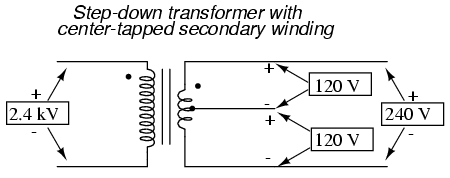
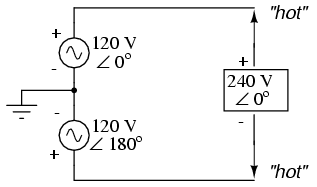
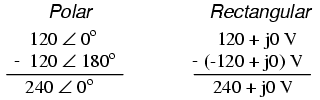
|
|
The statement "in phase but opposite polarity" is nonesensical. I understand your point about how the phases are created, but the "opposite polarity" part of your statement is exactly the same as saying "180 degrees out of phase".
In US homes, you should measure voltage and phase relative to the neutral. If you do this, you will get the results AR-JEDI is showing = two phases, 180 degrees out of phase. This differs from 3 phase power where the phase difference is 120 degrees but is still measured relative to the neutral. |
|
Quoted: The statement "in phase but opposite polarity" is nonesensical. I understand your point about how the phases are created, but the "opposite polarity" part of your statement is exactly the same as saying "180 degrees out of phase". In US homes, you should measure voltage and phase relative to the neutral. If you do this, you will get the results AR-JEDI is showing = two phases, 180 degrees out of phase. This differs from 3 phase power where the phase difference is 120 degrees but is still measured relative to the neutral. Still not 2 phase, 2 LEGS of 1 phase that when referenced to ground (neutral) are 180 degrees out of phase. Two phase requires 4 hot wires 90 degrees out of phase and is not used anymore as far as I can tell. |
|
Quoted:
Quoted:
The statement "in phase but opposite polarity" is nonesensical. I understand your point about how the phases are created, but the "opposite polarity" part of your statement is exactly the same as saying "180 degrees out of phase". In US homes, you should measure voltage and phase relative to the neutral. If you do this, you will get the results AR-JEDI is showing = two phases, 180 degrees out of phase. This differs from 3 phase power where the phase difference is 120 degrees but is still measured relative to the neutral. Still not 2 phase, 2 LEGS of 1 phase that when referenced to ground (neutral) are 180 degrees out of phase. Two phase requires 4 hot wires 90 degrees out of phase and is not used anymore as far as I can tell. Trollslayer did not say it is a "two phase" power system. the fact remains, however, that referenced to neutral, L1 and L2 are 180' out of phase with each other. ar-jedi |
|
Quoted:
Quoted:
Yes, they are, as they are derived from a single transformer winding. Some people will claim they are 180 degrees out of phase relative to the neutral center tap, but that is not correct they are exactly in phase but opposite polarity. 1. tell me, what does "in phase but opposite polarity" mean in the context of AC power? 2. if L1 and L2 were in phase and both 120Vac RMS, how is 240Vac RMS voltage arrived at? show your math. 3. if L1 and L2 were in phase, how is it possible that the N conductor is the same size as the L1 and L2 conductors? would not the N conductor have to carry twice the current, since L1 and L2 are in phase? 4. show a way to make a center tapped transformer secondary where the ends are *not* 180 degrees out of phase. 5. follow the second link i provided above, and low and behold -- look at that -- there is a 180 degree phase angle shown graphically between L1 and L2. 6. i know wikipedia is not the be-all end-all, but they have it two-phase". The "hot" conductors' waveforms are offset by a half-cycle, or 180 degrees offset, when measured against the neutral wire. i have highlighted a noteworthy sentence above. ar-jedi here is the "schematic" of a pole pig transformer: http://www.utterpower.com/images/househ2.gif here is what L1 and L2 look like relative to the N: http://upload.wikimedia.org/wikipedia/en/1/1a/Splitphase.gif [/quote] Should't your waveform peak at 169.7v for 120vac? Since 120v is RMS here. The waveform you have drawn seems to indicate 84vac RMS. |
|
Quoted: Quoted: Quoted: The statement "in phase but opposite polarity" is nonesensical. I understand your point about how the phases are created, but the "opposite polarity" part of your statement is exactly the same as saying "180 degrees out of phase". In US homes, you should measure voltage and phase relative to the neutral. If you do this, you will get the results AR-JEDI is showing = two phases, 180 degrees out of phase. This differs from 3 phase power where the phase difference is 120 degrees but is still measured relative to the neutral. Still not 2 phase, 2 LEGS of 1 phase that when referenced to ground (neutral) are 180 degrees out of phase. Two phase requires 4 hot wires 90 degrees out of phase and is not used anymore as far as I can tell. Trollslayer did not say it is a "two phase" power system. the fact remains, however, that referenced to neutral, L1 and L2 are 180' out of phase with each other. ar-jedi Seems like we're in agreement, ar-jedi. |