


Armory Sponsor

Posted: 7/15/2012 10:41:19 AM EDT
|
Yesterday, I decided to try my hand at a second caliber since the 9mm was so smooth. I decided on .38sp thinking that it would be as simple or simpler than 9mm, so I loaded up 50 rounds. Details as follows:
The Problem: Of the 50 rounds created, I was able to push the bullet further into the case using my thumb and forefinger on 29. The other 21 rounds were solid, with no movement. Dillon 550b Dillon New Dynamic Dies Mixed brass Unique 4.9gr (per Lyman's 49th - min 4.0, max 6.0) Hornady 125gr XTP w/cannalure CCI SPP Desired OAL - 1.470 (per Lyman's 49th) Crimp was measured at about .375 I got the dies setup. My test load (no powder) came in at 1.471", so I pulled that bullet and started creating live rounds. I didn't think to check for setback by squeezing a round ( still learning  ). After the 50 were complete, I dropped each round into the cylinder of my handgun as I don't yet have a case gauge. Each round chambered easily, so no issues there. Next, I started checking OAL. On one of the rounds, when I move the caliper in tight, I saw the bullet move. I then went back and checked all 50. For 29 rounds, I was able to squeeze the bullet further in to the case, varying from 1.464 to as short as 1.420. ). After the 50 were complete, I dropped each round into the cylinder of my handgun as I don't yet have a case gauge. Each round chambered easily, so no issues there. Next, I started checking OAL. On one of the rounds, when I move the caliper in tight, I saw the bullet move. I then went back and checked all 50. For 29 rounds, I was able to squeeze the bullet further in to the case, varying from 1.464 to as short as 1.420.
It seemed that when I squeezed the round, the bullet would stop at the top of the cannalure. On the 21 rounds that were solid, they averaged 1.474 and were usually crimped below/before the cannalurre. One other note, the crimp die seemed to be screwed in to the toolhead very deeply. There were just a few threads available above the toolhead. Also, the rounds my a clicking-type sound when coming out of the crimp die. Any suggestionswould be greatly appreciated. |
|
Quoted:
You need to lower your seating die so that the roll crimp engages the case mouth. I'd like to add... The crimps of a 9mm and a 38sp are different.The 9mm gets a taper crimp, the 38sp gets a roll crimp. A roll crimp is much easier to tell when it is good enough but for inexperienced reloaders, tricky to achieve. Remember, when you screw down/in the die to achieve the crimp, you need to screw up/out the seating adjustment. http://www.exteriorballistics.com/reloadbasics/crimp.cfm |
| I have separate seating and crimp dies. In the Dillon die, the seating stem is not adjustable separate from the die itself, so lowering the seating die would cause the bullet to be seated deeper. These are Dillon's Dynamic Dies. Maybe I am not fully understanding your suggestion. |
|
Quoted: Ok, I use standard seater/crimp dies. Just lower your crimp die then until you can see the case mouth roll inwards.I have separate seating and crimp dies. In the Dillon die, the seating stem is not adjustable separate from the die itself, so lowering the seating die would cause the bullet to be seated deeper. These are Dillon's Dynamic Dies. Maybe I am not fully understanding your suggestion. |
|
It sounds like you have one of two problems.
1. Measure the expander diameter. If it is 0.358 or larger, then it might be the problem. If not... 2. Measure the inside of the sizing die. The rough math is ID of the die minus case wall thickness x 2. If the result is 0.358 or larger, then this is your problem. My opinion is this should not be fixed by crimping more. Some info below plus lots more here. Rifle loading, I know, but the same principle. |
|
I measured the expander, which is also the nut that holds the decapping pin. It measured at .318" at the widest point. I also measured the internal diameter of the sizing die and it is .373". The case thickness is .009", so subtracting that twice gives .355" which is below the .358" mark you mentioned
Here is a picture of the the loads. The 3 on the left are about 1.473", are crimped below the cannalure and do not move when squeezed. The 3 on the right started at 1.473", but with pressure were squeezed until they stopped at the top edge of the cannalure resulting in an OAL of 1.420". I believe I should be seating and crimping these in the cannalure. Is that a correct statement or is the OAL called for by the load data more important? 
|
|
If you are loading on a 550 and using the powder through die, you need to measure the "powder funnel" diameter.
Powder funnel. |
| Hornady recommends 1.450" for the 125 XTP in .38 Special. To get uniform crimps in .38 Special cases they need to be trimmed to the same length. Some .38 cases have thinner walls than others. IF your expanding die is doing no expanding then you may have tension problems with thin walled cases. Be careful shooting any loose bullets. You can get blooper loads with wild velocity variations and you can even get a bullet stuck in the barrel. If a shot doesn't feel or sound right STOP, unload, and check your barrel for a stuck bullet. But 1st find out what's causing the loose bullet in your cases and fix before going further. |
|
First be sure all cases are the same length, and debur the ones you trim. Seat bullets to mid cannelure before crimping. Don't obsess over OAL, seat to mid cannelure. That's what the cannelure is for. Then use more crimp.  44 Mag here, but your crimp should look like these. I bet your loose bullets are with a certain headstamp or two. Good luck |
|
Quoted:
First be sure all cases are the same length, and debur the ones you trim. Seat bullets to mid cannelure before crimping. Don't obsess over OAL, seat to mid cannelure. That's what the cannelure is for. Then use more crimp. 44 Mag here, but your crimp should look like these. I bet your loose bullets are with a certain headstamp or two. Good luck ok, i have to ask... what is the yellow on the right? |
|
Quoted:
First be sure all cases are the same length, and debur the ones you trim. Seat bullets to mid cannelure before crimping. Don't obsess over OAL, seat to mid cannelure. That's what the cannelure is for. Then use more crimp. 44 Mag here, but your crimp should look like these. I bet your loose bullets are with a certain headstamp or two. Good luck BAM! Do this and your problem should be solved. Refer back to that photo as an example of what your reloads should look like. If this does not fix your problem, something is wrong with your dies. If that is true, Dillon will make it right for you. |
|
Quoted: Quoted: First be sure all cases are the same length, and debur the ones you trim. Seat bullets to mid cannelure before crimping. Don't obsess over OAL, seat to mid cannelure. That's what the cannelure is for. Then use more crimp. 44 Mag here, but your crimp should look like these. I bet your loose bullets are with a certain headstamp or two. Good luck ok, i have to ask... what is the yellow on the right? Shot shell. Speer makes them. Are also available in 38/357. |
|
First of all, I'll make an educated guess you are loading 38 special for a revolver, OK? Bullet setback occurs in automatic pistols, setback is related to feeding, in revolvers if the bullet moves, it moves FORWARD, not backward, if you don't have enough crimp, bullets can creep forward and lock up the cylinder, 44 mag revolvers are notorious for locking up when the bullets aren't properly crimped and bullets creep forward. Insufficient crimp can also cause problems with powder burn, not enough pressure builds in the case before the bullet starts moving, so you have unburned powder and inconsistent velocities. |
|
Quoted:
BTW, you don't need to trim your pistol cases. +1 I load about a thousand .38 specials per month for cowboy action shooting. I used mixed headstamp brass that get more mixed every match. I've never trimmed a case. There are some slight variations in total length depending on the headstamp, but it isn't enough to worry about once your crimp is adjusted correctly. Neither of the bullets that I use for rifle or pistol have a crimp groove. I just crimp tight enough to bite into the bullet (lead). If your bullet has a crimp groove or cannelure, use it. Looking at your photo, it looks like the crimp is too light. Screw the crimp die down a little more until it creates a noticeable ramp from case wall to bullet. |
|
Quoted:
First of all, I'll make an educated guess you are loading 38 special for a revolver, OK? Bullet setback occurs in automatic pistols, setback is related to feeding, in revolvers if the bullet moves, it moves FORWARD, not backward, if you don't have enough crimp, bullets can creep forward and lock up the cylinder, 44 mag revolvers are notorious for locking up when the bullets aren't properly crimped and bullets creep forward. Insufficient crimp can also cause problems with powder burn, not enough pressure builds in the case before the bullet starts moving, so you have unburned powder and inconsistent velocities. You need more crimp. You should NOT have to trim those 38's. Use the above pics or a box of factory rounds to compare (measure) the amount of crimp to use. At first it's a bit scary on how much you need to "roll" that brass inwards. Thankfully what you're experiencing is an easy fix. |
|
Quoted: Thanks for all the help. I didn't realize that straight-walled handgun cases needed to be trimmed. I also need to check the expander. Can anyone recommend a good case trimmer for .38 that will also work with .223?  I suggest a lathe type trimmer. Change the shellholder and pilot to change calibers. Once your cases are the same length, your bullet seating will be easier to adjust.
|
|
Quoted:
Bullet setback occurs in automatic pistols, setback is related to feeding, in revolvers if the bullet moves, it moves FORWARD, not backward, if you don't have enough crimp, bullets can creep forward and lock up the cylinder, 44 mag revolvers are notorious for locking up when the bullets aren't properly crimped and bullets creep forward. I thought of this, too, but let it slide (pun intended). He should not be able to push the bullet into the case with his fingers. When he does so, he is getting set back. He should not be able to do that. It is indicative of low neck tension and a light crimp. Even a roll crimp should prevent pushing it back with your fingers. You are 100% correct but that's why I ignored the technical point you are making. I agree with the others, you do not need to trim your cases. Wilson makes a case holder for 38/357 and I have one but you don't need to do it. Any word back from the OP? |
|
I first ran into this strange phenomena when I had some scope rings that weren't properly tightened, with recoil the scope moved forward in the rings, but actually what was happening is the rifle moved back in relation to the scope, inertia of the scope caused that, and the same thing applies in this case, the inertial of the bullet sitting still while the revolver and the cartridge case moves backward away from it, its not what most people would expect. |


|
The numbers seem good but something is not right. You should not be getting setback at all...
If you want to, size one case and measure the ID. Expand the same case and measure the ID. If it is less than 0.357 it should be impossible to push the bullet in with your fingers. |
|
Quoted: I tried screwing the crimp die down. What I have now does not look like DryFlash's photo of a roll crimp. It may be hard to see in the picks, but basically it looks like the case is just squeezed in at the mouth and not rolled. I'm still doing something wrong.  http://i1050.photobucket.com/albums/s405/rcburns5/IMG_0019.jpg http://i1050.photobucket.com/albums/s405/rcburns5/IMG_0017.jpg Common problem if you try to seat bullets and crimp in the same step/die. Bullet is being crimped (smashed a little smaller) while it's being seated that last little bit. 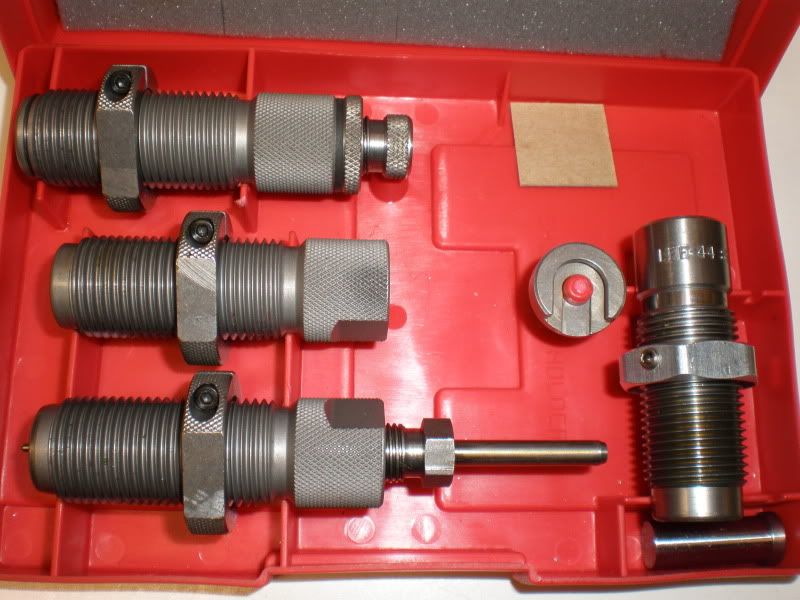 I seat only with the seat/crimp die (top die). Adjust die up so it won't crimp. Lower seating stem for proper seating depth. Then crimp in 4th die, in my case a Lee FCD (factory crimp die) on the far right. Don't over crimp. And if you want you ammo to look like mine, trim your cases to all the same length. |
|
Quoted:
Case tension is the primary thing holding the bullet, not crimp. Fix your case tension problem first. The cases are not being sized enough or your expander is larger than it should be. This is the proper answer. In all cartridges, neck tension is what should prevent the bullets from sliding deeper into the case. Crimp helps prevent bullet pull on recoil and helps slow powders build initial pressure for clean burning. Quoted:
I tried screwing the crimp die down. What I have now does not look like DryFlash's photo of a roll crimp. It may be hard to see in the picks, but basically it looks like the case is just squeezed in at the mouth and not rolled. I'm still doing something wrong.
http://i1050.photobucket.com/albums/s405/rcburns5/IMG_0019.jpg http://i1050.photobucket.com/albums/s405/rcburns5/IMG_0017.jpg Those pictures look like the Dillon dies are providing a taper crimp instead of a roll crimp. I'm not sure why Dillon would do such a thing. |
Armory Sponsor