


AR Sponsor

Posted: 1/2/2021 9:10:36 AM EDT
|
The long story is the trials and tribulations of building a PA10 in 6.5 CM from scratch. I was having feed issues. I installed the JP Adjustable Gas block, but still couldn't get there. I checked my buffer weight against other known working AR308s and found it to be the same. The last thing was getting the Tubb Flat wire spring, based on recommendations from this board. This has solved my issues, but I am trying to understand a few things. The first thing I noticed about the Tubb spring was that it was much weaker than the previous, '308' spring, which I could keep as a spare truck coil spring. Is a weak spring and less gas the most desirable way to run an AR308? Why do most AR308 stocks have heavy springs? |
|
While I grasp David Tubbs explanations in the videos... I will take his word as to why it exactly works. And it does for me , DPMS pattern carbine stocks, Vltor / Armalite pattern carbine stocks, and rifle stock setups.  CS AR-15, AR-10 & SR-25 Flatwire Buffer Springs  Everything You Should Know About AR Buffer Springs |
|
Quoted: In the video he said the ar10 spring was for A2. What about other configs? I wrote about it here: http://www.c3junkie.com/?page_id=977 The link above is mainly discussing small frame configurations but I use the 308 Tubb spring also for a PA10 as well as DPMS G2. |
|
Quoted: While I grasp David Tubbs explanations in the videos... I will take his word as to why it exactly works. And it does for me , DPMS pattern carbine stocks, Vltor / Armalite pattern carbine stocks, and rifle stock setups.  https://www.youtube.com/watch?v=lZQUYGbGmr4 https://www.youtube.com/watch?v=8fMVZbrnvu8 https://www.youtube.com/watch?v=lZQUYGbGmr4 https://www.youtube.com/watch?v=8fMVZbrnvu8Thanks for this. So the .308 spring ranges from 16-24 lbs, vs 13-16 lbs for the flat spring. |
|
Quoted: In the video he said the ar10 spring was for A2. What about other configs? @snakeyes711 I use the 308 Tubbs Flatwire in all my large Frame AR's . 6.5CM, .308.... various barrel lengths from 14.5", 16", 18", 20", 22".... various gas system lengths ( middie and rifle length ) various gas port sizes. With DPMS and Armalite carbine pattern stocks , and A2 rifle length stock setups.. And Adj. GB's on every large frame firearm ( SLR's opened 6 clicks from closed of the available 15 ) And heavy buffers in all stock patterns....( again all with the Tubbs .308 flatwire in all patterns ) DPMS Carbine pattern , KAK 2.5" 5.3oz Armalite Carbine pattern 3.25" 5.4oz Rifle A2 KAK 9.3oz 308 length rifle buffer And All function great.... ( Even with the short PSA / DPMS gas tube in all nine uppers, Lol ) FWIW... I tried all sorts of other recoil springs and buffer weights prior to falling for the 308 Tubbs and heavy for stock setup buffer weights. Every applicable Sprinco... ( the red and orange seriously slammed the BCG in to battery hard, and caused noticable muzzle dip. ) I even use a 308 Tubbs in my 9MM Colt pattern blowback AR, with 7.5ish oz buffer weight.... that application dramatically changed the "vigorious" cycling of the 9MM blowback. I have said this before... the 308 Tubbs in the 9MM blowback changed cycling from Linda Blair in the Exorcist,.... to a consistent smooth functioning Winnie the Pooh. 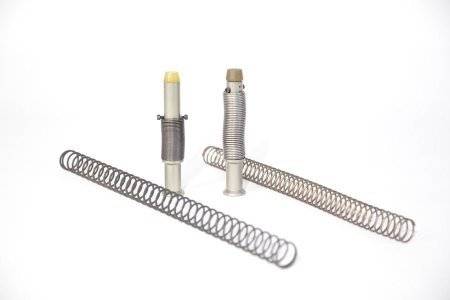
|
|
Quoted: Thanks for this. So the .308 spring ranges from 16-24 lbs, vs 13-16 lbs for the flat spring. Handy chart... ultimately, the 308 Tubbs holds the BCG "closed" milli-seconds longer ( easier on the brass rim during extraction since the chamber pressure is slightly lower from the milli-second delay. While retaining a "sane" open poundage... ( allowing moderate cycling, without slamming ) A2 (old) - 7.6lb closed, 14.5lb open A2 (new) - 9.1lb closed, 16.7lb open Tubb Flatwire - 10.5lb closed, 16.3lb open Tubb .308 Flatwire - 13lb closed, 16.7lb open SpringCo White ? (standard) - 8.3lb closed, 16.3lb open SpringCo Red (extra) - 10.5lb closed, 18.4lb open SpringCo Orange (increased) - 13.9lb closed, 24.8lb open |
|
Quoted: Handy chart... ultimately, the 308 Tubbs holds the BCG "closed" milli-seconds longer ( easier on the brass rim during extraction since the chamber pressure is slightly lower from the milli-second delay. While retaining a "sane" open poundage... ( allowing moderate cycling, without slamming ) A2 (old) - 7.6lb closed, 14.5lb open A2 (new) - 9.1lb closed, 16.7lb open Tubb Flatwire - 10.5lb closed, 16.3lb open Tubb .308 Flatwire - 13lb closed, 16.7lb open SpringCo White ? (standard) - 8.3lb closed, 16.3lb open SpringCo Red (extra) - 10.5lb closed, 18.4lb open SpringCo Orange (increased) - 13.9lb closed, 24.8lb open |
|
Checking spring tension is easy. You must have a bathroom scale.... Go to a hardware store, and pick up a 5/8" dowel. Mark the dowel with the internal length of your buff tube, less the rim thickness of your buffer (just less than 1/4" typically). Then mark it with the length of the buffer, less the lip thickness. Put the dowel with the marks down on the scale. Slide the spring on. Push the spring down to the first mark (the buffer tube length), and read the scale. That is your 'in battery' force. Then push it all the way down to the buffer mark, that is your full back force. I use gloves, and a large 3/4" washer to keep control of the spring when compressing it. |
|
Quoted: Checking spring tension is easy. You must have a bathroom scale.... Go to a hardware store, and pick up a 5/8" dowel. Mark the dowel with the internal length of your buff tube, less the rim thickness of your buffer (just less than 1/4" typically). Then mark it with the length of the buffer, less the lip thickness. Put the dowel with the marks down on the scale. Slide the spring on. Push the spring down to the first mark (the buffer tube length), and read the scale. That is your 'in battery' force. Then push it all the way down to the buffer mark, that is your full back force. I use gloves, and a large 3/4" washer to keep control of the spring when compressing it. Very Nice.... I have often pondered how to measure the recoil spring weights ! Thanks for sharing ! |
|
I used a Tubbs 308 spring in a 223 AR with, A5 tube and a kynshot RB5007 buffer. It was very light recoiling and handled light loads. I tested it with a load ladder of light to max loads and all functioned fine and locked back. The 308 spring didn't seem to require any coils cut using a BA Hanson Premium 16" barrel with the non-adjustable gas block that can with it. I put a Tubbs 308 wire in a Def10, but haven't had a chance to range test it yet. |
|
Quoted: ...ultimately, the 308 Tubbs holds the BCG "closed" milli-seconds longer ( easier on the brass rim during extraction since the chamber pressure is slightly lower from the milli-second delay. No, it really doesn't "hold the bolt closed milliseconds longer"... The force pushing the carrier back due to pressure on the piston is in the neighborhood of 400 pounds. Therefore, the difference in acceleration due to the spring, from the lightest spring to the heaviest spring is only 1.5%. Given a H2 buffer, that means the difference in unlocking time is several millionths of a second, not several milliseconds, and there is no significant decrease in initial extraction force, it remains around 380 pounds. All of the reduction in velocity due to a stiffer spring comes after the piston vents completely and the piston cavity pressure returns to ambient. EDIT: And, by the way, provided your brass is properly hardened, by the time the unlocking is complete (even with the standard set-up), the chamber pressure has dropped below the inflation pressure of the brass case, i.e., there is now a small clearance between the chamber wall and the case. The cause of damage to case rims during extraction is primarily due to inertia of the case and high bolt velocity, again with the caveat that the brass is made correctly. |
|
Interesting... I thought was quoting Glen Zediker. What he had to say made all sorts of sense to me..... rats.. now I have to look it up. Granted... I may not have quoted the millisecond v. millionths of a second factor correctly. ( I had to look it up... quite a bit of difference, BTW ) And because I don't quite get it.... what other factors are in play when going to a heavier recoil spring, and the resulting difference in perceived recoil ? I have always noticed the difference readily... and again, since I don't get it... the difference in feeling between a heavy and light weight spring must involve more then 1.5%. I am not trying to be flippant at all.. |
|
Quoted: Does this sound right for spring weights? JP-SCS 10 1 side red color spring ~ 5 lbs closed, ~ 13 lbs open Quoted: Does this sound right for spring weights? JP-SCS 10 1 side red color spring ~ 5 lbs closed, ~ 13 lbs open Seems way light compared to what shown on bfoosh06's list. Quoted: Handy chart... ultimately, the 308 Tubbs holds the BCG "closed" milli-seconds longer ( easier on the brass rim during extraction since the chamber pressure is slightly lower from the milli-second delay. While retaining a "sane" open poundage... ( allowing moderate cycling, without slamming ) A2 (old) - 7.6lb closed, 14.5lb open A2 (new) - 9.1lb closed, 16.7lb open Tubb Flatwire - 10.5lb closed, 16.3lb open Tubb .308 Flatwire - 13lb closed, 16.7lb open SpringCo White ? (standard) - 8.3lb closed, 16.3lb open SpringCo Red (extra) - 10.5lb closed, 18.4lb open SpringCo Orange (increased) - 13.9lb closed, 24.8lb open |
AR Sponsor