


AR Sponsor

[ARCHIVED THREAD] - 6.5Grendal Bolt Failure (Page 1 of 2)
Posted: 4/26/2019 7:01:41 PM EDT
|
Yesterday, a lug sheared of my 6.5 Grendel bolt. The chambering is basically a 6AR. The load is 28.5gr of Varget with a Nosler 105CC bullet giving a muzzle velocity of about 2700fps.
Has anyone else experience this type of failure with the 6.5 Grendal bolt or similar bolt? |
|
What bolt? I or II? Who made the bolt? What material?
There were some that came up on the Grendel forum that were failing left and right. I have heard of an issue in a long time so yours may be a rarity these days. I had a BCM 5.56 bolt crack, so any of them can break. |
|
I bought the rifle second-hand from a friend. I think that the upper is Whitley upper. The original bolt was an Alexander Arms and that failed too and I think it was because the load was too hot (29 to 30 gr of Varget).
This bolt is a JP bolt ( I sent email to them on Thursday...no response yet). The barrel is 26inches. Whitley's page shows loads from 28 to 29gr for RL15 and H4895. Quickload shows my load to be nowhere near max. |
That's a lot of Varget. 
Quickload's telling me that 30 grains in a 6 AR is making about 75k psi. That's what fucked your original bolt. Your new load is probably around 63k. Book for the Grendel is, what?, 58k? I would back that off, even as much as I like hotrodding things. |
|
6.5 Grendel working pressure max is 50,000psi.
6mm AR should be less since you have a tighter neck to flow through. 28.5gr of Varget is a max load under a 123gr 6.5mm, but not a 6mm. If you look at .308, 7mm-08, and .260 Rem working pressures, it gets progressively reduced due to overbore and bottle neck constraints of propellant conversion and that relationship with chamber pressure. One guy I know who has knowingly chased pressure with the 6mm AR has shorn off lugs as a rule, because he's shooting for score. All his loads exceed anything I've seen with published data from Whitley, and exceed Grendel by a lot. You really need another bolt and extension design if you want to push the pressure above that the lugs can take in the AR15 with larger case diameters. You can gain about 3,000psi more with a narrower case, but then you lose case capacity and often ogive length allowable with the high BC 6mm bullets. |
|
Quoted:
I used 28.5 of Varget which is about 3000psi below max according to Quickload. The primer edges are round and there are no swipe marks or ejector marks on the case head. And 2779 fps. |
|
I have owned a number of Grendels, and had two bolt failures. After the second bolt failure (usually a lug near the extractor), I spoke with a custom rifle builder about the bolt failures. He said that in his experience 90% of the forged AR15 uppers he has seen need to have the face of where the barrel extension mates into the upper receiver squared off. Most of the forged uppers people use for building 5.56 rifles aren't bothered by this little bit of mis-alignment. However, Grendels have less support for the bolt lugs, and his belief was that uneven pressure on bolt lugs caused by the very small out of square mating of barrel extension and upper receiver caused lugs to fail over time. So, I bought another bolt, faced off the upper receiver square (it actually needed to be squared) and never had another bolt failure. Maybe I got lucky, but I have faced off every forged AR15 upper receiver since then, and just as the custom builder told me, 90% of them ARE out of square. The tool to square them is cheap, and it is an easy job to do. ETA: the company that makes the Mutant rifles, makes a mid size AR15 (between 5.56 and 308 size) that has a larger bolt, and barrel extension. |
|
Reading pressure signs only sort of worked for P.O. Ackley. He was a gunsmith who understood the mechanisms, the limitations of the materials and realized that failure could maim or kill.
Thanks to modern sensors we now know that some of his loads were seriously over pressure. If I had a piezoelectric sensor I might feel comfortable to push a caliber toward its limits, but, since I don't I pay attention to the load data of those who do. ETA Wilson Combat also makes an option like the mutant as well |
|
Quoted:
I used 28.5 of Varget which is about 3000psi below max according to Quickload. The primer edges are round and there are no swipe marks or ejector marks on the case head. When we tested with a calibrated pressure trace breech (calibrated over a 6 month period), we saw QL was usually 10,000psi off. What did your pressure ladder look like or did you do one? |
|
That .136 deep bolt pocket isn't your friend. The bolt would have been stronger with a .125 or even better yet a .110 pocket. And the extractor.....that would be stronger too if the barrel extension relief cut on the back side wasn't cut across the back of the hook.
Take a look at this 50AE bolt. Do you think it would be stronger if the pocket was cut deeper? Nope. Tony 
|
|
Quoted:
That .136 deep bolt pocket isn't your friend. The bolt would have been stronger with a .125 or even better yet a .110 pocket. And the extractor.....that would be stronger too if the barrel extension relief cut on the back side wasn't cut across the back of the hook. Take a look at this 50AE bolt. Do you think it would be stronger if the pocket was cut deeper? Nope. Tony https://i.imgur.com/yPuD4T8.jpg It makes sense intuitively, though, because the less you undercut the lugs, the stronger they'll be. My HeWhoShallNotBeNamed big bolt is .125" deep. |
|
Did you chronograph that load or are you just guessing based on WAG?
Most of 6mmAR load data suggest at least 1.5 grain reduction from his published loads to start. He suggests 27.0 grains as close to maximum with Berger bullets using both RE-15 and H4895. He clearly stated that using 27.5 grains seemed too high. Varget, while very close to RE-15, is not RE-15. He used slightly higher loads with moly coated bullets. Are yours moly coated? He also warned that large primer brass loads needed to be reduced by at least 2.0 grains to start. Whatever the cause, breaking bolts can get expensive in a hurry. I see his replacement bolts are around $120. You should probably buy two, one for the parts bin for added security. |
|
Quoted:
What is the COAL that you used. I used 2.392" Quoted:
Quoted:
We must have different Quickloads, because mine's saying 62325 psi for that load. And 2779 fps. 2.250” I use mag length for everything. |
|
Quoted:
I have owned a number of Grendels, and had two bolt failures. After the second bolt failure (usually a lug near the extractor), I spoke with a custom rifle builder about the bolt failures. He said that in his experience 90% of the forged AR15 uppers he has seen need to have the face of where the barrel extension mates into the upper receiver squared off. Most of the forged uppers people use for building 5.56 rifles aren't bothered by this little bit of mis-alignment. However, Grendels have less support for the bolt lugs, and his belief was that uneven pressure on bolt lugs caused by the very small out of square mating of barrel extension and upper receiver caused lugs to fail over time. So, I bought another bolt, faced off the upper receiver square (it actually needed to be squared) and never had another bolt failure. Maybe I got lucky, but I have faced off every forged AR15 upper receiver since then, and just as the custom builder told me, 90% of them ARE out of square. The tool to square them is cheap, and it is an easy job to do. ETA: the company that makes the Mutant rifles, makes a mid size AR15 (between 5.56 and 308 size) that has a larger bolt, and barrel extension. Good info on squaring the upper Where did you buy the tool to square the upper? |
|
Quoted: Quickload needs to be calibrated for 6.5 Grendel, and even more so for 6mm AR. When we tested with a calibrated pressure trace breech (calibrated over a 6 month period), we saw QL was usually 10,000psi off. What did your pressure ladder look like or did you do one? |
|
Quoted:
That's an interesting position, and certainly flies in the face of common knowledge. It makes sense intuitively, though, because the less you undercut the lugs, the stronger they'll be. My HeWhoShallNotBeNamed big bolt is .125" deep. |
|
Quoted:
What is a pressure ladder? Quoted:
Quoted: Quickload needs to be calibrated for 6.5 Grendel, and even more so for 6mm AR. When we tested with a calibrated pressure trace breech (calibrated over a 6 month period), we saw QL was usually 10,000psi off. What did your pressure ladder look like or did you do one? Shoot each of those loads over a chronograph, Magnetospeed, or Labradar, and document the trend line (for every charge increase of .3gr, velocity increases by x fps). If you see a departure from that trend line, document and see if it will do it with another ladder. Example: 25.0gr 25.3gr 25.6gr 25.9gr 26.2gr 26.5gr 26.8gr 27.1gr 27.4gr 27.7gr |
|
Quoted:
That .136 deep bolt pocket isn't your friend. The bolt would have been stronger with a .125 or even better yet a .110 pocket. And the extractor.....that would be stronger too if the barrel extension relief cut on the back side wasn't cut across the back of the hook. Take a look at this 50AE bolt. Do you think it would be stronger if the pocket was cut deeper? Nope. Tony https://i.imgur.com/yPuD4T8.jpg Correctly made .136" depth bolts have been working fine for 15 years now. With radii changes to the roots of the lugs, the lug contact with the bolt body matches that of a .125" face depth. With 9310 AQ and good heat treat, in a square upper, the bolt longevity is excellent. I've shot untold thousands of rounds across multiple guns and gas system lengths over the years now, still no failures of any kind. If you chase the pressure though, you'll shear lugs at certain round counts, depending on the gas system length and port size, assuming a square upper. Bill A. said they had an AR15 pressure test breech with years of proof loads on it that never failed, as well as a full auto test apparatus. |
|
Quoted: Quickload needs to be calibrated for 6.5 Grendel, and even more so for 6mm AR. When we tested with a calibrated pressure trace breech (calibrated over a 6 month period), we saw QL was usually 10,000psi off. What did your pressure ladder look like or did you do one? The problem isn't that it's a Grendel, the problem is people pushing them way too hard. I'll agree with the guy on squaring the receiver, it does make a difference, and HWSRUN, was adaman about it. Every upper he built he squared the receivers on, and that was carried over by others that built uppers with his parts commercially. I'm sure there's plenty of pressure trace test data for the G though I haven't looked into it. I will do that if I build one, which I might in the next year, but there are so many calibers now it's like picking out candy, it's all delicious. I know they did a lot of Pressure trace data on the 6.8, and continued to do it over the years, but I've been out of that game now for several years, and out of ARs, but I would expect the F guuy's to have done it as well. I would bank on what LRRP says on the Grendel and variants, just as I trusted HWSRUN on the 6.8 spec II, they are the go to authorities in their calibers. |
|
Quoted: The problem is the extractor lip strength when you use a .125" face depth. You can more than make up for extractor strength AND use a stronger .125" bolt depth, by not screwing up and cutting the extractor like a 5.56 unit. I don't think you understand what I'm talking about here. The correct answer to keep the extractor and bolt strong, is to use a .125" bolt pocket depth and an extractor that doesn't have the extension relief cut clear across the back of the hook. Tony 
|
|
Quoted:
That is not correct information. You missed the part where I said the extractor would be plenty strong with a .125" bolt if AA didn't cut the barrel extension relief all the way across the back of the extractor hook, like is done with a 5.56 extractor. You can more than make up for extractor strength AND use a stronger .125" bolt depth, by not screwing up and cutting the extractor like a 5.56 unit. I don't think you understand what I'm talking about here. The correct answer to keep the extractor and bolt strong, is to use a .125" bolt pocket depth and an extractor that doesn't have the extension relief cut across the back of the hook. Tony https://i.imgur.com/v5DWlp4.jpg Quoted:
Quoted: The problem is the extractor lip strength when you use a .125" face depth. You can more than make up for extractor strength AND use a stronger .125" bolt depth, by not screwing up and cutting the extractor like a 5.56 unit. I don't think you understand what I'm talking about here. The correct answer to keep the extractor and bolt strong, is to use a .125" bolt pocket depth and an extractor that doesn't have the extension relief cut across the back of the hook. Tony https://i.imgur.com/v5DWlp4.jpg Since the case rim is a larger diameter and thicker, the groove for the rim has to be deeper and wider and you don't want to make the lip thinner on the bore axis dim. One of the biggest complaints with the .125" bolt face depths in 7.62x39 and Grendel is extractor lips ripping off. There have been manufacturers here assert that .125" face depth is fine with their .264 LBC barrel/bolt combos, no failures of any kind they are aware of, only for the next post to be one of their customers showing his shorn off extractor lip. Also, with those relief cuts on the spine of the extractor, if you don't have them and are using 5.56 extractor pocket depth, you now shear against the lugs of the extension since the extractor has to snap over a much fatter cartridge than the puny 5.56 case head. This was one of the mechanical engineering challenges Colt had with the 7.62x39 that Bill researched and accounted for in the early stages. I remember him telling me about it many years ago, and have seen it on after-market bolts that were getting scored by the extension lugs. He said he relocated the depth of the extractor pocket and the extractor pin is in a different location to deal with extractor articulation and these challenges. I just looked at all my bolts, and some after-market samples have the relief cuts for the extension lugs, however my group buy bolt doesn't (It's in my 12" pistol). I've shot it almost exclusively suppressed so far with CLGS and Bootleg Adjustable gas, factory ammo only so far. There are no scoring marks on the extractor spine adjacent to the extractor reinforcement bridge/lug. 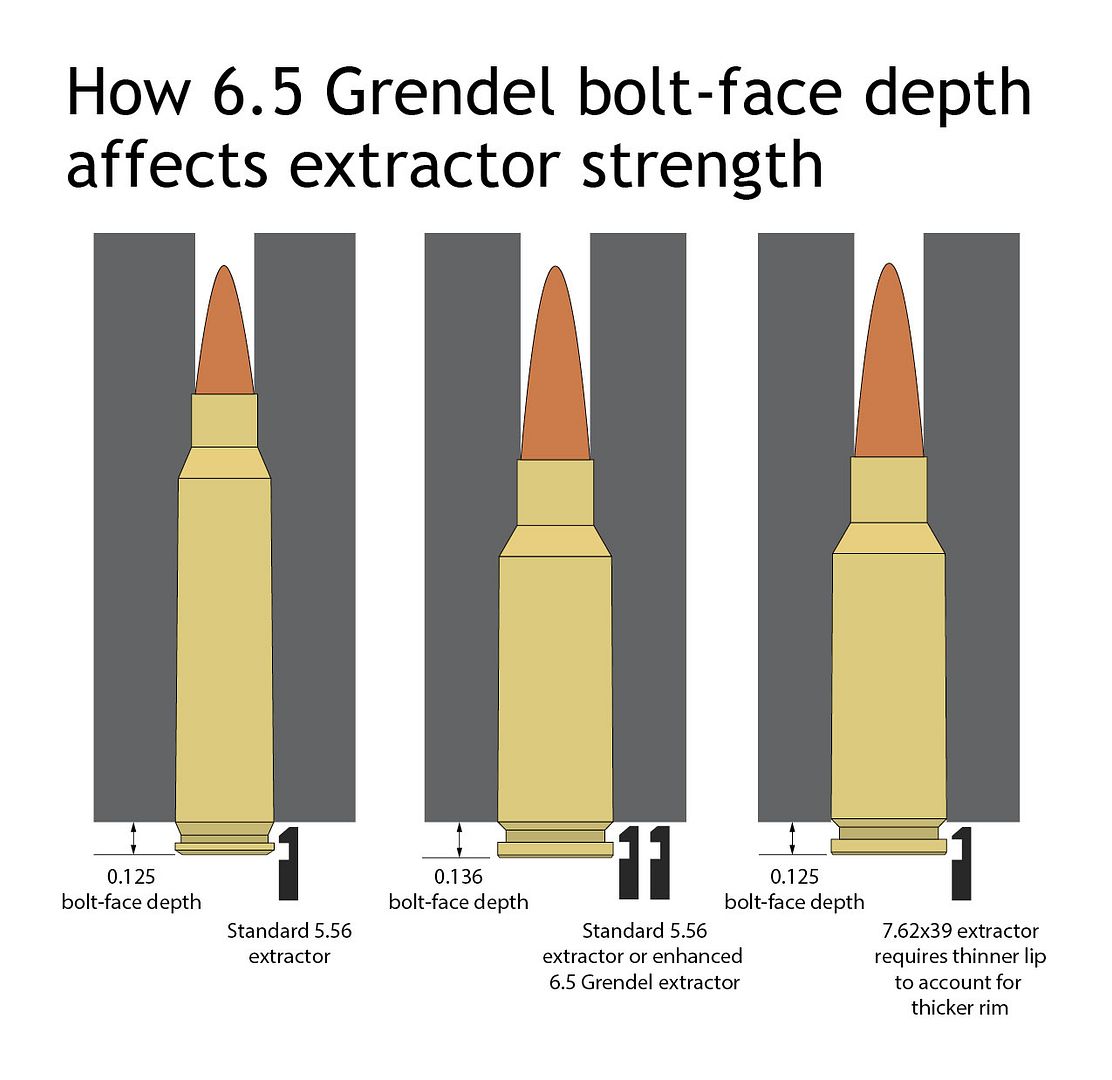
|

|
Quoted:
Donno, maybe. Here's what PSA's Grendel and PSA's 223 extractors look like. The Grendel claw is the deeper one, on the left. http://i68.tinypic.com/inrig8.jpg That drawing is BS. No AR15 cartridge is fully supported in the chamber as the drawing infers. There is no physical reason a .125 bolt cannot have an extractor as strong as a .136 bolt face. The .136 also leaves more of the case unsupported than the .125 bolt face. I've seen it stated here that the .136 provides more support to the case head, which is also BS because of the extractor groove. The single solitary reason a .136 bolt face was ever used was to make it proprietary so people would have to buy from AA. Because physically it does not make sense. Another other point I'm going to call out is LR stating he did the actual testing for the Grendel reloading manual. Which he did not. He was the proof reader, period. Pay close attention to keeping the Grendel under 50,000 PSI. It will break bolts with hotter loads. Many loads stated in this very forum that look to enhance the Grendel's abilities are over 50K pressure. This is one of the reasons Serbia limited the Grendel to 105 grain projectiles in their testing. Serbia found it inadequate with projectiles of any higher grain weight. Also why the Grendel proponents are not saying much about Serbia looking at the Grendel. The Grendel inherently hits pressure very quickly. Pressure ladders for most cartridges can be run safely in .5 grain steps. The Grendel should be done in .2 to .3 grain steps for this reason. While a fine cartridge the Grendel's limitations should be known. Limited bolt strength Weak case radius area (its very thin) Prone to finicky feeding Limited on pressure Magazine stack angle This is because the case is at the limit of available diameter in an AR15. Its physics, simple physics. To watch LR try to debate cartridge/chamber/bolt design with Tony is laughable. I own and shoot both 6mmAR and 6.5 Grendel. I also build some of the best bullets for either caliber. |
|
Quoted:
Exactly. That drawing is BS. No AR15 cartridge is fully supported in the chamber as the drawing infers. There is no physical reason a .125 bolt cannot have an extractor as strong as a .136 bolt face. The .136 also leaves more of the case unsupported than the .125 bolt face. I've seen it stated here that the .136 provides more support to the case head, which is also BS because of the extractor groove. The single solitary reason a .136 bolt face was ever used was to make it proprietary so people would have to buy from AA. Because physically it does not make sense. Another other point I'm going to call out is LR stating he did the actual testing for the Grendel reloading manual. Which he did not. He was the proof reader, period. Quoted:
Quoted:
Donno, maybe. Here's what PSA's Grendel and PSA's 223 extractors look like. The Grendel claw is the deeper one, on the left. http://i68.tinypic.com/inrig8.jpg That drawing is BS. No AR15 cartridge is fully supported in the chamber as the drawing infers. There is no physical reason a .125 bolt cannot have an extractor as strong as a .136 bolt face. The .136 also leaves more of the case unsupported than the .125 bolt face. I've seen it stated here that the .136 provides more support to the case head, which is also BS because of the extractor groove. The single solitary reason a .136 bolt face was ever used was to make it proprietary so people would have to buy from AA. Because physically it does not make sense. Another other point I'm going to call out is LR stating he did the actual testing for the Grendel reloading manual. Which he did not. He was the proof reader, period. Not sure where you're getting your information from about the Reloading Handbooks. I pitched and launched the project, collaborated with co-authors, outlined the chapters, wrote at least 1/3 of the material in both handbooks, along with 3 other attributed authors. Stokes did the intro for Volume II based on his experience as a guide in Alaska, Joe wrote several chapters, and Greg did the terminal ballistics testing and In-Design formatting. We all worked together to fine-tune, edit, work out the page counts, proof-read initial drafts, before going to print. Your statements about me being a "proof-reader only" couldn't be more false and misplaced. Pay close attention to keeping the Grendel under 50,000 PSI. It will break bolts with hotter loads. Many loads stated in this very forum that look to enhance the Grendel's abilities are over 50K pressure. This is one of the reasons Serbia limited the Grendel to 105 grain projectiles in their testing. Serbia found it inadequate with projectiles of any higher grain weight. Also why the Grendel proponents are not saying much about Serbia looking at the Grendel. The Grendel inherently hits pressure very quickly. Pressure ladders for most cartridges can be run safely in .5 grain steps. The Grendel should be done in .2 to .3 grain steps for this reason. Try loading .5gr pressure ladders in .223 Remington and see what happens. Not enough resolution to determine departure from the trend until it's too late. Grendel uses roughly 30gr of case capacity, so you load .3gr increments. Remember that 1% of usable case volume rule. While a fine cartridge the Grendel's limitations should be known. Limited bolt strength Weak case radius area (its very thin) Prone to finicky feeding Limited on pressure Magazine stack angle This is because the case is at the limit of available diameter in an AR15. Its physics, simple physics. To watch LR try to debate cartridge/chamber/bolt design with Tony is laughable. I own and shoot both 6mmAR and 6.5 Grendel. I also build some of the best bullets for either caliber. While you may laugh, my perspective on the Beowulf and Grendel bolts and extractors are informed by lengthy discussions with the designer of those cartridges and the unique aspects of the AR15 critical components designed to feed, fire, extract, and eject them. I'm not sure why anyone would want these details excluded from the conversation. |

|
Quoted:
Did you chronograph that load or are you just guessing based on WAG? Most of 6mmAR load data suggest at least 1.5 grain reduction from his published loads to start. He suggests 27.0 grains as close to maximum with Berger bullets using both RE-15 and H4895. He clearly stated that using 27.5 grains seemed too high. Varget, while very close to RE-15, is not RE-15. He used slightly higher loads with moly coated bullets. Are yours moly coated? He also warned that large primer brass loads needed to be reduced by at least 2.0 grains to start. Whatever the cause, breaking bolts can get expensive in a hurry. I see his replacement bolts are around $120. You should probably buy two, one for the parts bin for added security. I don't know where you got:"He clearly stated that using 27.5 grains seemed too high. " He says: " For a single "across the course" load, a favorite with some rifles has been 27.5 to 27.8 gr. Hodgdon's H4895 with a 105 gr. Berger BT bullet" Yes H4895 is faster than Varget which is faster than RL15. Whitley uses 29gr of RL15 and 28.0 of H4895 and I am in between with 28.5 with Varget as expected by the relative speeds of the powders. My bullets are not moly coated. |
|
Quoted: Load a 10rd set, starting with the published start load at the bottom, then work up in 1% case volume increments, in this instance, .3grs. Shoot each of those loads over a chronograph, Magnetospeed, or Labradar, and document the trend line (for every charge increase of .3gr, velocity increases by x fps). If you see a departure from that trend line, document and see if it will do it with another ladder. Example: 25.0gr 25.3gr 25.6gr 25.9gr 26.2gr 26.5gr 26.8gr 27.1gr 27.4gr 27.7gr |
|
Quoted:
I don't think these one load/one shot ladders are meaningful. I shoot 20-shots strings with ONE load and see 25-40fps variations in velocity. Quoted:
Quoted: Load a 10rd set, starting with the published start load at the bottom, then work up in 1% case volume increments, in this instance, .3grs. Shoot each of those loads over a chronograph, Magnetospeed, or Labradar, and document the trend line (for every charge increase of .3gr, velocity increases by x fps). If you see a departure from that trend line, document and see if it will do it with another ladder. Example: 25.0gr 25.3gr 25.6gr 25.9gr 26.2gr 26.5gr 26.8gr 27.1gr 27.4gr 27.7gr How far off the lands are you? Same brass, same # of firings? What's your chamber length to the mouth and have any of your cases grown past that dimension? If you run a pressure ladder, you will see and confirm nodes where the charge weight doesn't affect the mv much at all. A big problem with 6mm AR is no pressure test data from an industry source. You can't just look at what someone else is doing, then pick a load and go with it, especially since there is no chamber standard for it on top of everything else. |
|
Quoted:
What was your start load? How far off the lands are you? Same brass, same # of firings? What's your chamber length to the mouth and have any of your cases grown past that dimension? If you run a pressure ladder, you will see and confirm nodes where the charge weight doesn't affect the mv much at all. A big problem with 6mm AR is no pressure test data from an industry source. You can't just look at what someone else is doing, then pick a load and go with it, especially since there is no chamber standard for it on top of everything else. |
|
Quoted:
Dude! You're a legend in your own mind. Give it up. You have some good points from time to time, but this is not one of those times. It's just a fluke. Tell him to rub some dirt on it and suck it up. It will be alright from here on out. Quoted:
Quoted:
What was your start load? How far off the lands are you? Same brass, same # of firings? What's your chamber length to the mouth and have any of your cases grown past that dimension? If you run a pressure ladder, you will see and confirm nodes where the charge weight doesn't affect the mv much at all. A big problem with 6mm AR is no pressure test data from an industry source. You can't just look at what someone else is doing, then pick a load and go with it, especially since there is no chamber standard for it on top of everything else. I have no clue what you're talking about, but I do know that none of it is related even remotely to the topic of the thread. Any time a member has a problem and we try to help that member out with questions that will paint a better picture of what is going on, we ask the questions I asked. In the reloading forum, you will find the same kinds of questions. Can't say I've ever seen anyone respond the way you did. Something is way off with you. |
|
Quoted:
What is the COAL that you used. I used 2.392" We need to know how far you are off the lands, if any. If you're jamming the lands with a max load, with a cartridge that generates more bolt thrust than 6.5 Grendel, then that would explain shearing a lug. You also said your chamber is basically a 6mm AR. What exactly is the chamber? |
|
Quoted:
Except that drawing/mockup pic is not correct. It doesn't show the step down of the barrel extension relief cut on the back side of the extractor. Tony You'd really need a 3D animation of the bolt articulating into and out of the chamber to illustrate the issue with snap over and clearance with the extension lugs. But you don't want a thin lip on a thick, wide case rim like 6.5 Grendel has, with standard AR15 extractor width. The mechanical engineering behind the 6.5 Grendel bolt and extractor that Bill did is sound, and has proven itself to have great durability/longevity when made correctly. When companies who don't invest in learning what that approach is try to mimic it without a full analysis of the components, they will deviate from it and get lesser results, unless they re-design the extension and bolt entirely. |
|
Quoted: I don't think these one load/one shot ladders are meaningful. I shoot 20-shots strings with ONE load and see 25-40fps variations in velocity. Creighton Audette's Load Development Theory Bottom line is sounds like load is too hot. Don't know what this may, or may not have to do with your lug shearing but it can help with accuracy. A lot of this has already been worked out and you can search for good working loads, powders, bullets, rifle, etc., but each item is a variable. Something else to consider along the lines of stress on each individual lug is that the bolt is not supported symmetrically. The extractor leaves a blank spot. I think it was Westrom's ArmaLite relieved the lug opposite the extractor and that proved to actually make the bolt less susceptible to shearing lugs as it made the stress symmetrical. |
|
Quoted:
Yeah, for mag length I use 2.28 and the load is still below max. But according to another poster, QL should revise its max load. Quoted:
Quoted:
Yeah, there it is. 2.250” I use mag length for everything. But according to another poster, QL should revise its max load. |
|
Quoted:
Here is a link that explains what LRRP was trying to say. Instead of one round at each loading, use two. Creighton Audette's Load Development Theory Don't know what this may, or may not have to do with you lug shearing but it can hep with accuracy. A lot of this has already been worked out and you can search for good working loads, powders, bullets, rifle, etc., but each item is a variable. Something else to consider along the lines of stress on each individual lug is that the bolt is not supported symmetrically. The extractor leaves a blank spot. I think it was Westrom's ArmaLite relieved the lug opposite the extractor and that proved to actually make the bolt less susceptible to shearing lugs as it made the stress symmetrical. Quoted:
Quoted: I don't think these one load/one shot ladders are meaningful. I shoot 20-shots strings with ONE load and see 25-40fps variations in velocity. Creighton Audette's Load Development Theory Don't know what this may, or may not have to do with you lug shearing but it can hep with accuracy. A lot of this has already been worked out and you can search for good working loads, powders, bullets, rifle, etc., but each item is a variable. Something else to consider along the lines of stress on each individual lug is that the bolt is not supported symmetrically. The extractor leaves a blank spot. I think it was Westrom's ArmaLite relieved the lug opposite the extractor and that proved to actually make the bolt less susceptible to shearing lugs as it made the stress symmetrical. |
|
Quoted:
I chrono all my loads I don't know where you got:"He clearly stated that using 27.5 grains seemed too high. " He says: " For a single "across the course" load, a favorite with some rifles has been 27.5 to 27.8 gr. Hodgdon's H4895 with a 105 gr. Berger BT bullet" Yes H4895 is faster than Varget which is faster than RL15. Whitley uses 29gr of RL15 and 28.0 of H4895 and I am in between with 28.5 with Varget as expected by the relative speeds of the powders. My bullets are not moly coated. Quoted:
Quoted:
Did you chronograph that load or are you just guessing based on WAG? Most of 6mmAR load data suggest at least 1.5 grain reduction from his published loads to start. He suggests 27.0 grains as close to maximum with Berger bullets using both RE-15 and H4895. He clearly stated that using 27.5 grains seemed too high. Varget, while very close to RE-15, is not RE-15. He used slightly higher loads with moly coated bullets. Are yours moly coated? He also warned that large primer brass loads needed to be reduced by at least 2.0 grains to start. Whatever the cause, breaking bolts can get expensive in a hurry. I see his replacement bolts are around $120. You should probably buy two, one for the parts bin for added security. I don't know where you got:"He clearly stated that using 27.5 grains seemed too high. " He says: " For a single "across the course" load, a favorite with some rifles has been 27.5 to 27.8 gr. Hodgdon's H4895 with a 105 gr. Berger BT bullet" Yes H4895 is faster than Varget which is faster than RL15. Whitley uses 29gr of RL15 and 28.0 of H4895 and I am in between with 28.5 with Varget as expected by the relative speeds of the powders. My bullets are not moly coated. You're mixing bullet types and expecting similar results. Robert Whitley posted some loads using VLD bullets which have much less bearing surface and some loads using moly-coated bullets that allow much higher powder charges. He clearly stated that his 27.5 grain load of H4895 using HIS bullets showed more pressure than he likes to see, "but were usable". You are comparing his maximum loads in his rifle using a different brand bullet and different powder and wondering why you can't do the same using a different bullet and suffering a broken bolt. He also states his Bartlein barrel used a special chamber with a custom "gentle throat angle". Bullet weight is only one factor in pressures. Bearing surface, core hardness, jacket material, primer selection, powder lot, powder type, actual barrel dimension, chamber dimensions, atmospheric conditions, and probably a half-dozen other factor contribute to chamber pressures. What does Nosler's data say? They're going to have more experience with their bullets than any other source. Good Luck. |
|
I don't have a 6mmAR. I do have two 6mmWOA's. I chose this wildcat (thought about the 6mm Hagar) over Grendel based cases because I wanted more metal left on the bolt. Everyone that jumps into this rabbit hole has to accept that they're pretty much on their own. I'm limiting myself to 2650 fps with Sierra 107's loaded to jump .020". 2600 fps is probably a safer bet. I have 26" barrels too. Good groups can be had at lower velocities and the only place these heavy bullets get used (by me) is at the 600 yard line. Very rarely do I get these uppers out for competition. All magazine length bullets shoot very well (Sierra 70's and Hornady 87's) and work fine on reduced courses. They don't have to be maxed out to shoot well. Even Sierra's 95 grain Match King's are too long for magazine use in my caliber. Ideally a mid-sized frame AR needs to be developed to house these rounds. A magazine that allows for 2.500" OAL, a bigger bolt and barrel extension and we could really get the performance increase that these larger cases are capable of. Until then we are stuck trying to shoe horn something into an AR-15 that they were never designed for. That means I need to lower my expectations of what is possible. I like lighter bullets in all non-standard chambers. They just work well without any of the headaches. The heaviest bullets I shoot in 6.5 Grendel is 107/108 grains. The heaviest I shoot in 6.8spc is 115, but I prefer 90's. I pretty much limit myself to 87's in my 6mmWOA, the 70's are very accurate. The lighter bullets don't stress the rifle or brass and can produce velocities that you would expect from "a high power rifle". |
|
Quoted: 2.392" is way beyond magazine COL length and could very well be jamming the lands. We need to know how far you are off the lands, if any. If you're jamming the lands with a max load, with a cartridge that generates more bolt thrust than 6.5 Grendel, then that would explain shearing a lug. You also said your chamber is basically a 6mm AR. What exactly is the chamber? My loads are .020" or more off the lands. |
|
Quoted:
I have a 243LBC AR with a 40deg shoulder which is slightly longer than the 6mmAR. My loads are .020" or more off the lands. Quoted:
Quoted: 2.392" is way beyond magazine COL length and could very well be jamming the lands. We need to know how far you are off the lands, if any. If you're jamming the lands with a max load, with a cartridge that generates more bolt thrust than 6.5 Grendel, then that would explain shearing a lug. You also said your chamber is basically a 6mm AR. What exactly is the chamber? My loads are .020" or more off the lands. What was your starting load? Also, might want to change the thread title to correctly reflect this is a wildcat and not 6.5 Grendel. |
|
Quoted:
So a 6mm AR Turbo 40° Improved. With that case capacity, you should have more room away from pressure. What was your starting load? Also, might want to change the thread title to correctly reflect this is a wildcat and not 6.5 Grendel. Don't remember the starting load since I used this rifle over 3 years ago. Don't know about changing the title since it is a 6.5 Grendel bolt. |
[ARCHIVED THREAD] - 6.5Grendal Bolt Failure (Page 1 of 2)
AR Sponsor