


AK Sponsor

Posted: 7/24/2010 11:58:13 AM EDT
|
I sanded down a bunch of Romanian and Russian wood furniture and refinished with shellac, i know shellac is the original finish for the Romanian wood and not sure about the Russian but is their anyway to harden shellac or is it always soft, just the carpet from my gun safe touching the Romanian wood left an imprint and that after 2 weeks drying. I used like 9 coats of Zinsser Bulls-Eye Amber Shellac sanded lightly in between coats and used a tack cloth, I really hate to have to sand everything back down and refinish with a varnish but if that's gonna be a tougher finish than shellac i guess I will
What does the experts say... |
| I just finished a russian 74 stock using the same Zinsser Amber. I didn't totally strip the old finish just cleaned and steel wooled it. Used two coats of the shellac and feels hard as can be, but the finish does scuff easier than polyurethanes. After hanging over my fireplace held up with string you can see the string marks on the stock. A coat of wax over the shellac may add durability but poly is probably the way to go. Birchwood Casey Tru oil was always a pretty good finish. |
|
Wow, I was just getting ready to go out and buy some amber shellac to test out on some pistols grips. Eventually I had planned on using it on a whole set of AK furniture some time down the road.
I wasn't going to take the gun into battle or anything, but I don't want a stock finish that can't stand up to carpet and string. 
Maybe imaposer will chime in on this. He seems to know a lot about wood finishing. |
| literally you can see the each individual strand of the carpet that is on the door of the safe in the finish and where it touched my A4 clone stock there is an imprint with the same finish as on an A2 stock. When you hold the finished wood it feels solid and hard, it is definitely dry and "cured". I guess you don't get much with nine coats. It sure seems like the old Romanian Set that I sanded had a shellac finish that was a bitch to get off even with a palm sander. |
|
it was a fresh can, I did eight pieces real quick and resealed the can, waited one hour sanded with 0000 steel wool, for nine coats, then let dry in my basement with a dehumidifier running right next to the pieces and they hung for almost two weeks that way. I think I will removed the shellac with denatured alcohol and try again with varnish, that will be much more resilient
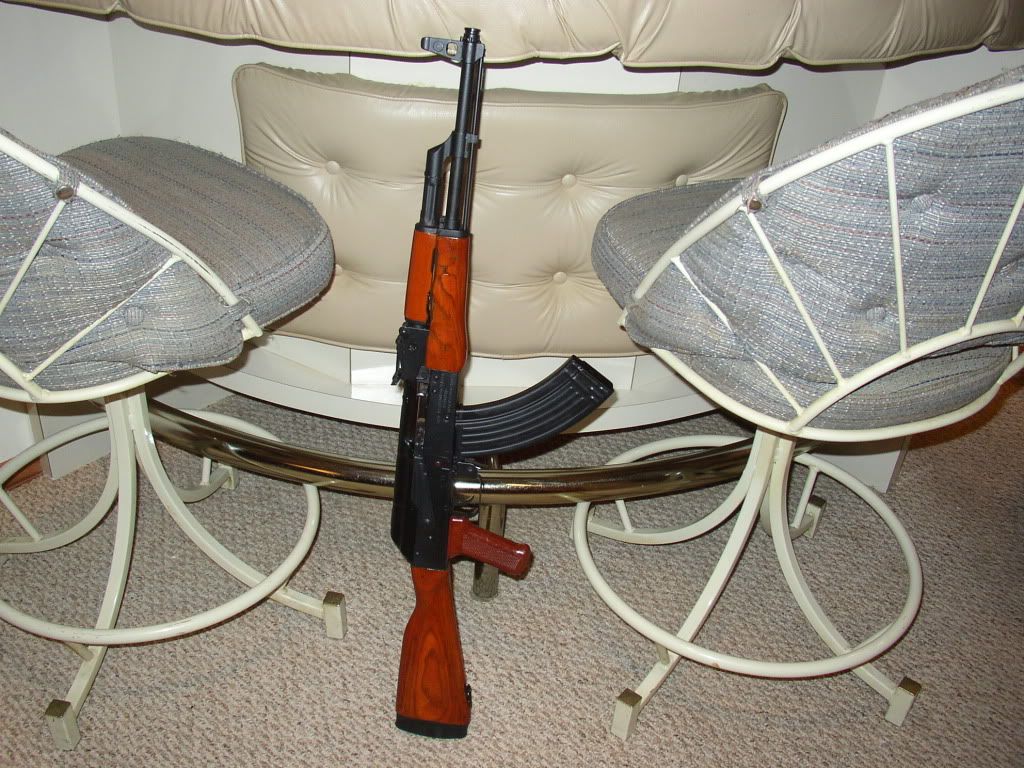
here's the rifle with the pieces installed: 
|
| Shellac is alcohol-based which is why it absorbs moisture. Alcohol is the solvent for it, which is found in some gun cleaners. I don't think shellac is a good choice for this application. Maybe it would be okay if force-dried between coats, or if a drying agent can be added to it. I like linseed oil-based finishes on guns, but on something like this probably the polyurethane would be the most expedient and most durable. I think you probably have messed up the work and will have to take all the woof off the gun, strip off the shellac and start over. |
|
Quoted:
Shellac is alcohol-based which is why it absorbs moisture. Alcohol is the solvent for it, which is found in some gun cleaners. I don't think shellac is a good choice for this application. Maybe it would be okay if force-dried between coats, or if a drying agent can be added to it. I like linseed oil-based finishes on guns, but on something like this probably the polyurethane would be the most expedient and most durable. I think you probably have messed up the work and will have to take all the woof off the gun, strip off the shellac and start over. This. I'd probably go the polyurethane route (semi-gloss or satin) with that - after all the previous finish has been stripped down. |
| First, make sure the shellac was still good and had not expired. I have never had this problem, but I was going for an original type finish and was only using about two coats. If you need to strip it try some orange stripper. It works great and won't burn your skin. |
|
I'm starting to question if the commies really used shellac or some form of lacquer.
My buddy is a high end woodworker and he uses shellac a lot.....but he uses it for a sealer and base coat. He's telling me that plain shellac has some problems I didn't know about. Shellac has poor water resistance and turns white if you get it wet. He says if you put a glass full of ice on a shellacked surface it leaves a white ring. I don't see the Russians using a stock finish that would turn white as soon as it got wet. Shellac is a hard finish, but it softens if you get it hot. Again, I don't see the Russians using a stock finish that would get soft after a couple of magazines. He's telling me that shellac is easy to use but you need to apply it in thin coats. I told him about the technique of mixing 4 parts iodine to 8 parts amber shellac to get the Russian Red color, and he said that would work, but that it should be given a finish coat to waterproof the shellac. He uses Minwax Acrylic water based finish and says this gives you the best of both types of finishes. The Minwax top coat waterproofs the shellac and gives a more abrasion resistant finish, and using satin gloss Minwax cuts the hard gloss of the shellac. He also suggested using shellac as a sealer, then mixing a stain in with the Minwax acrylic finish to color the wood. Since the Minwax is water based, it should take a water based stain like leather dye well. When I get time to order more water based leather dye from Tandy, I'll do some experimenting to see what can be done. All this knowledge about shellac is making me wonder if the Russians really used amber shellac or some other type of varnish or lacquer finish that didn't have shellacs problems. As to why a shellacked stock would be soft, I'm not sure. I "Thought" that shellac was a harder finish, but possibly not. If that's the case, a coat or two of the Minwax might harden it up. |
My aks hit the ground, dirt, sun and humidity most of the year and I haven't seen any problems with my shellac finish even scratching off. We actually lay down our aks on the grass and dirt when we go to the range as we're mostly prone shooters. I have acetoned strip old coats, sanded/wool, bleached and shellac several Romanian furniture but back then I didn't use that many coats as the OP. I like the orange look more than the dark reddish on my Romanians so I'm satisfy with just a few coats of the orange shellac color on the guns.


|
|
I wonder if using dewaxed shellac would help.
Natural shellac contains about 5 percent wax and will produce excellent results; but dewaxed shellac, whether pre-dissolved or in flake form, is more water-resistant. You can remove wax from regular shellac by letting it settle and then decanting the liquid. |
| I refinished a romanian AK stock with a russian red stain/dye then applied 5 coats of zinsser amber shellac and after a month or two the bottom of the handguard was chipping off and spots on the buttstock were wering away. Currently the gun is wearing original russian wood and not a mark on any part of them. the russkie shellac feels worlds stronger than the zinsser. |
| i agree the Zinsser is too soft, I just looked the Russian wood stock same finish nine coats of Zinsser and where it was touching the forearm in the box I was temporarily storing them in you can see the impression it left right at the lightening cut...the Minwax idea sounds like it might work, but then again this shellac wont be that hard to get off, I may try the Minwax with one set and then a varnish with the other... |
|
If you're using shellac first thing to do is make sure it isn't expired (new to you doesn't mean it hasn't been sitting on a store shelf for months/years). Next you may want to try thinning it bit to give you a little longer working time with it, it will still dry fairly fast though. You shouldn't need 9+ coats on it, you simply want to seal the wood.
As for drying...depending on the humidity, it can take awhile to dry. If you want to speed the drying up try hanging it in your car on a hot day in direct sunlight for a few days in a row. Even though it may feel dry to the touch it hasn't fully cured. Pile on too many coats and it wants to stay sticky cause the solvent gets trapped and takes forever to fully evaporate (if it ever does). You'll see the same thing with linseed oil if too much is used. Tung oil (not the formby's stuff) usually gives good results. YMMV, just my .02 |
| After sanding the old finish you did give it a wash/wipe off with denatured alcohol before applying the shellac, right? This gets rid of any contaminants left on the wood surface that would prevent proper adhesion and hardening of your first coat of shellac. First coat of shellac should dry for 4-24 hours depending on relative humidity. Nine coats of shellac were about six too many. I usually use the Zinsser non-amber (I forget the name) for the first coat and then add amber for a second or third coat depending on the color I want. |
| You're using FAR to many coats. One or two thin coats and that's it. Each time you apply it, the alchohol present in the mixture wants to soften all of those coats you've already applied. Get a few clean rags and soak them with denatured alhohol and begin wiping with the wood grain. Just keep doing this until most of that shellac you've applied has been removed. After this process, you may want to apply just one light coat and be done with it, since there will be a very thin, hard basecoat left that basically gets pushed into the wood as you're wiping it down with the alcohol. When I apply it, I just keep the ends of the bristles wet and never go back over the same spot twice as your brushing it on. This will give you a very light coat with a few thin spots, but it doesnt matter because those spots will get hit with the second light coat. I wait two or three days between coats and never apply more than two. Also remember, that once opened, shellac has a "shelf life" which is usually 6 months. After that, it needs to be discarded. Also, sanding only one hour after a coat with steel wool isnt the way to go! The preservative in steel wool that keeps it from rusting is getting pushed into the shellac, which in turn would prevent it from drying, so forget steel wool. In fact, I'm not a big fan of sanding lightly between coats with anything. |
|
while I disagree with the above poster on multiple coats, he did bring up a good point on the steel wool. I wash my steel wool with solvent before using. When using the steel wool, if it doesn't immediately cut the finish and create fine white dust, the finish isn't dry. Not dry enough and the steel wool will only push its grains and dust into the soft finish.
I use many cotes with no problems, but I don't continually go over the old surface - a single pass, because the above poster is correct, in that the subsequent coats at least partially dissolve the undercoat. The key is in the application. Traditional in doing a French Polish is a sponge type product wrapped in cheesecloth and more finish added from the back. On production work of Russian plum (over 400 stock sets) I dunked the whole stock set and hung it to drip dry, then wiped away the drip. I dunked them 4-5 times, let them dry a week or more, buffed with steel wool, then a final hand coat, then a few more weeks drying time before I figured they were "cured". Until that time, I couldn't let one stock touch another (wax paper). While I recommend Zinsser Bullseye, for OTS product, I used Mohawk dried product and thinned with alcohol. This process does not yield as highly refined a finish as a "French Polish" but it closely replicates the original finish, is quick and easy labor wise - it has along dry time, but I think the results are worth it. 


|
|
The problem with all this is, I just don't see the Russians going to all this time and trouble.
I'd like to know what they used. It doesn't sound like it was shellac because of the issue with turning white when water contacts it and the issue with the softness of it. If shellac softens when it gets up around 130 degrees and is soft enough when dry that any contact will leave impressions in the finish, that doesn't sound like a suitable finish to be used on a military weapon. I'm starting to suspect some type of lacquer or fast drying varnish. |
|
You have a good point - but I think what you're missing is that cosmetically appealing is not a military requirement.
If I didn't care about runs and drips, and was dealing with virgin wood, I could just dunk in a heated solution and move on. That's how USGI wood stocks were oiled - a hot linseed oil submersion. But there are a finite number of available wood finishes, and I think we can eliminate a linseed/flax or other nut oil like teak due to the fact that it is affected by alcohol. For the same reason, I think we can eliminate polyurethanes. That we can take the flaking finish off a military stock and dissolve it in lacquer thinner or alcohol is a pretty good indication to me that the finish is either lacquer (nitrocellulose, et al) or shellac (organic secretion of insects - "shell lac" with lac being resin). While most OTC products are called "xxxx finish" as a marketing ploy, meaning "the type of finish obtained by using xxxxx" and may not include any of the actual xxxx substance, and have the addition of polymers and drying agents, I think the behavior of the original military finish indicates its category. |
|
mix in some denatured alcohol, helps cure it quicker.... also, after it dries for a day or so... hit it with a blow dryer evenly.... Thins coats by the way.... you don't layer it too much... will slow the cure process big time.
Some Russian 74 handguards I refinished a few months ago... the upper is the original shellac. 
|
|
Zinsser makes an amber polyurethane that looks like it will give similar results to their amber shellac. Takes longer to dry but it is more durable. Just found it last night. Years back I put a poly over a lam lower that came in a E.German stockset (never seen another EG laminate HG ). To be quick and dirty you can put poly over shellac even though the pros say no. That lower is practically new looking even today.
If you use too many coats or go to thick you get the chipping. 
I'll post pics of my re re finished 74 set w/ 2 light coats shellac and a light poly overcoat. When it dries. |
|
While I'm no expert on all things Russian or Romanian, I can assure you the Romanian's used an orange/amber shellac on any original AKM-variation made for their own use. That being said, they were manufacturing hundreds a week, year by year. That would almost have to dictate they finished in large quantities and needed a very quick drying product. Shellac fits this bill, cheap and reasonably durable. Now the butt-stock's on the Romanian-"G" rifles were "dipped" in black paint either before or after the shellac was applied (usually before) but this would be the exception.
They weren't looking for perfection, they were looking for "good enough". Lacquer has some of the same drawbacks that shellac does and in most cases, is much worse. A lacquer-finish applied to a stock as a top-coat is fine, just as long as it never gets used. It works great for indoor furniture or vintage guitars but sucks when exposed to high humidity or God forbid, actual water. For the ultimate durability, you can never go wrong with polyurethane. It just won't look "correct" on a vintage Com-Bloc weapon but it will last damn near forever and be about as close to water-proof as any man-made finish can be! Good luck. |

AK Sponsor