


Posted: 7/3/2025 12:37:24 PM EDT
| So last year I started setting up a static 100Y range with some steel targets, mostly 7x12 silhouettes @80Y with a 12x20 at 100Y. This past winter I noticed running the course that white targets are a bitch to see with a snowy background and realized that making target ID harder was actually a good thing. So, this spring I started my way up the mountain, creating a dynamic course using 7x12 silhouettes and to make it harder (as if I needed to), I painted all of my targets camo - various styles of brown/green. I have 6 shooting stations with 1-2 targets each at 50-100Y and even though I put them all up myself, when I am a running drills, they are still hard to locate/ID and the stress it adds, in addition to the uphill sprints I am doing, makes the challenge even more difficult. All in all, it works for me and I was just curious if anyone else does the same or has input on this? |
f that noise...

|
Seems in real life, finding the target to engage is the hardest part. I have accidently camouflaged my steel, at it was nearly impossible to engage with iron sights. Instead of camo, you got me thinking. Maybe put some thrift store clothing on the steel targets. Wont last long, but at least a day of my training. Seems more realistic than a paint camo. |
|
Yes, I've been doing this for a while. Painted some of my steel flat tan. It almost disappears in front of most natural backgrounds. Bonus:when the steel gets alot of impacts, with all that grey showing, it's even MORE blended in. Reminds me of all the grey colored animals that are hard to see until they move... I think it's a great training aid, as it does make it way harder to find, let alone engage, which is far more realistic than the "perfect conditions" setups. It really shows advantages of just a little magnification as well. Yesterday I was shooting a course, and one of the steels was practically invisible, at just 50 yards, because of this factor. I'm ashamed to say, this only occurred to me by accident. After one of our weekend-long shoots, I took a steel 12x20" out to 450 yards for some longer range work. At this point, that white steel had been blasted grey by all the shooting we'd done. I had put it against a brown/reddish background of rock & dirt. That thing vanished past 400 yards. I could barely make it out with the 2.5x optic on one gun, more easily with the 1-6c LPVO on another, dialed up. It's a greater, and much more realistic challenge. |
|
Originally Posted By JoeDevola: Bonus:when the steel gets alot of impacts, with all that grey showing, it's even MORE blended in. Reminds me of all the grey colored animals that are hard to see until they move... Yeah, when I did the tactical games they had some head size targets at 200+ yards which were shot grey by the time I got to them... I had 20/20 vision at the time and they were very hard to make out with the naked eye. At the time it felt good getting hits on any of them without magnification and match ammo. Using T-shirts is also a great idea |
per aspera ad astra
|
We just tried T shirts on steel last week. The shirt lasted about 7 rounds, and came off once in that time. It was completely destroyed. Very surprising, looked like it had been wrapped around a grenade. This was just my basic 62gr FMJ load, distance was 75 yards, 18" barreled gun, so MV was around 2,900 FPS. |
|
Originally Posted By JoeDevola: We just tried T shirts on steel last week. The shirt lasted about 7 rounds, and came off once in that time. It was completely destroyed. Very surprising, looked like it had been wrapped around a grenade. This was just my basic 62gr FMJ load, distance was 75 yards, 18" barreled gun, so MV was around 2,900 FPS. Interesting. The splash from steel can be amazingly destructive. The t-shirts I've shot have been on dummies. In John Murphy's class we used a white t-shirt so you can see the hits easier, but that may not be ideal for your particular training objectives. Kelly McCann and Garrett Machine use a variety of shirts on dummies. |
per aspera ad astra
| Well, I have stepped up my game, albeit by accident. I wear specs (near sighted w/astig in both eyes)and while I bought antifog wipes, they only help when you remember to use them. I started running drills at night up on my mountain range and hiking up to the positions, I would get crazy hot and my glasses would fog up, so I just took them off and ran drills without them. I did a lot better than I thought I would. Fast fwd to Friday at dusk, I went out to the barricade for some drills and same thing, plus my eye piece had a smear, so it was crazy hard to make out the already camo'd targets in low light. Again, I did better than anticipated. So, going forward I am going to run drills w/o specs to keep myself sharp. |
f that noise...

|
Most of ours are painted camo- "Robflage" as it's came to be known LOL. I have a weird knack of making a few squiggly lines blend into the background- or so I'm told. Once a year or so I'll take them all to the house and roll some thick brown paint on all of them, flip them over and thick white paint on the other side. At the range they get touched up with camo or with white paint. |
www.jrhenterprises.com
Over 30 Years in business- Thank you for your business!
Quickest ways to contact us-
912.375.1480
[email protected]
Over 30 Years in business- Thank you for your business!
Quickest ways to contact us-
912.375.1480
[email protected]
|
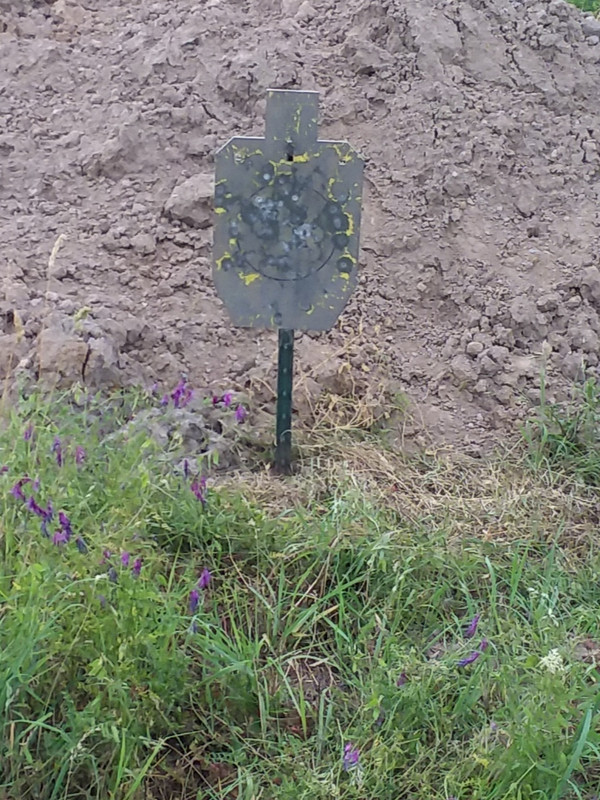
Originally Posted By JoeDevola: See this bad boy, with a little tall grass in the mix, it practically disappeared at 100 meters, was tough to make out at 50 from some positions. https://i.postimg.cc/wTtnxYxy/20250716-092319.jpg Had a great time the other day running a COF in the same area. Exact same spot, but right now that grass is tall, close to shoulder level of the target. Steel was painted tan with a little grey. We did it on a cloudy day, in the rain, and that bitch was completely invisible with naked eye or RDS, from every firing position. Distances varied, around 50-175 yards. Magnification wins the day. I ran it with a rifle set up with a Vortex 3x, and got solid 100% hits. Again, would have been completely impossible even at 50-60 yards. |
|
Very cool! Reading Mark Spicer's Sniper: The Techniques and Equipment of the Deadly Marksman, it was noteworthy that in WW1 snipers generally used 3-to-4 power magnification. Distances were 400 yards max. I've found having that degree of magnification very valuable on my rifles. |
per aspera ad astra