



Posted: 5/6/2026 2:54:45 PM EDT
|
Nice article from 2009 on Retention shooting: Retention shooting: What is it? In my experience not enough people get proper practice in such things. DHS and the Rangemaster Master instructor course have retention shooting as part of their qualifications, but perhaps even then the focus is not as much as it should be. At those distances slow is fatal and misses are still possible if you don't practice. |
per aspera ad astra


A Man's Home Trailer is his White Castle!
Joined:
Oct 2006
Posts:
53420
EE: 100% (160)
 FL, USA
|
Retention shooting is hugely important, and often overlooked. I don't like the article, as he's promoting the old "speed rock" method, and I vehemently disagree with his retention technique of falling back on your own ass. Terrible advice. When I train retention shooting, I do it Shivworks style. Craig Douglas explains: 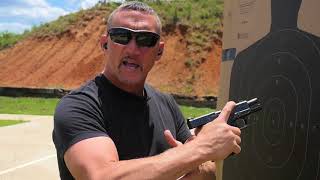 Craig Douglas of Shivworks goes over retention shooting. And this class with him demonstrating to Lovell with WPS is absolute gold:  Retention Shooting | Private Class with Craig Douglas |
|
There is no doubt Shivworks is the leader in retention shooting. That article actually makes a slight error in naming. The "elbow-up-elbow-down" draw is for the "Half Hip" position: 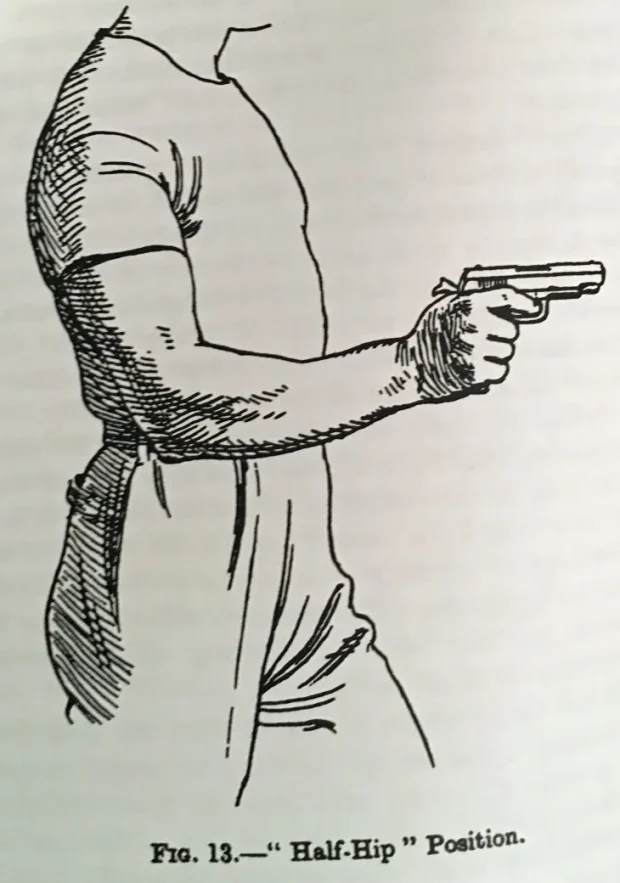 It's a very different draw than the speed rock. "elbow-up-elbow-down" draw can be performed from open carry in under half a second (with practice) |
per aspera ad astra
|
That's true, an actual speed rock ends up with with the gun alot closer to the holster than what he describes. I kind of blurred that distinction. Indeed, at very close range, fast hits are possible that way. Fastest I've done though is in the .80's, out of a 7000 series ALS, at 3 yards. I'm generally in that range using that Shivworks technique from concealment, AIWB, at arms length. I think I've done a couple .79s, never cracked the half second mark. |

|
Originally Posted By JoeDevola: Retention shooting is hugely important, and often overlooked. I don't like the article, as he's promoting the old "speed rock" method, and I vehemently disagree with his retention technique of falling back on your own ass. Terrible advice. When I train retention shooting, I do it Shivworks style. Craig Douglas explains:  https://www.youtube.com/watch?v=j8f3PJ7FOhk https://www.youtube.com/watch?v=j8f3PJ7FOhkAnd this class with him demonstrating to Lovell with WPS is absolute gold: https://www.youtube.com/watch?v=zqnaoI11YpA |
Mach
Nobody is coming to save us.
.
Nobody is coming to save us.
.
|
Originally Posted By JoeDevola: That's true, an actual speed rock ends up with with the gun alot closer to the holster than what he describes. I kind of blurred that distinction. Indeed, at very close range, fast hits are possible that way. Fastest I've done though is in the .80's, out of a 7000 series ALS, at 3 yards. I'm generally in that range using that Shivworks technique from concealment, AIWB, at arms length. I think I've done a couple .79s, never cracked the half second mark. Roger Phillips had a video where he explained the elbow-up-elbow-down draw, but not really seeing anything online. I guess I need my own video series. This draw was very common up to the 40's. COL Cooper was very familiar with the technique, but did not promote it after developing his shooting system. I'm told COL Askins had a .25 sec draw using the technique. IIRC the fastest I've ever been able to do when I'm warmed up was .40 sec. The technique is valuable for 5-to-10ft conversational distances. In John Murphy's class he had a Man vs Man draw exercise where we lined up side by side at around 5ft from silhouettes and took turns reading our partner when to "GO"... I was carrying an M&P pistol with manual safety "on" concealed strong side... and nobody in class could beat me.... even if they started drawing first. One unpracticed guy couldn't even get his pistol out of the holster before I got 1 or 2 hits... and the most skilled guys carrying a Glock AIWB who started first were perhaps a bit astonished they couldn't beat me. You need to keep the pistol tighter (like the Shivworks Position 2) if the threat is within reach. |
per aspera ad astra
|
Originally Posted By Mach: IMO this is largely wrong and not how I was taught at FLETC . The differences being the thumb not sticking out and the gun not angled down as much and the elbow more against the body giving much more retention instead of a chicken wing approach. I think that elbow, the forearm and the bicep hard against the rib cage needs to be all that for solid retention using the big muscles. This is about retention and drawing and rounds on target in min time with hands on. Also stepping forward with the support foot to increase distance from the threat to the gun side ( I don't appendix carry ) is important for retention also. I think consistency and muscle memory is important and don't see the need to put the thumb straight up. Even if you practice shooting from a contact retention position a lot, and you should, I doubt that thumb is going to be standing straight up because you never do that any other time. Keeping a solid muscle memory grip and the weapon aligned with your forearm like it is in any other shooting stance is also important because that keeps the slide action clear. In the contact retention position, now more than ever, you need a strong combative stance and you also do not want your support arm across your chest as they are doing, you need to protect your neck from an edged weapon attack from the outside of the left side of your body with that arm. Let your support arm take the cuts, not your neck. Hand across your chest like one hand point shoulder stance is inappropriate in this situation, all that does is keep an injured hand out of the way of your rounds. In a contact stance you need to start out at least ( it will change ) using that hand and arm to protect your neck from an outside edged weapon attack. Originally Posted By Mach: Originally Posted By JoeDevola: Retention shooting is hugely important, and often overlooked. I don't like the article, as he's promoting the old "speed rock" method, and I vehemently disagree with his retention technique of falling back on your own ass. Terrible advice. When I train retention shooting, I do it Shivworks style. Craig Douglas explains: https://www.youtube.com/watch?v=j8f3PJ7FOhkAnd this class with him demonstrating to Lovell with WPS is absolute gold: https://www.youtube.com/watch?v=zqnaoI11YpACraig Douglas vetted all his techniques in a long running "fight club" style environment, and spends most of his time instructing NAVY SEALs, SF, Intelligence, and gov orgs. The flagged thumb actually should be a standard part of your draw as it feeds into the drawstroke and the thumb is dropped once you have two hands on the pistol. The support side arm is normally used for fending, but in his demo he skipped that part for brevity. Muzzle angled downward prevents you from shooting yourself while your support side arm is fending (support side arm must stay high). I was told by an SF guy that the muzzle angles higher with more training/experience. Shivworks likes hips facing the threat. It's a BJJ thing to prevent a takedown. I feel they perhaps focus too heavily on it, as it is constraining, but that is the way they do it. |
per aspera ad astra
|
Originally Posted By Mach: IMO this is largely wrong and not how I was taught at FLETC . The differences being the thumb not sticking out and the gun not angled down as much and the elbow more against the body giving much more retention instead of a chicken wing approach. I think that elbow, the forearm and the bicep hard against the rib cage needs to be all that for solid retention using the big muscles. This is about retention and drawing and rounds on target in min time with hands on. Also stepping forward with the support foot to increase distance from the threat to the gun side ( I don't appendix carry ) is important for retention also. I think consistency and muscle memory is important and don't see the need to put the thumb straight up. Even if you practice shooting from a contact retention position a lot, and you should, I doubt that thumb is going to be standing straight up because you never do that any other time. Keeping a solid muscle memory grip and the weapon aligned with your forearm like it is in any other shooting stance is also important because that keeps the slide action clear. In the contact retention position, now more than ever, you need a strong combative stance and you also do not want your support arm across your chest as they are doing, you need to protect your neck from an edged weapon attack from the outside of the left side of your body with that arm. Let your support arm take the cuts, not your neck. Hand across your chest like one hand point shoulder stance is inappropriate in this situation, all that does is keep an injured hand out of the way of your rounds. In a contact stance you need to start out at least ( it will change ) using that hand and arm to protect your neck from an outside edged weapon attack. I agree.... I was involved in a shooting in which I had to employ "retention technique." What I was taught about retention shooting was basic and simple (thus easily replicated under stress). I was simply taught to ground the butt of the pistol grip into your ribs and angle the pistol away from the body (for slide clearance). When shit went down, replicating said technique was done subconsciously. |