


Posted: 3/19/2026 1:27:04 AM EDT
 Les (Jim) Fischer BigJimFish Written: March 19, 2026 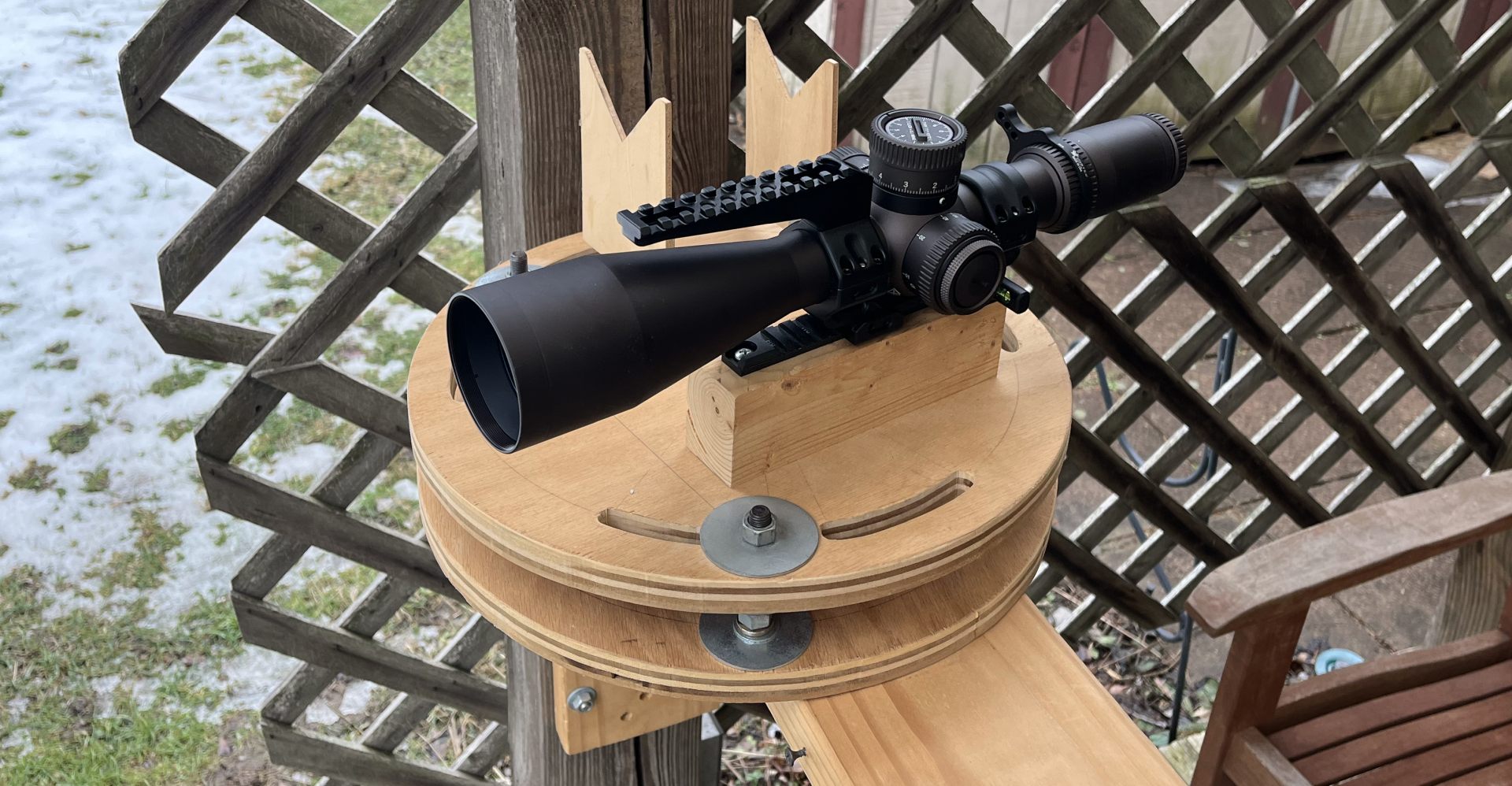 Vortex Razor HD III 6-36x56 on the mechanical test fixture Table of Contents: - Background - Look and Feel - Reticle - Comparative Optical Evaluation - Mechanical Testing - Summary and Conclusion - Your Pro and Con Breakdown: - Testing Methodology Background: It’s been a tick since I did a review on a Vortex. I’ve wanted to do this one for a while but it never came together. I’m not totally sure why now, but a buddy of mine recently bought one and I borrowed it for a day (thanks, Steve!) to test the adjustments for him and gather data for this review. Better late than never, I guess. I couldn’t do every test I usually do with the HD III in a day, but I got most of it done and I certainly hit the big points.  It was 2015, look at that young guy! I had almost no gray hairs back when I reviewed the Gen II Razor HD. Gold was $1,160/oz and silver was $15. Look and Feel: Vortex continues its unusual color scheme with the HD Gen III. As with the HD II, the Gen III uses a somewhat tan color anodizing, but this time it adds a bit of a tint somewhere between copper and burgundy. It’s very pretty and, even a little more than before, it almost certainly won’t match your rifle. Worth noting is that there is also a black Europtic exclusive edition. As before, the Razor is a boat anchor: this time coming in at 45.1oz. The Gen III is almost an inch longer than that Gen II, most likely to accommodate the significantly higher max magnification, as this generation’s high-powered model is 6-36x56 instead of 4.5-27x56. Higher magnification for big 56mm scopes has certainly been the trend amongst competition shooters and I think this was a good choice. Also a good choice was bumping the close focus down to 10yds from the previous 32yds, as you now have the option of using it on a .22lr as well. The rest of the controls are pretty similar with pull up to unlock non-translating turrets, and a pop-up turn indicator on the side. With regard to those turrets, Vortex has introduced a new and interesting zeroing system. For this, you lock the turret in place at zero, loosen a single angled hex on the turret, and use a coin or the supplied tool to zero using the top of the cap. When turning this, you have no clicks but there are graduations so you have the ability to move the adjustment continuously and can adjust your zero to a finer increment than a single click. It reminds me a little of the old U.S. Optics EREK knobs - except it is much easier to do and more intuitive. Now about the turret feel: this is interesting as I tried one out not long after it came out at a SHOTShow and I have now also tried my buddy’s brand new one. They were not the same. Vortex took a lot of heat for the turret feel when the Gen III came out, and rightfully so. The turrets had super hard clicks with basically no resistance between them. Even being large turrets that were only 10mil per turn, it was difficult to adjust only one click at a time. They also had the reputation of not wanting to stay unlocked but rather having the tendency to slip down and lock mid turn. None of this was the case on the current production. These are some of the best feeling turrets that I have encountered. They have really smooth but tactile clicks with just the right amount of pressure in between and they do not try to re-lock themselves but rather require an appropriate amount of force to do so. These rank with the Tangent Theta and Sightron PLR as the best feeling turrets I have encountered. Hopefully they all feel like this now. 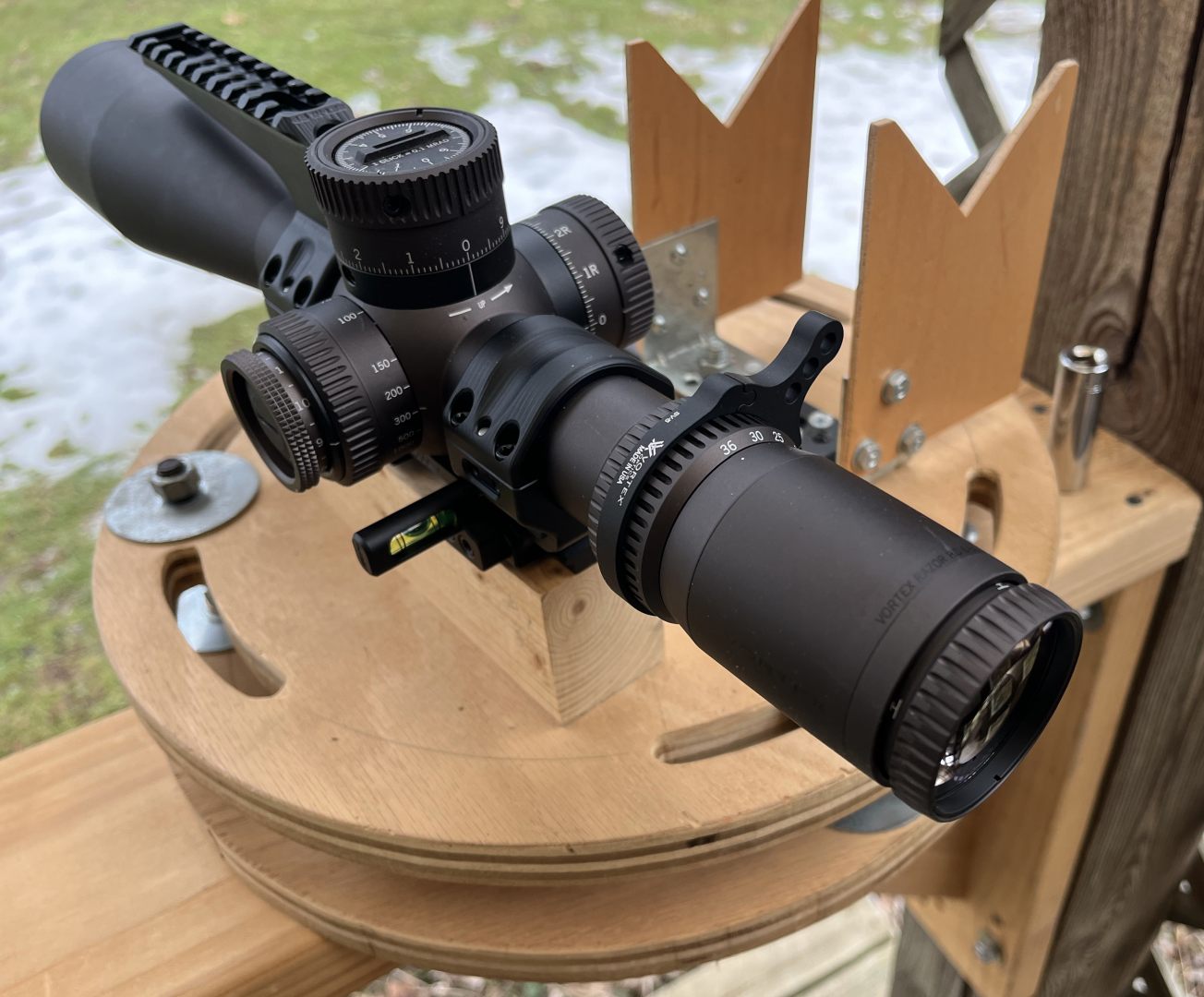 Vortex Razor HD III 6-36x56 on the mechanical test fixture Reticle: The Razor HD III 6-36x56 example I tested had the EBR-7D (MRAD) reticle. This is a mostly .2mil graduated reticle with graduations switching to .1mil after 6 mils in the 12, 3, and 9 o’clock directions. It has a Christmas tree with .2mil dots in the horizontal every 1 mil in the vertical. Despite being pretty complete, the dots are light so it’s less distracting than most trees. Only the main stadia on the reticle are illuminated and this illumination is red. Overall it’s a well designed and nicely proportioned reticle. This appears to be the only current mil reticle with a similar single current MOA reticle. It is worth noting that in the past there were also Horus reticles and earlier iterations of the EBR-7, so you may still find those options depending on where you look. 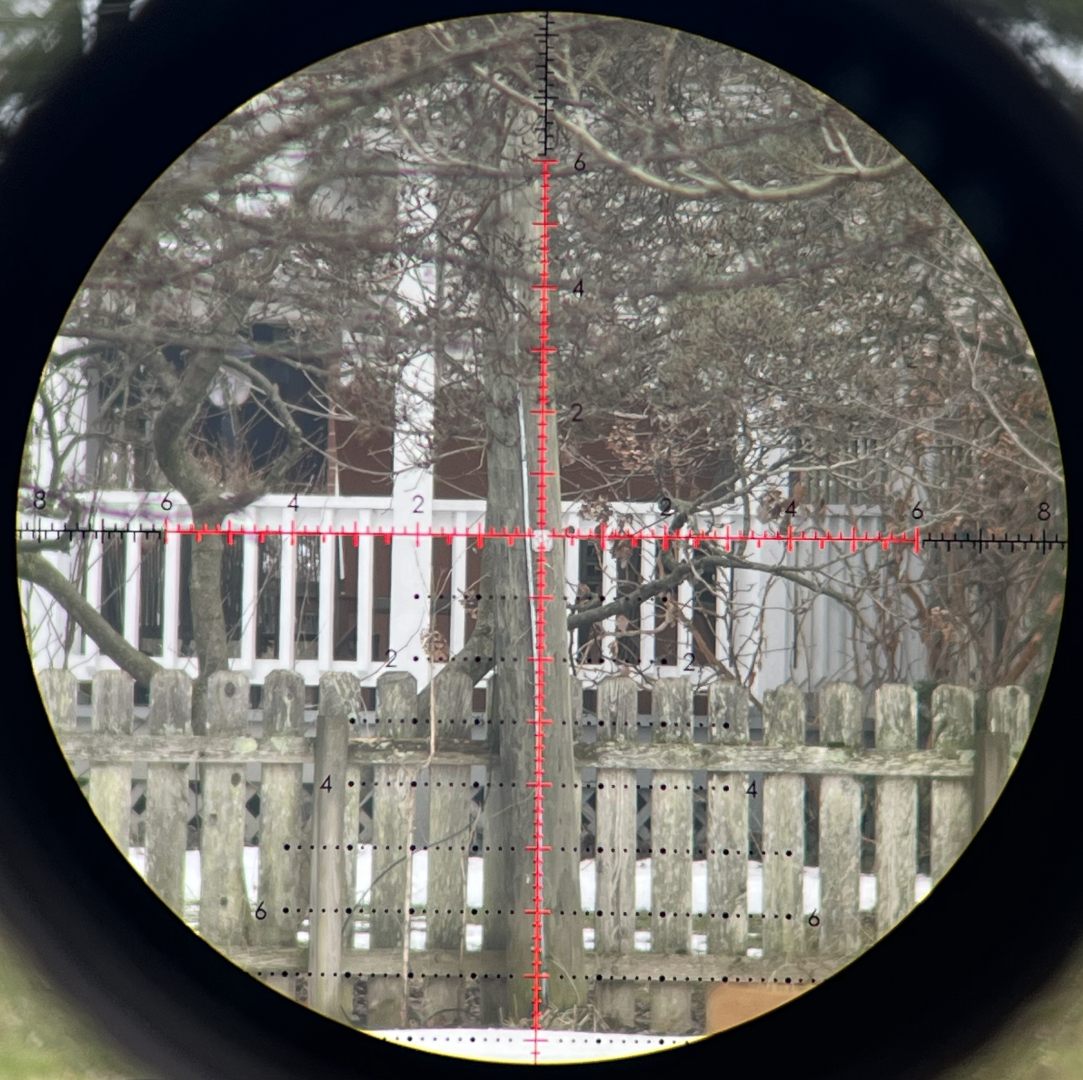 Through the scope with the Vortex Razor HD III 6-36x56 and the EBR-7D (MRAD) reticle Comparative Optical Evaluation: Owing to the relatively short time I had with the Razor HD III, I did not get a chance to test the optics quite as well as usual. In this case, the big differences were that most of the testing was done at 25x instead of at three or four different magnifications, I did not get to test stray light handling due to the conditions, and ditto with mirage. I did have a full lineup to test the Vortex HD III against, though, with a Minox ZP5, Sightron S6 5-30x56, Leupold Mark 5HD 5-25x56, and Sig Tango 65-30x56 acting as the comparison scopes. 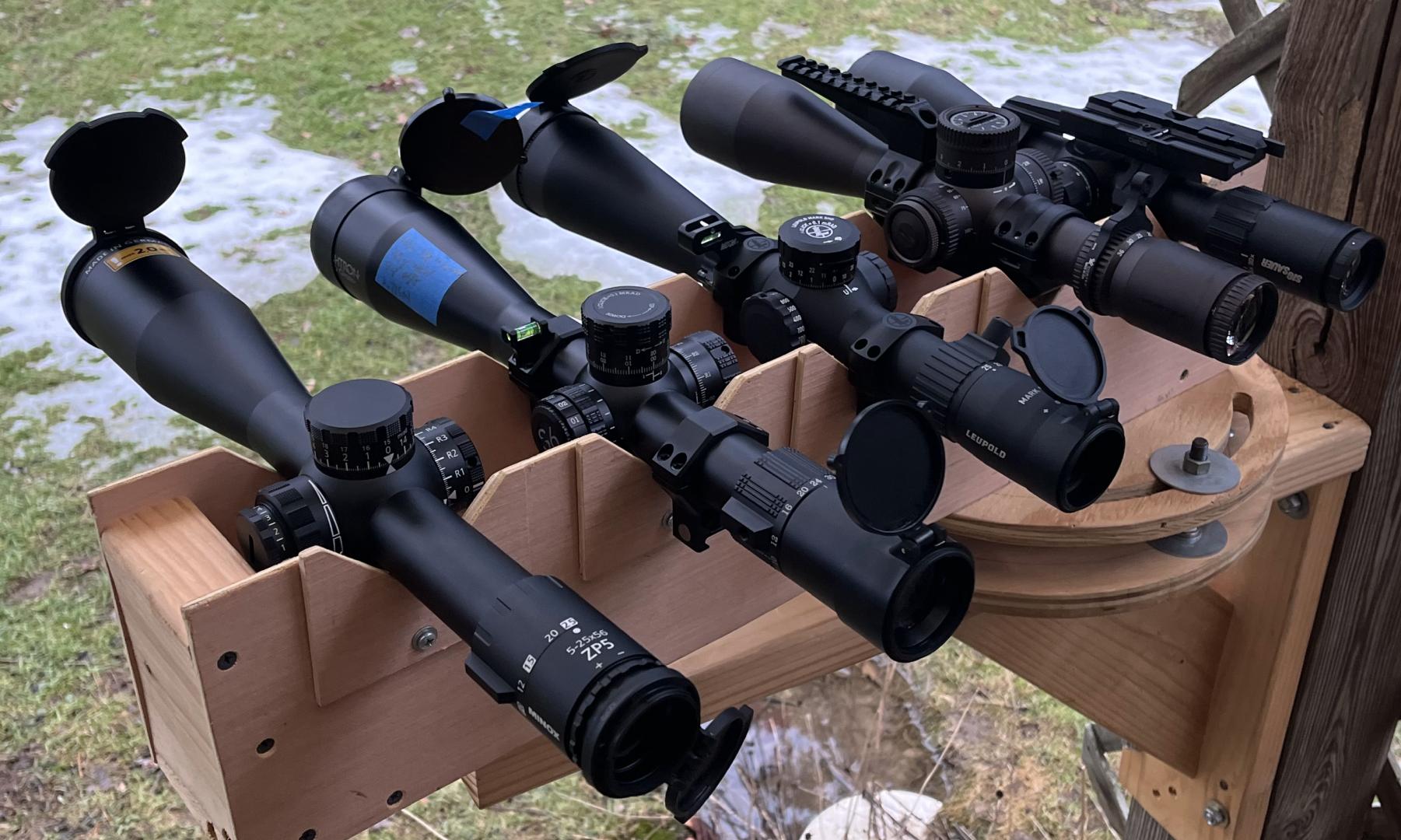 The optical test lineup, left to right: Minox ZP5, Sightron S6 5-30x56, Leupold Mark 5HD 5-25x56, Vortex Razor HD III 6-36x56 and Sig Tango 6 5-30x56 I’ll start with field of view because this is where the Vortex Razor HD III is most outstanding. I have created a condensed statistic for this. I call it the FoV multiplier (FoVX). (See, I can do acronyms, too!) The FoVX is calculated ((max power * FoV @ max mag in ft) + (min power * FoV @ min mag in ft)) / 2. This gives a number that basically averages how good the FoV of a scope is at both ends of its power range. For this statistic, the Vortex Razor HD III 6-36x56 ties the all-time high score at 124.50. Rather surprisingly, it actually ties the Arken, a much lower cost scope for this. You’re not looking through a straw on this one. It has a massive FoV. It’s a bit of a shame to not have done stray light testing on it as it is hard to balance stray light with FoV and I am now curious how it would have done. That is my biggest regret in this abbreviated testing. Moving on from FoV, the Razor also had the best depth of field in the bunch despite pretty steep competition here, as several of these scopes are well optimized for that. It also sported the roomiest eyebox of all of them at 25x, something that I found pretty impressive. On most measures of optical performance, the Vortex trailed only the Minox. These were resolution, chromatic aberration, and contrast. Its only middle of the pack finish was in edge-to-edge performance, where it trailed both the Minox and Sightron. Overall, the Vortex Razor HD III 6-36x56 is an excellent optical performer in the ~$2k scope price range and probably actually the top in that price range, but absolutely not an alpha class scope. It has a very well optimized optical design as evidenced by scoring near the top in almost all measures of optical performance despite the handicap of the 6x erector ratio that gives it the massive 6-36x magnification range but also makes it a good bit harder to achieve the same optical performance as scopes with a 5x erector. The Minox is in another league, though, and this is very obvious side-by-side. The ZP5 is an alpha scope optically and very comparable to ZCO and TT, even if it is far from them in turret design. The Vortex Razor HD III is much closer to the Leupold Mark 5, Sightron S6, and, I think, probably even closer to the Bushnell XRS 3 - though I sadly don’t have that scope on hand anymore to make that most interesting (to me, anyway) direct comparison. All if this is important to note because of the ambiguity in the pricing of the Vortex Razor HD III. At the MSRP of $4,799 it would be a terrible optical performer, but if you’re buying it for $2,000 it is optically remarkably good. At the $2,400 I currently see it listed at, it is good, but I’m not blown away. Mechanical Testing: Most scopes have some deviation from perfect adjustment magnitude, though they are doing far better now than just a few years ago. This adjustment magnitude error will vary from example to example within the same model of scope. This is because it is not a product of design errors, but rather variances introduced within manufacturing and assembly, thus the performance of my test samples is a piece of information with only limited value due to representing only one example. Typically, we measure adjustment magnitude error as a percentage such that a scope whose reticle moves 10.1 mils when adjusted 10.0 mils tracks at 101% and one whose reticle moves 9.9 mils when 10.0 is dialed tracks at 99%. Having both reviewed and tested quite a number of scopes from a large selection of manufacturers, I can tell you that the average deviation in adjustment magnitude from ideal is almost exactly 1% if the two past scopes that failed tracking (and therefore can’t be linearly assessed) are not included. Reticle size deviation is close to that of adjustments at .9%. The average reticle cant measured is .07 mils in 10 mils traveled, or .4 degrees. 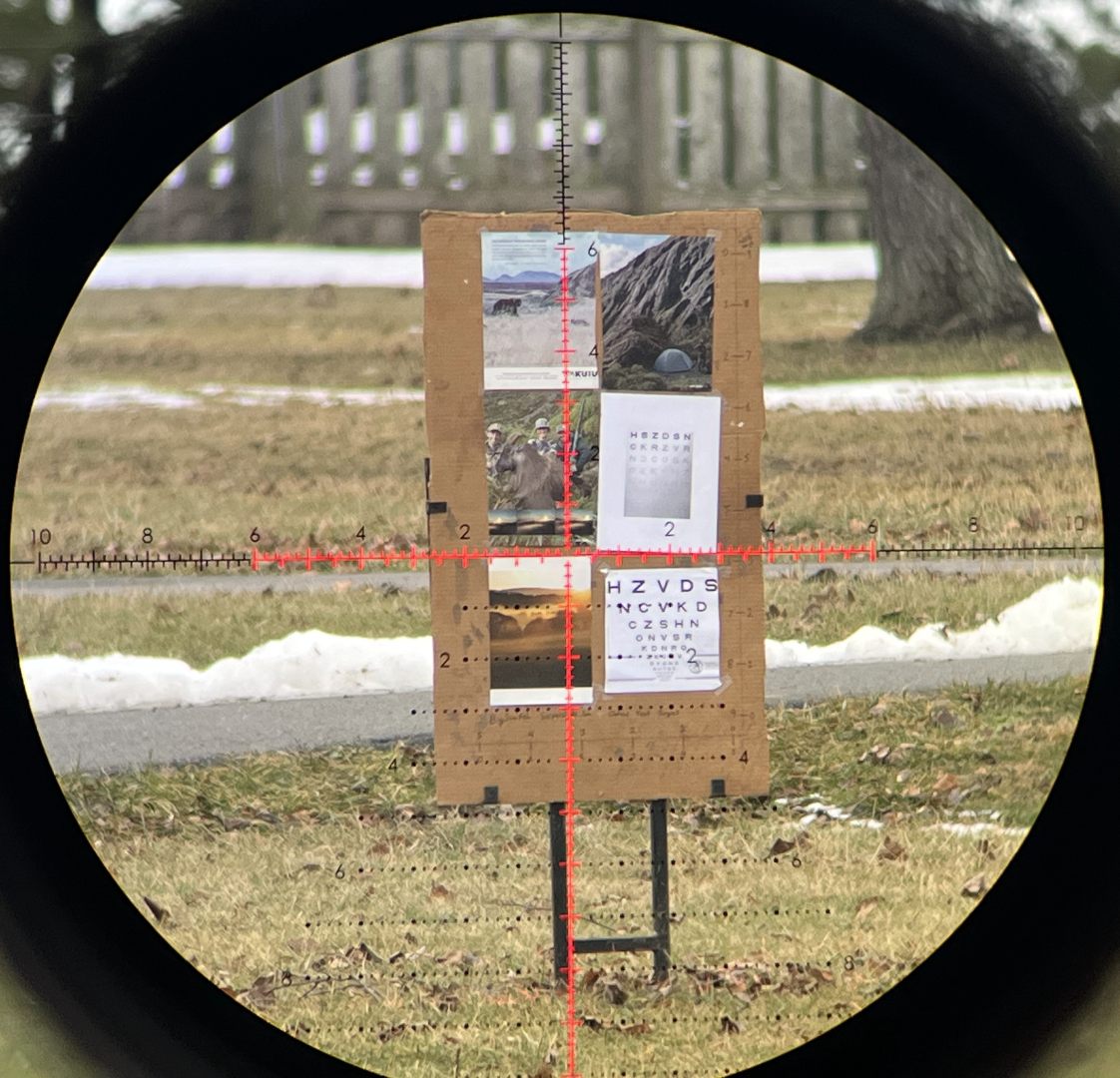 Looking at the test target through the scope with the Vortex Razor HD III 6-36x56 and the EBR-7D (MRAD) reticle In the example I tested (there will be sample to sample variance on all these metrics) 10.0 mils on the reticle was 10.1 mils on the calibrated test target for a 1% error. 10.0 mils on the adjustments were 9.85 mils on the target for a 1.5% error. There was only the slightest (.025 mils) CCW cant in the reticle in 10.0 mils, for only a .14 degree cant - an excellent result on the most important metric as it is very difficult to correct for. There was no POI shift with power ring, diopter, or parallax, and the parallax is not super sensitive to off-center eye position. The Razor HD III has a non-translating turret, so it has a spline. The slop in this was barely detectable and less than .025 mils, so a non-issue. I measured 18.3 mils up from center and 18.2 mils below for a total travel of 36.5 and I understand the knob can actually do a fourth turn to get there. There was no ghost movement at either end of the adjustment and no tubing out when adjusting the windage at max elevation. The windage knob turns 6.7 mils in either direction before the stop. Mechanically, this is not exceptional, but it’s all fine and would pass most manufacturers’ QC. This example had slightly more turret deviance than average, but this disappears into your corrected dope anyway and doesn’t cause any issues. The scope tracked mechanically sound, had a straight reticle, and I saw no red flags. Summary and Conclusion: I’m going to start this out with the elephant in the room: Vortex lists this scope with an MSRP of $4,800. Is this Kohl’s or CounterSniper? Fortunately, though the pricing scheme is similar, this is a high quality product. The pricing is just absurd and dishonest. I have heard people paying all kinds of prices from almost $3k to around a flat $2k for this Vortex, but I have never heard of anyone paying near MSRP. Given the price range, I don’t really know where to evaluate it. For instance, the Vortex Razor HD III is currently the highest cost scope in the optical testing lineup I used by a large margin at $500 more than the next highest, and it is not the best performer. We might say that the unfavorable Minox price comparison results only from the insane “closeout” sale Minox is currently doing on the ZP5 on Europtic. With current market conditions, however, all four of the currently available scopes in this lineup (the Tango 6 has been discontinued) are very heavily discounted and, ostensibly, the Razor is actually the most discounted at 50% off with a retail of $4,799 and a current price of $2,399. We may observe that the discounts on the Minox and Leupold are more uncharacteristic than those on the Vortex (always discounted) or Sightron (often seasonally discounted), but it sure takes a lot of industry knowledge and history to even know that. The typical consumer is just misled by a mark up to mark down mentality more prevalent in women’s clothing than the shooting sports. Vortex Razor HD III 6-36x56 on the mechanical test fixture Now that I’m done with my rant, here are my thoughts on the actual product. As with the previous Razor HD Gen II 4.5-27x56mm, the biggest downside of the Razor HD Gen III 6-36x56 is its remarkable heft. At 45.1oz, it is the third heaviest scope I have ever tested, just behind its predecessor and a hair under a full pound heavier than the Leupold Mark 5HD. That is really the only downside. I think Vortex has chosen a very attractive power range at 6-36x, they have a great reticle, and the post revisit turrets are some of the nicest I have ever tested. The Razor HD III has a great elevation travel of more than 36 mils and a wonderful 10yds close focus. Optically, it is very well designed and outperforms most scopes in the ~$2k range, though it is much further from the alpha class Minox, ZCO, and TT than it is from scopes in the ~$2k range. Mechanically, the example I have performed pretty average in testing, which means it didn’t have any big problems and would pass most companies’ QC. Vortex is well known both for their excellent customer service and, on the Razor series, also for the durability and longevity of the product. Your Pro and Con Breakdown: Pros: - Very nice feature choices, with a 6-36x magnification range and 10yd close focus - The turrets are superb in both feel and function. They have a pop-up turn indicator, and a simple and unique zeroing system that allows for more precise than .1mil zero setting. - Well-balanced optical performance that bests everything I have tested in the ~$2k price range. - Excellent lifetime warranty and good reputation for service and durability. - The color? Cons: - 45.1oz is unbelievably heavy - The $4,800 MSRP is dishonest and the actual typical price is difficult to determine - Optical performance is not close to alpha class despite the MSRP - The color? |
|
Not sure the rub regarding the price. Vortex has been going off MAP for around a decade or more, so this is pretty widely known. Highest I have ever seen them listed at was MAP of 2999$. Most ppl purchase for sub 2500$. You say it isn’t Alpha glass, but sans the ZP5 blowouts, what in the sub 3k price beats it optically as well as an overall package from your experience? |
|
Originally Posted By SuperJlarge: Not sure the rub regarding the price. Vortex has been going off MAP for around a decade or more, so this is pretty widely known. Highest I have ever seen them listed at was MAP of 2999$. Most ppl purchase for sub 2500$. You say it isn’t Alpha glass, but sans the ZP5 blowouts, what in the sub 3k price beats it optically as well as an overall package from your experience? The rub is that giving your scope an MSRP that is close to twice what you expect street price to be is a dishonest marketing tactic designed to trick a low knowledge impulse buyer into making an impulse purchase thinking they have come upon a lucky limited time opportunity. It is intended to be deceptive and I have a problem with that. As for the Alpha glass thing, the Razor HD Gen III is optically a really good scope. It has a very well balanced optical design that is quite strong across all the areas of performance I look at. Not counting the ZP5 blowouts or the one currently heavily discounted S&B 5-25x PM II that is about $3k flat, I haven't tested any sub 3k scopes that are it's match in optical performance though I wish I would have still had the Bushy XRS 3 around to test side by side with it as my notes on it's performance were quite similar and it is made by the same OEM. I think the Vortex is probably a little better based on my notes but I would sure like to have had them side by side because I think they are probably pretty close. Anyhow, the important distinction here is that optically there is a much larger gap between the Razor HD Gen III and the Alpha glass scopes than there is between the Vortex and the ~2k scopes. It basically performs at the top of the ~2k price range across all aspects of optical performance because it is so well balanced but it never does the whole alpha thing. By the alpha thing, I mean the next level resolution I have noted across several scopes as well as this micro-contrast thing they do that makes it seem like there is a small fraction of the amount of mirage that you see through other optics. I have noted these characteristics even in alpha glass scopes that don't have the best optimized optical design such as the S&B 3-20X50 PMII that has poor chromatic aberration. As for overall package. That has a lot to do with how you value individual features and I can't say there are any absolute winners. I really like the Vortex turrets, close focus, reticle, the power range they chose, and their zero set system, but they also weigh an absolute metric ton and have an odd color. As with any scope, the whole package value is a pretty user specific measure. I do my best to help folks find their way to the best scope for their use case and preferences. A best overall scope for all users even at any particular price is not a common situation if it occurs at all. |