


|
Quoted: Thanks. Quoted: Quoted: Quoted: Where can I get a .308 version of the tool to true the face of the receiver? All I found was AR15 sized tools. Nobody makes an off the shelf tool. A guy on predator masters forum named dtech does them for around $20. Thanks. |
|
Here's how my Lilja barreled Grendel shoots at 1000yds, using just some of the main techniques mentioned in the thread. They certainly didn't hurt my accuracy.
Receiver face was checked for square with a lapping tool. Barrel extension was de-edged and polished, then bedded with Blue Loc-tite. Gas block was aligned and bedded with Red. Gas tube sealed with Blue. I don't even mess around with primer pocket cleaning, uniforming, reaming flash holes, and haven't even trimmed these cases. I just use Lapua brass, hand-weigh each load, and rapid-fire sub-MOA groups at 1000yds. There are at least 6 rounds I put on target, and I couldn't see where I was hitting, but could hear the dings. Went over to a 3/4" IPSC sil and drilled its forehead, then put 6 more in the chest, got bored. Not enough range to have fun with. The rest of the hits on the small IPSC-ish sil are from 24" and 26" 6.5 Creedmoors, and 178gr AMAX from an SR25. 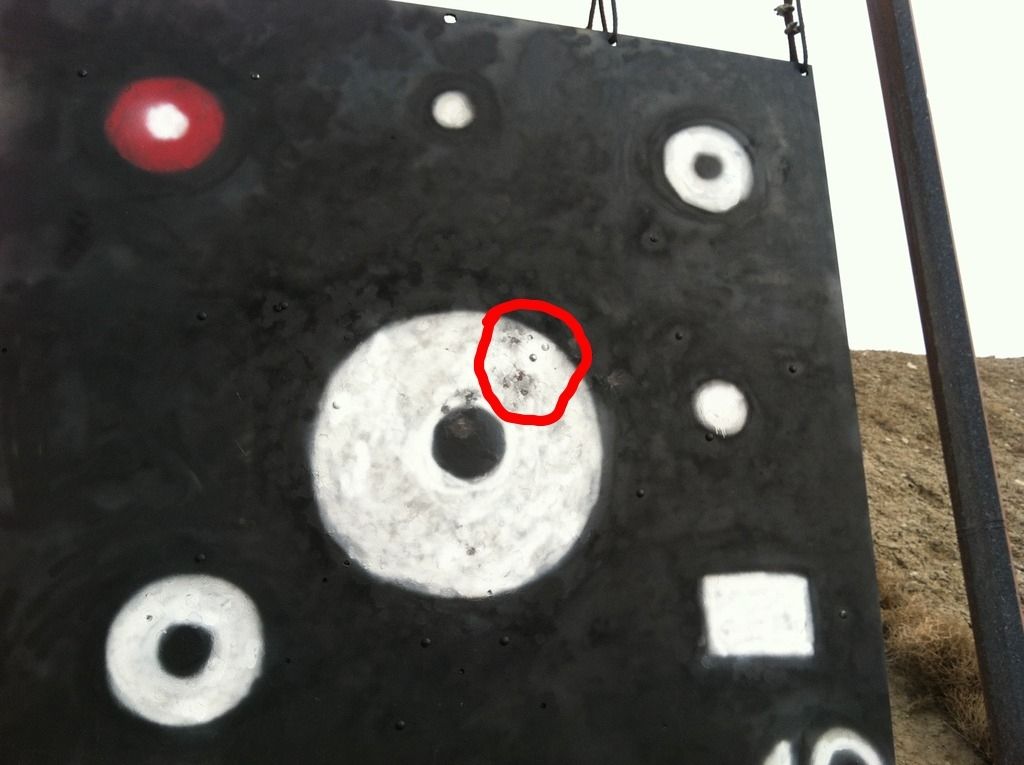

|
|
Quoted:
Why should the shim stock seam be on the side and not the top/bottom? I assume it is because gravity sucks. And because of this barrels tend to flex in the vertical plane. Varmint Al's site has more about that kind of stuff than you probably want to know: http://www.varmintal.com/amode.htm |
|
Quoted:
I'm Hellbender from the Hide and I wrote the above articles several years ago. Thank you wheelchairman for saving these posts. I don't post much anymore, as my life is very busy. I will try to keep an eye on these posts and answer questions as I get the time. Chris, the reason I put the seam on the side is most of the pressure from loading the bipod, laying on barricades, sandbags, etc. is up and down, not side to side. Does it REALLY matter?? Probably not, but seems to make sense to me. The hand guard takes a lot of whacks during use, and most of these are up and down. Good morning. About your recommendation for polishing/smoothing BCG components... is this only for traditional phosphate coated parts? Lots of new coatings out there: melonite, NiB, etc. |
|
Here is a thread on large frame AR lapping tools if anyone is interested. |
|
I posted this in another thread but I'll put it here as well since this is the thread about "fine tuning" thinigs.
When installing a gas block over the gas port....do the holes have to be concentric? Or as long is there is overlap you'll be fine? This is what I mean on the gas port in the barrel and gas block: Is this ok? As long as there is full overlap? 
Or does it need to be like this: 
|
|
Quoted: I posted this in another thread but I'll put it here as well since this is the thread about "fine tuning" thinigs. When installing a gas block over the gas port....do the holes have to be concentric? Or as long is there is overlap you'll be fine? This is what I mean on the gas port in the barrel and gas block: Is this ok? As long as there is full overlap? http://study.com/cimages/multimages/16/drawingnonconcentriccircles.png Or does it need to be like this: http://study.com/cimages/multimages/16/drawingconcentriccircles.png |
|
Quoted: I don't believe being offset will cause any issues. I aim for center though. Quoted: Quoted: I posted this in another thread but I'll put it here as well since this is the thread about "fine tuning" thinigs. When installing a gas block over the gas port....do the holes have to be concentric? Or as long is there is overlap you'll be fine? This is what I mean on the gas port in the barrel and gas block: Is this ok? As long as there is full overlap? http://study.com/cimages/multimages/16/drawingnonconcentriccircles.png Or does it need to be like this: http://study.com/cimages/multimages/16/drawingconcentriccircles.png A very painful lesson I learned from positional alignment along the fore and aft axis of port alignment is this: if you move the gas block back more than a few thousandths, you can run into the issue of setting the gas tube back into the carrier key by that same distance. When I made the mistake of doing that on my big Mega, I had the carrier key colliding with the gas tube enough to actually pretension the barrel. My cold shot would be something like four to six inches from the rest of one very strange group. If it weren't for a very odd experience at Fort Benning back in the 80s, I don't know if I EVER would have figured it out. Replacing the gas tube and the block with a unit that needed no alignment fixed the issue immediately. I went from this:  To this:  The Benning incident that clued me in to the gas tube having that much influence on a barrel stemmed from the 20 ( or whatever...Ranger, help me out ) to 600 meter pop up range qualifications in Infantry School back in the 80s. The day I had to qualify it was sometime in December or January and it was raining cats and dogs. My qual rifle was an old...old...old....XM16E1 with triangular hand guards. Everyone was wet as could be and everything we had was soaked. It was about 40 or 45 degrees out. I'm in my foxhole when the targets start popping up and I take aim and squeeze the trigger on my first shot and POW! The water just EXPLODED off of the gas tube. It literally superheated right off the tube. Sooooo....for every shot I took I would have to raise up my head and BLOW the steam away ( the rain was comnig down that hard ) each time. I still managed a 35/40 score.....but I was pissed....I would have had expert had it not been for my bobbing and weaving above the sights with each shot. It made me realize how incredibly HOT a gas tube gets with one shot....and also HOW FAST IT COOLS BETWEEN SHOTS. The weirdness in my groups with my Mega was VERY indicative of something reacting to temperature over time. Changing the block and tube fixed the issue immediately. The key thing HERE is that when I check the original alignment of my ports, the gas block was .037 thousandths of an INCH forward of being in true position over the barrel port in the FORWARD direction. Sooooo, I milled the block BACK .037 INCH. In my job, I work with SI Units ( metric ) and I think in MICRONS. Can you see where I got into trouble. To add insult to injury I was using a straight Wilson Gas tube along with the Wilson block. I fucking Hubble Space Telescoped my gun. Add the possible over length of the straight gas tube with with over length ( almost 40 thousandths ) of the block position and who KNOWS how over long I had that system. I never thought how proprietary their parts might be versus Syrac or Odin Works. Lemme tell ya...I learned my lesson and learned it well. THE MORAL OF THE STORY: When attempting to align the block and barrel port positions to "true" make sure you aren't setting your gas tube too far back. I have learned you can reshape and remove a bit off of the ball end of the tube....enough to prove my theory which incited me to replace the gas system....and the gun will run. your best be, though is to feel free to shim forward a bit but try to keep from "milling backward" if you can. |
|
Quoted:
A very painful lesson I learned from positional alignment along the fore and aft axis of port alignment is this: if you move the gas block back more than a few thousandths, you can run into the issue of setting the gas tube back into the carrier key by that same distance. When I made the mistake of doing that on my big Mega, I had the carrier key colliding with the gas tube enough to actually pretension the barrel. My cold shot would be something like four to six inches from the rest of one very strange group. If it weren't for a very odd experience at Fort Benning back in the 80s, I don't know if I EVER would have figured it out. Replacing the gas tube and the block with a unit that needed no alignment fixed the issue immediately. I went from this: http://www.ar15.com/media/viewFile.html?i=71788 To this: http://www.ar15.com/media/viewFile.html?i=80164 The Benning incident that clued me in to the gas tube having that much influence on a barrel stemmed from the 20 ( or whatever...Ranger, help me out ) to 600 meter pop up range qualifications in Infantry School back in the 80s. The day I had to qualify it was sometime in December or January and it was raining cats and dogs. My qual rifle was an old...old...old....XM16E1 with triangular hand guards. Everyone was wet as could be and everything we had was soaked. It was about 40 or 45 degrees out. I'm in my foxhole when the targets start popping up and I take aim and squeeze the trigger on my first shot and POW! The water just EXPLODED off of the gas tube. It literally superheated right off the tube. Sooooo....for every shot I took I would have to raise up my head and BLOW the steam away ( the rain was comnig down that hard ) each time. I still managed a 35/40 score.....but I was pissed....I would have had expert had it not been for my bobbing and weaving above the sights with each shot. It made me realize how incredibly HOT a gas tube gets with one shot....and also HOW FAST IT COOLS BETWEEN SHOTS. The weirdness in my groups with my Mega was VERY indicative of something reacting to temperature over time. Changing the block and tube fixed the issue immediately. The key thing HERE is that when I check the original alignment of my ports, the gas block was .037 thousandths of an INCH forward of being in true position over the barrel port in the FORWARD direction. Sooooo, I milled the block BACK .037 INCH. In my job, I work with SI Units ( metric ) and I think in MICRONS. Can you see where I got into trouble. To add insult to injury I was using a straight Wilson Gas tube along with the Wilson block. I fucking Hubble Space Telescoped my gun. Add the possible over length of the straight gas tube with with over length ( almost 40 thousandths ) of the block position and who KNOWS how over long I had that system. I never thought how proprietary their parts might be versus Syrac or Odin Works. Lemme tell ya...I learned my lesson and learned it well. THE MORAL OF THE STORY: When attempting to align the block and barrel port positions to "true" make sure you aren't setting your gas tube too far back. I have learned you can reshape and remove a bit off of the ball end of the tube....enough to prove my theory which incited me to replace the gas system....and the gun will run. your best be, though is to feel free to shim forward a bit but try to keep from "milling backward" if you can. Quoted:
Quoted:
Quoted:
I posted this in another thread but I'll put it here as well since this is the thread about "fine tuning" thinigs. When installing a gas block over the gas port....do the holes have to be concentric? Or as long is there is overlap you'll be fine? This is what I mean on the gas port in the barrel and gas block: Is this ok? As long as there is full overlap? http://study.com/cimages/multimages/16/drawingnonconcentriccircles.png Or does it need to be like this: http://study.com/cimages/multimages/16/drawingconcentriccircles.png A very painful lesson I learned from positional alignment along the fore and aft axis of port alignment is this: if you move the gas block back more than a few thousandths, you can run into the issue of setting the gas tube back into the carrier key by that same distance. When I made the mistake of doing that on my big Mega, I had the carrier key colliding with the gas tube enough to actually pretension the barrel. My cold shot would be something like four to six inches from the rest of one very strange group. If it weren't for a very odd experience at Fort Benning back in the 80s, I don't know if I EVER would have figured it out. Replacing the gas tube and the block with a unit that needed no alignment fixed the issue immediately. I went from this: http://www.ar15.com/media/viewFile.html?i=71788 To this: http://www.ar15.com/media/viewFile.html?i=80164 The Benning incident that clued me in to the gas tube having that much influence on a barrel stemmed from the 20 ( or whatever...Ranger, help me out ) to 600 meter pop up range qualifications in Infantry School back in the 80s. The day I had to qualify it was sometime in December or January and it was raining cats and dogs. My qual rifle was an old...old...old....XM16E1 with triangular hand guards. Everyone was wet as could be and everything we had was soaked. It was about 40 or 45 degrees out. I'm in my foxhole when the targets start popping up and I take aim and squeeze the trigger on my first shot and POW! The water just EXPLODED off of the gas tube. It literally superheated right off the tube. Sooooo....for every shot I took I would have to raise up my head and BLOW the steam away ( the rain was comnig down that hard ) each time. I still managed a 35/40 score.....but I was pissed....I would have had expert had it not been for my bobbing and weaving above the sights with each shot. It made me realize how incredibly HOT a gas tube gets with one shot....and also HOW FAST IT COOLS BETWEEN SHOTS. The weirdness in my groups with my Mega was VERY indicative of something reacting to temperature over time. Changing the block and tube fixed the issue immediately. The key thing HERE is that when I check the original alignment of my ports, the gas block was .037 thousandths of an INCH forward of being in true position over the barrel port in the FORWARD direction. Sooooo, I milled the block BACK .037 INCH. In my job, I work with SI Units ( metric ) and I think in MICRONS. Can you see where I got into trouble. To add insult to injury I was using a straight Wilson Gas tube along with the Wilson block. I fucking Hubble Space Telescoped my gun. Add the possible over length of the straight gas tube with with over length ( almost 40 thousandths ) of the block position and who KNOWS how over long I had that system. I never thought how proprietary their parts might be versus Syrac or Odin Works. Lemme tell ya...I learned my lesson and learned it well. THE MORAL OF THE STORY: When attempting to align the block and barrel port positions to "true" make sure you aren't setting your gas tube too far back. I have learned you can reshape and remove a bit off of the ball end of the tube....enough to prove my theory which incited me to replace the gas system....and the gun will run. your best be, though is to feel free to shim forward a bit but try to keep from "milling backward" if you can. That's very interesting. The results are surprising. I suppose another way to counter this is to insert gas tube, install bcg in receiver with bolt locked into extension, pin tube in gas block, align block without tube putting pressure on carrier key, tighten block screws. |
|
Quoted:
Would the gas tube to upper fit being pretty damn snug have similar or at least an adverse impact on accuracy? I've since replaced it, now it moves freely, but haven't been able to test it yet. Donno about accuracy but if the BE, gas port, gas block and tube are not all square and it it croocked it can bind in the gas key. Common problem w kitchen table and low tier mfg guns. ETA, saw LRRpf52s post abobove bout the long gss tube. Yep, you don't want to defeat the benefits of the inline stoner gas system and a free float handguard by having a jammed up gas tube. |
|
Quoted: Would the gas tube to upper fit being pretty damn snug have similar or at least an adverse impact on accuracy? I've since replaced it, now it moves freely, but haven't been able to test it yet. Ya know, that is a darn good question. I would say that if the alignment was near perfect and there was no gas tube bump when the gun goes into battery AND there was no forward impingement, then I am not sure that there would be measurable impact on accuracy. That probably depends on the coefficient of thermal expansion on ALL of the components in the system. Let's say they all balance out to ZERO.....then you shuold be good. BUT if they stack to a very positive or very negative value that creates a load or tension in the system..then you may have issues. Having looked at a lot of five and seven and ten shot groups in this forum.....I have seen that there are numerous guns, including mine as it sits now, that print 1,2,3 right in a hole and then 4 and 5 right next to the group. Or 1,2,3, then 4 and 5 somewhere then 6 and 7 right next to the original group, etc. I do wonder, that the guns that print single ragged holes don't have dimensionally perfect gas systems....among many other variables, of course. There are some other tips in this thread that have me wanted to go through my gun AGAIN....just to see if I can't squeeeeeeze just a bit more accuracy out. For instance.....my JP barrel extension lugs are razor sharp and DO scratch the bullets and cases. I am going to dress those edges AND ONLY dress those edges ( doing nothing else to the system ) to see what happens. |
|
Quoted:
Good morning. About your recommendation for polishing/smoothing BCG components... is this only for traditional phosphate coated parts? Lots of new coatings out there: melonite, NiB, etc. Quoted:
Quoted:
I'm Hellbender from the Hide and I wrote the above articles several years ago. Thank you wheelchairman for saving these posts. I don't post much anymore, as my life is very busy. I will try to keep an eye on these posts and answer questions as I get the time. Chris, the reason I put the seam on the side is most of the pressure from loading the bipod, laying on barricades, sandbags, etc. is up and down, not side to side. Does it REALLY matter?? Probably not, but seems to make sense to me. The hand guard takes a lot of whacks during use, and most of these are up and down. Good morning. About your recommendation for polishing/smoothing BCG components... is this only for traditional phosphate coated parts? Lots of new coatings out there: melonite, NiB, etc. I've polished the bearing surfaces on a NiB bolt. It was slicker than ever. |
|
Quoted:
This might be a silly question but are any of these mods worth doing to a regular AR not shooting match ammo? While you may squeeze some more accuracy out, the bottom line is a crappy barrel is a crappy barrel. Also, minute-of-man is still all you need for most "regular ARs" |
|
Quoted:
While you may squeeze some more accuracy out, the bottom line is a crappy barrel is a crappy barrel. Also, minute-of-man is still all you need for most "regular ARs" Quoted:
Quoted:
This might be a silly question but are any of these mods worth doing to a regular AR not shooting match ammo? While you may squeeze some more accuracy out, the bottom line is a crappy barrel is a crappy barrel. Also, minute-of-man is still all you need for most "regular ARs" That's what I was thinking, thanks. |
|
Quoted:
Here is a thread on large frame AR lapping tools if anyone is interested.http://www.ar15.com/forums/t_3_121/694671_AR10_Upper_Receiver_Lapping_Tool.html There are a couple companies making these, I think I will order one... Also, I ordered some shim stock, top to bottom my upper seems to be .014" over the OD of the BE, but side to side it is right on the money??? So the upper seems eccentric. Perhaps I should just bed w locktite instead of trying g to use the shim stock?? |
|
Quoted:
Quoted:
Quoted:
Is careful technique with calipers good enough to measure the ID of the receiver and OD of the barrel extension? And if the difference is less than 0.0025", go ahead with bolting them together? The difference should be .002 on the high, that is the spec. You should be using a set of Deltronics for that measurement. |
|
Regarding step #11, Buffer Spring Tuning:
Is there accuracy potential to be found by buffer spring tuning? Or am I missing the point? Before I start cutting spring coils, what can I expect to gain and/or accomplish? (Considering my particular deal; 20" chambered in 223, rifle-length gas system/non-adjustable gas block, relatively heavy AR) |
|
Quoted: The gas tube and hot it is mounted is one of the most overlooked aspects of AR10/AR15 accuracy. Gas tube construction also. LMT didn't put that locator on the MRP and MWS for nothing. |
|
Shameless bump.
I'd rather know what I'm getting myself into before I start cutting up stuff 
Quoted:
Regarding step #11, Buffer Spring Tuning: Is there accuracy potential to be found by buffer spring tuning? Or am I missing the point? Before I start cutting spring coils, what can I expect to gain and/or accomplish? (Considering my particular deal; 20" chambered in 223, rifle-length gas system/non-adjustable gas block, relatively heavy AR) |
|
Quoted:
Shameless bump. I'd rather know what I'm getting myself into before I start cutting up stuff
Quoted:
Shameless bump. I'd rather know what I'm getting myself into before I start cutting up stuff
Quoted:
Regarding step #11, Buffer Spring Tuning: Is there accuracy potential to be found by buffer spring tuning? Or am I missing the point? Before I start cutting spring coils, what can I expect to gain and/or accomplish? (Considering my particular deal; 20" chambered in 223, rifle-length gas system/non-adjustable gas block, relatively heavy AR) im sorry, but i cant see how cutting the spring is a good thing. if u want to get THAT fine tuned, get the JP silent capture and the 3 different springs and go from there. i personally went with the reg buffer with heavy spring. |
|
Quoted:
im sorry, but i cant see how cutting the spring is a good thing. if u want to get THAT fine tuned, get the JP silent capture and the 3 different springs and go from there. i personally went with the reg buffer with heavy spring. Quoted:
Quoted:
Shameless bump. I'd rather know what I'm getting myself into before I start cutting up stuff
Quoted:
Regarding step #11, Buffer Spring Tuning: Is there accuracy potential to be found by buffer spring tuning? Or am I missing the point? Before I start cutting spring coils, what can I expect to gain and/or accomplish? (Considering my particular deal; 20" chambered in 223, rifle-length gas system/non-adjustable gas block, relatively heavy AR) im sorry, but i cant see how cutting the spring is a good thing. if u want to get THAT fine tuned, get the JP silent capture and the 3 different springs and go from there. i personally went with the reg buffer with heavy spring. I've used the Tubbs flatwire with success as well. EDIT: Watch his videos but basically a flatwire has a more consistent tension where as a coil has different tension at different compression lengths |
|
Quoted:
I've used the Tubbs flatwire with success as well. EDIT: Watch his videos but basically a flatwire has a more consistent tension where as a coil has different tension at different compression lengths Quoted:
Quoted:
Quoted:
Shameless bump. I'd rather know what I'm getting myself into before I start cutting up stuff
Quoted:
Regarding step #11, Buffer Spring Tuning: Is there accuracy potential to be found by buffer spring tuning? Or am I missing the point? Before I start cutting spring coils, what can I expect to gain and/or accomplish? (Considering my particular deal; 20" chambered in 223, rifle-length gas system/non-adjustable gas block, relatively heavy AR) im sorry, but i cant see how cutting the spring is a good thing. if u want to get THAT fine tuned, get the JP silent capture and the 3 different springs and go from there. i personally went with the reg buffer with heavy spring. I've used the Tubbs flatwire with success as well. EDIT: Watch his videos but basically a flatwire has a more consistent tension where as a coil has different tension at different compression lengths I can see different springs...but to start cutting coils...no. i just dont get that. |
|
Quoted:
im sorry, but i cant see how cutting the spring is a good thing. if u want to get THAT fine tuned, get the JP silent capture and the 3 different springs and go from there. i personally went with the reg buffer with heavy spring. Quoted:
Quoted:
Shameless bump. I'd rather know what I'm getting myself into before I start cutting up stuff
Quoted:
Regarding step #11, Buffer Spring Tuning: Is there accuracy potential to be found by buffer spring tuning? Or am I missing the point? Before I start cutting spring coils, what can I expect to gain and/or accomplish? (Considering my particular deal; 20" chambered in 223, rifle-length gas system/non-adjustable gas block, relatively heavy AR) im sorry, but i cant see how cutting the spring is a good thing. if u want to get THAT fine tuned, get the JP silent capture and the 3 different springs and go from there. i personally went with the reg buffer with heavy spring. Personally I like the JP SCS because it's not only quiet but it's noticeably smoother operation. That being said the JP SCS with a spring pack is approx $170. Carbine buffer springs from Brownells are $3 apiece. You can buy 58 buffer springs for the cost of one SCS kit and you can fine tune an AR quite easily by clipping coils. That level of tuning is really geared toward 3gun shooters looking to eliminate anything that will move the sights off target for double taps and sequential targets. |
| I don't have my barrel yet but I started doing some of these things to a new 308 bolt carrier group I'm using in a 6.5 creedmoor build. I have to say that with about an hours worth of work, manually cycling the bolt feels so much better than it did when it was new. I cycled the action manually a couple hundred of times and polished everywhere that showed wear in the new finish. It feels tons better now. It's like a pre break in. |
|
Any comments on this? I've got one upper that exhibits this trait
|
|
Quoted:
That recommendation to soften the edges on the lug seats is no baloney. My ArmaLite AR10 was a case-eater and then I did this some years ago. Case life doubled. Although just 223/5.56 I've radiussed & polished everything. No more brass shavings, no more scratched/gouged cases. Aside from the occasional case head line (those get tossed at the first sign of that), I wear out primer pockets before having any other reason to scrap them. It might take a few hours of delicate hand work, but well worth it IMO |


