


Posted: 3/10/2026 8:57:26 PM EDT
[Last Edit: kingfish][Edited]
|
I have lots of accessories such as phone, illuminated scopes, night, vision, etc., that basically runoff USB-C, which I can power them up, in an emergency using my charging brick. But how do I charge up the brick if my power is out? Can someone please recommend me a good solar charging kit, which is portable and I can carry easily in a backpack or go hiking with that is not too big? |


|
I have the older version of this: Anker And this version of this one: Big Blue And a couple others. A Goal Zero Nomad 7 and some random Talent Cell 28 or 30 watt or something. I like the Big Blue the best. Anker 2nd. Haven’t really played with the Talent Cell and the (older) Nomad is last. The Big Blue will charge an Anker 13000mah portable USB battery from 0 to full in about 6 hours and the built in ammeter is pretty nice. The Anker in about 7.5-8. Talent Cell is unknown. The Nomad will charge a 4 pack of Nimh AA’s in a full day of sun. Not “worthless” but damn near. I have a full kit with 16340’s, 16650’s, 18650’s, lithium AA’s, nimh AA/AAA, C & D cell adapters, buck/boost converters/various sized battery holders, a few Fenix 18650 lights, lanterns, headlamps and other “portable” devices powered by various batteries. 3-4 multi-cell type chargers and multiples of all the charging cords (micro, mini, iphone, USB-C). EX: If the grid were down medium-long term, I have a couple Comet brand submersible RV pumps and could rig some pex water lines up to my 2nd level where a small indoor reservoir could be tied into my plumbing high point to gravity feed everything in the house with cold water except my upstairs shower without manually hauling water. It can be powered by components of this kit, namely a 3x or 4x 18650 series battery holder fed into a buck/boost to get 12v output, then into the 12v pump to move water. The pump moves (I think) up to 5L of water a minute and only takes 45w. It’ll raise water up to 36ft, though I have about 18ft to lift it from where I’d place the barrels. Pretty efficient setup. |
Liberal: Give up your guns to prevent murder.
Gun Owner: Cut off your penis to prevent rape.
Liberal: I'm not going to rape anyone!!!
Gun Owner: Thanks for proving my point.
Gun Owner: Cut off your penis to prevent rape.
Liberal: I'm not going to rape anyone!!!
Gun Owner: Thanks for proving my point.
|
Good rule of thumb is actual output will be about half of advertised output. The Big Blue 28 watt is the sweet spot IMO for large enough to be useful even in less than ideal conditions, small and light enough to still be able to bring it easily and durable enough to work. I do have smaller, lower wattage panels if size and weight does take priority, understanding that those are compromises with limitations (but better than nothing) 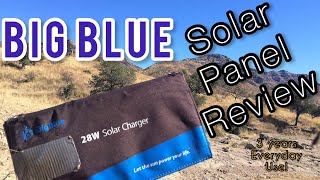 Big Blue Solar Panel Review (3 Yrs Full-Time Everyday Use) |

|
I did this about 20 years ago OP, and found you can get pretty decent performance out of a 20 watt panel, but today a 30 watt will be the same size. I would recommend that if you want the best performance and to get the most out of low light or cloudy conditions that you piece a system together yourself-you also don’t lose everything if one element goes out on you-you just replace that part of your little mini system. Get a flexible/folding panel, a voltage boosting charge controller Here, and make or buy a 12V lithium battery that you can connect a USB charging hub to. What you don’t want is to have a charging circuit connected to the panel that is current limiting when charging a USB charging bank…. You’d only charge at 2A when your panel might be capable of more. This also gives you the option of being able to charge all manner of primary cells (AAA, AA, C, D, RCR123’s, 18650’s etc.) from a dedicated 12 volt charger. In 2013 I went to a model airplane fly-in down in Arkansas and my only charging was done with a 26W panel, a charge controller, and a 6ah SLA battery. I was there for 3 days and never waited to charge-and I was charging 2 cell lithium 2200mah cells pretty much non-stop. This is far above what you would need for keeping your devices charged in a grid down situation, and your options for panels, chargers, and batteries are much better now. |
Never make another person a priority when they merely see you as an option...
"Some People Are Like Slinkies. They're Not Really Good For Anything, But They Bring a Smile To Your Face When Pushed Down The Stairs."
"Some People Are Like Slinkies. They're Not Really Good For Anything, But They Bring a Smile To Your Face When Pushed Down The Stairs."

This was a neat find- a USB-C charging connector that attaches to MC4 connects- It's pollen season here, so everything outside is covered... https://www.amazon.com/dp/B0C8JG93MD?ref_=ppx_hzsearch_conn_dt_b_fed_asin_title_5 Is the USB/MC4 connector. https://www.amazon.com/dp/B0CNTJCQLW?ref_=ppx_hzsearch_conn_dt_b_fed_asin_title_3&th=1 Here are some good flexible panels we have been using for various applications- fans in greenhouse and other structures, etc. https://www.amazon.com/dp/B0CNTJCQLW?ref_=ppx_hzsearch_conn_dt_b_fed_asin_title_3&th=1 They aren't bug out bag small however. I think it would be in most folks best interest to at least have one of the USB/MC4 connectors, lots of panels out in the wild... |
www.jrhenterprises.com
In business since 1992- Over 30 Years in business- Thank you for your business!
Quickest ways to contact us-
912.375.1480
[email protected]
In business since 1992- Over 30 Years in business- Thank you for your business!
Quickest ways to contact us-
912.375.1480
[email protected]

|
Originally Posted By Lowdown3: This was a neat find- a USB-C charging connector that attaches to MC4 connects- https://www.ar15.com/media/mediaFiles/92237/IMG_8391-3727838.jpg It's pollen season here, so everything outside is covered... https://www.amazon.com/dp/B0C8JG93MD?ref_=ppx_hzsearch_conn_dt_b_fed_asin_title_5 Is the USB/MC4 connector. https://www.amazon.com/dp/B0CNTJCQLW?ref_=ppx_hzsearch_conn_dt_b_fed_asin_title_3&th=1 Here are some good flexible panels we have been using for various applications- fans in greenhouse and other structures, etc. https://www.amazon.com/dp/B0CNTJCQLW?ref_=ppx_hzsearch_conn_dt_b_fed_asin_title_3&th=1 They aren't bug out bag small however. I think it would be in most folks best interest to at least have one of the USB/MC4 connectors, lots of panels out in the wild... That’s a neat gadget-you’re just limited to running/charging at whatever rate the devices you are powering will take, not what the panel will actually put out. |
Never make another person a priority when they merely see you as an option...
"Some People Are Like Slinkies. They're Not Really Good For Anything, But They Bring a Smile To Your Face When Pushed Down The Stairs."
"Some People Are Like Slinkies. They're Not Really Good For Anything, But They Bring a Smile To Your Face When Pushed Down The Stairs."
|
Originally Posted By TheOtherDave: That’s a neat gadget-you’re just limited to running/charging at whatever rate the devices you are powering will take, not what the panel will actually put out. Yes. We use a few of these panels around the homestead for various small solar so we have them already. Haven't been overly impressed with the price/performance ratio on stuff like the Goal Zero little panels- more money less power and more fragile. They have their place and we have 1 or 2 of them in ammo cans along with extra rechargeable batteries, power packs, folding panels etc. 20mm can holds a ton of charging options to keep NODs, thermals, seismics, radios, etc. running. Light and small enough to throw in a vehicle during a vehicular bugout. After some of our solar system took a hit during Helene, we used some of these for charging small items, phones, Ipads, radios, thermals etc. during cleanup to reduce the load on our home system. |
www.jrhenterprises.com
In business since 1992- Over 30 Years in business- Thank you for your business!
Quickest ways to contact us-
912.375.1480
[email protected]
In business since 1992- Over 30 Years in business- Thank you for your business!
Quickest ways to contact us-
912.375.1480
[email protected]
|
Originally Posted By Lowdown3: Yes. We use a few of these panels around the homestead for various small solar so we have them already. Haven't been overly impressed with the price/performance ratio on stuff like the Goal Zero little panels- more money less power and more fragile. They have their place and we have 1 or 2 of them in ammo cans along with extra rechargeable batteries, power packs, folding panels etc. 20mm can holds a ton of charging options to keep NODs, thermals, seismics, radios, etc. running. Light and small enough to throw in a vehicle during a vehicular bugout. After some of our solar system took a hit during Helene, we used some of these for charging small items, phones, Ipads, radios, thermals etc. during cleanup to reduce the load on our home system. Not a knock on Goal Zero, but as cheap as panels are these days, I can’t imagine spending what they want for putting the brand label on one… I just bought 150 watt flexible panels for a recumbent trike solar conversion for $50 a piece….. I’m 100% sure they are made in the same factory that makes the brand name ones. If it ever fails, I can afford to buy 2 or 3 more for the same price… or in my case, I just bought extra that I can use and swap out if ever needed. |
Never make another person a priority when they merely see you as an option...
"Some People Are Like Slinkies. They're Not Really Good For Anything, But They Bring a Smile To Your Face When Pushed Down The Stairs."
"Some People Are Like Slinkies. They're Not Really Good For Anything, But They Bring a Smile To Your Face When Pushed Down The Stairs."
|
Originally Posted By kingfish: Thanks a lot for so E of those “outside the box” tips. Unfortunately I have family members that might be using this stuff and they’d have no clue. It would be wasted It’s all fairly plug and play…. Not a lot to figure out or screw up.. |
Never make another person a priority when they merely see you as an option...
"Some People Are Like Slinkies. They're Not Really Good For Anything, But They Bring a Smile To Your Face When Pushed Down The Stairs."
"Some People Are Like Slinkies. They're Not Really Good For Anything, But They Bring a Smile To Your Face When Pushed Down The Stairs."

Member
Joined:
May 2023
Posts:
244
EE: 0% (0)
 TX, USA
|
Originally Posted By Lowdown3: This was a neat find- a USB-C charging connector that attaches to MC4 connects- https://www.ar15.com/media/mediaFiles/92237/IMG_8391-3727838.jpg It's pollen season here, so everything outside is covered... https://www.amazon.com/dp/B0C8JG93MD?ref_=ppx_hzsearch_conn_dt_b_fed_asin_title_5 Is the USB/MC4 connector. https://www.amazon.com/dp/B0CNTJCQLW?ref_=ppx_hzsearch_conn_dt_b_fed_asin_title_3&th=1 Here are some good flexible panels we have been using for various applications- fans in greenhouse and other structures, etc. https://www.amazon.com/dp/B0CNTJCQLW?ref_=ppx_hzsearch_conn_dt_b_fed_asin_title_3&th=1 They aren't bug out bag small however. I think it would be in most folks best interest to at least have one of the USB/MC4 connectors, lots of panels out in the wild... Thanks for the links ill be picking up that connector for sure. Also thank you for the smooth larperator patch @ shot 
|
|
Originally Posted By Sc00t3r: Thanks for the links ill be picking up that connector for sure. Also thank you for the smooth larperator patch @ shot Thank you! Appreciate your help! |
www.jrhenterprises.com
In business since 1992- Over 30 Years in business- Thank you for your business!
Quickest ways to contact us-
912.375.1480
[email protected]
In business since 1992- Over 30 Years in business- Thank you for your business!
Quickest ways to contact us-
912.375.1480
[email protected]

|
this is a rabbit hole.. and as someone who just went down phase 1 of it, i would like to contribute a few thoughts. probably there some folks here that know a lot more than me, but lets keep it good for people just getting into it a bit.. and let me define that... stage 1- i got a solar panel and i can charge things... big blue and the ilk.. you plug in a usb cable or 2 and charge a thing or two. wooo! i have a big blue 28w.. and a goal zero 7w.. but i have some higher wattage devices and unfortunately for my life bought this USB power meter.. that $10 sent me down the rabbit hold hard.. you see that big blue 28w (at least my version) cant actually output 28w to any 1 device.. it has a wattage limit on each port so it can theoretically give you 28w but really it can give you more like 12w on 2 ports if you are lucky and more like 12w for 1 device and 6 for another if you are lucky. the panels are rated based on being placed in orbit around the sun or some such thing, so less optimal placement, etc.. Attached File now this actually brings into question the charging rate of the devices... most devices cant actually benefit from PD or high rated ports, but some can.. your phone for example if newer can do 30+ watts, but that baofeng radio even new USBC seem to top out at 6w.. so if you have 2 ports and 2 6w devices, you can only capture 12w off that 28w panel. worse, very few panels support high rate devices in the 30w PD range.. here are some numbers I captured using a variety of high capacity chargers rated for up to 100w galaxy s22 : 18-20watts tops galaxy s25 : 30 watts baofeng Uv5g : 6 watts baofeng uv5g plus : 6 watts no-name chinese clip fan : 5 watts milwaukee top-off battery charger : 100w amazon 40,000 mah USB battery bank PD 30w : actually 20 watts (tests at 20 in / 20 out). so while this is great for "i can actually charge something" its not real optimal in a power outage unless you can match capacity to output otherwise there will be a lot of waste in addition to the imperfect art of capturing the sunlight and keeping it at max production. Stage 2 - i got a 60w fold out panel on prime day for $50 on a bit of a lark. this one has a 40w PD USBC port, a 12-18w usb port, and a full wattage powerpole out port.. note that the big blue doesnt have a full power powerpole out that could redirect all 28 (or whatever it was in reality) to a different voltage controller down-stream. I put a milwaukee battery charger on it, and fuck me it actually ran 40w consistent in strong sun. given the peaks and valleys as clouds drift by this might be optimal for this panel, but it has only the one high speed port and one 12watt port and thats it.. so again, if Im not pushing 40w out of the PD port (say i plug in my phone which aint the best and tops out at 20w), then I'm probably missing out. but at least I CAN capture high wattage for high drain devices. so while I can capture more, again, the imperfection of matching input to output looms. this is where the powerpole connector out comes in - what to do to make use of that full power unregulated source? Attached File (sorry about the poor pic, the sunlight was brutal) Stage 3 - so i pull out the old 100w panel i bought at costco years back that never got wired up. learning a bit about how mppt charge controllers work and the like I bought a solar (powerpole) to dual USBC PD converter, so I can put that thing to work at industrial scale. this works great except devices are finicky and some can synch up at high PD rates and some cant. boo! also it has 2 ports, so again, i could be missing out on output. so I also bought a 12-30v to 12v voltage regulator and wired it up for powerpole and went solart->Mppt->12v socket-> 12v usbc charger block with multiple outputs. This actually worked somewhat well with constant sunshine, as the nicer brick is more capable of presenting the various PD current options devices want, and it can host 6 devices to ensure we pull all 100w (lol ya, i'd be super happy with 80), and i can switch the power brick anytime. however, every time a cloud comes over, charging stops, devices freak, so its probably not good at all for the devices and battery management. wattage drops hard when its shaded on that panel - even worse than on the 60w fold up jobbie. Stage 4 - i had in the past started a solar battery project but it ran into challenges with wiring and i stopped, then later got the panel but was busy with work and then later the battery (deep cycle) was dead, so i gave up. anyhow, i restarted this as a way to solve stage 3. * note: i would rather eat snails that pay $500 or more for one of those jackery boxes. that's just me, maybe you like that kind of thing. I found a bluetti that looked almost perfect for my needs and much more reasonably priced, but then realized it had a 3A charge controller, and that was a hard pass. my requirements just didnt fit any of the smaller devices, so I built. this battery box cost me about $150 in stuff. the new wire up is Solar (100w panel or 60w panel, using powerpole connector) -> solar battery box (has 10a solar charge controller)-> LifePo Battery-> 12v USB and 12v output. this way the battery levels out the experience. the solar charges the battery the battery runs the devices. excess is stored up to the limit of the battery and devices that want to pull high loads like 100w (e.g. milwaukee battery charger) can do so even beyond what the solar can produce as long as I dont let the battery run down all the way. I only have a smallish battery (15ah) because i am using it as the float for solar not to be some giant battery array, but the same hardware could run a 100ah battery if I wanted to switch it out in a bigger box, as 100w panel at 8hours of sun would be somewhat better matched to a 100 ah battery.. - or I could do an array of up to 4 of the 15Ah batteries for 60 Ah. The battery box has powerpole in, mppt solar charge controller, 8 usb ports (4 capable of pd 35watt), 50A giant battery switch, and 2 x 12v plugs for other high wattage (each capable of 240w) so I can run 100w usb for example, or plug in the 12v to 6 usb for even more usb, or a 120v adapter, albeit limited to 20a quite honestly i think this thing plus the 60w panel is a great match, and both are pretty portable unlike the 100w panel which is frickin huge. this is really where the powerpole output jack on the flexsolar makes a big difference over the big blue with all usb outputs. Attached File Attached File Attached File Attached File Now, if you want the benefit of a battery system and also portability, another option would be a dedicated USB only bank that can actually handle wattage such as the AOHI Laptop Power Banks you can locate on Amazon. there are several with dedicated high wattage input ports, capability to both charge and discharge at the same time, and high capability to charge slow and fast devices up to 140w. running a panel like the flexsolar 60w (using the 40w port, with the other potential 20 lost to provide hopefully consistency at 40w) to the bank while traveling (e.g. on your backpack), or layed out at camp etc.. that would give you only USBC capabilities (no 12v) but in much a smaller form factor for more cost. The nestout batteries i beleive do the same kind of thing. but importantly if you use something like the big blue or another brand and expect to charge from USB make sure you can take the full power available in that configuration. Anyway, thanks for coming to my Ted Talk.  |
|
Originally Posted By bionicmonkey: this is a rabbit hole.. and as someone who just went down phase 1 of it, i would like to contribute a few thoughts. probably there some folks here that know a lot more than me, but lets keep it good for people just getting into it a bit.. and let me define that... stage 1- i got a solar panel and i can charge things... big blue and the ilk.. you plug in a usb cable or 2 and charge a thing or two. wooo! i have a big blue 28w.. and a goal zero 7w.. but i have some higher wattage devices and unfortunately for my life bought this USB power meter.. that $10 sent me down the rabbit hold hard.. you see that big blue 28w (at least my version) cant actually output 28w to any 1 device.. it has a wattage limit on each port so it can theoretically give you 28w but really it can give you more like 12w on 2 ports if you are lucky and more like 12w for 1 device and 6 for another if you are lucky. the panels are rated based on being placed in orbit around the sun or some such thing, so less optimal placement, etc.. https://www.ar15.com/media/mediaFiles/56039/1000007317_jpg-3793112.JPG now this actually brings into question the charging rate of the devices... most devices cant actually benefit from PD or high rated ports, but some can.. your phone for example if newer can do 30+ watts, but that baofeng radio even new USBC seem to top out at 6w.. so if you have 2 ports and 2 6w devices, you can only capture 12w off that 28w panel. worse, very few panels support high rate devices in the 30w PD range.. here are some numbers I captured using a variety of high capacity chargers rated for up to 100w galaxy s22 : 18-20watts tops galaxy s25 : 30 watts baofeng Uv5g : 6 watts baofeng uv5g plus : 6 watts no-name chinese clip fan : 5 watts milwaukee top-off battery charger : 100w amazon 40,000 mah USB battery bank PD 30w : actually 20 watts (tests at 20 in / 20 out). so while this is great for "i can actually charge something" its not real optimal in a power outage unless you can match capacity to output otherwise there will be a lot of waste in addition to the imperfect art of capturing the sunlight and keeping it at max production. Stage 2 - i got a 60w fold out panel on prime day for $50 on a bit of a lark. this one has a 40w PD USBC port, a 12-18w usb port, and a full wattage powerpole out port.. note that the big blue doesnt have a full power powerpole out that could redirect all 28 (or whatever it was in reality) to a different voltage controller down-stream. I put a milwaukee battery charger on it, and fuck me it actually ran 40w consistent in strong sun. given the peaks and valleys as clouds drift by this might be optimal for this panel, but it has only the one high speed port and one 12watt port and thats it.. so again, if Im not pushing 40w out of the PD port (say i plug in my phone which aint the best and tops out at 20w), then I'm probably missing out. but at least I CAN capture high wattage for high drain devices. so while I can capture more, again, the imperfection of matching input to output looms. this is where the powerpole connector out comes in - what to do to make use of that full power unregulated source? https://www.ar15.com/media/mediaFiles/56039/1000007332_jpg-3793099.JPG (sorry about the poor pic, the sunlight was brutal) Stage 3 - so i pull out the old 100w panel i bought at costco years back that never got wired up. learning a bit about how mppt charge controllers work and the like I bought a solar (powerpole) to dual USBC PD converter, so I can put that thing to work at industrial scale. this works great except devices are finicky and some can synch up at high PD rates and some cant. boo! also it has 2 ports, so again, i could be missing out on output. so I also bought a 12-30v to 12v voltage regulator and wired it up for powerpole and went solart->Mppt->12v socket-> 12v usbc charger block with multiple outputs. This actually worked somewhat well with constant sunshine, as the nicer brick is more capable of presenting the various PD current options devices want, and it can host 6 devices to ensure we pull all 100w (lol ya, i'd be super happy with 80), and i can switch the power brick anytime. however, every time a cloud comes over, charging stops, devices freak, so its probably not good at all for the devices and battery management. wattage drops hard when its shaded on that panel - even worse than on the 60w fold up jobbie. Stage 4 - i had in the past started a solar battery project but it ran into challenges with wiring and i stopped, then later got the panel but was busy with work and then later the battery (deep cycle) was dead, so i gave up. anyhow, i restarted this as a way to solve stage 3. * note: i would rather eat snails that pay $500 or more for one of those jackery boxes. that's just me, maybe you like that kind of thing. I found a bluetti that looked almost perfect for my needs and much more reasonably priced, but then realized it had a 3A charge controller, and that was a hard pass. my requirements just didnt fit any of the smaller devices, so I built. this battery box cost me about $150 in stuff. the new wire up is Solar (100w panel or 60w panel, using powerpole connector) -> solar battery box (has 10a solar charge controller)-> LifePo Battery-> 12v USB and 12v output. this way the battery levels out the experience. the solar charges the battery the battery runs the devices. excess is stored up to the limit of the battery and devices that want to pull high loads like 100w (e.g. milwaukee battery charger) can do so even beyond what the solar can produce as long as I dont let the battery run down all the way. I only have a smallish battery (15ah) because i am using it as the float for solar not to be some giant battery array, but the same hardware could run a 100ah battery if I wanted to switch it out in a bigger box, as 100w panel at 8hours of sun would be somewhat better matched to a 100 ah battery.. - or I could do an array of up to 4 of the 15Ah batteries for 60 Ah. The battery box has powerpole in, mppt solar charge controller, 8 usb ports (4 capable of pd 35watt), 50A giant battery switch, and 2 x 12v plugs for other high wattage (each capable of 240w) so I can run 100w usb for example, or plug in the 12v to 6 usb for even more usb, or a 120v adapter, albeit limited to 20a quite honestly i think this thing plus the 60w panel is a great match, and both are pretty portable unlike the 100w panel which is frickin huge. this is really where the powerpole output jack on the flexsolar makes a big difference over the big blue with all usb outputs. https://www.ar15.com/media/mediaFiles/56039/1000007369_jpg-3793107.JPG Now, if you want the benefit of a battery system and also portability, another option would be a dedicated USB only bank that can actually handle wattage such as the AOHI Laptop Power Banks you can locate on Amazon. there are several with dedicated high wattage input ports, capability to both charge and discharge at the same time, and high capability to charge slow and fast devices up to 140w. running a panel like the flexsolar 60w (using the 40w port, with the other potential 20 lost to provide hopefully consistency at 40w) to the bank while traveling (e.g. on your backpack), or layed out at camp etc.. that would give you only USBC capabilities (no 12v) but in much a smaller form factor for more cost. The nestout batteries i beleive do the same kind of thing. but importantly if you use something like the big blue or another brand and expect to charge from USB make sure you can take the full power available in that configuration. Anyway, thanks for coming to my Ted Talk. Good stuff, thank you. And yeah the sun has been hellacious here hasn't it!! 99 "feels like 113" I think is today's forecast again. Along with the normal "you can DIE outside" warnings. We ran the other day about 4:30, was wringing sweat out of my shirt the first mile, 2nd mile ran with shirt off, small hot breeze is better than no breeze. Told the wife, I must be getting old, I'm here thinking already "I can't wait till fall." 
|
www.jrhenterprises.com
In business since 1992- Over 30 Years in business- Thank you for your business!
Quickest ways to contact us-
912.375.1480
[email protected]
In business since 1992- Over 30 Years in business- Thank you for your business!
Quickest ways to contact us-
912.375.1480
[email protected]