


Posted: 7/31/2026 12:41:41 PM EDT
[Last Edit: DriverDiver][Edited]
| Just picked up my general, an am looking to get set up for hf voice, working in learning code but it’s not very promising. Local VHF/uhf doesn’t hold the interest the same way longer distance HF does. Looking to get set up on a budget. I can see this being a huge money sink, but it’s gonna have to happen incrementally. What can you recommend? |


|
I'd get a used FTDX3000 or TS-590SG. I'm seeing them often for sub $1k and sometimes ~$800. Then I'd put up an 80m horizontal delta loop and some sort of multiband vertical. You can pick up used Hustler 6BTV's pretty cheap sometimes or a DX Commander would work. Anything that will give you 10, 15, 20 and 40 meters at least. You could do a EFHW 4010 deployed as an inverted L in a pinch. If you have noise issues I'd do a 60' LOG antenna as well. ETA No affiliation, but just posted. https://forums.qrz.com/index.php?threads/yaesu-ftdx3000-w-300-hz-filter.998774/ |

|
You didn't mention if this was for home shack use or mobile setup. You stated you like to talk SSB. For a home shack I recommend starting with a 100 watt rig. Also if you want to run FT8, which most new to HF eventually gravitate, get a rig with a USB port for easy CAT control & digital work. For antennas, a simple wire dipole can work the world at the right time. There are many options & designs for wire antennas. Depends on your terrain & lot. You can make a simple fan dipole with 20m/40m elements, get it up as high as possible & have fun for a long time. You could easily use the internal tuner in your rig to tune 15m,20m, & 40m. 15 & 20 for daylight & 40 after the sun goes down. 15m (21MHz)will easily tune as it's a 3rd harmonic of 40m (7MHz). A vertical antenna will also work if you put in the effort to lay down a good radial field, again it depends on your space restrictions. Myself, I use both wire doublets strung between trees & a fan vertical. Stick with a good brand radio, it doesn't matter which one, I'm sure something has already tickled your fancy.  I could recommend a transceiver but there are many good ones to choose from. I could recommend a transceiver but there are many good ones to choose from. For mobile there are others here with better knowledge than me when it comes to mobile HF setups. If your more a POTA or hiker type, then perhaps a smaller QRP rig is in order. Welcome to HF! 
|
"Don't let your ego write checks your body can't cash."
| This is for home use. For now. I can see going mobile in the future. Thanks for the feedback. Just trying to figure this out, passing the test and knowing what you want or are doing are different animals entirely. The technician and general tests were easy to study for, and I’m up to scoring in the low to mid 70s on Extra practice tests. All from zero as of last Thursday. I studied Thursday and Friday night for the Technician, not knowing that you could take them back to back. Took the tech exam Saturday morning and then did a remote test for General Sunday evening. |
|
Originally Posted By HogSniper: You didn't mention if this was for home shack use or mobile setup. You stated you like to talk SSB. For a home shack I recommend starting with a 100 watt rig. Also if you want to run FT8, which most new to HF eventually gravitate, get a rig with a USB port for easy CAT control & digital work. For antennas, a simple wire dipole can work the world at the right time. There are many options & designs for wire antennas. Depends on your terrain & lot. You can make a simple fan dipole with 20m/40m elements, get it up as high as possible & have fun for a long time. You could easily use the internal tuner in your rig to tune 15m,20m, & 40m. 15 & 20 for daylight & 40 after the sun goes down. 15m (21MHz)will easily tune as it's a 3rd harmonic of 40m (7MHz). A vertical antenna will also work if you put in the effort to lay down a good radial field, again it depends on your space restrictions. Myself, I use both wire doublets strung between trees & a fan vertical. Stick with a good brand radio, it doesn't matter which one, I'm sure something has already tickled your fancy. I could recommend a transceiver but there are many good ones to choose from. For mobile there are others here with better knowledge than me when it comes to mobile HF setups. If your more a POTA or hiker type, then perhaps a smaller QRP rig is in order. Welcome to HF! Thank you. There seems to be a million ways to skin the antenna cat. I don’t have any substantial trees but space isn’t a problem. I’m thinking of something semi portable at first, even if it is an old portable mast kit or something to start with some flavor of wire antenna. A tower isn’t out of the question, just a matter of finding such things. I want to get started and stay engaged while working towards the tower and code goals. I want to keep it simple at first, but I’m sure FT8 is gonna come up a some point. |

|
First thing is to think about what you want to do. Portable? Home? DX? Regional? Rag chew? All impact your selections. For your first rig, you indicated budget is a concern, you could get a used rig, or a new one for just over $1,000 or so. For antennas...This is an interesting discussion. It partially goes back to what do you want? DX means lower take off angle, rag chew, regional means another. For starting, I strongly recommend an EFHW. They get TONS of hate. But, when you erect one as a flat top, it will perform almost as well as a dipole, plus will cover 10, 15, 20, and 40M bands. Yes, there are compromises with the coverage of the higher bands. But, my EFHW has worked from Russia to Alaska, and I'm not on the radio that much. It is simple, effective and covers multiple bands. There are lots of far more complicated antennas that will not work any better. Regardless of what antenna you decide - dipole, OCFD, EFHW, you do NOT need to spend $300 on one. These are all wire antennas with *maybe* a balun. Get silicone wire, BNTECHGO, 18 gauge, from Amazon, and build them. A balun or unun can be had for like $50 or less. For the EFHW, I recommend the TennTennas from Ebay. They are built an hour or so from me. The big advantage to the EFHW is that it covers multiple bands without a tuner, and can cover them all with a tuner. It is hardly perfect, but is great to get started with. Once you figure things out some, then look at other options - verticals, loops, half squares, the list is endless. ANY wire antenna will work at 10' off the ground. May not work the best, but it will work far better than leaving it in your garage until you can get it 20-40' high!! Then you need coax, connectors, and lots of little things. If you have a Ham Radio Outlet near you, go there and play around. If not, DX Engineering, Giga Parts and MTC (Main Trading Company - Paris TX). MTC doesn't have nearly as many accessories as the other two, but I like them as they are a small store. And, almost all ham radios are 12 volts. Either get a power supply, or if you are considering portable, a battery and charger. Either one works fine. I have both. Even a 10AH 12V battery will run an HF rig for an hour or more easy. |

|
Lots of rigs that will work, new I would look at IC 7300 mk2, and YAesu 710. Plenty of other choices though. See if there is a club near you and if any of them have gear you could try out, or a club station. I am 5 hours to the nearest Ham Radio Outlet, but was able to combine that with a family trip and try out the 3 radios I wanted, and came up with a clear winner for me. Not sure what your options are there. Antenna - I went with an Off CEnter Fed Dipole - someone will post a link to the thread here, been great for me! |
|
FT-710 if you plan to stay at home. If you have interest in POTA or SOTA, i'd say an FTX-1f optima and leave the amp at home when you go. The antenna is space dependent. If you have a small yard and no trees, easier to go vertical. If hku have atleast one tall tree, then wires become possible. |
When I was first starting off, I found this guy's "reference station" videos helpful just to see how to set up my station. Reference Design HF Radio: Icom IC-7300 (#244) |
Don't confuse where I live with where I'm from.

|
Ditto the IC-7300. Since the upgraded MK2 came out, used ones can easily be found. The MK2 upgrades are supposed to be very good, it's up to you to decide if the extra cost is worth it. As for an antenna, I'd recommend starting out with a center-fed fan dipole for 40 and 20 Meters. The 40 meter elements will also load up on 15 Meters. Depending on your property layout, an EFHW may fit better. If available area is small, a vertical may be the way to go. 75 Meters will be a struggle without an amp because of QRN, especially during the summer months. Learning CW is nowhere nearly as difficult as many make it out to be, but it does require a modicum of determination and perseverance. There are many online trainers to help you. Practice sessions should be short, ~15 minutes, done once or twice a day. Receiving practice is available online: LINK CW offers the advantage of cutting through the noise while using low power and less-than-ideal antennas. It's also excellent for operating SOTA and POTA FWIW, I only work CW and have been pounding brass for 72 years, running either 50 or 5 Watts into wire dipole antennas. Knowing how to "read" propagation forecasts allows one to easily work DX. Dipole antennas Inverted Vee Antenna Fan dipole End Fed Half Wave Using 40 meter dipole on 15 |
"...Capitalism...shares its blessings unequally; ...Socialism...shares its miseries equally."
Winston Churchill
Winston Churchill

I will not mention radios, I am the guy that everyone points to and says "don't be like him".  A decent antenna that can be used at home or portable is a vertical antenna. I like EFHW antennas, and use one as my main antenna in the shack, but if I was starting with a single antenna, I would get a wolf river coil set up. You can do 6-80 meters with one, they are easy to set up and tune once you get the hang of it. Verticals have a low take off angle and are pretty omnidirectional. Male some radials for it out of some speaker wire to start if you want, or even use some steel measuring tapes. I checked into the weekly HF net last week with a version of the antenna. |
World ain't what it seems, is it Gunny?

|
Since you mentioned budget I would recommend a used IC-7300. You can find them for as low as $650 these days because the mk2 version recently came out. Then you need a 30 amp 120v power supply. Then make your own wire dipole antennas, by either buying a dipole with a 1:1 current balun and add other wires or buy the balun and add wire or if you want to buy a good all around multiband antenna that is a single wire either a 80-10m EFHW. ( End Fed Half Wave ) and be able to tune most bands with the internal tuner of the IC-7300 or an Off Center Fed dipole. |
Mach
Nobody is coming to save us.
.
Nobody is coming to save us.
.
This guy made an excellent series of videos on the IC-7300 going through all(?) of the functions with reference to the owner's manual pages. Watching some of these would give you a good view into how the radio operates. Icom IC-7300 From A to Z - #1 Introduction, setting Bands & Modes & programming your own call sign |
Don't confuse where I live with where I'm from.
Member
Joined:
Jan 2022
Posts:
2993
EE: 0% (0)
 MO, USA
|
Originally Posted By Mach: Since you mentioned budget I would recommend a used IC-7300. You can find them for as low as $650 these days because the mk2 version recently came out. Then you need a 30 amp 120v power supply. Then make your own wire dipole antennas, by either buying a dipole with a 1:1 current balun and add other wires or buy the balun and add wire or if you want to buy a good all around multiband antenna that is a single wire either a 80-10m EFHW. ( End Fed Half Wave ) and be able to tune most bands with the internal tuner of the IC-7300 or an Off Center Fed dipole. This^ totally. |
|
If you're going to be doing much work with antennas, a NanoVNA is worth it's weight in gold: LINK There's a learning curve, but plenty of how-to videos on YouTube. |
"...Capitalism...shares its blessings unequally; ...Socialism...shares its miseries equally."
Winston Churchill
Winston Churchill

|
Originally Posted By Frank_B: If you're going to be doing much work with antennas, a NanoVNA is worth it's weight in gold: LINK There's a learning curve, but plenty of how-to videos on YouTube. And if you're on HF, you're doing work with antennas. |
This is...a clue - Pat_Rogers
I'm not adequately aluminumized for this thread. - gonzo_beyondo
CO, MI, OR - Please lobby your legislators to end discrimination against non-resident CCW permit holders
I'm not adequately aluminumized for this thread. - gonzo_beyondo
CO, MI, OR - Please lobby your legislators to end discrimination against non-resident CCW permit holders
|
Responses for the newbie... Originally Posted By Frank_B: If you're going to be doing much work with antennas, a NanoVNA is worth it's weight in gold: LINK There's a learning curve, but plenty of how-to videos on YouTube. A NanoVNA does much the same thing as the expensive antenna analyzers. For my purposes, this is primarily measuring SWR to see where it is for the various bands I like to use. I use the free NanoVNA Saver software from Github, because it allows manipulation of the NanoVNA from your PC, mouse, and keyboard, instead of the small and crappy touch screen of the NanoVNA that sucks to use. Note that some (many?) radios can also measure SWR, so this is not necessarily a "must have" although it is nice. Originally Posted By Gamma762: And if you're on HF, you're doing work with antennas. Only if you want to. You can get an antenna that offers low/usable SWR on multiple bands and not really have to dick around with it. OCFD (off-center fed dipoles) offer this. Fan dipoles. Others, too. If you buy a modern radio like an IC-7300 or a Yaesu 710 it will have a built-in "tuner" to create the impedance match that the radio electronics need in order to not be damaged when transmitting. The radio's tuner will be adequate for antennas designed to work on specified bands. Working the antenna's specified bands can keep you busy and happy almost indefinitely. If you choose to try to work additional bands outside of the antenna's design, that is when you may want to play around with altering antenna wire length, or adding an external Tuner that can do more than the ones built into the radio, or getting a different antenna. FWIW. the wire antennas become nearly invisible once up in the air, so are not an eyesore. I have an OCFD about 60' up in the air in the back yard and I have pointed it out to people while standing at the street in front of the house. They usually cannot spot it right away. I have to point it out to them before they can find it, so set aside any worries about how obvious the antenna might be. |
Don't confuse where I live with where I'm from.

| A Yaesu FT 450D can be found dirt cheap. I keep one under the dinette in my camper. I think if you could cut a piece of barbed wire out of a fence, and run it up in a tree, it would tune it. Very rugged and reliable radios. |
If its broke. I can fix it. If it doesn't exist. I can make it. If its metal.
|
Originally Posted By Emoto: ...Note that some (many?) radios can also measure SWR... This is what it looks like on the 7300. The frequency steps and number of bars are menu selectable. 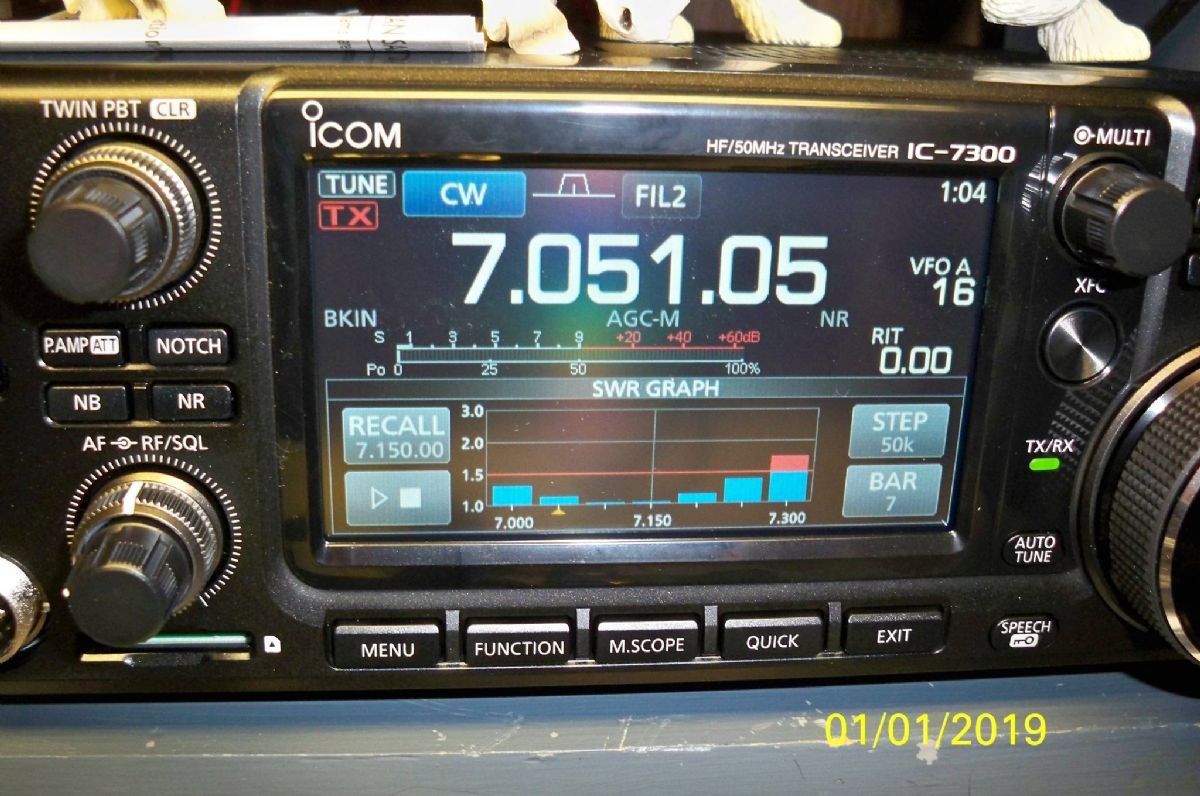
|
"...Capitalism...shares its blessings unequally; ...Socialism...shares its miseries equally."
Winston Churchill
Winston Churchill
Join the Community
Your next conversation starts here.
Create your free account to join discussions, share your experience, save topics, and connect with the AR15.COM community.
- Join discussions
- Follow topics and replies
- Connect with fellow enthusiasts
Already a member? Sign in
Stay informed by subscribing to our Newsletter