


|
Remarkable difference between your hogs an Pickles. Shows what 'natural selection' vs farm genetics is really all about.
Pickles is still on an all she can eat diet of soured corn, cattle protein and scraps. She got fish guts today from when I went catfishing. TRG |
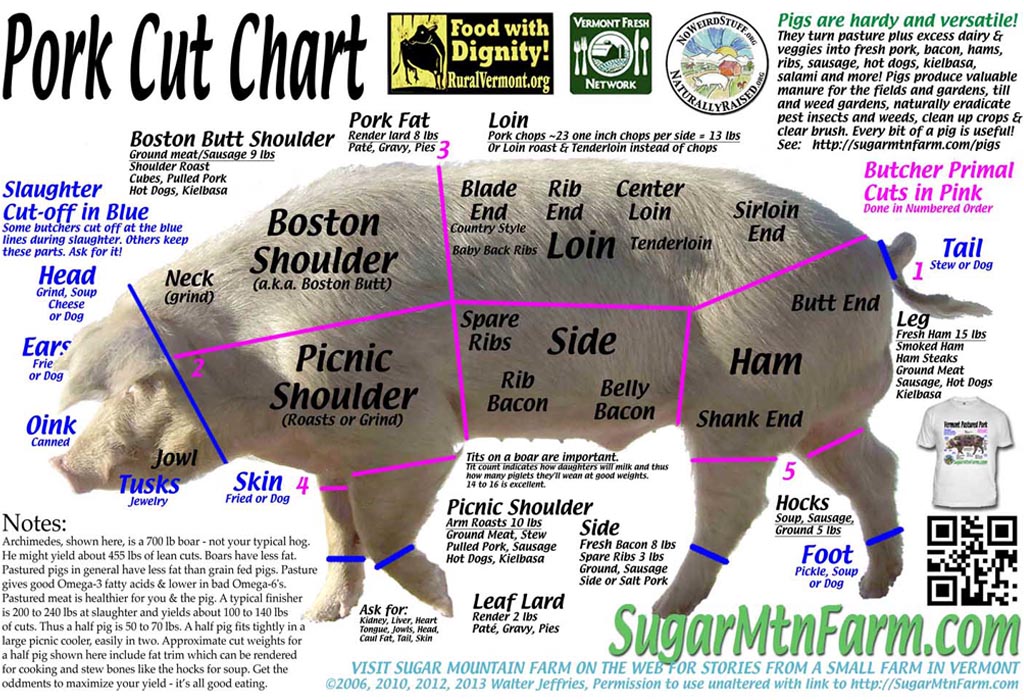
I was considering taking one of your photos and drawing butcher's lines on it, but figured this was easier...
Image from here. That is a VERY informative link (for me at least, perhaps not for those with more experience). Also note that the image here on arfcom is automatically scaled down. Right-click "view image...." or go to the link for a larger image you can read. Apparently you can also get a very similar version of this chart on a shirt. 
|
|
Quoted:
I was considering taking one of your photos and drawing butcher's lines on it, but figured this was easier...
Image from here. That is a VERY informative link (for me at least, perhaps not for those with more experience). Also note that the image here on arfcom is automatically scaled down. Right-click "view image...." or go to the link for a larger image you can read. Apparently you can also get a very similar version of this chart on a shirt.
http://sugarmtnfarm.com/blog/uploaded_images/PorkCutsChartLarge.jpg That's a great pic! Thanks for posting it. 
|
|
Quoted:
I'm looking forward to the final tab for these. I'll bet they are eating about 10 pounds of feed a day, each! Very good estimate. They're sure as hell not eating less than 10 pounds a day. We're dropping 100 pounds in the feeder about every three days, maybe less. I'll be interested in the tab too.....thus far I've just been stuffing the feed bills into the door-pocket on my truck. 
|
|
Quoted:
Remarkable difference between your hogs an Pickles. Shows what 'natural selection' vs farm genetics is really all about. I wonder how domestic hogs would do on a scratch diet like you're feeding Pickles. Would they not grow out nicely? Would it just take longer? Interesting question in light of some of the issues of "sustainability" that have come up in this thread. |
|
Quoted:
Quoted:
I'm looking forward to the final tab for these. I'll bet they are eating about 10 pounds of feed a day, each! Very good estimate. They're sure as hell not eating less than 10 pounds a day. We're dropping 100 pounds in the feeder about every three days, maybe less. I'll be interested in the tab too.....thus far I've just been stuffing the feed bills into the door-pocket on my truck.
I know that I have 100lbs of corn remaining, plus the amount (50lbs) in the tub souring. I think Pickles might breathe for another month or so, then she will be in serious jeopardy of my wallet pulling the plug on her. TRG |
|
Quoted:
Quoted:
I'm looking forward to the final tab for these. I'll bet they are eating about 10 pounds of feed a day, each! Very good estimate. They're sure as hell not eating less than 10 pounds a day. We're dropping 100 pounds in the feeder about every three days, maybe less. I'll be interested in the tab too.....thus far I've just been stuffing the feed bills into the door-pocket on my truck.
Wow! 100 pounds every three days! That will take alot of the fun out of it. They are looking great though! GNNC |
|
Quoted:
Quoted:
I know that I have 100lbs of corn remaining, plus the amount (50lbs) in the tub souring. What is your procedure for souring the corn? Are you using whole corn? How long does it take? Thx Add water. It's been hot, so it sours naturally. I use whole corn for it. Tried crushed/milled and it was just getting scattered in the dirt. She seems to pick up the whole corn much better. TRG |
|
Quoted:
Add water. It's been hot, so it sours naturally. I use whole corn for it. Tried crushed/milled and it was just getting scattered in the dirt. She seems to pick up the whole corn much better. TRG Are you soaking overnight or longer? I'd think you could soak once a week and feed out of it. *Also will work for other grains but I expect corn is cheapest right now |
|
Quoted:
Add water. It's been hot, so it sours naturally. I use whole corn for it. Tried crushed/milled and it was just getting scattered in the dirt. She seems to pick up the whole corn much better. TRG I tried that a few years ago. After a while, it smelled too much like old steamed shrimp shells to me. I'd mix it in with whatever I was feeding that day. Hogs didn't seem to like it any better or worse either. But I had stink fingers the rest of the day. 
|
|
Quoted:
Quoted:
Add water. It's been hot, so it sours naturally. I use whole corn for it. Tried crushed/milled and it was just getting scattered in the dirt. She seems to pick up the whole corn much better. TRG I tried that a few years ago. After a while, it smelled too much like old steamed shrimp shells to me. I'd mix it in with whatever I was feeding that day. Hogs didn't seem to like it any better or worse either. But I had stink fingers the rest of the day. It does have quite a perfume to it. She seems to eat more of it when it is soured. I am not sure if she likes it any better or worse, but the squirrels do not like the soured corn. Instead of watching 10 squirrels fill their paunches each day, there are now zero squirrels at her trough. And, oddly enough, my dogs have developed a 'taste' for the soured water on top of the corn. Must taste like watery cheese or something. They both like to drink/slurp it. TRG |
|
Quoted:
Quoted:
Add water. It's been hot, so it sours naturally. I use whole corn for it. Tried crushed/milled and it was just getting scattered in the dirt. She seems to pick up the whole corn much better. TRG Are you soaking overnight or longer? I'd think you could soak once a week and feed out of it. *Also will work for other grains but I expect corn is cheapest right now Corn is still cheap, but with deer season coming, I expect prices to jump. I also used the soured corn for catfish attractant at the lake Sunday. Cleaned several cats with my corn in their belly. TRG |
|
Found this, what do ya'll think about wheat?
Feeding wheat to pigs |
|
Looks like a fluff piece, to me. One 'brochure' and it is an alternative to corn? Call me skeptical. TRG |
|
Quoted:
One 'brochure' and it is an alternative to corn? Call me skeptical. You might want check google for "wheat", "feed" and "pig". Wheat is actually a preferred ingredient in hog feed: "Wheat has been fed to hogs in varying amounts for many years. Interest in wheat as a swine feed depends largely on the price relationship between wheat and other cereal grains." Okla State Univ "Because of its higher lysine content than corn, the relative price of wheat is dependent upon the price of soybean meal or other protein sources. The higher the price of soybean meal, the higher the value of wheat relative to corn." Univ of Florida "Wheat is grown primarily for human food and used in livestock diets only when it is economical. When viewed in the context of cash grain markets, wheat appears to be an expensive feed grain in the Corn Belt." Iowa State Univ In short, wheat equals or surpasses corn as a feed ingredient for swine on a pound-for-pound basis. A lot of hogs have been fed to market on slops of milk or water and wheat shorts or midds. |
|
Quoted:
Quoted:
One 'brochure' and it is an alternative to corn? Call me skeptical. You might want check google for "wheat", "feed" and "pig". Wheat is actually a preferred ingredient in hog feed: "Wheat has been fed to hogs in varying amounts for many years. Interest in wheat as a swine feed depends largely on the price relationship between wheat and other cereal grains." Okla State Univ "Because of its higher lysine content than corn, the relative price of wheat is dependent upon the price of soybean meal or other protein sources. The higher the price of soybean meal, the higher the value of wheat relative to corn." Univ of Florida "Wheat is grown primarily for human food and used in livestock diets only when it is economical. When viewed in the context of cash grain markets, wheat appears to be an expensive feed grain in the Corn Belt." Iowa State Univ In short, wheat equals or surpasses corn as a feed ingredient for swine on a pound-for-pound basis. A lot of hogs have been fed to market on slops of milk or water and wheat shorts or midds. My folks have fed bread from Mrs. Baird's Bakery for years. No doubt they can eat it. TRG |
|
Quoted:
Quoted:
My folks have fed bread from Mrs. Baird's Bakery for years. No doubt they can eat it. TRG The fattest hogs I've ever seen were raised on Wonder Bread store returns. Those hogs looked like they oozed oil! There was an enhanced jiggle when they walked. My dad raised horses, then cattle, on it for many years. Still does, actually. And, yes, the bread meant that we had some of the shiniest, fattest, healthiest mares in area. TRG |
|
Pigs are going to the butcher next week.
As Skunkum predicted, they killed my cup drinker. One of them flopped over on it and broke it. I put a spare on, but also rigged up a nipple drinker system. It took them about 2 minutes to figure out the nipples. I'll use this setup exclusively next time although it's a bit spendy on water. The pictures don't really do them justice as they're pretty large right now.
Bought the last hog feed today. Have to dig out all my receipts and total things up. 


|
|
Quoted:
Quoted:
Remarkable difference between your hogs an Pickles. Shows what 'natural selection' vs farm genetics is really all about. I wonder how domestic hogs would do on a scratch diet like you're feeding Pickles. Would they not grow out nicely? Would it just take longer? Interesting question in light of some of the issues of "sustainability" that have come up in this thread. My grandfather raised and fed his hogs on a diet like this. Whole corn and scraps. They fattened just fine. I don't know if they put on as much weight per unit of feed. I seriously doubt it. BUT, I also think a factor might be that they were not engineered to gain in certain ways on certain protein/fat/carb/nutrient percentages, as these hogs probably were. His hogs would have been overall fatter hogs, and by that I mean a higher percentage of actual fat per unit of body mass. I could be wrong and maybe you have old fashioned hogs. But as uxb has a brother who is one of the premier porcine geneticists in the world, I'm inclined to believe there are very few hogs being farrowed and marketed today which have not been influenced by the engineering of companies like PIC and others of their ilk. I wouldn't know where to go to get a "plain old pig" any more. Actually I'm not sure I could define a "plain old domestic pig." I know nothing of pig genetics, and don't know where the natural crosses stopped and the engineering began. Natural crosses would be my preference, but I recognize that leaner pork has us all somewhat spoiled. kitties |

Here's a picture of our hogs. In this picture, I had just dumped two bucket loads of dirt for them to play in. There were lots of roots in the dirt and they were having a big time. The next day they had leveled the pile out within their pen. They have been growing well. They're eating about 8 pounds of feed per day per pig. I've been giving them a big coffee can full of whole kernal corn each afternoon along with some bermuda hay and they're real excited about that. I hope to be able to take them to freezer camp in mid November. Last week they broke the supply pipe for the nipple feeder at an elbow. It was easy to fix, but I think I'll change how it's connected next year by using a flexible hose. Feral, your hogs look great. I'm sure it takes a few days to get used to things after they're off the farm. R. |
|
Quoted:
http://www.employsystems.com/stuff/pigs/13.jpg Here's a picture of our hogs. In this picture, I had just dumped two bucket loads of dirt for them to play in. There were lots of roots in the dirt and they were having a big time. The next day they had leveled the pile out within their pen. They have been growing well. They're eating about 8 pounds of feed per day per pig. I've been giving them a big coffee can full of whole kernal corn each afternoon along with some bermuda hay and they're real excited about that. I hope to be able to take them to freezer camp in mid November. Last week they broke the supply pipe for the nipple feeder at an elbow. It was easy to fix, but I think I'll change how it's connected next year by using a flexible hose. Feral, your hogs look great. I'm sure it takes a few days to get used to things after they're off the farm. R. I really like your shed. I've been wishing for a shed like that.
|
|
Quoted:
Quoted:
Quoted:
Remarkable difference between your hogs an Pickles. Shows what 'natural selection' vs farm genetics is really all about. I wonder how domestic hogs would do on a scratch diet like you're feeding Pickles. Would they not grow out nicely? Would it just take longer? Interesting question in light of some of the issues of "sustainability" that have come up in this thread. My grandfather raised and fed his hogs on a diet like this. Whole corn and scraps. They fattened just fine. I don't know if they put on as much weight per unit of feed. I seriously doubt it. BUT, I also think a factor might be that they were not engineered to gain in certain ways on certain protein/fat/carb/nutrient percentages, as these hogs probably were. His hogs would have been overall fatter hogs, and by that I mean a higher percentage of actual fat per unit of body mass. I could be wrong and maybe you have old fashioned hogs. But as uxb has a brother who is one of the premier porcine geneticists in the world, I'm inclined to believe there are very few hogs being farrowed and marketed today which have not been influenced by the engineering of companies like PIC and others of their ilk. I wouldn't know where to go to get a "plain old pig" any more. Actually I'm not sure I could define a "plain old domestic pig." I know nothing of pig genetics, and don't know where the natural crosses stopped and the engineering began. Natural crosses would be my preference, but I recognize that leaner pork has us all somewhat spoiled. kitties It has got to be a difference in genetics. Pickles is growing, but at a fraction of the rate of the domestics in this thread. She has also begun to develop a personality. She fights/plays with a plastic bag in her pen, and seems to 'scare herself' so that she has an excuse to run around her pen. I would put her age at about 6 months now, but her weight is probably only about 60 pounds. She has 'all-she-can-eat soured corn in her pen 24/7 and she seems to intentionally avoid the corn in her trough for the corn that is in the ground. She likes cookies too. I began giving her a couple of cheap cookies each time I go out to feed her. It will make it easier to draw a bead later this year. TRG |


|
Quoted:
Last week they broke the supply pipe for the nipple feeder at an elbow. It was easy to fix, but I think I'll change how it's connected next year by using a flexible hose. Feral, your hogs look great. I'm sure it takes a few days to get used to things after they're off the farm. Thanks.......yours are looking pretty stout too.
|

|
Quoted:
Quoted:
http://www.employsystems.com/stuff/pigs/13.jpg Here's a picture of our hogs. In this picture, I had just dumped two bucket loads of dirt for them to play in. There were lots of roots in the dirt and they were having a big time. The next day they had leveled the pile out within their pen. They have been growing well. They're eating about 8 pounds of feed per day per pig. I've been giving them a big coffee can full of whole kernal corn each afternoon along with some bermuda hay and they're real excited about that. I hope to be able to take them to freezer camp in mid November. Last week they broke the supply pipe for the nipple feeder at an elbow. It was easy to fix, but I think I'll change how it's connected next year by using a flexible hose. Feral, your hogs look great. I'm sure it takes a few days to get used to things after they're off the farm. R. I really like your shed. I've been wishing for a shed like that.My great grandfather built that barn long before world war II. The logs where hand hewn locally by him and friends. R. |
|
Quoted:
Quoted:
Quoted:
http://www.employsystems.com/stuff/pigs/13.jpg Here's a picture of our hogs. In this picture, I had just dumped two bucket loads of dirt for them to play in. There were lots of roots in the dirt and they were having a big time. The next day they had leveled the pile out within their pen. They have been growing well. They're eating about 8 pounds of feed per day per pig. I've been giving them a big coffee can full of whole kernal corn each afternoon along with some bermuda hay and they're real excited about that. I hope to be able to take them to freezer camp in mid November. Last week they broke the supply pipe for the nipple feeder at an elbow. It was easy to fix, but I think I'll change how it's connected next year by using a flexible hose. Feral, your hogs look great. I'm sure it takes a few days to get used to things after they're off the farm. R. I really like your shed. I've been wishing for a shed like that.My great grandfather built that barn long before world war II. The logs where hand hewn locally by him and friends. R. I was thinking I would have to jack that up and square it and keep it from rotting because even the old ones go down to rot eventually, but I had no idea it was bult by family. What a cool legacy. I want very much to take down teh barn my grandfather built (on the farm that was my dad's) and move it here, but there's no way I'll be able to do it. Even if I got it down, getting it back up would never happen. 
|
|
TRG have you hit Pickles with a wormer of any sort? You keep referencing genetics, however every feral hog we've penned/fed-to-slaughter seemed to grow at just about the same rate as Wilbur. The trick is making sure to give them some sort of wormer, plenty of water/food and somewhere to get out of the sun during the daytime. That said, our feral hog raising has always been pretty hands off and we're only looking for 150#'s max per pig before slaughter. |


|
Feral - those hogs look happy.
__________________ Here's a video of our hogs today. http://www.youtube.com/watch?v=ZkHNFLVlUoI Here's a video from their first day with us. http://www.youtube.com/watch?v=NcX9RrJgryw Today we gave them some watermelons that started coming up recently that weren't going to make it to full size. R. |
|
Quoted:
Well, folks, these'll be the last pics of this particular bunch of pigs. We haul 'em to the butcher tomorrow. 
They're a particularly nice bunch.....should make excellent pork. http://img.photobucket.com/albums/v40/FredFeral/Pigs2010/IMG_4402.jpg http://img.photobucket.com/albums/v40/FredFeral/Pigs2010/IMG_4396.jpg http://img.photobucket.com/albums/v40/FredFeral/Pigs2010/IMG_4392.jpg http://img.photobucket.com/albums/v40/FredFeral/Pigs2010/IMG_4391.jpg http://img.photobucket.com/albums/v40/FredFeral/Pigs2010/IMG_4390.jpg http://img.photobucket.com/albums/v40/FredFeral/Pigs2010/IMG_4408.jpg http://img.photobucket.com/albums/v40/FredFeral/Pigs2010/IMG_4405.jpg Bye nice piggies. 
|
|
Quoted:
Quoted:
Well, folks, these'll be the last pics of this particular bunch of pigs. We haul 'em to the butcher tomorrow.
They're a particularly nice bunch.....should make excellent pork. http://img.photobucket.com/albums/v40/FredFeral/Pigs2010/IMG_4402.jpg http://img.photobucket.com/albums/v40/FredFeral/Pigs2010/IMG_4396.jpg http://img.photobucket.com/albums/v40/FredFeral/Pigs2010/IMG_4392.jpg http://img.photobucket.com/albums/v40/FredFeral/Pigs2010/IMG_4391.jpg http://img.photobucket.com/albums/v40/FredFeral/Pigs2010/IMG_4390.jpg http://img.photobucket.com/albums/v40/FredFeral/Pigs2010/IMG_4408.jpg http://img.photobucket.com/albums/v40/FredFeral/Pigs2010/IMG_4405.jpg Bye nice piggies. buy nice piggies. TRG |
|
Quoted:
How did it go today? Did you have any trouble getting the hogs into the trailer? Getting them in the trailer was easy. I fed them––short ration–– in the trailer about 0545 this morning. Let 'em get good and hungry over the course of the day. When I came home from work they were more than happy to pile into the trailer for more food. I don't think I'd want to do more than four with this technique, but it works fine with four. They were pissed when they realized the door was closed. But not so pissed that weren't all asleep when we dropped the ramp at the butcher''s place. Three of them loaded into the pens at the butcher just fine. The last one put up a bit of a fight. Nothing major, but it took a while for him to come off the trailer and we had to horse him around a little bit. There's only so much "horsing" you'll do with a hog of his size. Mostly we just waited him out until he let us shove/coax/lead him into the holding pen. If you want tips on handling them let me know, I can probably pass a few your way. I'm beat and am going to bed or I'd just post some thoughts on the matter. |
|
Quoted:
If you want tips on handling them let me know, I can probably pass a few your way. I'm beat and am going to bed or I'd just post some thoughts on the matter. I would appreciate that. So far, my handling experience has been trying keep them from biting my pants and shoes when I'm in their pen. R. |
|
Quoted:
Looks like the price of corn is gonna go real high, how will that effect your hog farming next year? Probably not a lot. If the prices are sustained then feed will be more expensive. Commercial pork will be more expensive too though so things should look roughly the same. |
|
Quoted:
I would appreciate that. So far, my handling experience has been trying keep them from biting my pants and shoes when I'm in their pen. I don't handle them much myself but I'll share some thoughts. Number one rule: patience is a virtue. It costs nothing to give a pig time to do something on his own instead of trying to force him to do it. Number two rule: you can't outmuscle a hog, so you have to outsmart him. I use 4 tools: a sorting panel, a sorting paddle, and a bucket of feed. I carry a small electric prod but virtually never have to use it. The panel helps you keep pigs from turning around on you. If you want him to go north and he gets his head around pointing south, he beat you unless you can get him turned again. Pigs are insanely strong and it's much easier to walk behind them rather than trying to shove them backwards. The paddle is useful as a means of getting the hogs attention. It's filled with BBs and if you shake it in front of the pig it'll capture his interest and (usually) divert his attention for a bit. You can also stand behind a pig and reach the paddle forward until it touches or comes close to the pig's ear. He doesn't like his ears messed with and doing this may cause him to walk forward. Switch the paddle to the other side and you may be able to drive your pig forward. The one thing the paddle isn't useful for is whacking the pig. They just ignore that. The bucket of feed is self-explanatory. Bribery is perfectly acceptable if it gets your pig to go where you ned him to go. If all else failsyou can empty the feed out of the bucket and put the bucket over the pig's head (if it'll fit). This usually causes the pig to back up. The trouble with this is he'll be hard to "steer" while in reverse. Couple of things to do: definitely carefully scope out the place you're taking your hogs for butchering. Where will you park the trailer? How will you unload? Where do they need to end up? Ask the butcher for guidance on these matters. Also make sure you have enough help on hand once at the butcher. More later. |
|
Pigs turned out nicely this year. Got hanging weights of 170, 175, 184 and 203 pounds. These numbers correspond to live weights of 243, 250, 263 and 290 pounds.
We fed about 2700 pounds of feed and grew about 1000 pounds of pork. This gives a feed conversion ratio of ~2.7:1 which is pretty much where it should be. Feed cost $660 and the pigs themselves cost $200. It cost me $1.18 a pound to bring the pigs to their final weight. Sold the big pig at cost to a friend I owe a favor two. Sold about 250 lbs of halves at $2.50 a pound hanging weight which will defray my costs. Here are two nice bellies which weigh out at 15.5 pounds. You can see the bacon that they will become. This year they got a maple sugar and pepper cure***. Just put 'em up today....they'll be ready for the smoker in 8 or 9 days. 


***Cure: 150 grams kosher salt, 36 grams Instacure #1, 150 grams dark brown sugar, 1 tsp black pepper, 1/2 tsp ancho chile powder, 1/2 tsp mapleine, 3/4 cup maple syrup |
|
Quoted:
Quoted:
You ever made Italian Lonza from the primal backstraps? Is that a cured, large-cut sausage? Never made it. Google will give you the full procedure, but it is basically a dried sausage, salted, air dried, seasoned. It is used in soups, similar to the Cajun Tasso ham. The basic procedure is to fut the loin along its length so that it is rolled out flat, like a sheet of paper. Spice it liberally. Roll it back up. Tie it like a roast. Place in a salt box and cover liberally with salt. You use more salt, as needed, until the juices are pulled from the loin. (takes a week or two on the larger ones. Then hang it in a cool and dry place to let it finish drying. It has a texture of a rock, you can almost chip a tooth on it, but ... it is very very tasty. And it also gives you something new to try for pork preservation and storage. TRG |