[ARCHIVED THREAD] - Homemade uber-UPS system (pictures) (Page 2 of 3)
|
Quoted:
Looks like I'm nearly done with the batteries this week. I've got two more people coming by from CalGuns and CalPrep forums and that's it! Looks like about 19,000 pounds worth of batteries given away to the survival and amateur radio folks. People came here from as far away as Bakersfield (about 6 hour drive) to get batteries. The biggest load went to a guy to took two loads of 36 batteries each. My back is so happy that this is done with!  Good on ya, Paul. I bet you really made some preppers and hams happy. Stay Safe, AGreyMan |
|
Unfreaking believably nice...good job.
I am an IT guy and I've seen these become available when computer rooms run out of space and need to change their backup systems to get a smaller footprint. That might be a good source. Please be very careful.... the number of amps being generated here is enough to weld with - I once saw a 10-gauge steel rack that someone had tipped a battery's leads onto - it wasn't just burnt, it was melted! |
|
Late to the thread Paul, but I will ask anyway (besides, I suspect you considered it anyway).
The Original Post talked about how it fit into the garage structurals. Just looking at the construction pictures, did you tie that all together so it is earthquake worthy? Would hate to have that tilt forward or the bricks come out of the sides and cause a short when the cells drop. Particularly since that is right when you will want it. Nothing fancy, a feet of feet of steel strap tied of to something solid is propably all you need. Of course you took care of that, but still worth asking 
|
|
Quoted:
Late to the thread Paul, but I will ask anyway (besides, I suspect you considered it anyway). The Original Post talked about how it fit into the garage structurals. Just looking at the construction pictures, did you tie that all together so it is earthquake worthy? Would hate to have that tilt forward or the bricks come out of the sides and cause a short when the cells drop. Particularly since that is right when you will want it. Nothing fancy, a feet of feet of steel strap tied of to something solid is propably all you need. Of course you took care of that, but still worth asking There's "L" brackets on the 2x8's holding each row to the structural wall the thing is against. Since it sits in a corner and against the wooden "conduit" I had three ways to go to attach braces. I'm pretty comfortable the thing isn't moving. Might get some of the steel water heater mounting strap to attach the batteries to the shelves ... good tip. |
|
I just found this thread... I've been busy with building our addition and work has been crazy. I built our addition with the option of adding a UPS to power up the new electrical sub panel. Paul, your design is outstanding due to it's overall simplicity and ease of use. It's a whole lot simpler than my 1800 KVA UPS at the data center that I work at. After I read the thread the first time I talked to the guys who service our UPS and surplus UPS batteries are out there almost always at little or no cost.
It's also a whole lot easier than the old MK19 gyro battery racks !!! Thanks again shipmate. |
|
Nice set up Paul.
I agree with what someone else said on here about earthquakes. That was my first thought when I seen the blocks. The last thing you want is to have batteries falling and breaking during an earthquake. At that point is when you need them the most, because I pretty sure everything will go dark for a while anyway after an earthquake. I learned a little trick from a friend of mine who has been off grid his whole life. He coats his batteries with transmission fluid from a spray bottle. Just a fine mist on the connections and on the top and you will NEVER have anything growing on your batteries ever again. Have a paper towel or rag handy, and wipe up anything extra or where you feel you sprayed to much. There is always a slight film of oil left on the battery. Transmission fluid makes it a lot nicer and cleaner to work on batteries when you have to. I do this in all my vehicles as well. I have had my systems in my places for over 15 years now and never had to clean anything again once I started doing this. Also, have some rubber heater hose cut to fit over your connections when you have to remove them from the battery. It makes it a lot safer when performing any maintance on them. Even some rubber inner tube wrapped and zip tied around it is better than nothing if the hose won't fit because of the design and the way the wires come off the terminals in different directions. |
|
Quoted:
Crimps were done with the matching tool. If not crimped correctly the connectors can overheat and cause problems. http://i6.photobucket.com/albums/y215/paul1960/Amateur%20Radio/UPS/06UPS.jpg I found the ring terminals on the Woofers Etc. site, along with the 4 gauge cables. Where did you find the crimp tool for them, though? The more I look at your awesome setup the more I want to build something similar if only to run my HAM radio. |
|
Quoted:
Quoted:
I found the ring terminals on the Woofers Etc. site, along with the 4 gauge cables. Where did you find the crimp tool for them, though? Break out the torch and solder them.  I was actually thinking of that, too. Still, it might be nice to have the option of crimping them if I wanted. |
| Hey guys, am looking to put together an emergency power supply myself, but at the risk of sounding like a complete idiot, what are "UPS" batteries? I have no idea where to look in the Atlanta area, but if I know what they're used for maybe I can track them down............Thanks in advance! |
|
Quoted:
Hey guys, am looking to put together an emergency power supply myself, but at the risk of sounding like a complete idiot, what are "UPS" batteries? I have no idea where to look in the Atlanta area, but if I know what they're used for maybe I can track them down............Thanks in advance! UPS = Uninterruptible Power Supply |
|
I had an uber-crimper for my Anderson Power Poles from www.powerwerx.com
I have the $12.99 one - not the $219.99 one! http://www.powerwerx.com/tools-meters/powerpole-crimping-tool-15-30-amp.html |
|
Quoted:
I had an uber-crimper for my Anderson Power Poles from www.powerwerx.com I have the $12.99 one - not the $219.99 one! http://www.powerwerx.com/tools-meters/powerpole-crimping-tool-15-30-amp.html Whew!! That's a relief. I've got one of those. I was not sure it would handle the gauges you are using, though. I'm glad to know it will. This is the one you used for the 4 gauge, right? |
|
For crimping all my 2/0 cables and 4 gauge cables for my solar power system I used the brute hammer crimper from here.
http://www.solarseller.com/quick_cable_crimper_cutter_stripper.htm It's near the bottom of the page. |
|
For a versatile crimper, look for a used one of these on eBay. Occassionally you can find one for less than $100 w/ dies. Get the one with the dies that look like those in the first pix, not the bigger circular dies. Bought mine a couple yrs ago like new, w/ case and a complete die set for about $150. Now with the collapsing economy and not much electrical work many places, you should find one cheap.
Search Huskie, hydraulic, crimp*, and a combination of those. You can thank me later.

Also, Harbor Freight has a decent hydraulic crimper but not as good as a used Huskie with a complete set of dies, -but it will get the job done. 
|
|
Quoted:
For a versatile crimper, look for a used one of these on eBay. Occassionally you can find one for less than $100 w/ dies. Get the one with the dies that look like those in the first pix, not the bigger circular dies. Bought mine a couple yrs ago like new, w/ case and a complete die set for about $150. Now with the collapsing economy and not much electrical work many places, you should find one cheap. Search Huskie, hydraulic, crimp*, and a combination of those. You can thank me later.
http://i.ebayimg.com/12/!BeWcHS!!2k~$(KGrHqMOKjsEry10Wjk+BK81bDhdd!~~_12.JPG Also, Harbor Freight has a decent hydraulic crimper but not as good as a used Huskie with a complete set of dies, -but it will get the job done. http://www.harborfreight.com/cpi/photos/66100-66199/66150.gif I'll thank you now.  A search at eBay turned up one for $150. Harbor Freight's site does not list the price for theirs. I guess I'm going to have to keep a close eye on eBay for one. Thanks for providing the search terms. That helps alot. A search at eBay turned up one for $150. Harbor Freight's site does not list the price for theirs. I guess I'm going to have to keep a close eye on eBay for one. Thanks for providing the search terms. That helps alot.
|
|
Quoted:
Quoted:
For a versatile crimper, look for a used one of these on eBay. Occassionally you can find one for less than $100 w/ dies. Get the one with the dies that look like those in the first pix, not the bigger circular dies. Bought mine a couple yrs ago like new, w/ case and a complete die set for about $150. Now with the collapsing economy and not much electrical work many places, you should find one cheap. Search Huskie, hydraulic, crimp*, and a combination of those. You can thank me later.
http://i.ebayimg.com/12/!BeWcHS!!2k~$(KGrHqMOKjsEry10Wjk+BK81bDhdd!~~_12.JPG Also, Harbor Freight has a decent hydraulic crimper but not as good as a used Huskie with a complete set of dies, -but it will get the job done. http://www.harborfreight.com/cpi/photos/66100-66199/66150.gif I'll thank you now. A search at eBay turned up one for $150. Harbor Freight's site does not list the price for theirs. I guess I'm going to have to keep a close eye on eBay for one. Thanks for providing the search terms. That helps alot.
Life, be careful of the eBay one, it may not use the same dies as the one in my pix. I know the dies I show are great, the other "half circle" dies may not be as good. I don't know, never used that kind. You will find there is a learning curve choosing these things. The H-F unit is $59 [unbelievable price -dies are not finely polished tho...] and might be a good starter until you find the right Huskie. One Huskie die set could cost as much as the H-F unit. |
|
Quoted:
I think the Harbor Freight crimper will do just fine. Gonna order it today...... That's what I was going to do, too. I stopped by our local store just to see if they had one. i found one after a bit of searching... and, it was on sale!!!  It was only $49.99. So, $10 0ff. That works for me. Thanks all for the guidance. It was only $49.99. So, $10 0ff. That works for me. Thanks all for the guidance.
|
|
We went to HF today and I looked again at the Hyd crimper.
I remember now why I returned it in the Spring. They make the dies with wire gauge markings, BUUUTTTTT..... The gap in the dies is the wire gauge -NOT the diameter of the terminal. Completely stupid! So the 12 ga labeled die set has an opening the diameter -approx- of a 12 ga wire or about 1/16 of an inch. So the die set labeled 00 IIRC is good for about the yellow size terminal. Maybe the dies can be milled or drilled out, if so, they would likely work fine. The Huskie die sets I use most for #10 wire to #2 or so are the ones that have one die with a 'prong' on it and the associated dies for it have letters on them and are half circle ones of different radius and the terminal lies nicely in the appropriate one and the pronged other one comes down and distorts the terminal into the wire-strand bundle. You can see what I'm talking about if you look at certain huskie crimper auction pix on eBay. There are different Huskie crimpers, be sure you look at the kind in my first post about this. Also, the H-F dies might be able to be carefully mod'd to be like the Huskie and would then be a GREAT tool at a fantastic price. |
|
Quoted:
Wow, the Huskies are expensive. Hopefully, since I will be using this (very little) to build a couple battery banks, I can just "get by" with the cheapy HF/wanna be crimper. Better read what I wrote.
Huskies can be had on ebay for as low as $60, I've done it. The HF dies are screwy, read my last post. Maybe you can mod them. When you buy one, test a die for hardness with a file. If soft, you're pretty much home free and can drill [carbide bit?] the dies to your terminals' size requirements. Another way to open up a hardened die -like on a pair of bolt cutters [to make a handy one size crimper] is to get a diamond impregnated drum about 1/4" or so in dia, put it into a drill press, and carefully clamp the bolt cutter around the spinning dimond bit [IIRC, H-F has them, if not ebay]. Take it slow and you can modify a cheap set of bolt cutters to crimp most any terminal. |
|
Quoted:
Would anyone be willing to post a photo "how to" of the proper way to crimp using one of the hydraulic tools? With all the questions, I can't be the only neophyte to this. I'm back east w/ no tool, they're out west, but I can easily explain. What crimper do you have? I have the Huskie and have had the Harbor Freight one. What kind of terminals? |
I ended up getting the HF crimper shown below, works great!. I have been busy since Thanksgiving building my first small battery bank. It is not exactly a “respectable” power source but it could be handy someday. I wanted something mobile if absolutely necessary; basically a rolling two-tier cabinet (400ah). It could be picked up with a hand truck and loaded without too much trouble……


|


I started a thread on this topic because I recently purchased the inverter pictured below.

Unfortunately for me, I should have acquired more information prior to purchasing. After lots reading thereafter, I decided to get true sine wave. The “dirty” inverter can’t be returned; I suppose it could be useful someday. Anyway, other members indicated they have fried refrigerators and/or sensitive (microprocessor controlled) electronics using modified sine wave. Members have also indicated having caused serious damage to power tool recharges and/or power tool batteries. I definitely want to know I can (successfully) charge my DeWalt equipment without problems. Helpful information posted from other members: From Team Member: Skibane "Modified Sine Wave" is just a euphemism dreamed up by some inverter manufacturer's marketing department. It's basically a square wave with a duty cycle that varies with the load. It works OK for powering many loads, but tends to have serious problems powering motors. Typically, the motor develops less torque than it would from commercial sine wave power. This may cause hard starting and/or excessive current consumption. From: Red2000SS Using a bank of batteries you can either get very clean power or dirty power - choppy waveform - it has nothing to do with the batteries, and is entirely dependent on the inverter used. For appliances that are pure resistive loads - coffee pot, electric skillet, toaster, griddle, electric popcorn popper, hot plate, etc - it doesn't really matter at all - modified sine wave inverters are fine - there is no point spending more money on a pure sine wave inverter. Anything with a motor in it - blender, mixer, refrigerator will run better off a pure sine wave inverter. Will it work on a modified sine wave inverter? Yes. Will it adversely affect longevity / performance - possibly / probably. Modified sine wave inverters are usually a lot cheaper than pure sine wave inverters. If you are running resistive loads (incandescent lights, electric heaters, stove, toaster, etc) the modified sine wave inverters are fine. Running motors or sensitive electronics you are better off with a pure sine wave inverter. |
|
Quoted:
I started a thread on this topic because I recently purchased the inverter pictured below. http://img.photobucket.com/albums/v488/mr_joshua/813-3000_vl1.jpg Unfortunately for me, I should have acquired more information prior to purchasing. After lots reading thereafter, I decided to get true sine wave. The “dirty” inverter can’t be returned; I suppose it could be useful someday. Anyway, other members indicated they have fried refrigerators and/or sensitive (microprocessor controlled) electronics using modified sine wave. Members have also indicated having caused serious damage to power tool recharges and/or power tool batteries. I definitely want to know I can (successfully) charge my DeWalt equipment without problems. Helpful information posted from other members: From Team Member: Skibane "Modified Sine Wave" is just a euphemism dreamed up by some inverter manufacturer's marketing department. It's basically a square wave with a duty cycle that varies with the load. It works OK for powering many loads, but tends to have serious problems powering motors. Typically, the motor develops less torque than it would from commercial sine wave power. This may cause hard starting and/or excessive current consumption. From: Red2000SS Using a bank of batteries you can either get very clean power or dirty power - choppy waveform - it has nothing to do with the batteries, and is entirely dependent on the inverter used. For appliances that are pure resistive loads - coffee pot, electric skillet, toaster, griddle, electric popcorn popper, hot plate, etc - it doesn't really matter at all - modified sine wave inverters are fine - there is no point spending more money on a pure sine wave inverter. Anything with a motor in it - blender, mixer, refrigerator will run better off a pure sine wave inverter. Will it work on a modified sine wave inverter? Yes. Will it adversely affect longevity / performance - possibly / probably. Modified sine wave inverters are usually a lot cheaper than pure sine wave inverters. If you are running resistive loads (incandescent lights, electric heaters, stove, toaster, etc) the modified sine wave inverters are fine. Running motors or sensitive electronics you are better off with a pure sine wave inverter. MrJ, don't be too quick to discount your modified sinewave inverter. There's a lot of urban myth regarding inverters nowadays. For example, we've been using the lowly 1000 watt Xantrex [and smaller ones] to run PCs for years as well as different kinds of motors -and starting a month and 1/2 ago to charge up Dewalt batteries [at the quonset project in the mtns]. We had roughly 5 chargers running at any one time and had more problems with the chargers tripping out while on a 6000 watt light tower diesel genny when a significant load was placed on it than we did with the sq-wave inverter. Once we had the solar panels and batteries hooked up, the Dewalts were charged exclusively by the inverters. We must have had 12 Dewalt tools to power at different times, mostly the small Dewalt impacts that were life-savers getting the thing put together, I'm still in awe how much work they did and how well they held up to unavoidable abuse. Also, we had good luck running the horizontal bandsaw motor with these inverters, we were surprised and agreed it seemed to like the inverter better than the Honda or diesel gennys. So it's probably best to take with a grain of salt general comments folks make WRT stuff if they don't give first-hand specifics. Frankly, I can't think of a modern electronic device like a PC or others with a modern PS that would be damaged. As far as motors, like a refrigerator, you could easily make a test by putting a digital thermometer on the housing and measure the temperature with different inverters. Oh, we also used the inverter to charge up one of the man lifts -and right now, hopefully if the one isn't tripped out by the Outback MPPT, it's running about 5 or 6 battery tenders to keep all the batteries in the various heavy equipment topped off. So don't judge your inverter short. I've seen no reason to buy a sinewave inverter yet, but probably will pick up one on eBay after the first of the year when I expect demand for them and prices to fall, to evaluate alongside the Xantrex's. |

|
Quoted:
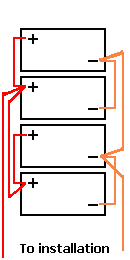
I hope the author (Paul) doesn’t mind that I hijacked one of his pics. It is a great layout image, and was perfect for my question (see lower text regarding wiring). http://img.photobucket.com/albums/v488/mr_joshua/Slide1-1.jpg Yes it is. And it's also usually extremely important that the intra-bank connections all be the same length. See battery bank wiring. Paul can get away with a sub-optimal wiring scheme (no offense sir) since the amount of power he's going to draw from his battery banks is low relative to their capacity. This means that imbalance in current drawn from each battery due to the different values of resistance seen by each battery (caused by the varying length of the cable connecting each to the load) won't greatly degrade the batteries lifetime under load. |
|
OK, so based on the necessity to keep the system in balance, and wiring is all equal in length; does it matter where the wire leads are landed on a bussbar?
In other words, when the terminals are landed on the bussbar, is the entire bussbar “energized” equally regardless of what terminals are feeding versus which are drawing power? Some bussbars (pictured below) have four studs. If you have three incoming “feed” lines and one drawing power (to inverter), there is no way to wire in perfect balance…. 
|
|
Quoted:
OK, so based on the necessity to keep the system in balance, and wiring is all equal in length; does it matter where the wire leads are landed on a bussbar? In other words, when the terminals are landed on the bussbar, is the entire bussbar “energized” equally regardless of what terminals are feeding versus which are drawing power? Some bussbars (pictured below) have four studs. If you have three incoming “feed” lines and one drawing power (to inverter), there is no way to wire in perfect balance…. http://img.photobucket.com/albums/v488/mr_joshua/Buss.jpg You are correct that a 'perfect' balance isn't attainable -or needed. As long as the bussbar is a reasonable cross-section and length, and the connections are of low resistance, you are GTG. |
|
Also, once the batteries have some use on them, they are likely to be 'out of balance'.
There are simple ways to measure the characterisics of the batteries so they can be arranged for optimum 'balance' if that is important to your application. That's the drawback of putting batteries in parallel. Sometimes it's easier to put them in series w/ a higher voltage and switching them in parallel when needed, like for higher current loads -when all you have available are smaller batteries |