


|
Quoted:
Quoted: I checked the hives today to see how the new installations were doing. The made-up nucs were less busy (naturally) - but still buzzing: http://i3.photobucket.com/albums/y91/Eyesofsilver/Beekeeping/2011/IMG_4424.jpg] Those four in the bottom right hand corner are planning something. I don't think they should be trusted. TRG I'm mailing you a small box. When you get it - shake it a few times - then open it.  |
|
Have you posted a cost breakdown of each item?
A shopping list of expected purchases, costs, equipment list? If I wanted to have two hives, what are my time expectations ans costs likely to be? I live in East Texas. I have native bees buzzing around and pollinating plants, and I find them from time to time in trees...waaaaay up there. I have never heard of Africanized bees around here harming anyone. But, what investment risk is there if I buy everything, then end up with african bees instead? TRG |
|
Quoted: Have you posted a cost breakdown of each item? A shopping list of expected purchases, costs, equipment list? If I wanted to have two hives, what are my time expectations ans costs likely to be? I live in East Texas. I have native bees buzzing around and pollinating plants, and I find them from time to time in trees...waaaaay up there. I have never heard of Africanized bees around here harming anyone. But, what investment risk is there if I buy everything, then end up with african bees instead? TRG Here is a link to starter kits by Mann Lake: http://www.mannlakeltd.com/ListProduct.asp?idCategory=33 I have found them to be about the cheapest, good source out there. I placed about 5 orders with them this year - and was completely happy with what I got. That page can give you a starting point for costs. Shipping on woodware (hive bodies, honey supers, telescoping roof, inner cover, hive stand, bottom board) can cost almost as much as the product itself - so waiting for free shipping season in Fall and early spring makes a big cost difference. Buy woodware unassembled. I recommend not only the hive body they include in the kit - but at least 2 more bodies and a total of 30 frames/foundation for growth in the 1st year. Don't forget the cost of the bees. |
|
Quoted:
Have you posted a cost breakdown of each item? A shopping list of expected purchases, costs, equipment list? If I wanted to have two hives, what are my time expectations ans costs likely to be? I live in East Texas. I have native bees buzzing around and pollinating plants, and I find them from time to time in trees...waaaaay up there. I have never heard of Africanized bees around here harming anyone. But, what investment risk is there if I buy everything, then end up with african bees instead? TRG I'd really like fr you to do this if you have some free time. I.e. tools needed, where you got them, what you paid and so forth. With a resource like the OP it's hard not to abuse it
Thanks again OP. My granddad/dad used to raise bees when I was a little lad. We had something in the order of 50 hives on a primarily clover resource area. I remember having more honey than we knew what to do with and the taste of chewing on a honey comb that's still hot from the electric knife. Hopefully once I settle down I'll start up a project similar to OP's using this damn fine thread as a reference. |
|
I had one hive from 2010 that just wasn't thriving. I have watched it through the Spring and the queen just didn't get her act together and actively lay eggs in the right quantity and pattern. Her egg-laying has been trailing off - and I decided 3 weeks ago to replace her - as the hive obviously wasn't planning to. So a week ago I found a local queen supplier with good stock and took delivery today. I put the new queen and attendants in the hive and terminated the old queen. Lesson learned: Wishing isn't an active course of action when you know the queen is not doing her thing. I waited too long for the hive to supersede her - which they never did. Introducing a queen in June is very late - and risky. By the time her laying is really productive - it will be very late in the season to have a strong enough hive to have good chances over the winter. I should have done this over a month ago (hindsight being what it is). I will now need to heavy feed this hive to build it up and help it get to a winter-hardy state. The new queen: 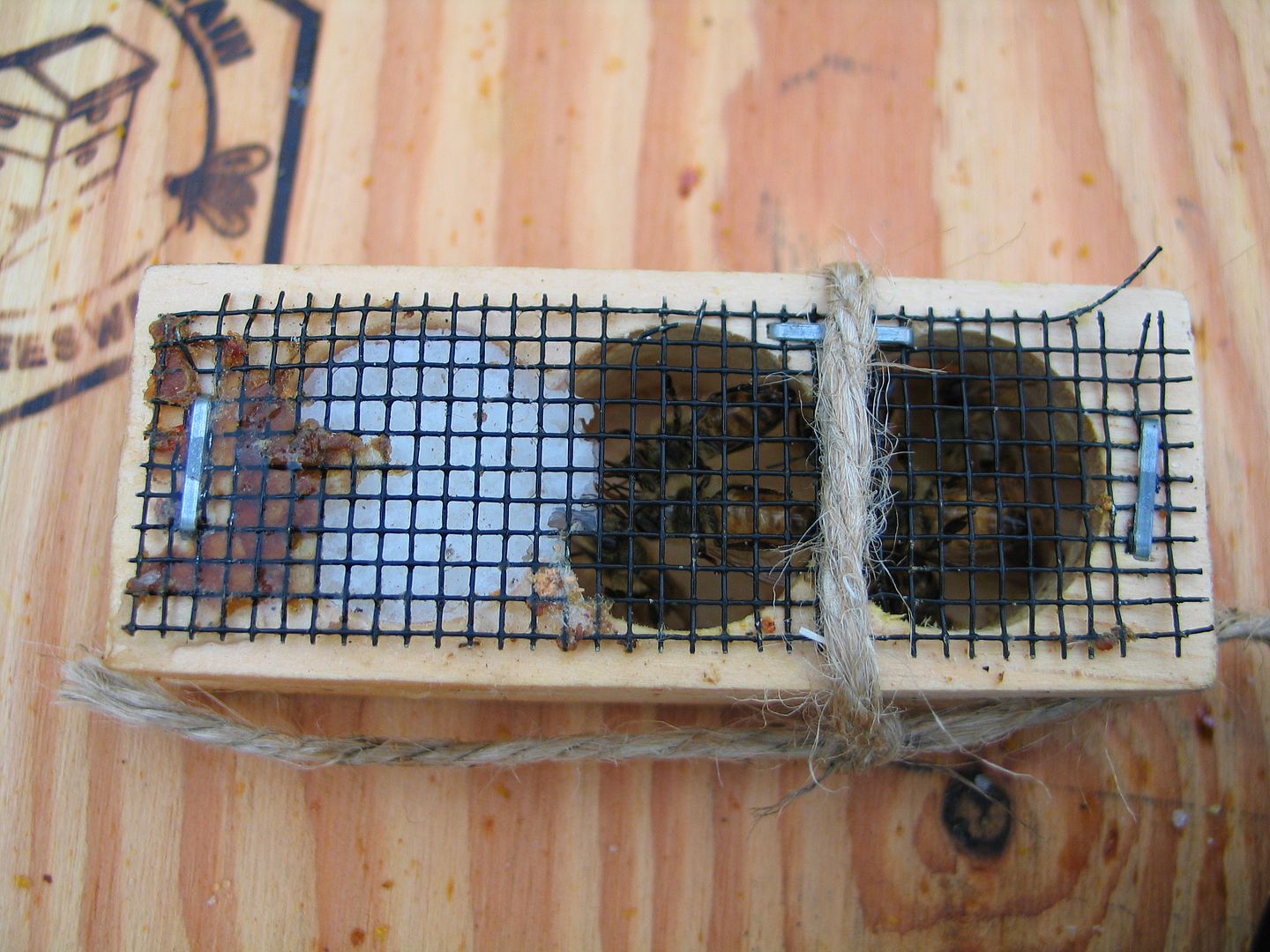 |
|
Quoted:
The new queen: http://i3.photobucket.com/albums/y91/Eyesofsilver/Beekeeping/2011/IMG_4812.jpg Great thread. I've been playing find the queen in every pic that you mention the queen to be part of, but no luck. In the pic above where the queen is in the box, it looks like there are several bees in the box. Am I wrong? |
|
Quoted: Great thread. I've been playing find the queen in every pic that you mention the queen to be part of, but no luck. In the pic above where the queen is in the box, it looks like there are several bees in the box. Am I wrong? There are several bees in the box. They are attendants - to take care of the queen, feed her etc. Here is a pic for you to practice on: 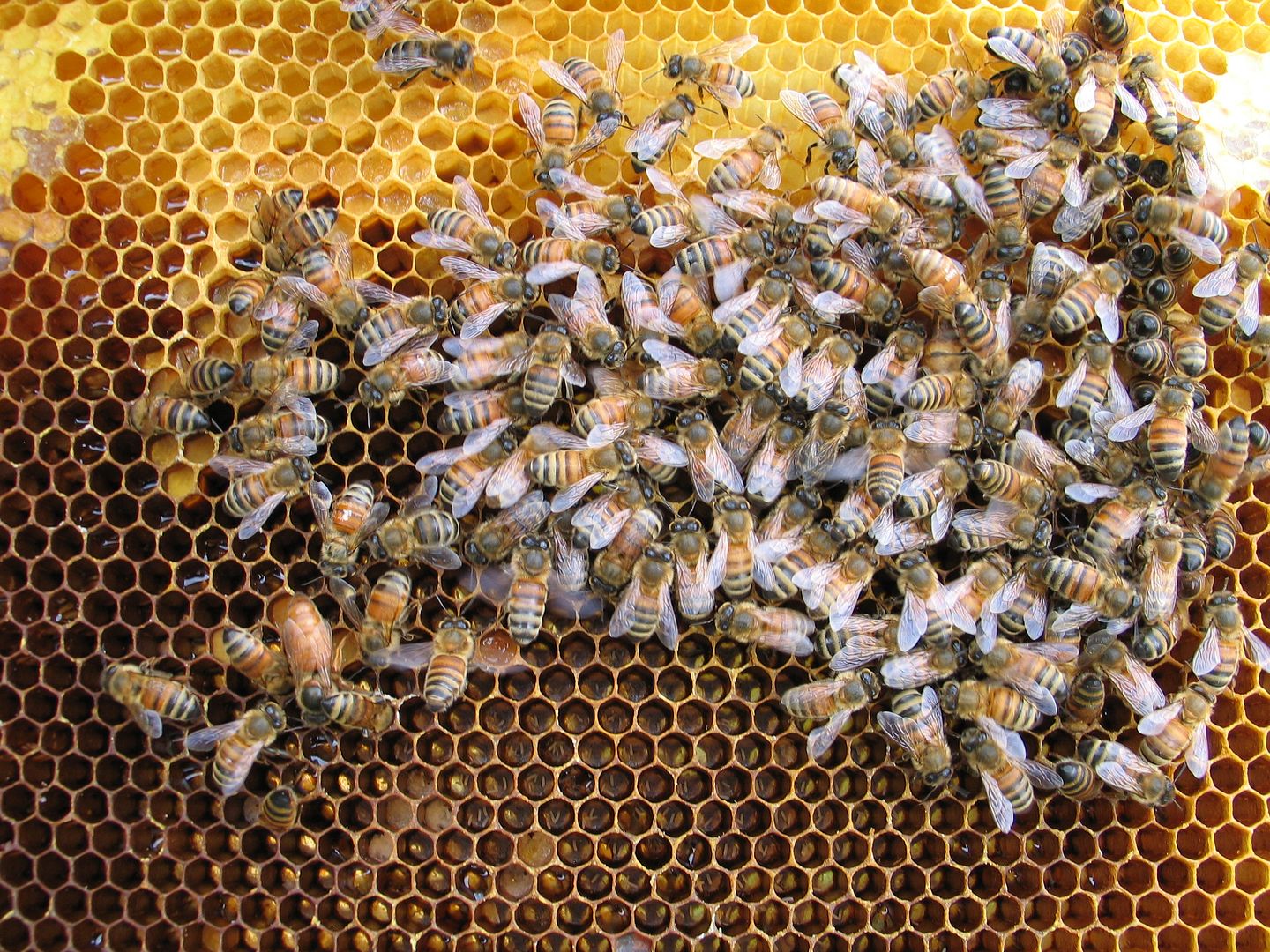 (Hint: Left half of photo) By the way - if you look closely in the open cells - you'll see that this new queen is laying multiple eggs per cell. This is a settling-in problem. After a few weeks she got it worked out. The photo is a rare example of this issue. |
|
Quoted:
Quoted:
Quoted:
The new queen: http://i3.photobucket.com/albums/y91/Eyesofsilver/Beekeeping/2011/IMG_4812.jpg Great thread. I've been playing find the queen in every pic that you mention the queen to be part of, but no luck. In the pic above where the queen is in the box, it looks like there are several bees in the box. Am I wrong? There are several bees in the box. They are attendants - to take care of the queen, feed her etc. Here is a pic for you to practice on:
http://i3.photobucket.com/albums/y91/Eyesofsilver/Beekeeping/2011/IMG_4433.jpg (Hint: Left half of photo) By the way - if you look closely in the open cells - you'll see that this new queen is laying multiple eggs per cell. This is a settling-in problem. After a few weeks she got it worked out. The photo is a rare example of this issue. Indeed. I've never seen that. Great photos, and great tutorial! 
|

|
I'll post here also. My second hive box has 7 frames filled and the last three frames have the comb built out and they are starting to fill them with honey. Should I go ahead and put the super on now? If so, should I use a queen excluder,also why do some say use one and others say not necessary to use one?
Thanks, BravoCharlie |
|
Quoted: I'll post here also. My second hive box has 7 frames filled and the last three frames have the comb built out and they are starting to fill them with honey. Should I go ahead and put the super on now? If so, should I use a queen excluder,also why do some say use one and others say not necessary to use one? Thanks, BravoCharlie Personally - I would put on another super in a few days. On the assumption that you have good laying pattern and they have the bottom box fairly used for eggs/pollen/honey - then a new super is indicated. I own queen excluders because I used to think they were needed - but my further reading on the subject has shown that there is a risk associated with using them. If a queen has mostly filled your current topmost box - and you add a queen excluder on top of that and then a new honey super atop that - one risk is that the queen/colony may sense that the queen has no vertical room to continue laying. If they conclude this - that can spawn a swarming decision. And if they conclude that they will swarm - stopping that is practically impossible. This is not to say that people don't use QEs successfully - they do. But we always need to be thinking ahead and thinking like bees. People that I have seen use QE insert an Imrie shim immediately above the QE to provide for an upper entrance - and carefully monitor the laying pattern and room for expansion below the QE. I'm not sure if there is surplus honey coming in now where you live. Unless there is - you wouldn't need a QE. For most of us - nectar sources are pretty limited right now. My message is not to criticize the use of QEs - but to call attention to the possible hive reaction to their use depending upon where the queen is laying. The Beekeepers Handbook (Sammataro) has an excellent section on supering on pages 74-77 with good illustrations of the options. You could also consider reversing. Hope this helps. |

|
Quoted:
Beekeeping protip: Wear the hat.http://a3.sphotos.ak.fbcdn.net/hphotos-ak-ash4/296969_2485908941277_1059266746_2834842_758761901_n.jpg Oooo.. Ow. 
Yes, they go for the face. Damn, Barbara, they nailed you right good and proper, didn't they. 
|
|
Temperatures this Winter have been consistently above average. February has been kind - with irregular highs in the 50s and 60s. I decided to feed some home-made fondant about 2 weeks ago. They devoured it at an amazing speed. Its been warm (for February) this week and the girls have been busy flying. They are bringing generous pollen stores back to the hive... impressive pollen baskets full of very light yellow pollen. I have no idea where its coming from. Not out large Pussy Willow. It must be some tree that is blooming without being obvious. It may be 70F on Thursday. If so - I'm going to open hives and see if she is laying a good pattern and check supplies. Yesterday: 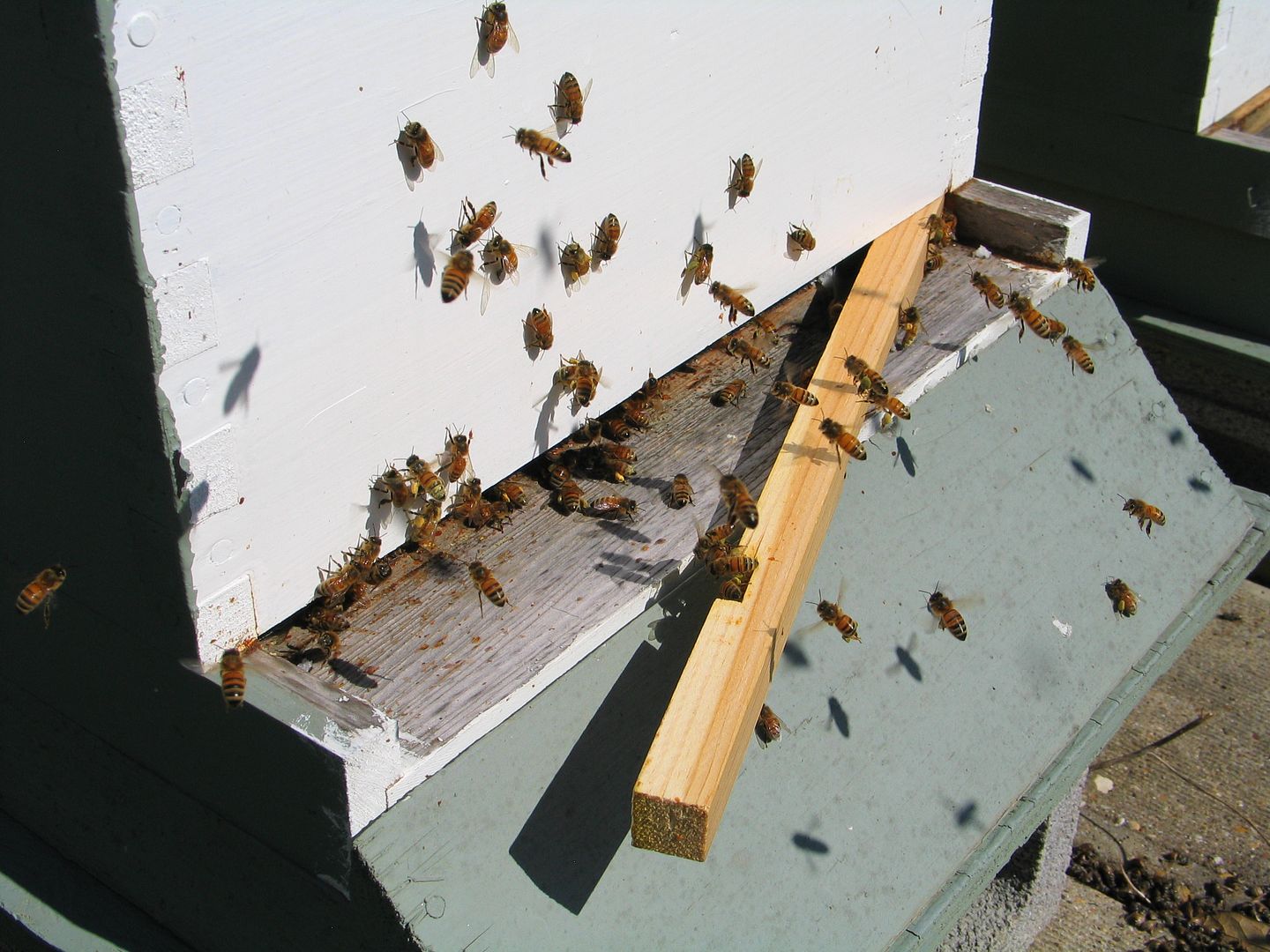 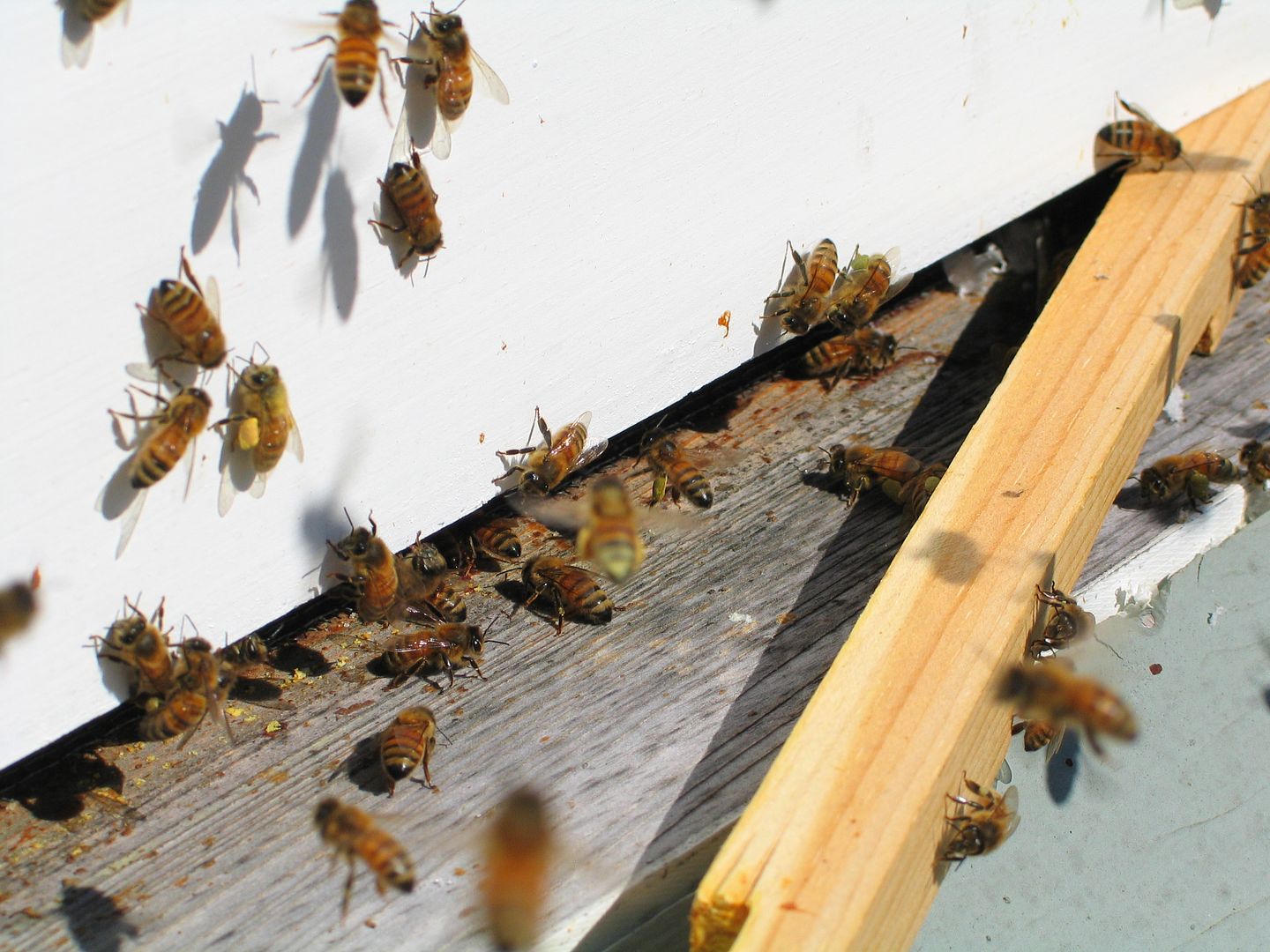 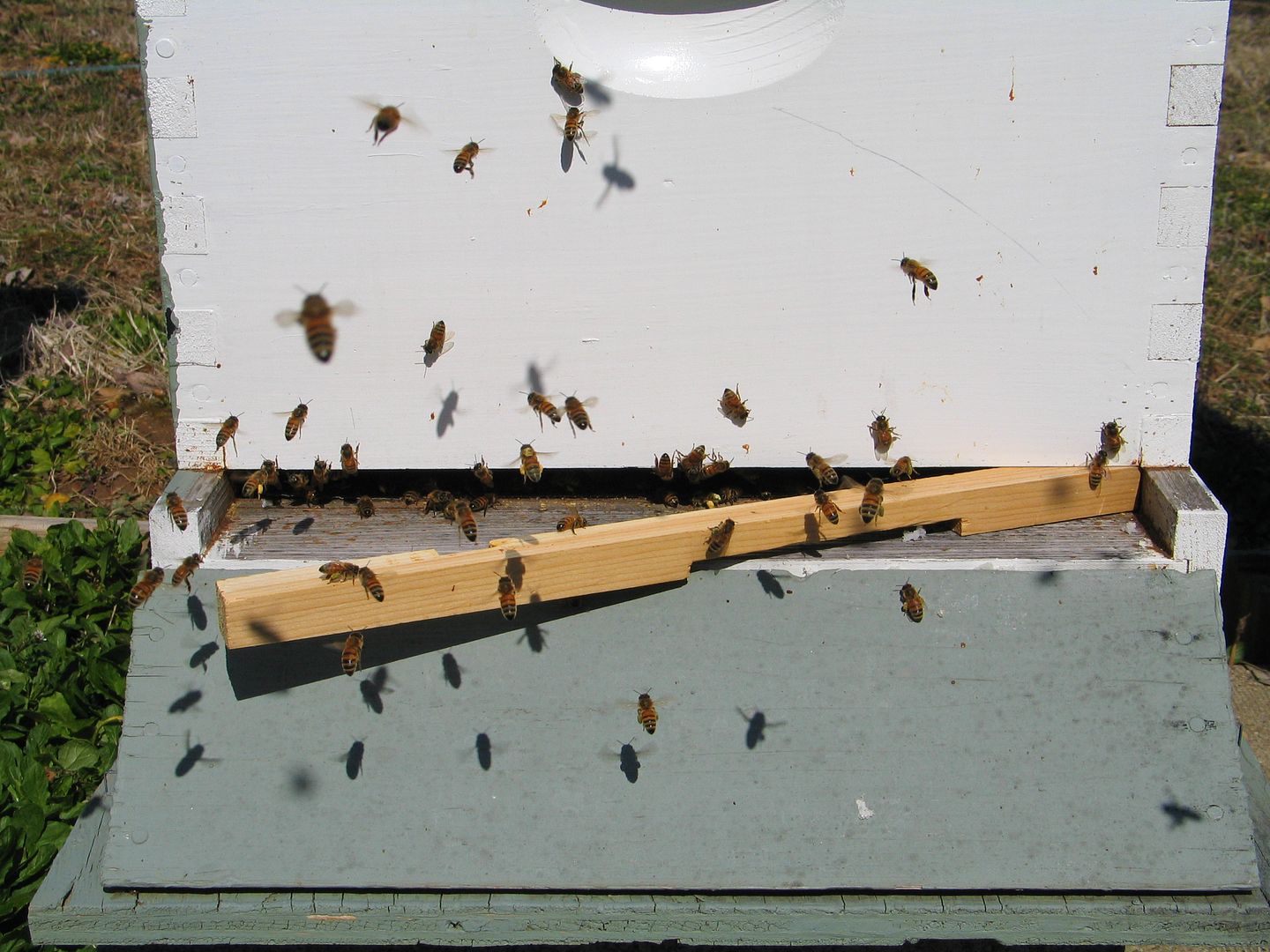 |
|
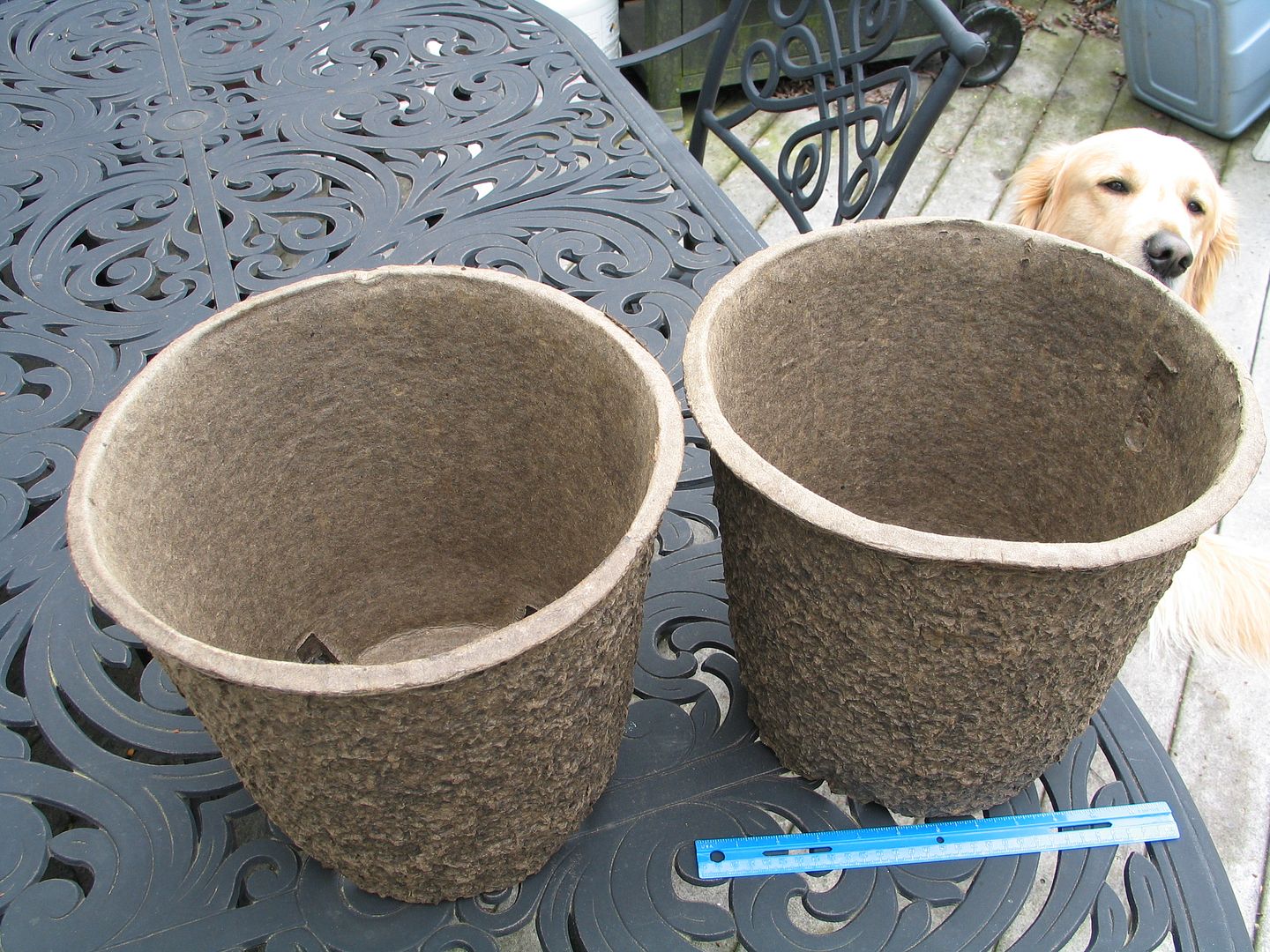
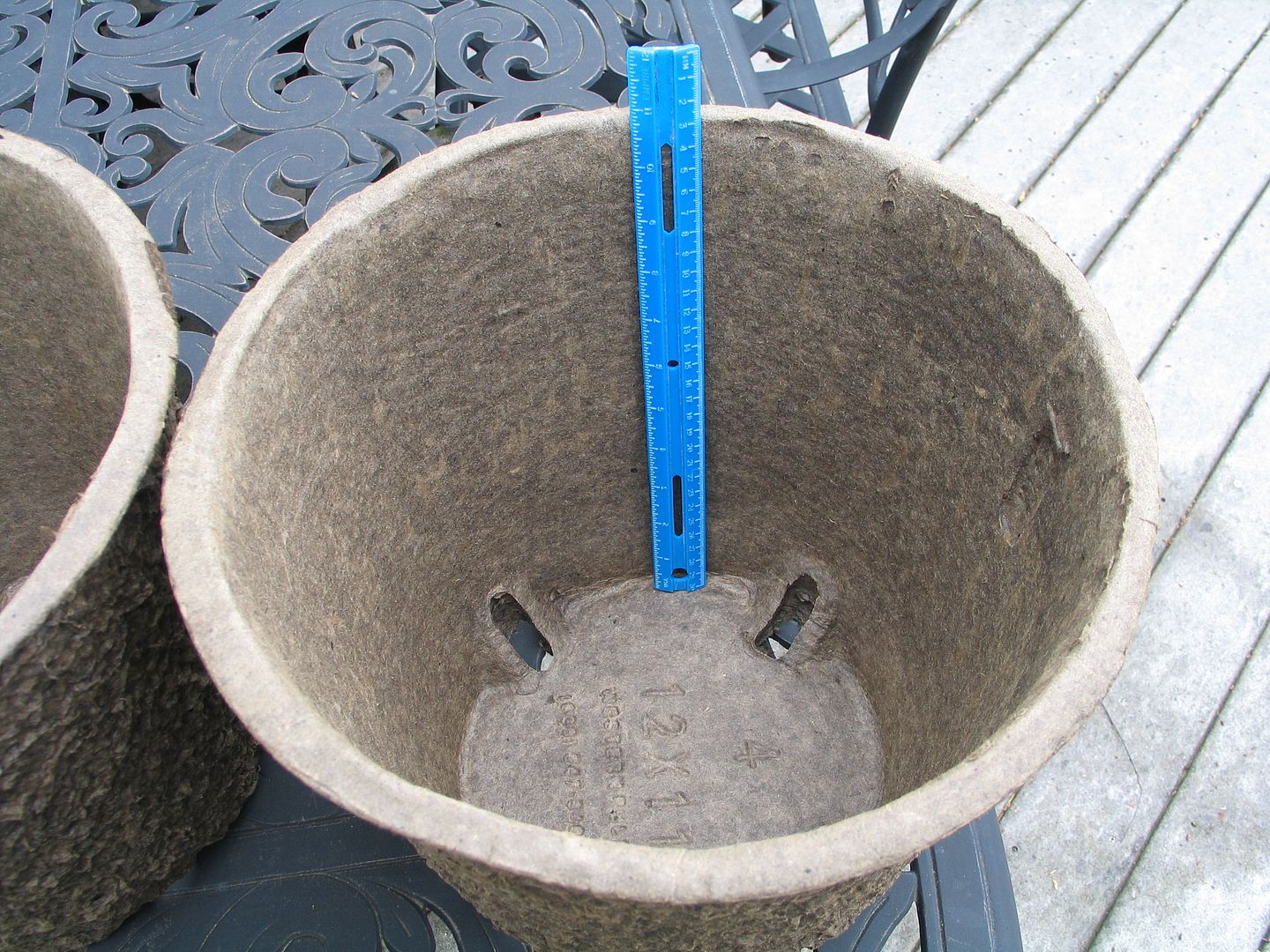
Quoted: You're building swarm traps? Just a guess. I don't have a clue. Winner...winner...chicken dinner! I had placed a double wood nuc trap a few weeks ago - and I have to tell you that it weighed a ton when I was trying to wrestle it into place. So I was looking for a lightweight, relatively disposable substitute that had an internal volume that would meet the minimum requirements (which is fairly large). Its made of two very large pulp pots glued together. I have to mix some peat and glue to close most of the drainage holes on the ends... but they are pretty cheap. The downside is that they are pretty hard to find in the right size. The result is an internal volume LARGER than two deep nucs. 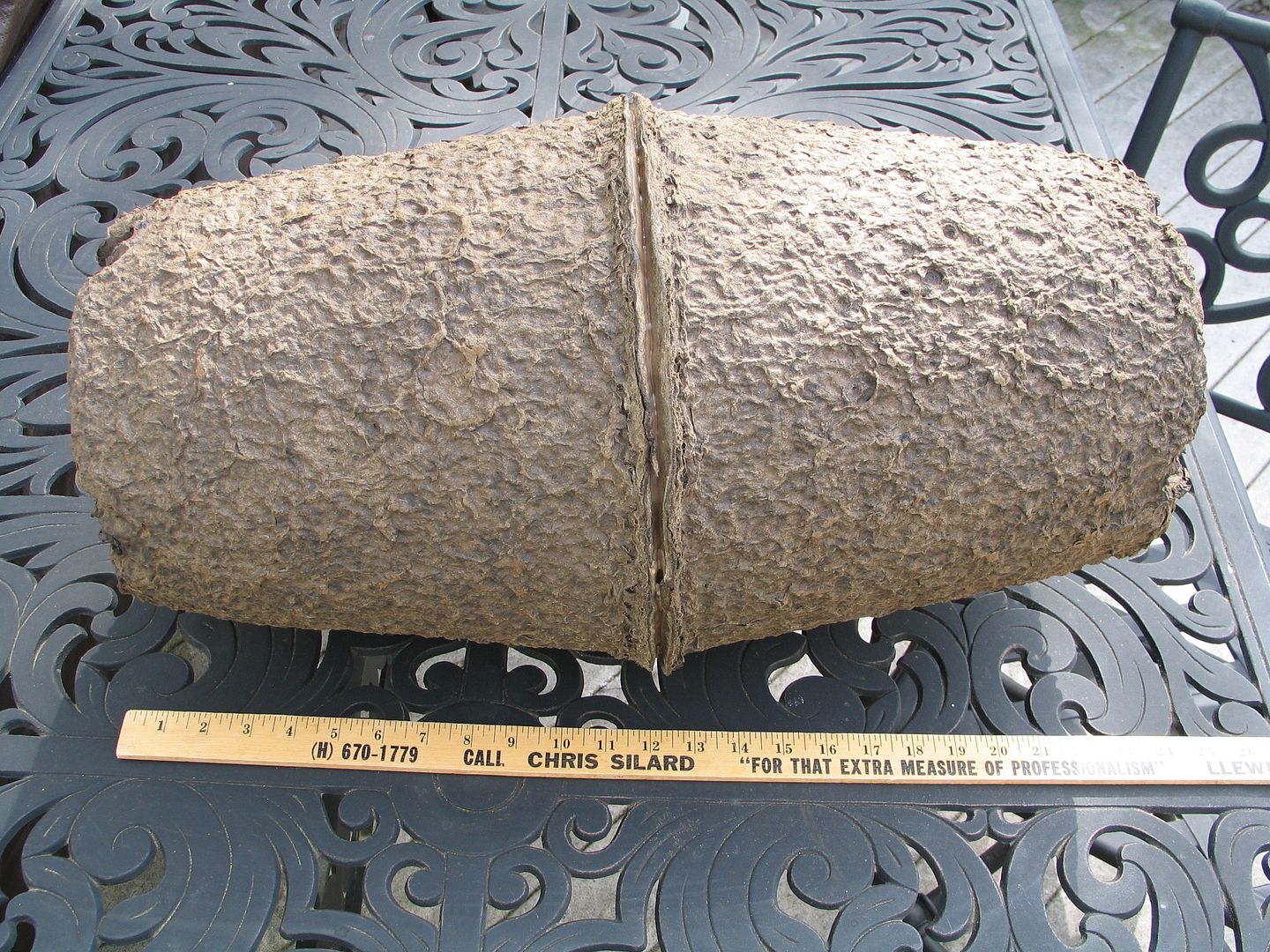 I also think that this will be not only easier to haul up 8' into a tree - but easier to mount as well. I'm going to bait them with some beeswax scraps and lemongrass oil - and hang them this weekend. I made six of them. We'll see how they do! |
|
Quoted:
Quoted:
You're building swarm traps? Just a guess. I don't have a clue. Winner...winner...chicken dinner! I had placed a double wood nuc trap a few weeks ago - and I have to tell you that it weighed a ton when I was trying to wrestle it into place. So I was looking for a lightweight, relatively disposable substitute that had an internal volume that would meet the minimum requirements (which is fairly large). Its made of two very large pulp pots glued together. I have to mix some peat and glue to close most of the drainage holes on the ends... but they are pretty cheap. The downside is that they are pretty hard to find in the right size. The result is an internal volume LARGER than two deep nucs. http://i3.photobucket.com/albums/y91/Eyesofsilver/Beekeeping/2012/IMG_5500.jpg I also think that this will be not only easier to haul up 8' into a tree - but easier to mount as well. I'm going to bait them with some beeswax scraps and lemongrass oil - and hang them this weekend. I made six of them. We'll see how they do! That's pretty cool! Are they fastened together with anything but glue? If you can give a step-by-step, I'd love that. I know it looks obvious, but there are probably some things you figured out that I can filch. 
|
|
Quoted: Quoted: Quoted: You're building swarm traps? Just a guess. I don't have a clue. Winner...winner...chicken dinner! I had placed a double wood nuc trap a few weeks ago - and I have to tell you that it weighed a ton when I was trying to wrestle it into place. So I was looking for a lightweight, relatively disposable substitute that had an internal volume that would meet the minimum requirements (which is fairly large). Its made of two very large pulp pots glued together. I have to mix some peat and glue to close most of the drainage holes on the ends... but they are pretty cheap. The downside is that they are pretty hard to find in the right size. The result is an internal volume LARGER than two deep nucs. http://i3.photobucket.com/albums/y91/Eyesofsilver/Beekeeping/2012/IMG_5500.jpg I also think that this will be not only easier to haul up 8' into a tree - but easier to mount as well. I'm going to bait them with some beeswax scraps and lemongrass oil - and hang them this weekend. I made six of them. We'll see how they do! That's pretty cool! Are they fastened together with anything but glue? If you can give a step-by-step, I'd love that. I know it looks obvious, but there are probably some things you figured out that I can filch. I have two more to assemble... and you're right... its pretty dead simple. Just glue and a hanging method. I'll photo the next one. |
|
Quoted:
Quoted:
Quoted:
Quoted:
You're building swarm traps? Just a guess. I don't have a clue. Winner...winner...chicken dinner! I had placed a double wood nuc trap a few weeks ago - and I have to tell you that it weighed a ton when I was trying to wrestle it into place. So I was looking for a lightweight, relatively disposable substitute that had an internal volume that would meet the minimum requirements (which is fairly large). Its made of two very large pulp pots glued together. I have to mix some peat and glue to close most of the drainage holes on the ends... but they are pretty cheap. The downside is that they are pretty hard to find in the right size. The result is an internal volume LARGER than two deep nucs. http://i3.photobucket.com/albums/y91/Eyesofsilver/Beekeeping/2012/IMG_5500.jpg I also think that this will be not only easier to haul up 8' into a tree - but easier to mount as well. I'm going to bait them with some beeswax scraps and lemongrass oil - and hang them this weekend. I made six of them. We'll see how they do! That's pretty cool! Are they fastened together with anything but glue? If you can give a step-by-step, I'd love that. I know it looks obvious, but there are probably some things you figured out that I can filch. I have two more to assemble... and you're right... its pretty dead simple. Just glue and a hanging method. I'll photo the next one. Awesome. ETA: Will they disintegrate in prolonged wet weather? Just wondering how diligent you'd have to be about checking them. |
|
Quoted: Quoted: Quoted: Quoted: Quoted: You're building swarm traps? Just a guess. I don't have a clue. Winner...winner...chicken dinner! I had placed a double wood nuc trap a few weeks ago - and I have to tell you that it weighed a ton when I was trying to wrestle it into place. So I was looking for a lightweight, relatively disposable substitute that had an internal volume that would meet the minimum requirements (which is fairly large). Its made of two very large pulp pots glued together. I have to mix some peat and glue to close most of the drainage holes on the ends... but they are pretty cheap. The downside is that they are pretty hard to find in the right size. The result is an internal volume LARGER than two deep nucs. http://i3.photobucket.com/albums/y91/Eyesofsilver/Beekeeping/2012/IMG_5500.jpg I also think that this will be not only easier to haul up 8' into a tree - but easier to mount as well. I'm going to bait them with some beeswax scraps and lemongrass oil - and hang them this weekend. I made six of them. We'll see how they do! That's pretty cool! Are they fastened together with anything but glue? If you can give a step-by-step, I'd love that. I know it looks obvious, but there are probably some things you figured out that I can filch. I have two more to assemble... and you're right... its pretty dead simple. Just glue and a hanging method. I'll photo the next one. Awesome. ETA: Will they disintegrate in prolonged wet weather? Just wondering how diligent you'd have to be about checking them. Fair question re: rain. I thought about it. I'm split on whether to treat them or not. I considered melting beeswax and painting it on the top. I need to check the traps every 3 days or so - otherwise once I get a swarm - tearing the trap apart (literally) will be a heck of a mess. |
|
Quoted:
Quoted:
Quoted:
Quoted:
Quoted:
Quoted:
You're building swarm traps? Just a guess. I don't have a clue. Winner...winner...chicken dinner! I had placed a double wood nuc trap a few weeks ago - and I have to tell you that it weighed a ton when I was trying to wrestle it into place. So I was looking for a lightweight, relatively disposable substitute that had an internal volume that would meet the minimum requirements (which is fairly large). Its made of two very large pulp pots glued together. I have to mix some peat and glue to close most of the drainage holes on the ends... but they are pretty cheap. The downside is that they are pretty hard to find in the right size. The result is an internal volume LARGER than two deep nucs. http://i3.photobucket.com/albums/y91/Eyesofsilver/Beekeeping/2012/IMG_5500.jpg I also think that this will be not only easier to haul up 8' into a tree - but easier to mount as well. I'm going to bait them with some beeswax scraps and lemongrass oil - and hang them this weekend. I made six of them. We'll see how they do! That's pretty cool! Are they fastened together with anything but glue? If you can give a step-by-step, I'd love that. I know it looks obvious, but there are probably some things you figured out that I can filch. I have two more to assemble... and you're right... its pretty dead simple. Just glue and a hanging method. I'll photo the next one. Awesome. ETA: Will they disintegrate in prolonged wet weather? Just wondering how diligent you'd have to be about checking them. Fair question re: rain. I thought about it. I'm split on whether to treat them or not. I considered melting beeswax and painting it on the top. I need to check the traps every 3 days or so - otherwise once I get a swarm - tearing the trap apart (literally) will be a heck of a mess. If they're cheap, I think I'd wet one down to see what happens. They won't just melt or anything. Nurseries keep plants in them to sell, which requires water. I have, however, gotten some of those pots that are in bad shape before. No idea how long they'd been sitting there. |
|
I received a call that a swarm was in a residential backyard and available for the asking. I was told they were on the arch of a children's play set. So Sunday morning I loaded up some items to collect them. When I arrived they looked like this: 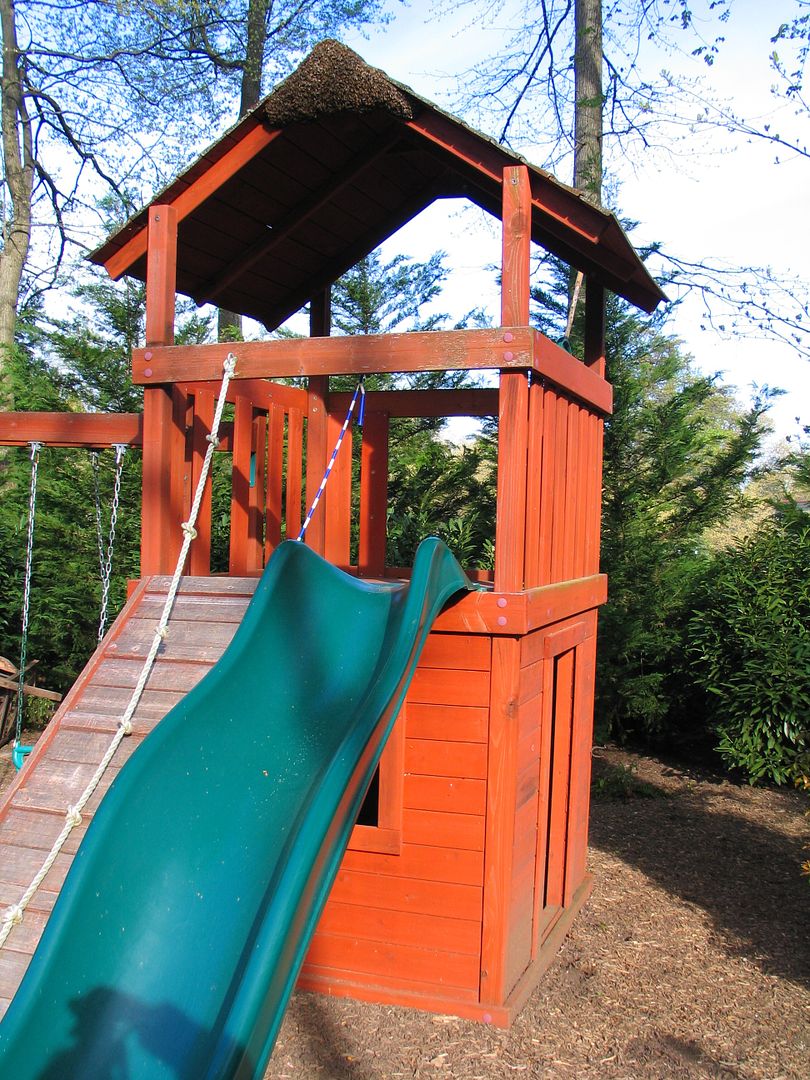 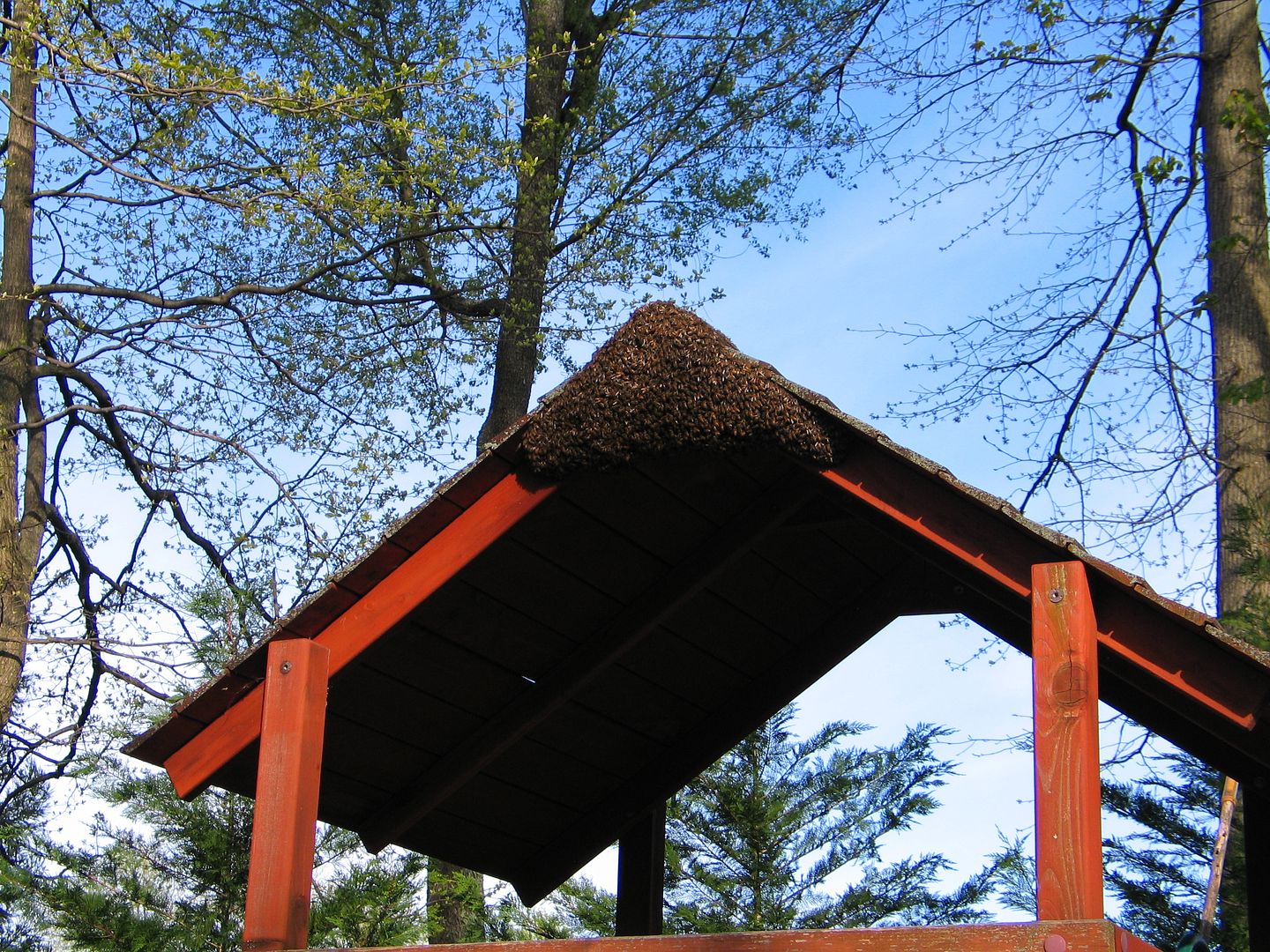 They were wrapped under and inside the roof arch: 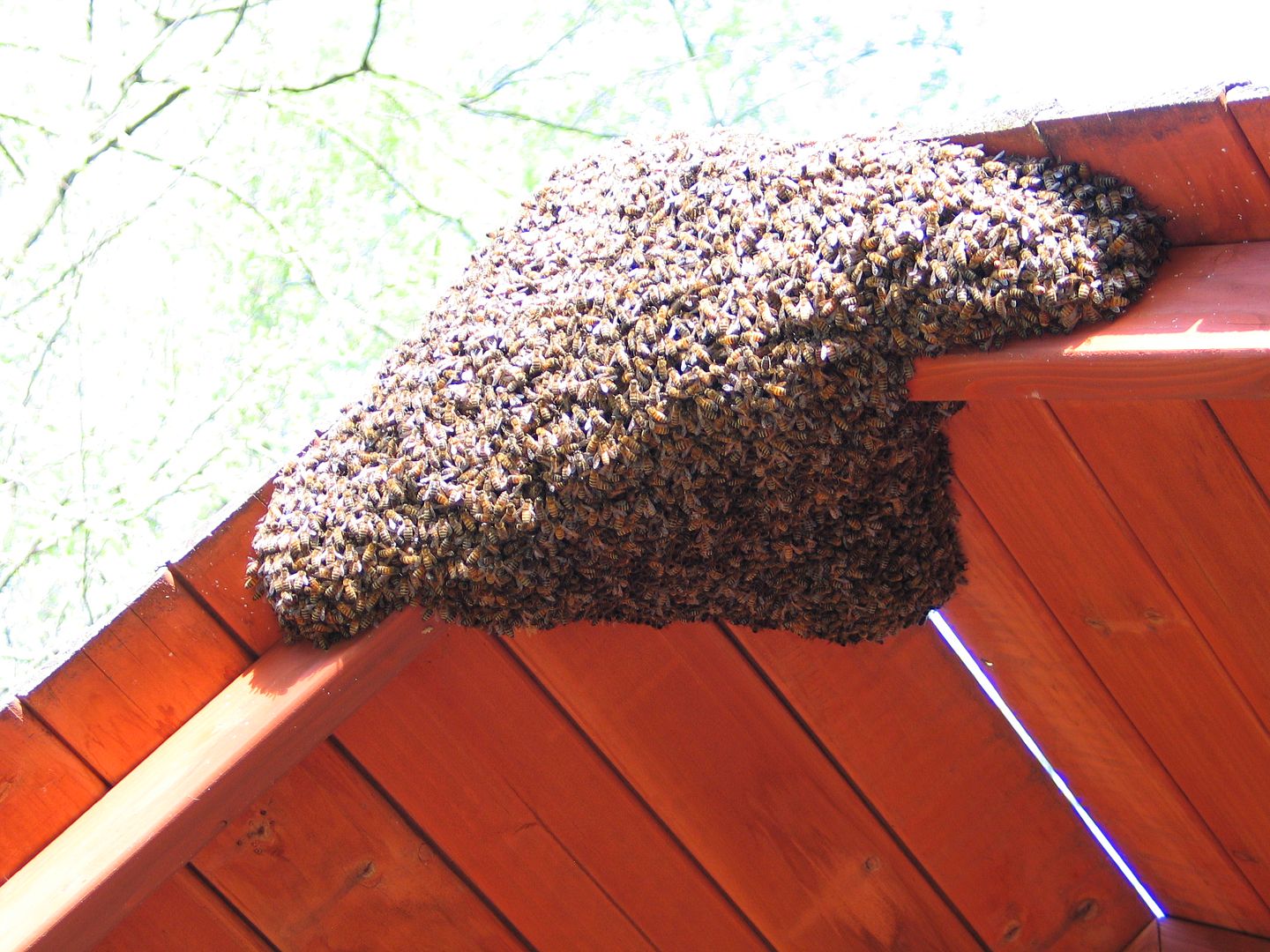 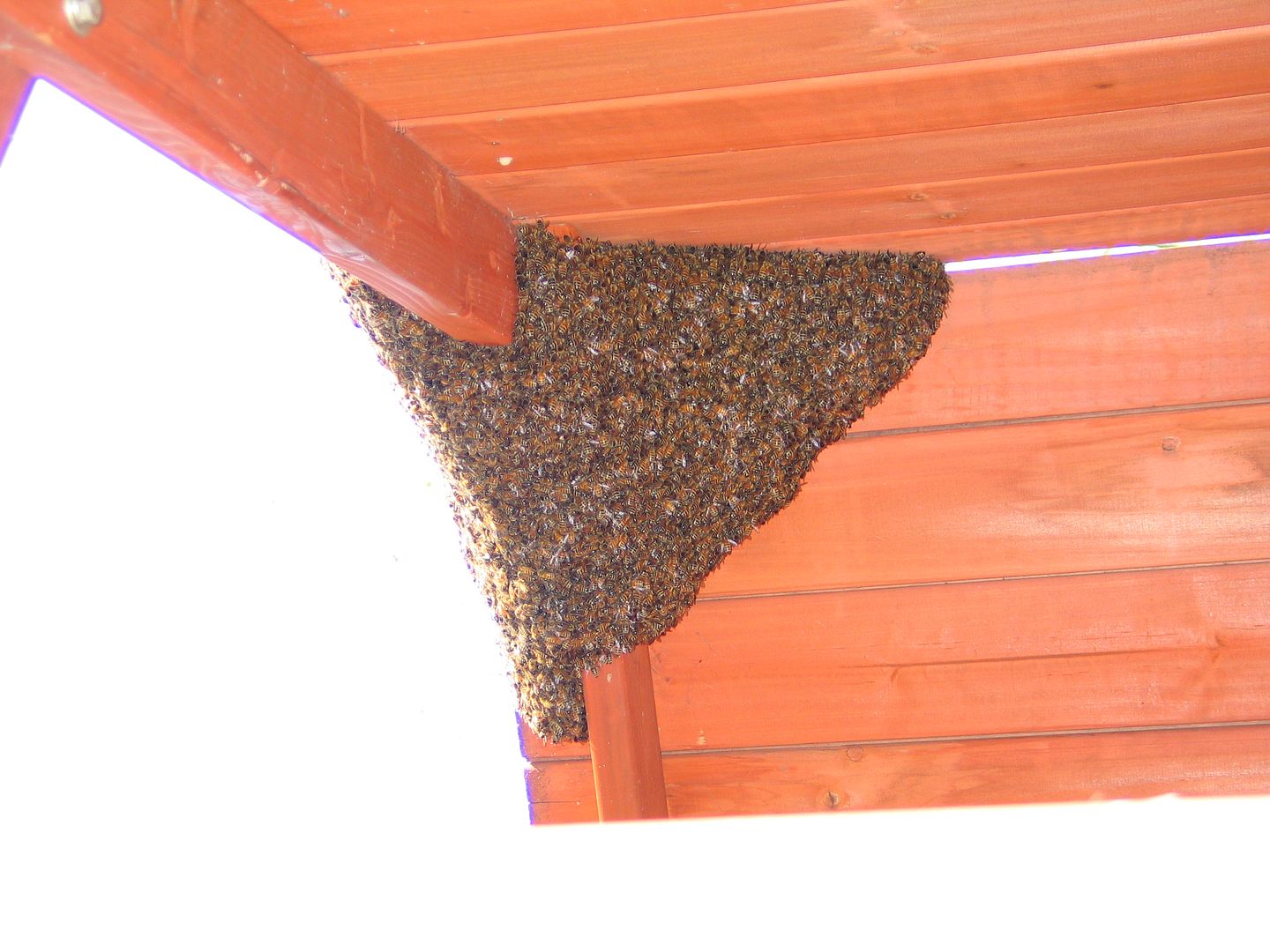 So while I considered how to collect them - something caught my eye in the backyard next door. A beehive with 5 mediums on it! I asked the neighbor what the deal was - and she said that the neighbor permitted a University beekeeping program to place the hive there. The swarm had been on the play set for 2+ days - and when the students responded to the swarm call - I'm told they had no idea what to do - so they poured honey on the fence (as if that would work). Then they left.  Well - their loss - my gain. The homeowner wanted them preserved - but gone. They were now on her property. I had brought a deep nuc, one hive body and a big cardboard box. I decided to use the latter. It was certainly lighter to deal with - and an easier target to drop bees into. I considered whether to wear gloves ( I don't use them for beekeeping) - and since I was going to have to scrape them off a structure - decided to start with the safer approach. That turned out to be a VERY good decision. So I took the box up on the platform and started gently exploring. The spray is sugar water.  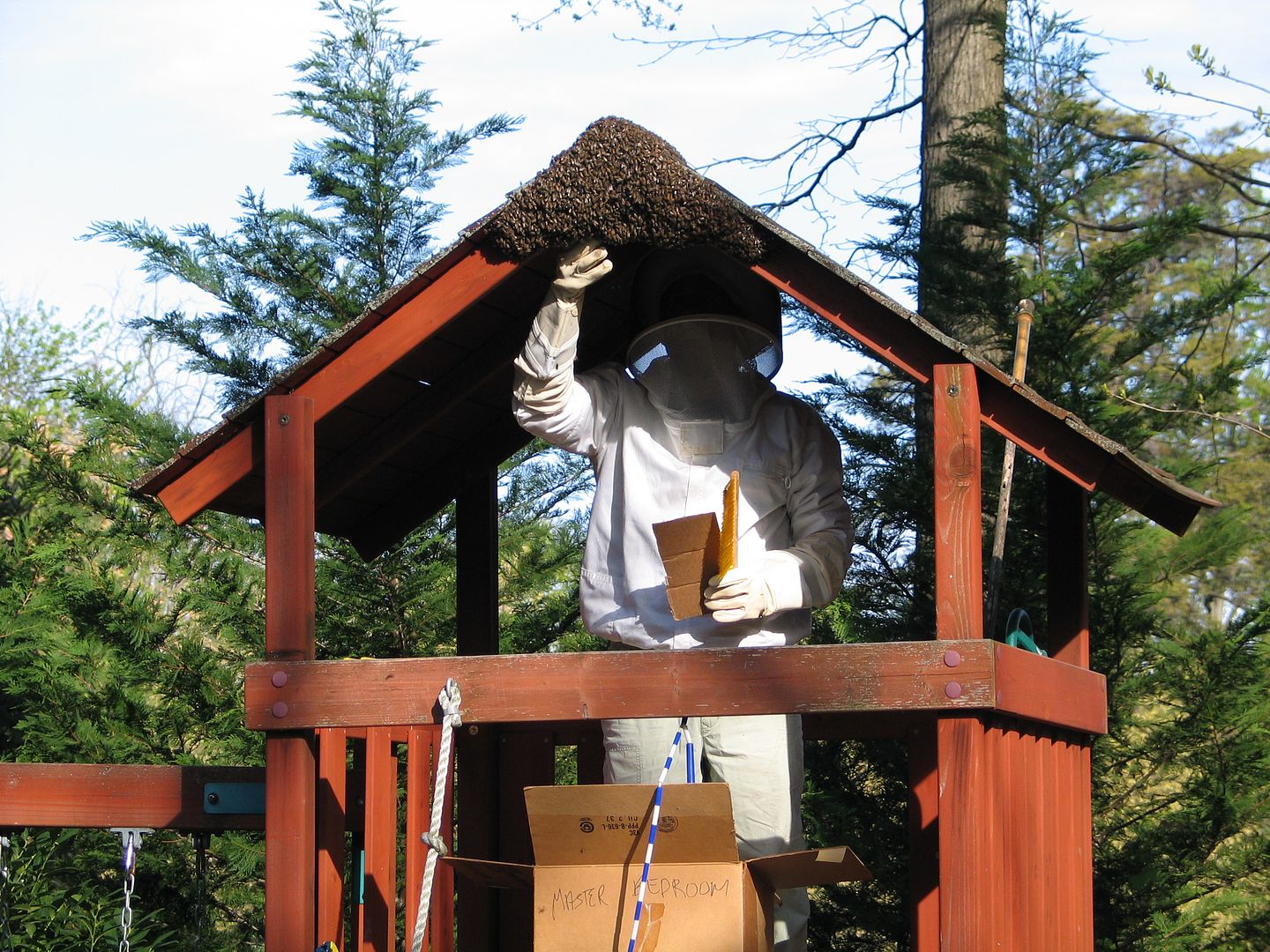 I got a big handful of bees and dumped them in the box: 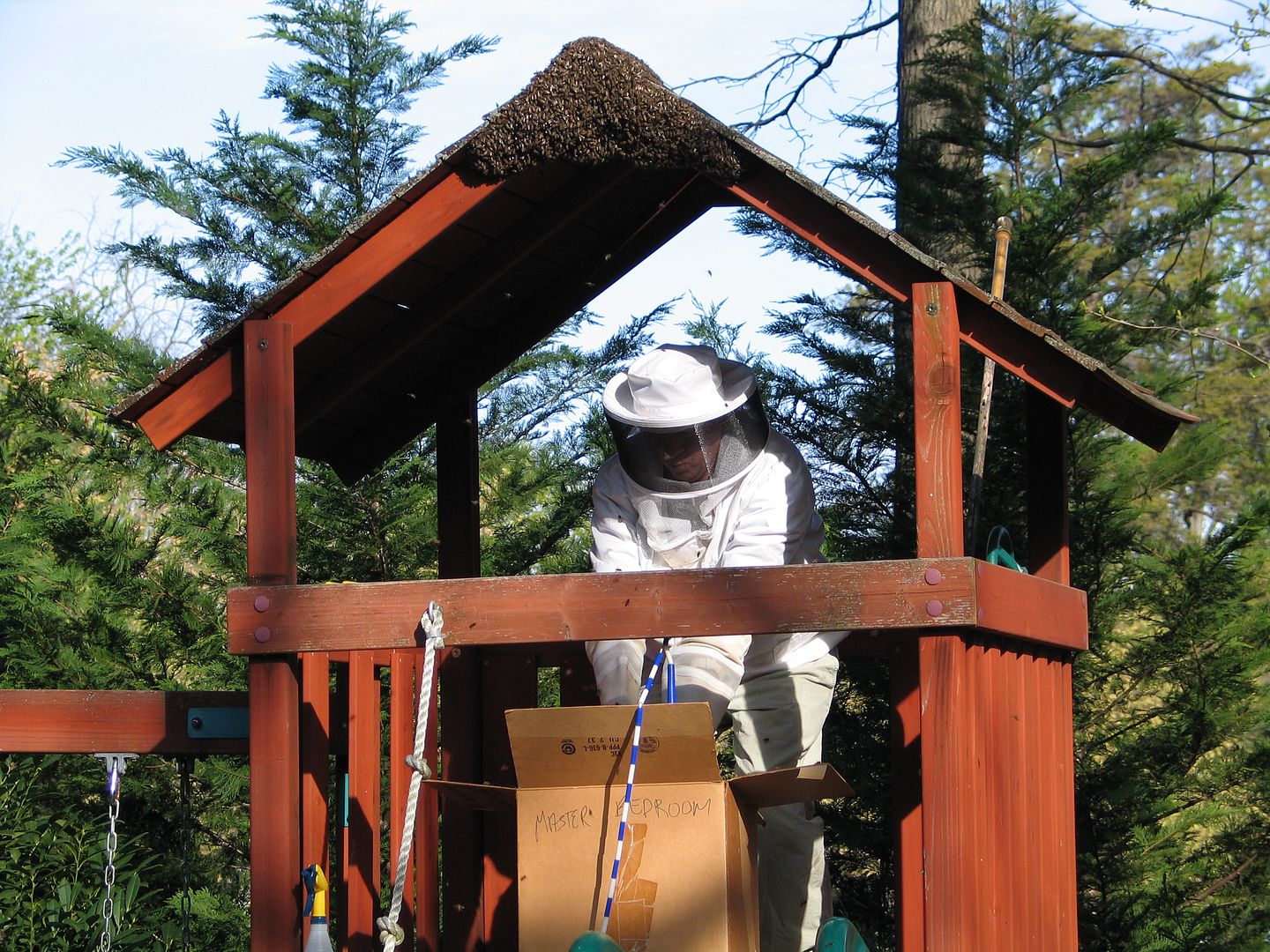 Then I got smart(er) and moved the box closer to the swarm: 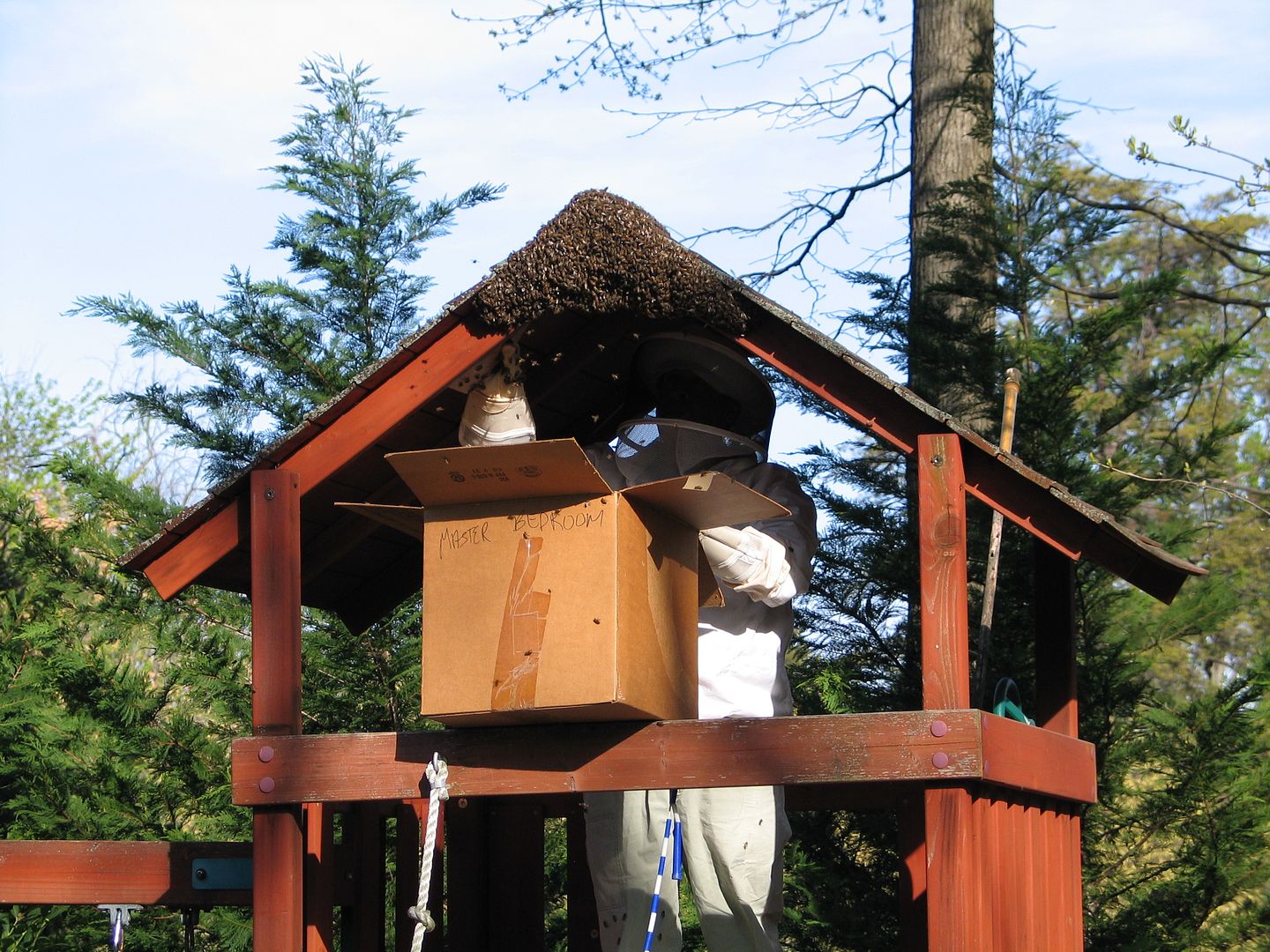 Then I started to gently scrape them off the structure with a cardboard scoop: 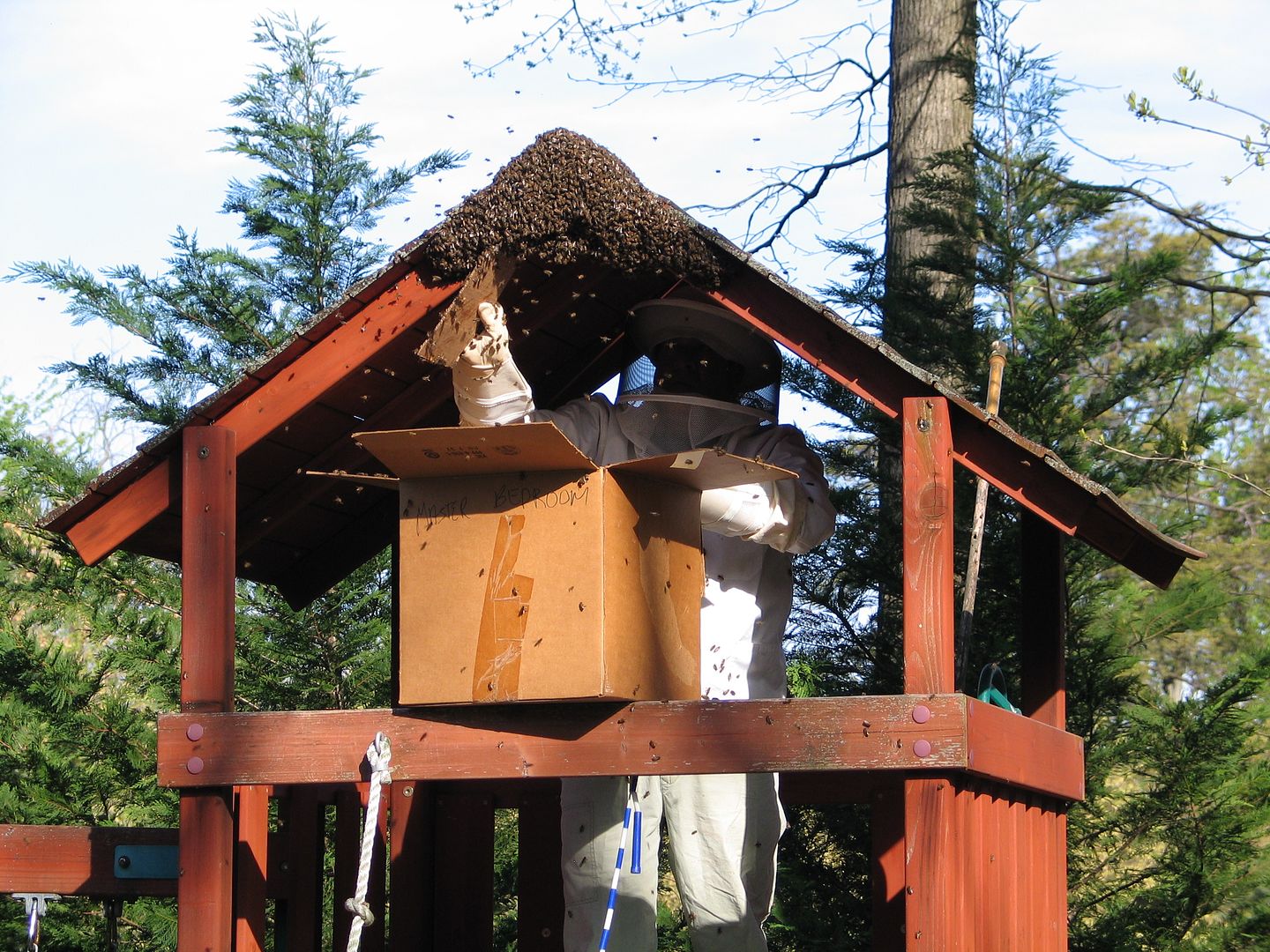 One a big pile of bees fell into the box with a THUD - a lot of them were in the air: 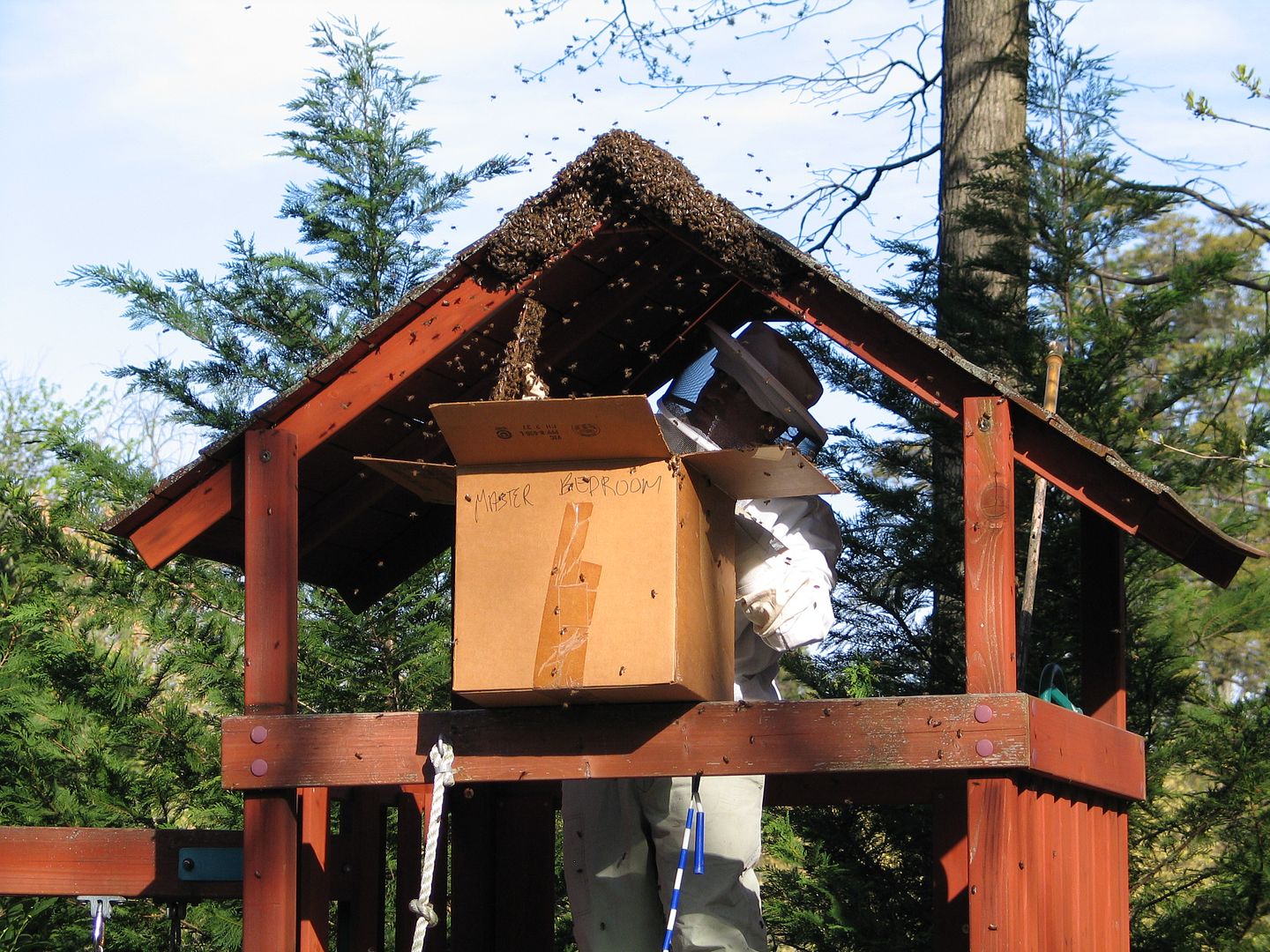 More scraping/scooping: 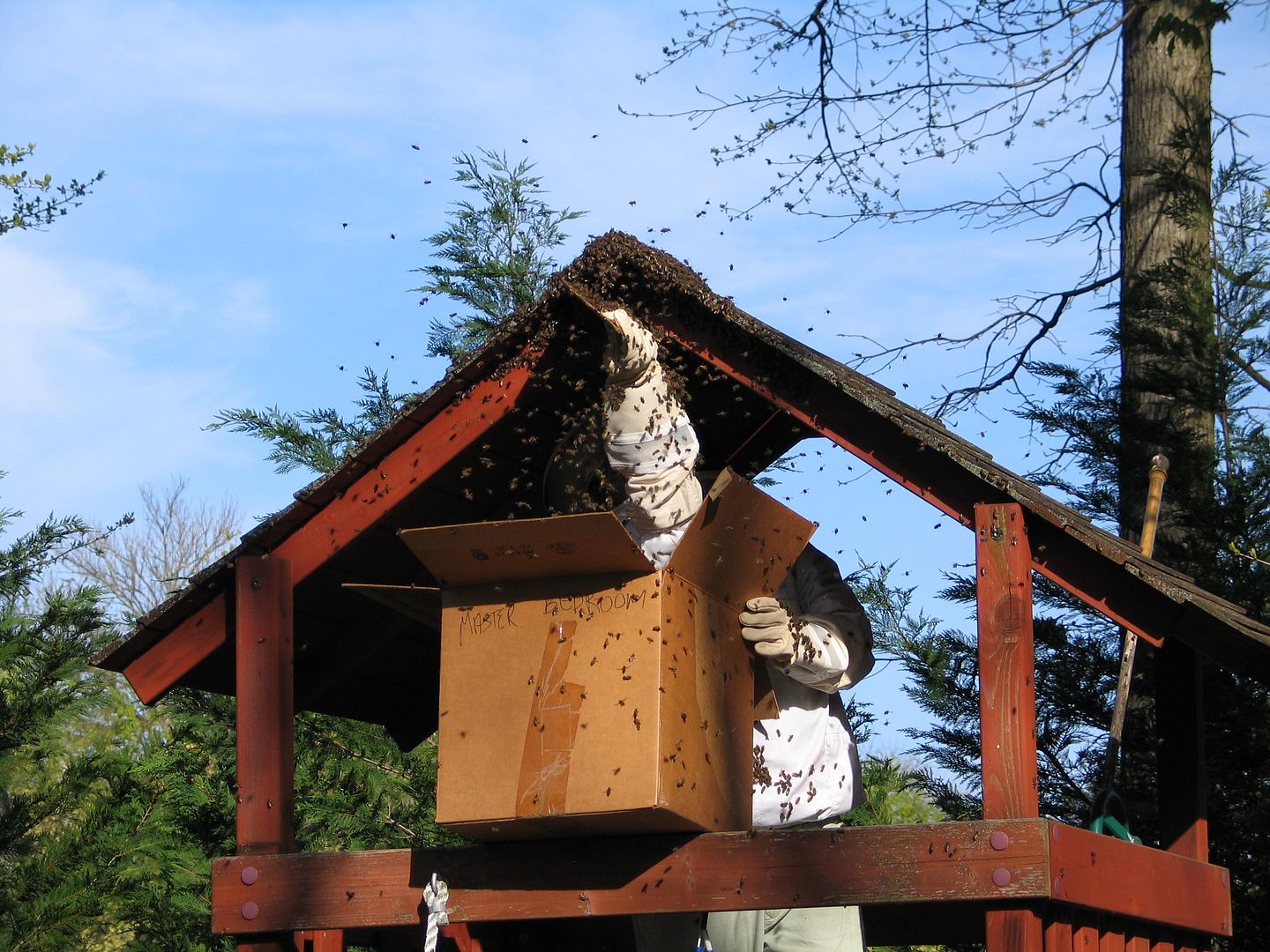 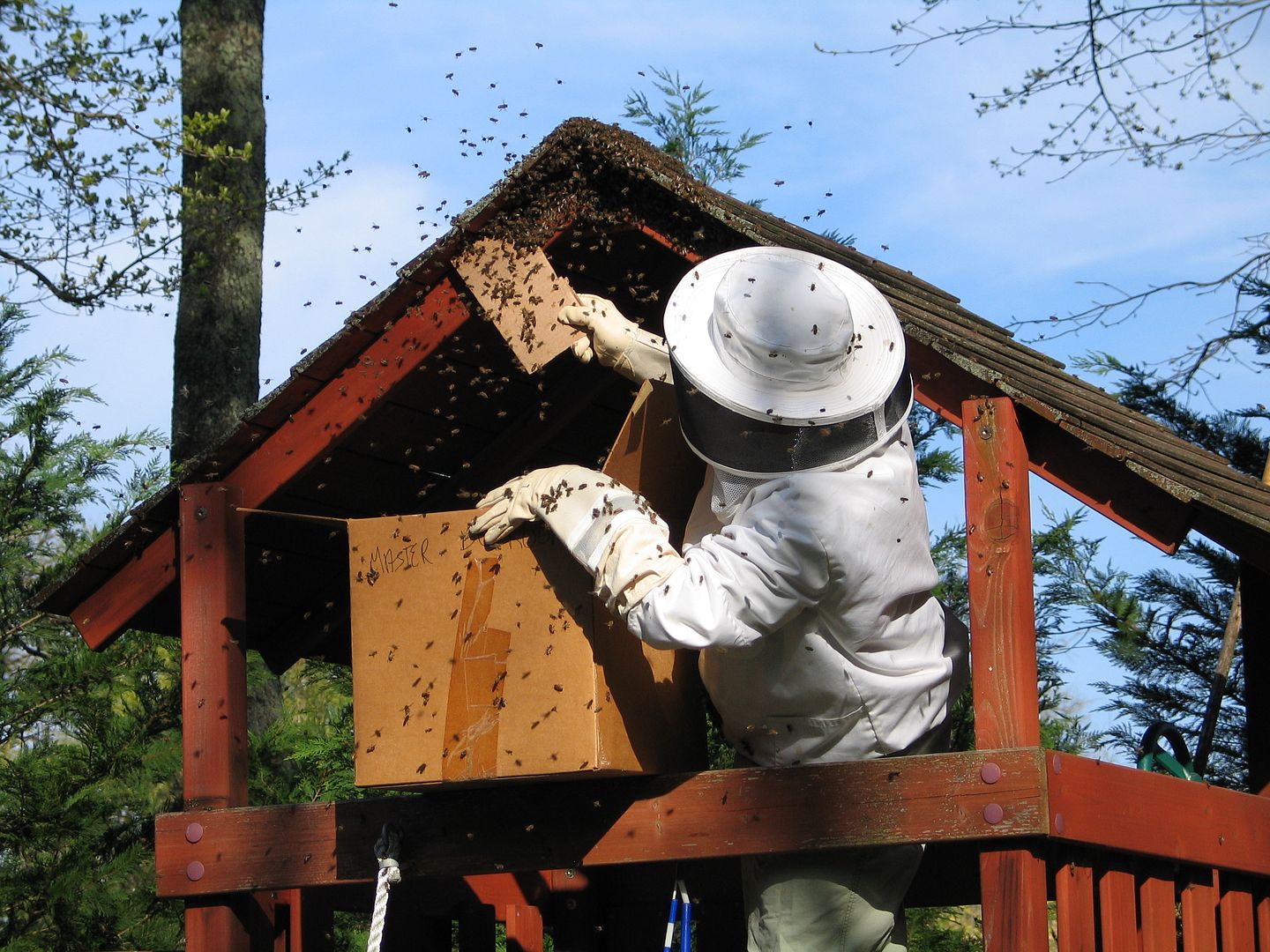 Now there were a lot of them in the air: 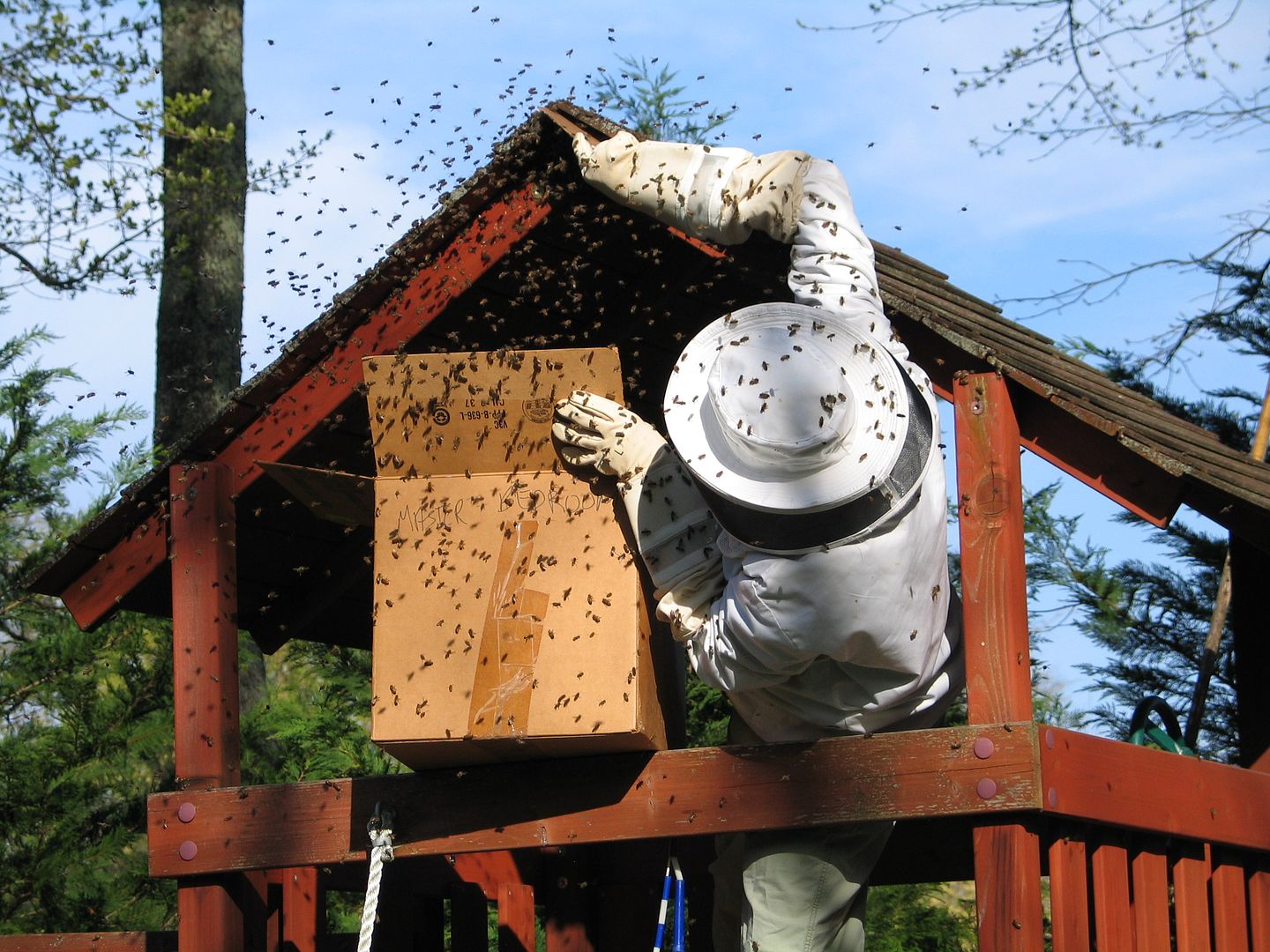 They were 2-3" thick on the roof too - so I scooped them off of there too. All the while I was conscious of the old saying "The greatest chance of getting hurt in collecting a swarm is falling off whatever you are on". There were 50-100 bees on my side of the railing at any time - so leaning against it was likely to result in a LOT of stings through clothing. Every scoop that went in the box - probably half of them rose up in a cloud to get back to the queen scent. This made it unclear at any moment whether the queen was in the box - or still on the structure. Those in the air moved back to the peak. Inspecting for a queen: 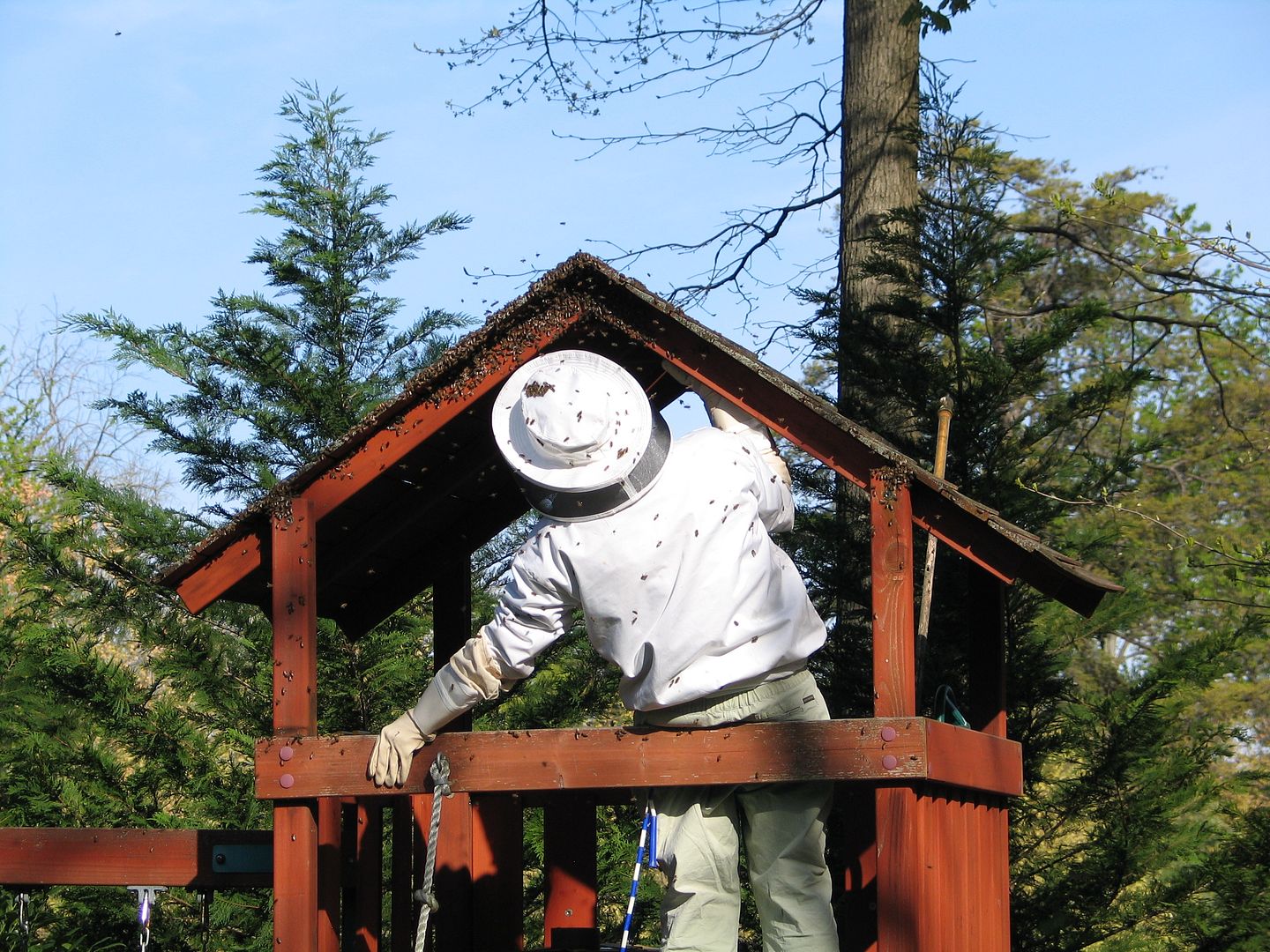 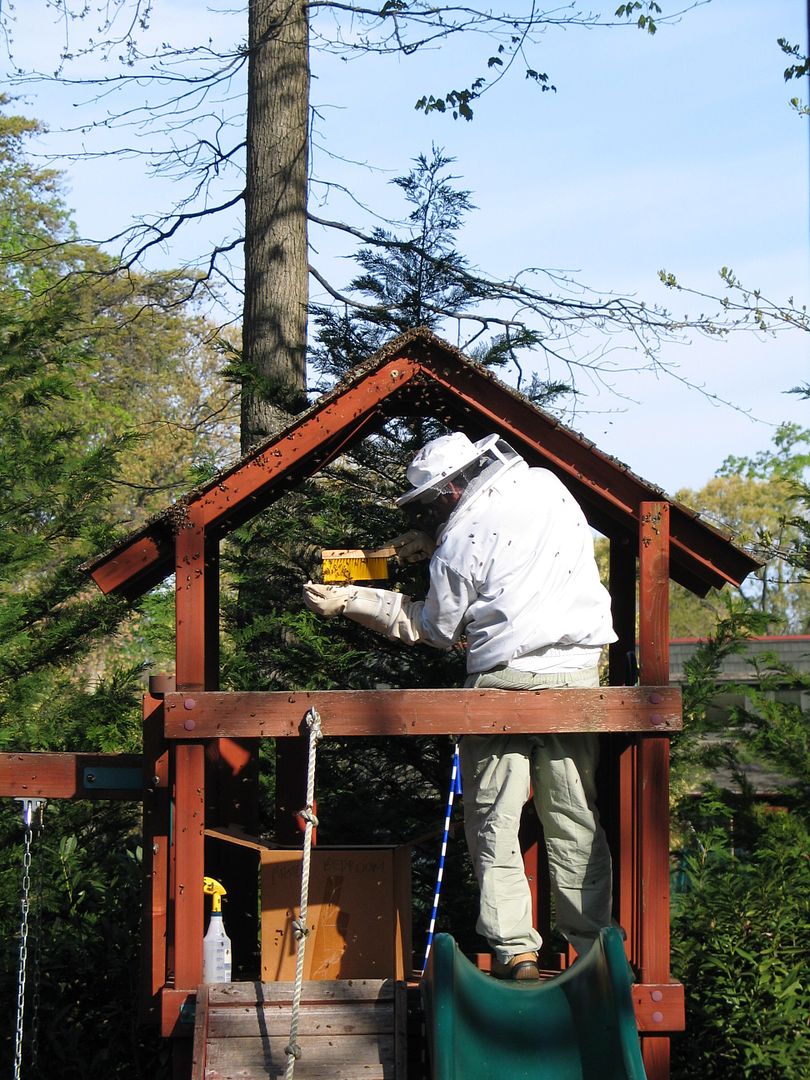 I had cleared the structure (mostly) 5-6 times - so I decided to smoke it a little and see if they would move down to the box: 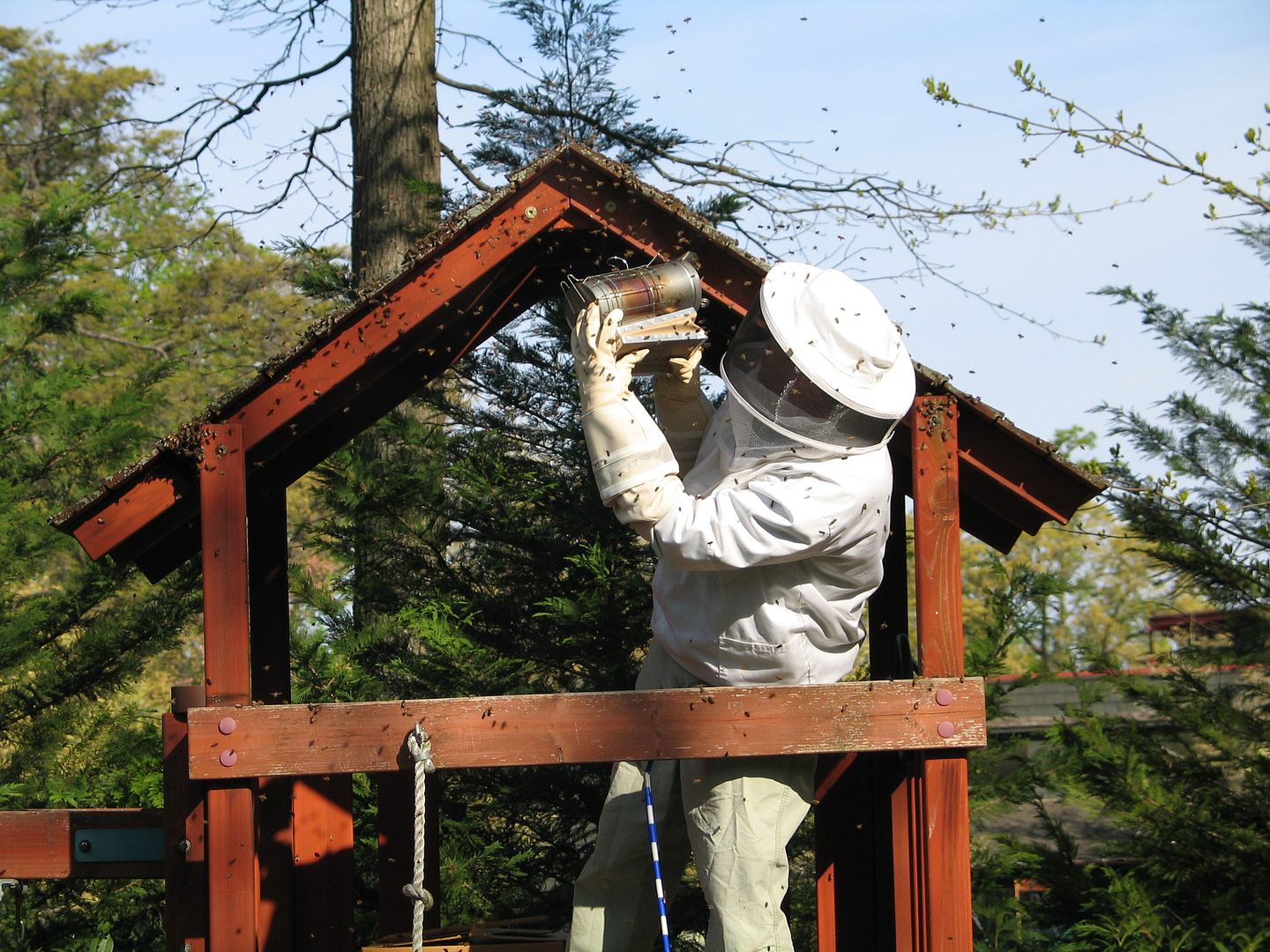 After smoking a few times to conceal the former queen pheromone - I notice that hundreds were marching dutifully up the side of the box to enter. 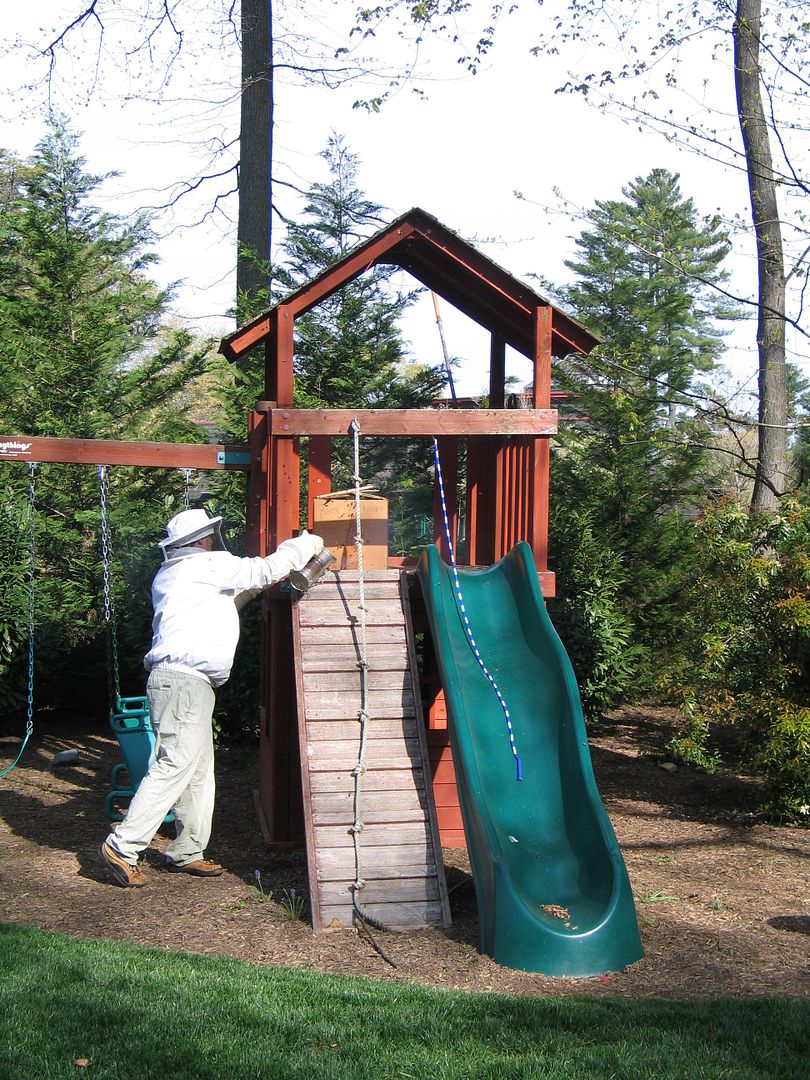 So I gave them 3-4 minutes - then lightly smoked the ramp and floor.... and they kept moving into the box. Lather... repeat. After 20 minutes of that - it looked like 98% of the live ones were in the box - and none were leaving. Time to tape it closed: 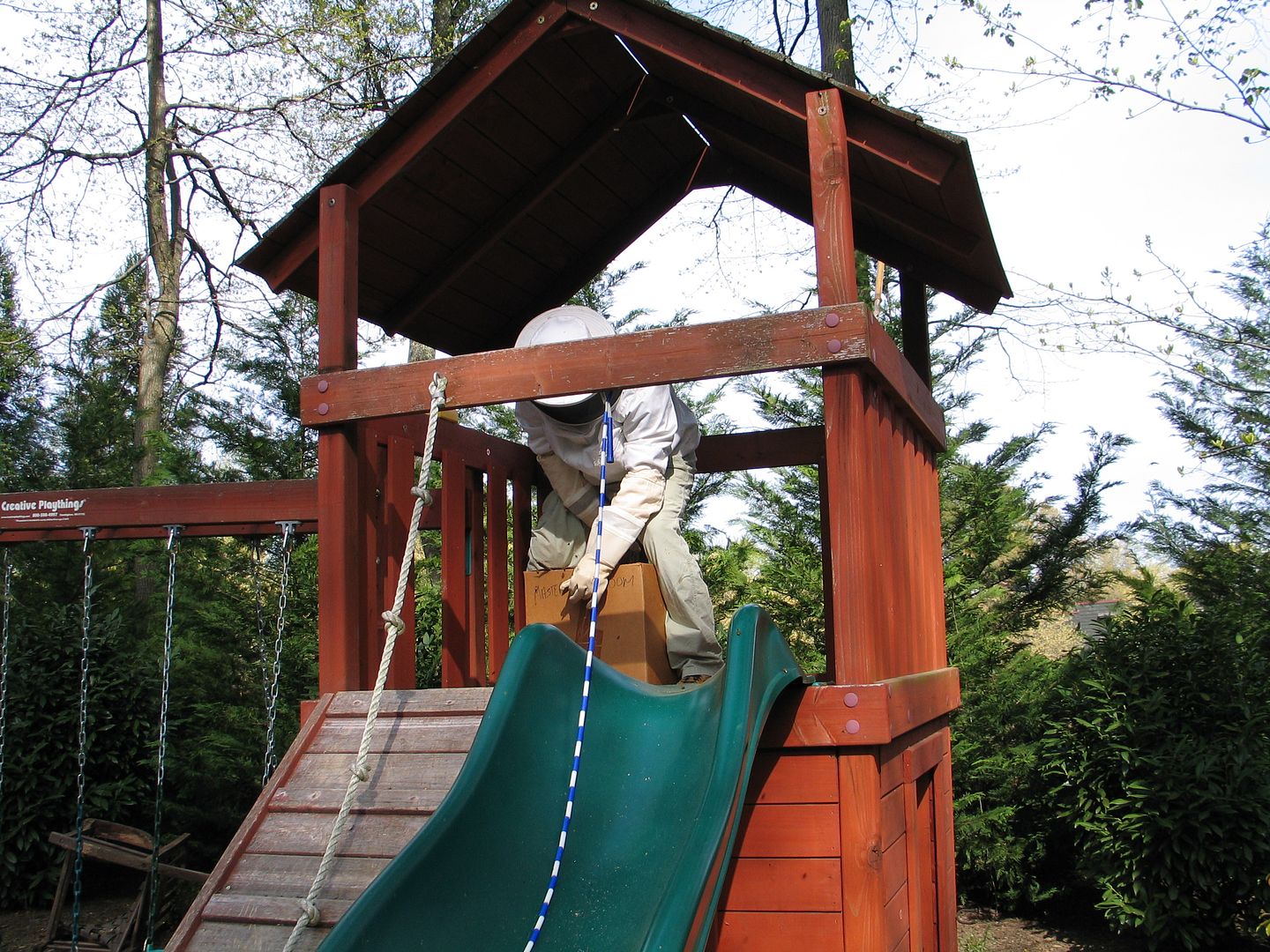 Done! 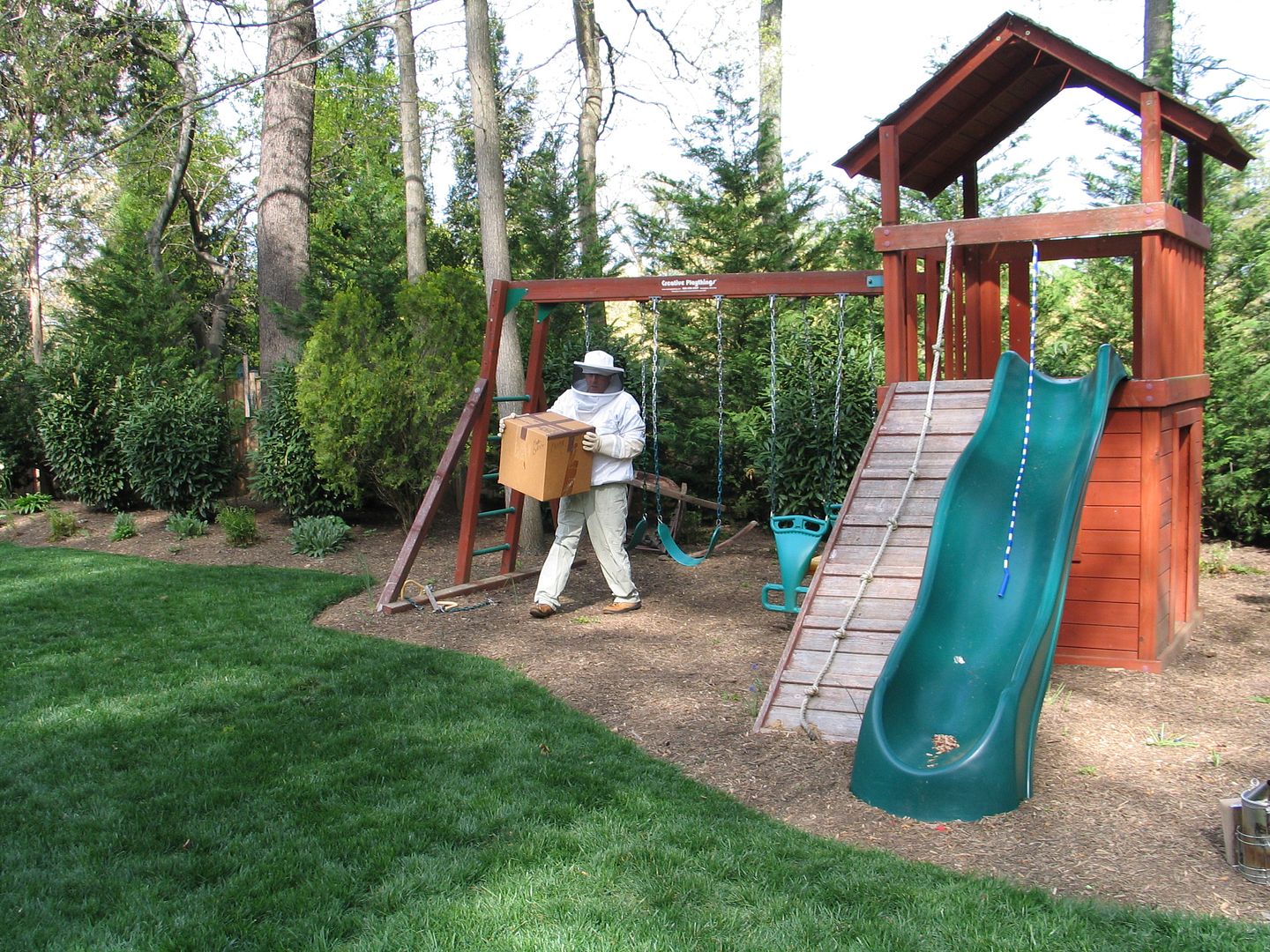 I told the homeowner that some would remain - but probably either die with 24 hours or drift back to the original hive. When I took my gloves off - there were roughly two dozen stingers embedded in the leather.  And that is the swarm capture! Lessons learned: 1. Come prepared. Think through what you may need. You never know quite what you will find. 2. While I didn't tape my pants closed and didn't have a problem - it was careless not too. Hundreds of bees at your feet is like playing bee sting roulette. Tucking pant legs into socks would work. 3. I baited the cardboard box with lemongrass oil. I have no idea how effective it was. 4. Mind your jacket/shirt at the belt line while you are stretching and twisting. I had a bare back a few times and had to leave, carefully peel of the jacket with a few dozen bees on it - and tuck everything back in place. There were several hundred bees in the air... so errors can have real consequences. 5. Make sure you have a hive body and extra super/frames ready BEFORE you get the call. There is no time for getting these tegether when you get the call. 6. If you are off the ground - keep your body position and security as your #1 priority. Several stings can cause you to react and lose your balance. Hope this was educational! |
|
Quoted: Love this thread. CWO, were you ever able to identify the queen while boxing the swarm? Seems like the box was a great way to go. I never saw her. She apparently went in with one of the large clumps of bees I was able to dislodge. This was a large swarm - and there were just too many bees to sort through. I'll give her a few days and then check for eggs in her hive. A quick check yesterday showed everything looking as it should. Glad folks like it. That gives me motivation to keep building the thread with new topics. |
| CWO, I noticed that you mentioned earlier in this thread that each one of the frames is a hive. So I guess I am confused because you start with five frames with bees and five empty frames and then you want the bees to fill the empty frames. So does each frame have a queen? and if so, where do the queens come from for the 5 empty frames? Also, if there are multiple queens within each box, dont the bees fight each other to defend their queen? |
|
Quoted: CWO, I noticed that you mentioned earlier in this thread that each one of the frames is a hive. So I guess I am confused because you start with five frames with bees and five empty frames and then you want the bees to fill the empty frames. So does each frame have a queen? and if so, where do the queens come from for the 5 empty frames? Also, if there are multiple queens within each box, dont the bees fight each other to defend their queen? A hive in this case is 10 vertical frames per box. The next box stacked on top has 10 more frames. A hive only has a single queen - regardless of how many frames are in it. 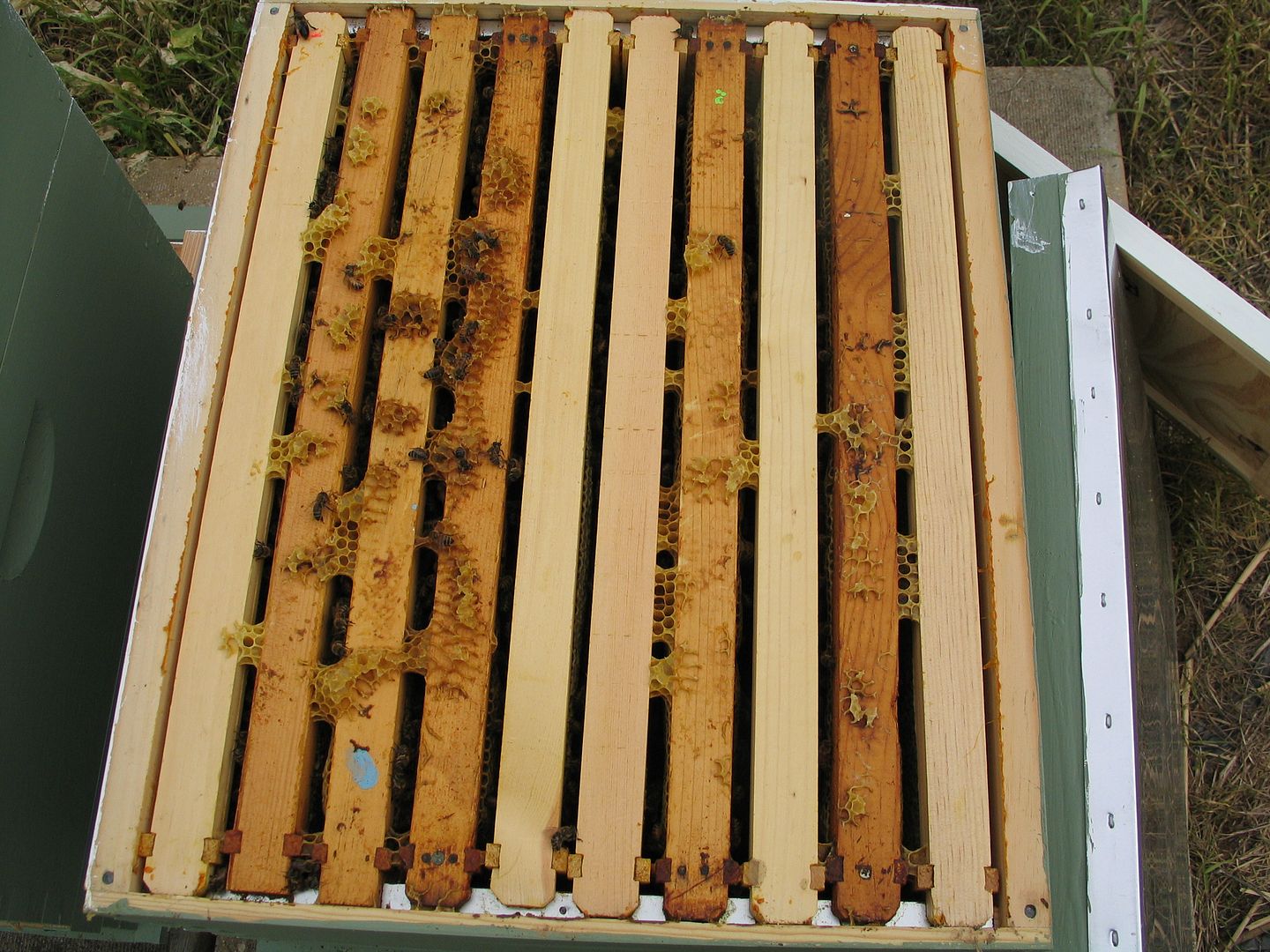 In the example at the beginning of the thread - a 5 frame "Nuc" comes with a queen, bees , and frames of brood, eggs and honey to give bees a quicker start. Those 5 Nuc frames are added to a hive body with 5 more empty, undrawn (no comb) frames. As the colony expands - more frames are stacked. But the hive is based around a single queen. Hope this clears it up for you. |
|
Quoted:
I received a call that a swarm was in a residential backyard and available for the asking. I was told they were on the arch of a children's play set. So Sunday morning I loaded up some items to collect them. When I arrived they looked like this: http://i3.photobucket.com/albums/y91/Eyesofsilver/Beekeeping/2012/Swarm%20Collection%20April%202012/IMG_5589.jpg http://i3.photobucket.com/albums/y91/Eyesofsilver/Beekeeping/2012/Swarm%20Collection%20April%202012/IMG_5590.jpg They were wrapped under and inside the roof arch: http://i3.photobucket.com/albums/y91/Eyesofsilver/Beekeeping/2012/Swarm%20Collection%20April%202012/IMG_5591.jpg http://i3.photobucket.com/albums/y91/Eyesofsilver/Beekeeping/2012/Swarm%20Collection%20April%202012/IMG_5592.jpg So while I considered how to collect them - something caught my eye in the backyard next door. A beehive with 5 mediums on it! I asked the neighbor what the deal was - and she said that the neighbor permitted a University beekeeping program to place the hive there. The swarm had been on the play set for 2+ days - and when the students responded to the swarm call - I'm told they had no idea what to do - so they poured honey on the fence (as if that would work). Then they left.
Well - their loss - my gain. The homeowner wanted them preserved - but gone. They were now on her property. I had brought a deep nuc, one hive body and a big cardboard box. I decided to use the latter. It was certainly lighter to deal with - and an easier target to drop bees into. I considered whether to wear gloves ( I don't use them for beekeeping) - and since I was going to have to scrape them off a structure - decided to start with the safer approach. That turned out to be a VERY good decision. So I took the box up on the platform and started gently exploring. The spray is sugar water. http://i3.photobucket.com/albums/y91/Eyesofsilver/Beekeeping/2012/Swarm%20Collection%20April%202012/IMG_5594.jpg http://i3.photobucket.com/albums/y91/Eyesofsilver/Beekeeping/2012/Swarm%20Collection%20April%202012/IMG_5595.jpg I got a big handful of bees and dumped them in the box: http://i3.photobucket.com/albums/y91/Eyesofsilver/Beekeeping/2012/Swarm%20Collection%20April%202012/IMG_5596.jpg Then I got smart(er) and moved the box closer to the swarm: http://i3.photobucket.com/albums/y91/Eyesofsilver/Beekeeping/2012/Swarm%20Collection%20April%202012/IMG_5597.jpg Then I started to gently scrape them off the structure with a cardboard scoop: http://i3.photobucket.com/albums/y91/Eyesofsilver/Beekeeping/2012/Swarm%20Collection%20April%202012/IMG_5598.jpg One a big pile of bees fell into the box with a THUD - a lot of them were in the air: http://i3.photobucket.com/albums/y91/Eyesofsilver/Beekeeping/2012/Swarm%20Collection%20April%202012/IMG_5599.jpg More scraping/scooping: http://i3.photobucket.com/albums/y91/Eyesofsilver/Beekeeping/2012/Swarm%20Collection%20April%202012/IMG_5601.jpg http://i3.photobucket.com/albums/y91/Eyesofsilver/Beekeeping/2012/Swarm%20Collection%20April%202012/IMG_5604.jpg Now there were a lot of them in the air: http://i3.photobucket.com/albums/y91/Eyesofsilver/Beekeeping/2012/Swarm%20Collection%20April%202012/IMG_5606.jpg They were 2-3" thick on the roof too - so I scooped them off of there too. All the while I was conscious of the old saying "The greatest chance of getting hurt in collecting a swarm is falling off whatever you are on". There were 50-100 bees on my side of the railing at any time - so leaning against it was likely to result in a LOT of stings through clothing. Every scoop that went in the box - probably half of them rose up in a cloud to get back to the queen scent. This made it unclear at any moment whether the queen was in the box - or still on the structure. Those in the air moved back to the peak. Inspecting for a queen: http://i3.photobucket.com/albums/y91/Eyesofsilver/Beekeeping/2012/Swarm%20Collection%20April%202012/IMG_5613.jpg http://i3.photobucket.com/albums/y91/Eyesofsilver/Beekeeping/2012/Swarm%20Collection%20April%202012/IMG_5618.jpg I had cleared the structure (mostly) 5-6 times - so I decided to smoke it a little and see if they would move down to the box: http://i3.photobucket.com/albums/y91/Eyesofsilver/Beekeeping/2012/Swarm%20Collection%20April%202012/IMG_5624.jpg After smoking a few times to conceal the former queen pheromone - I notice that hundreds were marching dutifully up the side of the box to enter. http://i3.photobucket.com/albums/y91/Eyesofsilver/Beekeeping/2012/Swarm%20Collection%20April%202012/IMG_5627.jpg So I gave them 3-4 minutes - then lightly smoked the ramp and floor.... and they kept moving into the box. Lather... repeat. After 20 minutes of that - it looked like 98% of the live ones were in the box - and none were leaving. Time to tape it closed: http://i3.photobucket.com/albums/y91/Eyesofsilver/Beekeeping/2012/Swarm%20Collection%20April%202012/IMG_5633.jpg Done! http://i3.photobucket.com/albums/y91/Eyesofsilver/Beekeeping/2012/Swarm%20Collection%20April%202012/IMG_5636.jpg I told the homeowner that some would remain - but probably either die with 24 hours or drift back to the original hive. When I took my gloves off - there were roughly two dozen stingers embedded in the leather.
And that is the swarm capture! Lessons learned: 1. Come prepared. Think through what you may need. You never know quite what you will find. 2. While I didn't tape my pants closed and didn't have a problem - it was careless not too. Hundreds of bees at your feet is like playing bee sting roulette. Tucking pant legs into socks would work. 3. I baited the cardboard box with lemongrass oil. I have no idea how effective it was. 4. Mind your jacket/shirt at the belt line while you are stretching and twisting. I had a bare back a few times and had to leave, carefully peel of the jacket with a few dozen bees on it - and tuck everything back in place. There were several hundred bees in the air... so errors can have real consequences. 5. Make sure you have a hive body and extra super/frames ready BEFORE you get the call. There is no time for getting these tegether when you get the call. 6. If you are off the ground - keep your body position and security as your #1 priority. Several stings can cause you to react and lose your balance. Hope this was educational! Fantastic pics, and an A-#1 job collecting that swarm. High Five from this beekeeper. And honestly, I think a big cardboard box is the best thing to collect a swarm unless you make a special screened container just for that (my beekeeping mentor has a little "suitcase" made of wood and screen wire that works fantastically well for swarm capture). I've used a box a few times and it worked great. |
|
Quoted:
Can we get some picks of honey harvesting, methods and containers. Good thread, makes me want some bees There are a few pics of the extracting process in the tacked thread at the top of the forum, but I don't remember the page. Probably not too long after the first of the thread. It was a while back. |
|
CWO I have an oddball question: During the honey jarring/canning process, we would always save a few wide mouth jars to stuff full of unspun honeycomb (honeycomb that didn't see the centrifuge) as well as honey as treats for kids. Do you have any idea if the introduction of wax to a jar of honey would limit the shelf life of the honey? I'm guessing no, but I've always been curious. |
|
Quoted: CWO I have an oddball question: During the honey jarring/canning process, we would always save a few wide mouth jars to stuff full of unspun honeycomb (honeycomb that didn't see the centrifuge) as well as honey as treats for kids. Do you have any idea if the introduction of wax to a jar of honey would limit the shelf life of the honey? I'm guessing no, but I've always been curious. I can't think of a reason why clean comb would shorten the shelf life of jar honey. |