


Posted: 8/12/2026 9:39:21 AM EDT
[Last Edit: lefty-weaver-g19][Edited]
|
I wrote this little song intro. Here are the chords being used. Bm (add 9) B (add #9) Bm (add9) B (add#9) A (add 11) G B (add #9) A (add 11) G B (add #9) A (add 11) G Bm (add 11) Those chords could be interpreted in other ways but this is what I came up with. I just created something that gave me the sound I wanted then analyzed it and moved a few notes within the chords to come up with the final piece. I then improvised using the B minor scale. I improvised a few different ideas and picked the parts I liked then recorded that. I’m tuned like a baritone B E A D F# B I wanted a dark type intro for a metal song. My question is do you have any suggestions for another mode to use for the lead guitar other than the B minor I’m using or even use something different over just certain chords? I’m happy with what I have but like to experiment. Here is the recording. https://streamable.com/5x9bee |

|
I only had a minute to sound this out and I've got spindles running so it is loud as hell in here, but here is a quick take: You're flirting with F# Phrygian (same notes as Bm or D) but you have to be careful with that D sharp (natural sixth) since you are pulling away from the minor character of your mode. You could also play with the flat fifth to pull it into Locrian, and you'll have an easier time doing that over your arpeggios than you would full voiced chords. Personally I would ditch the modal interchange and stick to F# Phrygian or Locrian, and re-harmonize your chord progression through that lens. Incidentally, the chord names you use don't immediately make sense to me as I'm not hearing the notes in some of them but that may be my current listening environment. |
|
Thank you for taking the time to offer input. I'll share the actual arpeggio fingerings and my thought process as to how I arrived at this. Right or wrong I think how I got here could help. I often think in terms of the minor scale and then while primarily working within the minor scale add in some notes. Sometimes to create tension and sometimes just adding in a passing tone to create a chromatic segment within the minor scale. My favorites to add in are the b2 and the b5 the tension they create is something I like and adds to the darkness effect I look for in my style of music. My understanding is that if I change the 2 to b2 and the 5 to b5 in the B minor scale I'm actually using the B locrian mode. The way I'm usually using the b2 and the b5 though is just in spots and often resolves to the 2, 5, or root and often I put the b2 in addition to the 2 to create that chromaticism from the 1, b2, and 2. In this particular piece I was playing around using as many open strings as I could throughout all the chords in the piece. Even sometimes having that half step interval in other places creating that tension. First arpeggio shape I'm starting right off with B minor but adding in the b9 or how I looked at was the same as the b2 from phrygian. 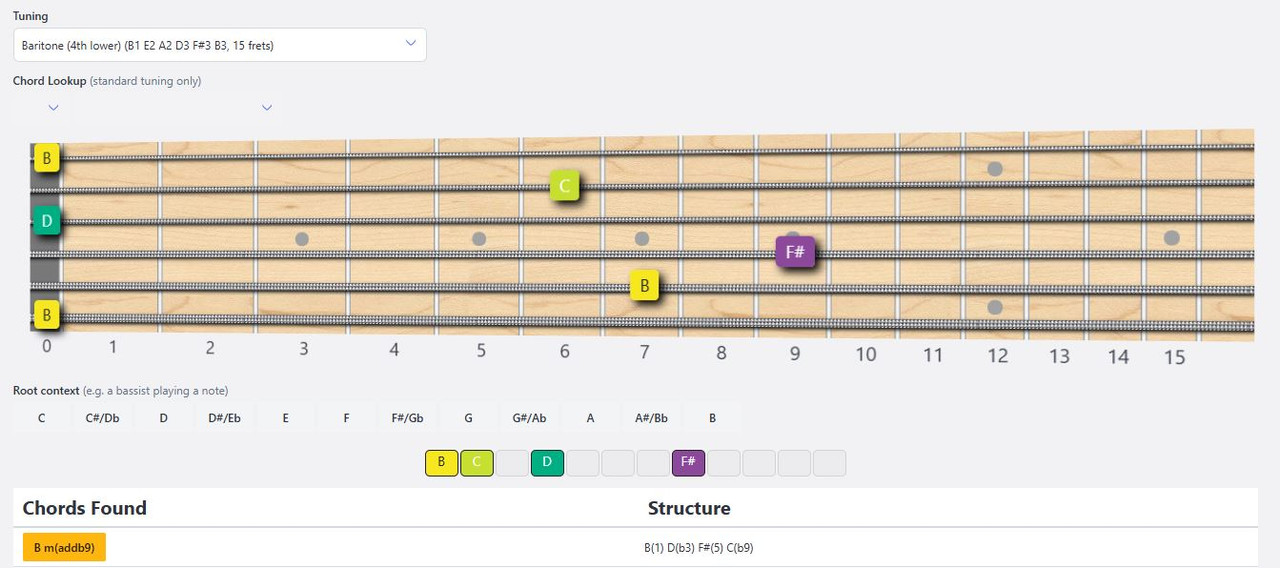 Second arpeggio shape I use that majorr 3rd that would seem to give a happier feel from the 1st chord, but I throw in that half step tension with the #9 or C## 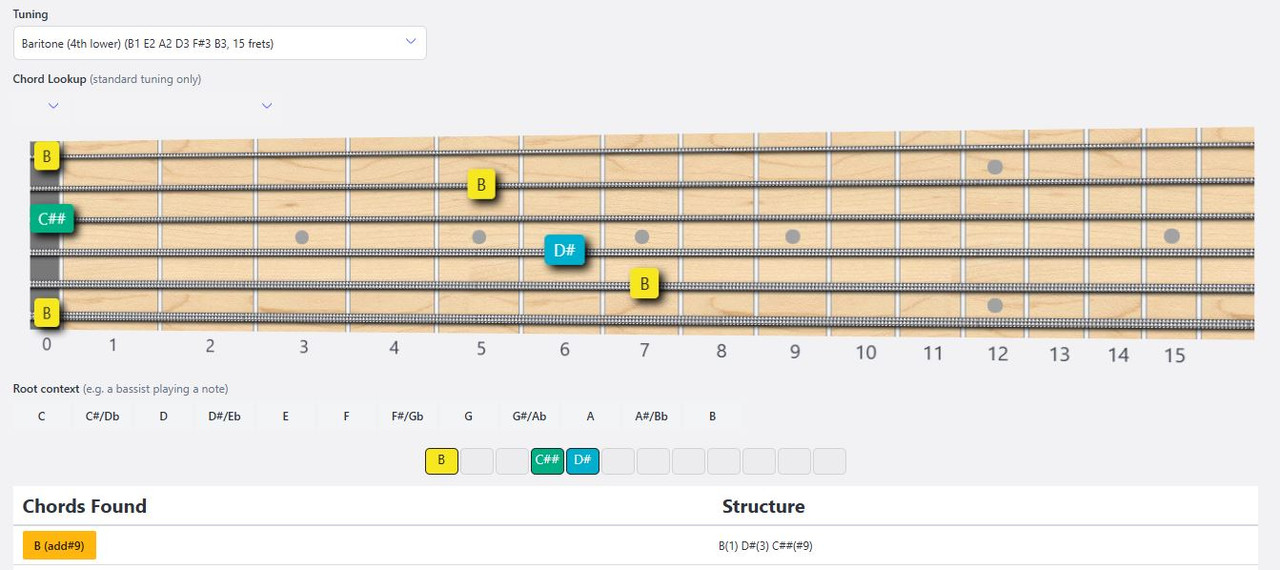 Since I looked at it as B minor with the added notes even with the major 3rd in the second chord I chose to start with B natural minor. Within a few takes improvising I had ideas I liked so then a few more takes putting those ideas together to get smoother I recorded what I have in the op. It worked well to my ears, but I was curious about if I should try another mode like the B locrian over the same arpeggios I have. I can certainly experiment with looking at it through the lens you recommended and experiment. |
|
Personally, I would stick to diatonics in the chord progression and leave the accidentals/chromatics to the melody. This is one of those "you can't break this rule until you understand why you are breaking the rule" things that I honestly rarely stray from even after all these years. You have the right idea of using the bass drone to ground the listeners ear as you play with modes (especially if you generally think of shapes instead of individual notes on the neck - I am a shapes and intervals guy myself and have horrible fretboard note location memory). By starting there you can begin to train your ear to create tension and resolution that gives the song deliberate movement. This also allows you to start chord leading with your solos which will make them much more interesting to listen to. Once you are comfortable there, then move on to things like borrowed chords and secondary dominants before moving to anything that requires you to double sharp or flat something LOL. There is a reason the m7/b5 is used in jazz more than the fully diminished chord! Some harmonizations are just hard to get a handle on. Is there a dark metal version of the ii/V/I progression in jazz? |
|
I’m listening to what you are saying just understand I have zero interest in using the same chord progressions every jazz or blues jam follows. I like to experiment with unusual sounds and let my ear be the guide to determine if I’m achieving the sound I have in my head. I know the basic major/minor scale shapes and basic open and barre chord shapes. I generally think in terms of notes and intervals though rather than follow commonly used shapes. I love intentionally using dissonance to build tension. I also like to emphasize off beats in my heavy riffs and use lots of syncopation. It’s not going to appeal to the masses but a local metal drummer has taken notice. He wants to work with me and even bought a peavey 5150 half stack so I can jam with him. I’ve only been playing about 8 months now and already wrote a complete album. All guitars are me but other instruments I programmed with midi. I wrote the lyrics but my cvocsls are AI enhanced. Requiem Earth complete album |
|
You completely misread me. I was asking if there is something already established within your genre with which you can ground yourself in the same way the simple standards and ii/V/I work for jazz so you can intentionally learn and improve. I'm not telling you to learn jazz. Genres have rules or they wouldn't be genres; it has nothing to do with specifically being jazz/blues/punk/metal/country/etc., per se. If you think you possess some sort of melodic/harmonic genius that can't be constrained by such conventions, then by all means build your own. Start with a bass drone, and a targeted mode (just modify what you posted here for starters). Phrygian or Locrian are what you are looking for to start with. Research the chords in these modes and build your arpeggios (though I would actually start with just whole note chords to get your feet wet). Then, start intentionally using the selected modes to solo over the chords/arpeggios, and learn to chord lead so you can be going somewhere with your note choices. After that start modulating the bass drone to create modal interchange. Rinse and repeat. Once you've got a better sense of movement you can start adding in scales like the melodic minor where the intervals are directionally-dependent. The beauty of understanding music isn't just being able to "play what is in your head." Other than a few rare individuals throughout the ages, composers have always had to understand theory in order to be able to make interesting (even surprising) and engaging music. The greatest shredders aren't great because of BPM, they are great because they can create interesting movement in their arrangements, sometimes completely chromatically. One guy can sound like one of Bernth's picking exercises and the other guy sounds like Eruption. I honestly hope this helps. |
|
You are correct I misunderstood your comment. No I do not think I’m a creative genius I just love creating and really have zero interest in playing covers. My work flow is to think of an idea in my head while I’m at work, in the gym, or what ever. Then try to find that idea on the guitar. Sometimes it comes right out, sometimes it leads me in a different direction, and sometimes it just doesn’t work like I thought it would. Once I have a riff I record it and determine what tempo it feels right at. Then I develop a basic drum beat with midi. Once I have a basic drum beat I re-record it to the drum beat. Then I double it and start working on the bass line. From there I determine if I want another guitar to do something different like a melody or what ever. Then I improve the drums. I’m not really putting myself in a genre other that what others would call what I do. There aren’t really rules for death metal or deathcore like there are for blues or jazz and I’m not really interested in following rules. With that said I do study theory to help me understand things that work and how different scales and modes sound due to the intervals they use. I generally just think of how intervals sound and use that to determine what intervals I want to use to get the sounds in my head. Here is something I wrote yesterday. Really simple B5, Bsus2, Bsus4 chord progression. I play a B Phrygian phrase over B5 then B minor over B sus2 and back to B Phrygian over Bsus4. Then I harmonize in 3rds using the scales with another guitar until the final phrase where both guitars play in unison with another guitar hitting only the final note an octave lower. This rings out until I go into a typical palm muted chug pattern. https://streamable.com/en239p |
|
I experimented with some different things but ended up sticking with the B minor scale because it sounded best to my ears and used this for the intro to a complete song I wrote. I then used B Phrygian for the rest of the song which came out well for this genre of music and the sound I wanted. When the heavy guitars kick in it’s at 155 bpm so I’m pretty happy I was able to maintain some sense of groove at that tempo. REQUIEM EARTH *Seven Signs* |
Sorry been away for a bit. This popped up in my feed an I immediately thought of this thread; I like this guy he can really explain these thing very simply. Much beyond my capacity to do so as I just don't exercise these muscles like I did 25 years ago. How Borrowed Chords Work In Minor Keys [Modal Mixture] |
|
Originally Posted By RickFinsta: Sorry been away for a bit. This popped up in my feed an I immediately thought of this thread; I like this guy he can really explain these thing very simply. Much beyond my capacity to do so as I just don't exercise these muscles like I did 25 years ago.  https://www.youtube.com/watch?v=tezgdZTKlwU https://www.youtube.com/watch?v=tezgdZTKlwUThat’s actually close to what I do. When I’m writing riffs, melodies, lead improvs, or what ever I start with minor pentatonic or natural minor and grab some notes from outside those scale intentionally. Once I have something I like or close I’ll analyze what I’m doing and consider what mode I may be using then experiment further using that mode. I find myself liking natural minor with occasional use of the b2 and/or b5 most often. I never use major keys they just don’t give me the sound I want for my genre of music. I intentionally try to do unorthodox things timing wise as well like emphasis the and of a beat or the 3rd beat. It’s not like those things haven’t been done it’s just not typically the way people are taught. I’ve studied theory much longer than I’ve played guitar so I feel comfortable doing things that aren’t normally recommended for beginners. I’m pretty pumped as my physical is starting to catch up with my mental understanding which is opening up things as some stuff I create in my head I can’t physically play yet lol. |