


Posted: 12/7/2025 1:47:20 PM EDT
[Last Edit: madmacs69][Edited]
|
Kind of hard to beat the price... Alvarez 5210 from I believe 1993 Landola J-672 from some time before 1973 Alvarez- Broken neck (separation at the scarf joint due to glue failure) currently under repair. Free; had glue and clamps. Needs tuners - on order $9 Needs nut, saddle, and bridge pins - on order $13 for bone Needs strings - originally came with 12's but going back with 10's cost $3 So all being well $30ish all in Landola Glue has gone at the neck/body joint - so effectively a neck reset needed without the disassembly hassles (looks like the fretboard is holding it together currently) Needs tuners - not sure if I'm going to try and find vintage (it's a cheap guitar) Needs bridge pins The 80yr old previous owner said she bought them both locally in STL where St Louis Music would have originally been the importers I suspect. Technically I think she could probably have convinced Alvarez to replace the 5210 due to the neck failure under its lifetime warranty. For $5 each I get a learning experience if nothing else. Alvarez dealer said likely beyond economic repair (without seeing), which I wouldn't disagree with based on likely labor rates 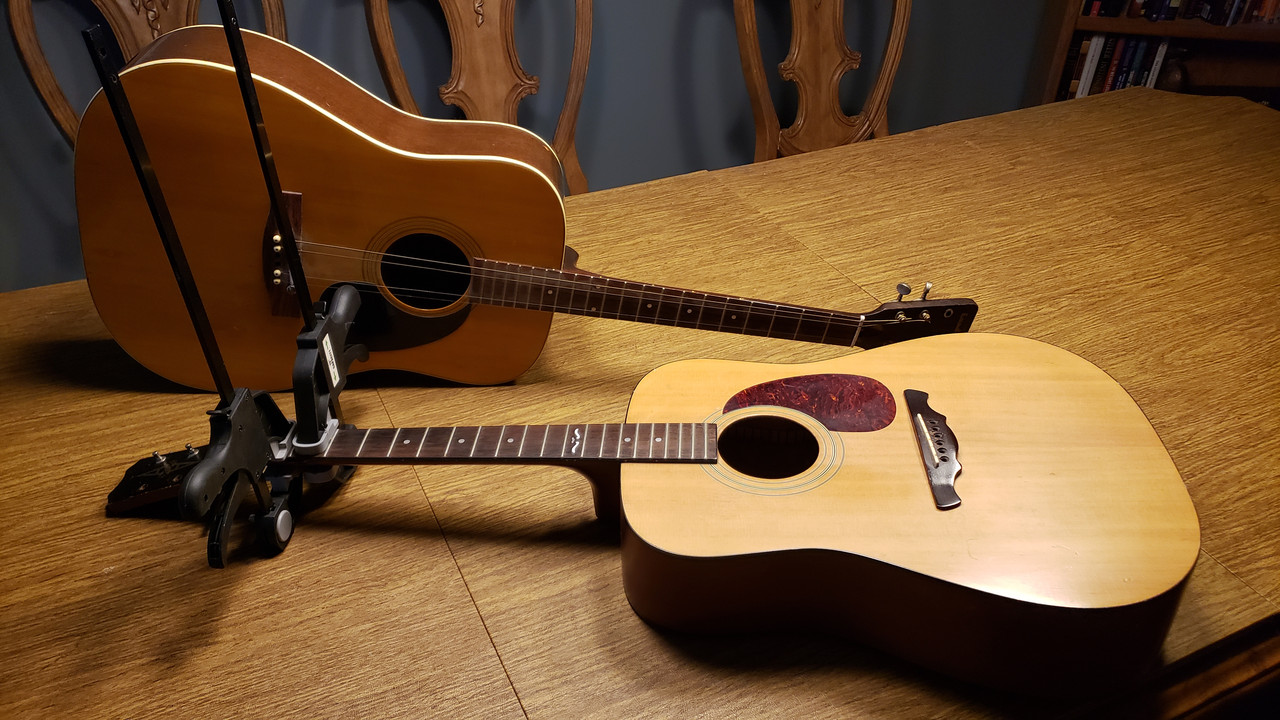
|

|
Kinda feels that way... have a feeling she'll just be glad to see them being put back into usable condition. Neck fix on the Alvarez seems to have gone well, just need parts before it can go much further... did polish the frets and oil the fretboard in the meantime too. Dovetail neck joint on the Landola is apart now, don't have a wood clamp long enough to reglue it... not as though either of them are urgent fixes... sounds like a Christmas project. |
|
Well that was an interesting experience if nothing else. Both now back into playable condition after their necks were repaired, albeit currently sporting super expensive bridge pin retaining devices (gotta love magic tape) due to sending a bridge pin across the room during tuning... I apparently need more practice at changing strings. Fortunately the Alvarez had separated at the scarf joint in the neck and only needed glue to fix it. In order for it to fail the strings would have to pull the head portion of the neck over to top of the fretboard by separating almost the entire fretboard from the neck - from an engineering point of view this isn't going to happen without all of the glue failing. The Landola had separated at the dovetailed neck joint and gluing it seems to have worked well too (it's basically all it had before). Both look as though they were probably failures due to humidity (and age.) At some point they would benefit from new bridge saddles, as a previous owner seems to have tried to cut slots like the nut rather than sanding the bottom of the saddle. One thing I did learn, but should have known, is how much tension the strings put on the neck. I originally strung the early 70's Landola with 13's but it creaked A LOT when tuning... it now has 10's with no creaking. Martin lists 13's as a total tension of 189.6lbs and 10's as a tension of 135.8 lbs 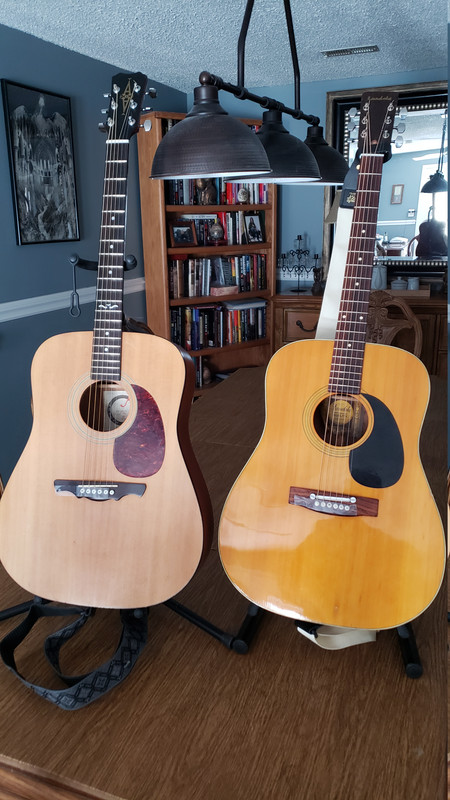
|

|
@madmacs69 Nice save on 2 guitars! There is a trick to keep the bridge pins from flying across the room. Many bridge pins are cut flat on the bottom, 90 degrees to the pin length. The bridge pin should not have any up tension on it at all, when the strings are tuned, the pin is there to keep the ball from moving into the hole, the ball should be against the wood and on the side of the pin. The little ball on the end of the string you stick down the pin hole is supposed to be wedged under the bridge against the guitar top and then when tensioned it catches under the bridge wood. It then transfers vibration energy to the top of the guitar. You will probably notice the guitar top vibrate better. If you have square ended bridge pins, take them out, after loosening the strings of course, and sand the end to a 45 degree angle along the groove assuming you don't have a slotted bridge and you do have slotted pins, which is almost a certainty since your pins come flying out. The 45 degree or so slope will force the string ball off the pin ( because it will not catch on the edge of the pin ) and then tensioned up against the wood instead of being tensioned up against the pin. Here, a pic is worth a thousand words. Attached File |
Mach
Nobody is coming to save us.
.
Nobody is coming to save us.
.