


F-16 intercepts a Robinson R-66 helicopter over Chicago (Page 2 of 2)
|
Originally Posted By TheOtherDave: Are you loitering around the LZ as or taking turns doing runs and keeping coverage with a wingman? Sandy 3 and 4 are primarily covering the helo formation's ingress and egress route ("RESCORT" is the colloquial term) while Sandy 1 and 2 are identifying the survivor and getting them to the actual pickup location. While the pickup is taking place, 1 and 2 are working ordnance as required on the actual LZ. 3 and 4 are providing top cover for 1 and 2 doing their work and focused on the LZ. There's an element of decoy involved, too, as you don't want to fly in a way that gives away the actual pickup location to anyone who may be watching and trying to intervene. It is a complicated dance down low. Fast jets can be effective at the job, but it takes a hell of a lot of practice and proficiency to make it work. |
|
Originally Posted By josepha1: A10 for the brrrrt intercepts. And it's slow. And being slow means it takes a lot longer to launch and complete the intercept. When the CAS alert out of Bagram switched from A-10s to F-15Es in 2007, there was a wonderful month or so where the Taliban and other ACM's were caught off guard by how quickly the Eagles could get on station delivering ordnance compared to how long it had taken the Hogs to get there. They had observers at Bagram who were able to relay the time the CAS alert jets took off, and they knew to the minute how long it took the A-10s to get to wherever the TIC was. Several of the units we supported relayed that the ACMs were totally caught off guard by how fast the Eagles got there and the balance of the engagements changed almost instantly. Here's a video I took in mid 2007 at Bagram of a real-world CAS alert launch. Watch for the ramp sweeper to nearly run over one of the WSOs running out to the jets during the scramble. 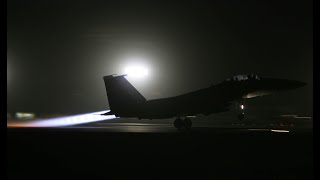 492FS F-15E CAS Scramble, Afghanistan 2007 |


|
Originally Posted By MudEagle: And being slow means it takes a lot longer to launch and complete the intercept. When the CAS alert out of Bagram switched from A-10s to F-15Es in 2007, there was a wonderful month or so where the Taliban and other ACM's were caught off guard by how quickly the Eagles could get on station delivering ordnance compared to how long it had taken the Hogs to get there. They had observers at Bagram who were able to relay the time the CAS alert jets took off, and they knew to the minute how long it took the A-10s to get to wherever the TIC was. Several of the units we supported relayed that the ACMs were totally caught off guard by how fast the Eagles got there and the balance of the engagements changed almost instantly. Here's a video I took in mid 2007 at Bagram of a real-world CAS alert launch. Watch for the ramp sweeper to nearly run over one of the WSOs running out to the jets during the scramble.  https://www.youtube.com/watch?v=ZEK9RKNsfQU https://www.youtube.com/watch?v=ZEK9RKNsfQUThat's freaking awesome. Today I learned the F-15 intakes are articulated. 
|

|
Originally Posted By MudEagle: The "on the brink of stalling" guy needs to look into high-AOA maneuvering in 4th Gen fighters, lol. Jets with leading edge slats and the power that a Block 40 or 50 Viper has don't stall like a general aviation aircraft. You can be down at sub-50 knots of airspeed well past stall AOA and still control the jet to Commercial PTS standards of heading/altitude/airspeed. I could do that in the F-15E, and the Eagle doesn't even have leading edge lift devices like a Viper or Hornet. That being said, helo intercepts are tough enough when you're intending to shoot 'em down. Having to do interception signals and close escort them is a big challenge. In the Strike for a short period we were qualified to do the SANDY mission, and the SANDY 3 and SANDY 4 roles are armed escort for the helo rescue package. The F-15E has to stay fast -- at least 350 knots -- when down low to stay maneuverable against MANPADS and other threats, and the speed differential with the rescue helos is substantial. That was one of the toughest mission checkrides I've ever taken due to that. Not trying to be a smartass here, but what would you do if the helo pilot pulled up into a hover? |

|
Originally Posted By ComfortablyDumb: Not trying to be a smartass here, but what would you do if the helo pilot pulled up into a hover? Originally Posted By ComfortablyDumb: Originally Posted By MudEagle: The "on the brink of stalling" guy needs to look into high-AOA maneuvering in 4th Gen fighters, lol. Jets with leading edge slats and the power that a Block 40 or 50 Viper has don't stall like a general aviation aircraft. You can be down at sub-50 knots of airspeed well past stall AOA and still control the jet to Commercial PTS standards of heading/altitude/airspeed. I could do that in the F-15E, and the Eagle doesn't even have leading edge lift devices like a Viper or Hornet. That being said, helo intercepts are tough enough when you're intending to shoot 'em down. Having to do interception signals and close escort them is a big challenge. In the Strike for a short period we were qualified to do the SANDY mission, and the SANDY 3 and SANDY 4 roles are armed escort for the helo rescue package. The F-15E has to stay fast -- at least 350 knots -- when down low to stay maneuverable against MANPADS and other threats, and the speed differential with the rescue helos is substantial. That was one of the toughest mission checkrides I've ever taken due to that. Not trying to be a smartass here, but what would you do if the helo pilot pulled up into a hover? In before someone suggests Ospreys. Keep in mind it isn't 1v1. They probably trade coverage with the wingman. Cover and Move. |


|
Originally Posted By Never_A_Wick: Well. R44s are gay.  In all seriousness I am a full scale plank flyer and have I only flown RC helicopters but I think you’re right. There are a lot of them out there and a lot of students flying them. Mast bumping problems and inertia decay due to bad collective management seem to be the major issues…. But are things that can be trained out. Plank, as in flying wing? Or plane flyer? Robinsons aren’t just used for training because they are cost effective, they do it because if you can learn to fly one, it’s easy to transition to pretty much any other helicopter . They are twitchy, underpowered, and as you mention they don’t have a ton of rotor inertia-that forces you to be smart about where and how high you fly, but the autos themselves aren’t scary if you are doing the right things before you need to come down-you just operate under the premis that you can only make it to what’s under your instrument panel if you have an in flight failure or emergency. For me, switching to an oddball part 103 coaxial helicopter with no transition training after 15 hours in an R22 was pretty straightforward. I haven’t flown an R44, it’s another $150 an hour over the 22. |
Never make another person a priority when they merely see you as an option...
"Some People Are Like Slinkies. They're Not Really Good For Anything, But They Bring a Smile To Your Face When Pushed Down The Stairs."
"Some People Are Like Slinkies. They're Not Really Good For Anything, But They Bring a Smile To Your Face When Pushed Down The Stairs."
|
Originally Posted By broken_reticle: I'm not saying they ain't gay. However, I have seen a number owned by people with more money than common sense, talent or skill. That’s probably fair. |
Never make another person a priority when they merely see you as an option...
"Some People Are Like Slinkies. They're Not Really Good For Anything, But They Bring a Smile To Your Face When Pushed Down The Stairs."
"Some People Are Like Slinkies. They're Not Really Good For Anything, But They Bring a Smile To Your Face When Pushed Down The Stairs."
|
Originally Posted By MudEagle: Sandy 3 and 4 are primarily covering the helo formation's ingress and egress route ("RESCORT" is the colloquial term) while Sandy 1 and 2 are identifying the survivor and getting them to the actual pickup location. While the pickup is taking place, 1 and 2 are working ordnance as required on the actual LZ. 3 and 4 are providing top cover for 1 and 2 doing their work and focused on the LZ. There's an element of decoy involved, too, as you don't want to fly in a way that gives away the actual pickup location to anyone who may be watching and trying to intervene. It is a complicated dance down low. Fast jets can be effective at the job, but it takes a hell of a lot of practice and proficiency to make it work. Are there any issues with conflicting rotor wash or wake turbulence from the jets or is that part of mission planning? |
Never make another person a priority when they merely see you as an option...
"Some People Are Like Slinkies. They're Not Really Good For Anything, But They Bring a Smile To Your Face When Pushed Down The Stairs."
"Some People Are Like Slinkies. They're Not Really Good For Anything, But They Bring a Smile To Your Face When Pushed Down The Stairs."
| Chicago is pretty much lawless these days. Does not surprise me in the least that tons of “pilots” ignore rules up there. The prevailing Chicago attitude is “I know it all, you can’t tell me shit. I don’t read anything anyway.” |
Trust me, I used to be with the Government
F-16 intercepts a Robinson R-66 helicopter over Chicago (Page 2 of 2)
Join the Community
Your next conversation starts here.
Create your free account to join discussions, share your experience, save topics, and connect with the AR15.COM community.
- Join discussions
- Follow topics and replies
- Connect with fellow enthusiasts
Already a member? Sign in
Stay informed by subscribing to our Newsletter