


Posted: 10/14/2024 1:51:11 PM EDT
|
I'm looking to get a drum sander. Primarily due to figured woods that chip out while planning. I think a 12" would be big enough. I would prefer a closed end model. I expect it would be more rigid thus accurate. I see Grizzly and shop fox both make one, approx $300 difference between the two altho they are one and the same outfit. Can't tell what the difference is. Grizzly G0459 and Shop Fox W1740. Some reviews have mentioned the plastic gears and rubber parts that fail on these. Also I see Baileigh makes a 17" one that is considerable more. SD-174. I have one grizzly item in my shop and its quality is poor at best. It had plastic gears in it that failed. Would rather stay away from them if possible. Anyone have any experience with Baileigh stuff? I guess I'd be happier in the end paying more and getting a better product plus a couple of inches more width tho I really don't need it. any words of wisdom here? |

|
Go for the open ended, you will be surprised how useful this can be. Also, IMHO, but bigger than you think you need. These are heave and expensive machines. Buy once and cry once. A good one will lat your lifetime. From a brand perspective, I chose a SuperMax single drum. Other than learning the proper way to load the paper, I have had zero issues. |
Joined:
Jul 2023
Posts:
523
EE: 0% (0)
 MS, USA
|
Originally Posted By DirtyDirk: if your running a max. width board how accurate is the thickness from side to side? Which is exactly WHY you don't want to screw with any of the open ended crap... If you are only taking very, very fine bites then you might be ok for a good while but you will be forever in getting there and keeping any precision (not to mention killing those china bearings if you you try to crank down hard for any long periods of actual use). I would personally opt for a smaller closed end drum sander over a slightly wider open end version if the costs were the similar if I could help it. For precision AND for durability reasons. Would not rule out buying used machines either if you might be able to get a slightly better machine for the same cost as a lesser model that is brand new and still in the box... Better tool can tend to last a lot longer.  |
|
Originally Posted By Aaron56: Which is exactly WHY you don't want to screw with any of the open ended crap... If you are only taking very, very fine bites then you might be ok for a good while but you will be forever in getting there and keeping any precision (not to mention killing those china bearings if you you try to crank down hard for any long periods of actual use). I would personally opt for a smaller closed end drum sander over a slightly wider open end version if the costs were the similar if I could help it. For precision AND for durability reasons. Would not rule out buying used machines either if you might be able to get a slightly better machine for the same cost as a lesser model that is brand new and still in the box... Better tool can tend to last a lot longer. my thoughts pretty much too. the feeling of getting a "deal" on a machine, especially new doesn't last long when the lack of quality rears its ugly head. |
|
Originally Posted By Aaron56: Which is exactly WHY you don't want to screw with any of the open ended crap... If you are only taking very, very fine bites then you might be ok for a good while but you will be forever in getting there and keeping any precision (not to mention killing those china bearings if you you try to crank down hard for any long periods of actual use). I would personally opt for a smaller closed end drum sander over a slightly wider open end version if the costs were the similar if I could help it. For precision AND for durability reasons. Would not rule out buying used machines either if you might be able to get a slightly better machine for the same cost as a lesser model that is brand new and still in the box... Better tool can tend to last a lot longer. Agreed. I had one of the original 16-32 models. It was a pain in the ass to keep the drum parallel to the table. It also began eating belts. After letting it sit for a year or so, I sold it off to someone else to fight with. Recently had to sand a 26" wide, figured Bubinga slab and did it by hand with belt sander. It was pretty flat, so it was just smoothing it. Had it needed to be flattened, I would have bought linear actuators off Amazon and made a flattening jig with a heavy router. You can get a pretty smooth surface with a dedicated surfacing router bit |
|
Just replaced a Grizzley with a Supermax, night and day difference in quality. Nothing wrong with open end models, when you actually try and move it you'll understand why and how they hold parallel. I think the carriage is 3/8 steel. Even the Grizzley was heavy but nothing like the Supermax. Also look at motor specs, these things draw immense power under load and a quality motor will handle it far superior to the cheap Chineseium motors Grizzley uses on their lower end models. If you want a closed end model go with something 25" or greater so you can run wider stock through it in the future when you grow your shop to that size. As far as the learning curve for a drum sander, keep it as close the it's breaker as you can to reduce voltage drop. Clean the abrasive after every pass, change the abrasive regularly during use. There's a reason why they sell it in 100' rolls, you'll go through those rolls very quickly if you are using the sander regularly. Take lots of very thin passes versus trying to take deeper passes. Expect some burning, you still need to sand it out with an orbital sander. |


Member
Joined:
Jun 2022
Posts:
7857
EE: 100% (31)
FL, USA

|
Originally Posted By Curmudgeon762: I have a Jet open ended one and so far no issues…. Same here. 16/32. It might be my favorite tool in the shop... I do a lot of stuff with thin wood and it's indispensable. Only problem I've had with it is a dirt dauber building a nest on one of the motor cooling fan blades. I was about ready to replace the drum thinking it had gone out of round somehow before I finally figured out where the vibration was coming from. Don't forget dust collection if you're not already geared up. |
Joined:
Jul 2023
Posts:
525
EE: 0% (0)
MS, USA
|
Originally Posted By Utahshooting: Agreed. I had one of the original 16-32 models. It was a pain in the ass to keep the drum parallel to the table. It also began eating belts. After letting it sit for a year or so, I sold it off to someone else to fight with. Recently had to sand a 26" wide, figured Bubinga slab and did it by hand with belt sander. It was pretty flat, so it was just smoothing it. Had it needed to be flattened, I would have bought linear actuators off Amazon and made a flattening jig with a heavy router. You can get a pretty smooth surface with a dedicated surfacing router bit If a board is warped good enough you still have to do that with even the best of sanders if you really want things to be true and flat in the end... Pressure rollers might mash things flat for the sanding as things go through but that wop will still be there once it pops out the other side. If its too big to get at least the one side somewhat flat on a joiner - A flattening jig is a damn good tool to have around. |
|
Originally Posted By DirtyDirk: if your running a max. width board how accurate is the thickness from side to side? Now that said, I am a bit AR about calibration and will happily spend hours making fine adjustments. 
|
Joined:
Jul 2023
Posts:
530
EE: 0% (0)
MS, USA
|
Originally Posted By ropwoo: The max has adjustments for this. I have had no issues with proper thickness from side to side. Now that said, I am a bit AR about calibration and will happily spend hours making fine adjustments. Those adjustments can and will change depending on the load you are placing on the machine. Shit is going to flex if you try to take any sort of bigger bites at a pass. Let that flexing happen for very long and those china bearings are not going to be long for this world. Yes, you can get good results if you are willing to sacrifice speed in a big way and limit yourself to tiny bites and flipping the board around for every pass but it will never be quite as precise a fully supported drum. Can be awesome tools if a guy is feeding them pretty much perfect boards spit out of a good quality finish planer (DW735 for the WIN here) and only needing to take a few very light passes. Not the correct tool if a guy wants to take off much more than that. |
|
Originally Posted By Aaron56: Those adjustments can and will change depending on the load you are placing on the machine. Shit is going to flex if you try to take any sort of bigger bites at a pass. Let that flexing happen for very long and those china bearings are not going to be long for this world. Yes, you can get good results if you are willing to sacrifice speed in a big way and limit yourself to tiny bites and flipping the board around for every pass but it will never be quite as precise a fully supported drum. Can be awesome tools if a guy is feeding them pretty much perfect boards spit out of a good quality finish planer (DW735 for the WIN here) and only needing to take a few very light passes. Not the correct tool if a guy wants to take off much more than that. Originally Posted By Aaron56: Originally Posted By ropwoo: The max has adjustments for this. I have had no issues with proper thickness from side to side. Now that said, I am a bit AR about calibration and will happily spend hours making fine adjustments. Those adjustments can and will change depending on the load you are placing on the machine. Shit is going to flex if you try to take any sort of bigger bites at a pass. Let that flexing happen for very long and those china bearings are not going to be long for this world. Yes, you can get good results if you are willing to sacrifice speed in a big way and limit yourself to tiny bites and flipping the board around for every pass but it will never be quite as precise a fully supported drum. Can be awesome tools if a guy is feeding them pretty much perfect boards spit out of a good quality finish planer (DW735 for the WIN here) and only needing to take a few very light passes. Not the correct tool if a guy wants to take off much more than that. They're not meant for hogging off material or flattening lumber. That's what the planer's for (with a sled if you don't have a big jointer). Get it surfaced on the planer down to about 1/8" of the final dimension, a couple passes through the drum sander and done. I ain't gonna argue physics about a box frame being stronger than a cantilever design; obviously it is, but the real question is whether the cantilever design is strong enough. And it is... with the added benefit of being able to surface boards twice its sanding width. Scads of these suckers are in use by happy owners everywhere. Sure, I'd love to have a 32"+ drum sander. But the price difference is several thousands of dollars. I'd rather invest that money in a jointer and do it right. But just to prove I have an open mind (tiny though it may be), I can also see how a big honkin' drum sander could replace both the planer and the jointer for everything other than edge jointing. One footprint in the shop that can take a roughly chainsawed slab down to a finished surface has its appeal too. |

|
Originally Posted By midmo: They're not meant for hogging off material or flattening lumber. That's what the planer's for (with a sled if you don't have a big jointer). Get it surfaced on the planer down to about 1/8" of the final dimension, a couple passes through the drum sander and done. I ain't gonna argue physics about a box frame being stronger than a cantilever design; obviously it is, but the real question is whether the cantilever design is strong enough. And it is... with the added benefit of being able to surface boards twice its sanding width. Scads of these suckers are in use by happy owners everywhere. Sure, I'd love to have a 32"+ drum sander. But the price difference is several thousands of dollars. I'd rather invest that money in a jointer and do it right. But just to prove I have an open mind (tiny though it may be), I can also see how a big honkin' drum sander could replace both the planer and the jointer for everything other than edge jointing. One footprint in the shop that can take a roughly chainsawed slab down to a finished surface has its appeal too. This is clearly the answer https://www.elitemetaltools.com/tool-shop/products/cantek-planer-sander-series-230v-three-phase-36-wide-belt-sander-spl900nda?sku=SPL900NDA Only $47k
|
|
Originally Posted By Homesteader375: This is clearly the answer https://www.elitemetaltools.com/tool-shop/products/cantek-planer-sander-series-230v-three-phase-36-wide-belt-sander-spl900nda?sku=SPL900NDA Only $47kOriginally Posted By Homesteader375: Originally Posted By midmo: They're not meant for hogging off material or flattening lumber. That's what the planer's for (with a sled if you don't have a big jointer). Get it surfaced on the planer down to about 1/8" of the final dimension, a couple passes through the drum sander and done. I ain't gonna argue physics about a box frame being stronger than a cantilever design; obviously it is, but the real question is whether the cantilever design is strong enough. And it is... with the added benefit of being able to surface boards twice its sanding width. Scads of these suckers are in use by happy owners everywhere. Sure, I'd love to have a 32"+ drum sander. But the price difference is several thousands of dollars. I'd rather invest that money in a jointer and do it right. But just to prove I have an open mind (tiny though it may be), I can also see how a big honkin' drum sander could replace both the planer and the jointer for everything other than edge jointing. One footprint in the shop that can take a roughly chainsawed slab down to a finished surface has its appeal too. This is clearly the answer https://www.elitemetaltools.com/tool-shop/products/cantek-planer-sander-series-230v-three-phase-36-wide-belt-sander-spl900nda?sku=SPL900NDA Only $47kIt is... The Arfcom Way.  |
Joined:
Jul 2023
Posts:
532
EE: 0% (0)
MS, USA
|
Originally Posted By Homesteader375: This is clearly the answer Only $47kThat same dollar amount could buy 9 or 10 lightly used 36" Extrema sanders which could be sprinkled around the shop like candy, would last years between major repairs (or minor), and be simple enough for anyone with a half brain to operate.  |
Joined:
Jul 2023
Posts:
533
EE: 0% (0)
MS, USA
|
Originally Posted By midmo: Scads of these suckers are in use by happy owners everywhere. Sure, I'd love to have a 32"+ drum sander. But the price difference is several thousands of dollars. I'd rather invest that money in a jointer and do it right. Homeowners doing a handful of boards each year and not really 'needing' their stuff to be very precise...     You save a lot of money on glue and wood filler when the parts fit correctly every single time you assemble them. Those savings add up over time...  |
|
Right but, he said " ...replace both the planer and the jointer for everything other than edge jointing. One footprint in the shop that can take a roughly chainsawed slab down to a finished surface..." That was the first thing I found that was a planer and drum sander combo since drum sanders aren't intended to be thickness planers but, he did say one foot print and not all over the shop. It was really mostly tongue in cheek as unless you're filthy rich or working for pay you're not usually dropping that kind of coin on a tool like that. |
Joined:
Jul 2023
Posts:
534
EE: 0% (0)
MS, USA
|
Originally Posted By Homesteader375: Right but, he said " ...replace both the planer and the jointer for everything other than edge jointing. One footprint in the shop that can take a roughly chainsawed slab down to a finished surface..." That was the first thing I found that was a planer and drum sander combo since drum sanders aren't intended to be thickness planers but, he did say one foot print and not all over the shop. It was really mostly tongue in cheek as unless you're filthy rich or working for pay you're not usually dropping that kind of coin on a tool like that. Good (fully supported on both sides) drum sanders CAN and ARE used frequently as thickness planers every day by small and large businesses alike. Especially so when it comes to highly figured woods that may (or may NOT) pop out the end of their particular planer with the same percentage of 'defect free' boards as the defect free finish that one will most always get with a sander. I personally used one of these for a shit ton of years as a thickness planer (for particular materials that would not do so well in the planers / not get 100% defect free surfacing with them) before I could save up and justify getting something better - https://www.grizzly.com/products/grizzly-24-5-hp-drum-sander/g1066r Mostly 'needed' to upgrade due to the pain in ass of the paper changes and how much time that was sucking up (time spent dicking around is money left uncollected). Those type machines WILL inexpensively function as thickness planers with (adjust only one time) precision and do it for many years under daily use before requiring any sort of major maintenance or repairs. Very simple machines that will take a beating over and over and over while consistently spitting out boards that are all the exact same thickness from side to side. (That big heavy ass aluminum drum is NOT getting out of the way of some wood stuff ran through it unless something is way bad wrong) Those type machines get much less expensive as the width goes down... A sander for surfacing is pretty much hitting the easy button and a guy need not worry about blade angles, grain direction, or the speed of the feeding with respect to the grain direction. I would guess that those would go for pretty cheap used and still in serviceable condition. (and beat the piss out of anything that had a floating drum for YEARS to come as far as 'accuracy' is concerned. At some point my new USPS delivery lady is going to figure out that the girls know their boundaries and wont cross any of their lines unless they are told they can do so. I would bet money that once she figures out the girls know her uniform and KNOW that they are trained not to mess with anyone in that uniform that she will calm down and potentially make some doggie friends on her route.  |
|
Originally Posted By Aaron56: Good (fully supported on both sides) drum sanders CAN and ARE used frequently as thickness planers every day by small and large businesses alike. Especially so when it comes to highly figured woods that may (or may NOT) pop out the end of their particular planer with the same percentage of 'defect free' boards as the defect free finish that one will most always get with a sander. I personally used one of these for a shit ton of years as a thickness planer (for particular materials that would not do so well in the planers / not get 100% defect free surfacing with them) before I could save up and justify getting something better - https://www.grizzly.com/products/grizzly-24-5-hp-drum-sander/g1066r Mostly 'needed' to upgrade due to the pain in ass of the paper changes and how much time that was sucking up (time spent dicking around is money left uncollected). Those type machines WILL inexpensively function as thickness planers with (adjust only one time) precision and do it for many years under daily use before requiring any sort of major maintenance or repairs. Very simple machines that will take a beating over and over and over while consistently spitting out boards that are all the exact same thickness from side to side. (That big heavy ass aluminum drum is NOT getting out of the way of some wood stuff ran through it unless something is way bad wrong) Those type machines get much less expensive as the width goes down... A sander for surfacing is pretty much hitting the easy button and a guy need not worry about blade angles, grain direction, or the speed of the feeding with respect to the grain direction. I would guess that those would go for pretty cheap used and still in serviceable condition. (and beat the piss out of anything that had a floating drum for YEARS to come as far as 'accuracy' is concerned. At some point my new USPS delivery lady is going to figure out that the girls know their boundaries and wont cross any of their lines unless they are told they can do so. I would bet money that once she figures out the girls know her uniform and KNOW that they are trained not to mess with anyone in that uniform that she will calm down and potentially make some doggie friends on her route. https://i.imgur.com/lTfLVao.jpg If it were honestly that simple, the entire industry would have ditched planers decades ago. |
Joined:
Jul 2023
Posts:
539
EE: 0% (0)
MS, USA

|
I have a Jet 22-44. So open on one end I don’t know about Baleigh but they are made in China too Except for the wildest grain, I have not had much tearout problems with my Dewalt 735 planer and traditional knives (I use Infinity brand knives). Things to do to prevent Use the slowest feed speed on the Dewalt (has two feed speed settings) Angle the piece as much as you can Wet the top of the board down before you pass it through And use new/sharp knives Also learn to use scrapers and scraper planes, as well as high angle planes to take care of highly figured boards For the sander- it is painfully slow unless you are OK with burning up the belts or resin from the wood on the belt and making ugly brown smears on the wood. I am using it for finish sanding on wide and particularly thin panels I glued up. You cannot take off much per pass to avoid those burn streaks. |
Joined:
Jul 2023
Posts:
542
EE: 0% (0)
MS, USA
|
Originally Posted By JQ66: Except for the wildest grain, I have not had much tearout problems with my Dewalt 735 planer and traditional knives (I use Infinity brand knives). Things to do to prevent Use the slowest feed speed on the Dewalt (has two feed speed settings) Angle the piece as much as you can Wet the top of the board down before you pass it through And use new/sharp knives Dewalt hit the ball out of the park with respect to lunchbox planers with the adjustable feed speeds and the blower for the chip collection. (and their blades IMO) Agree very much that it has to be some really wild grain to not be able to get very good results with one if a guy has sharp knives. Different species of wood (and different grain directions) WILL behave differently when run through through the same planer as far as the percentage of 'defect free' pieces that pop out the end after getting to the thickness one is looking for. A good sander is not going to give a shit about grain direction or particular species of wood. Everything that pops out the other side is going to have the same 100% defect free finish at whatever grit belts you were running.  Some thoughts about sanders and precision - This was done (sanded) in 2 chunks with no glue being used in the middle where I turned the corner for the initial (rough) glue up / assembly -  Notice how perfectly those parts fit back together after sanding the two separate pieces?   100% surface defect free parts that are perfectly flat and fit exactly as intended after surfacing the separate pieces...  There is no such thing as a helical that could have produced that same 100% defect free finish on every single one of those different pieces... (which is WHY you will never see a store bought butcher block type top from any supplier that comes with a 'planed' finish)  There will never come a day when I see stuff like this when using ANY sort of planer regardless of what sort of cutter head it has, the feed speed or whatever the blade angles happen to be -   |
|
Originally Posted By JQ66: I have a Jet 22-44. So open on one end I don’t know about Baleigh but they are made in China too Except for the wildest grain, I have not had much tearout problems with my Dewalt 735 planer and traditional knives (I use Infinity brand knives). Things to do to prevent Use the slowest feed speed on the Dewalt (has two feed speed settings) Angle the piece as much as you can Wet the top of the board down before you pass it through And use new/sharp knives Also learn to use scrapers and scraper planes, as well as high angle planes to take care of highly figured boards For the sander- it is painfully slow unless you are OK with burning up the belts or resin from the wood on the belt and making ugly brown smears on the wood. I am using it for finish sanding on wide and particularly thin panels I glued up. You cannot take off much per pass to avoid those burn streaks. Baileigh Drum sanders are made in Taiwan. Not much better but anything is better than Chinese made. As far as tearout, sorry but I don't think any planer is going to do the job I'm looking at. I doubt seriously hand tools will do much better other than a sanding block. When I talk about figured wood I'm not talking about something very minor like Curly Maple. I'm talking about crotch wood. Here is a picture of the first box I just finished. The top was sanded on my new Baileigh drum sander.  The wood is Ironwood. I don't know the hardness of Ironwood, its not on any chart I've ever seen. The only thing I can tell you is I have some Ipe and I'd consider Ironwood somewhere between Sugar Maple and Ipe. Ironwood (Ostrya virginiana) is a very fine grained wood, very hard. Usually is very light colored, almost white except for a old one. Then the center gets that light brown color you see on my box lid. A Giant Ironwood tree is around 12" in Dia. They don't get very big. You'll never find it in a commercial store. The stuff I have I harvest from my woods and saw it up myself. picture of the wood on the front, same stuff, Ironwood. 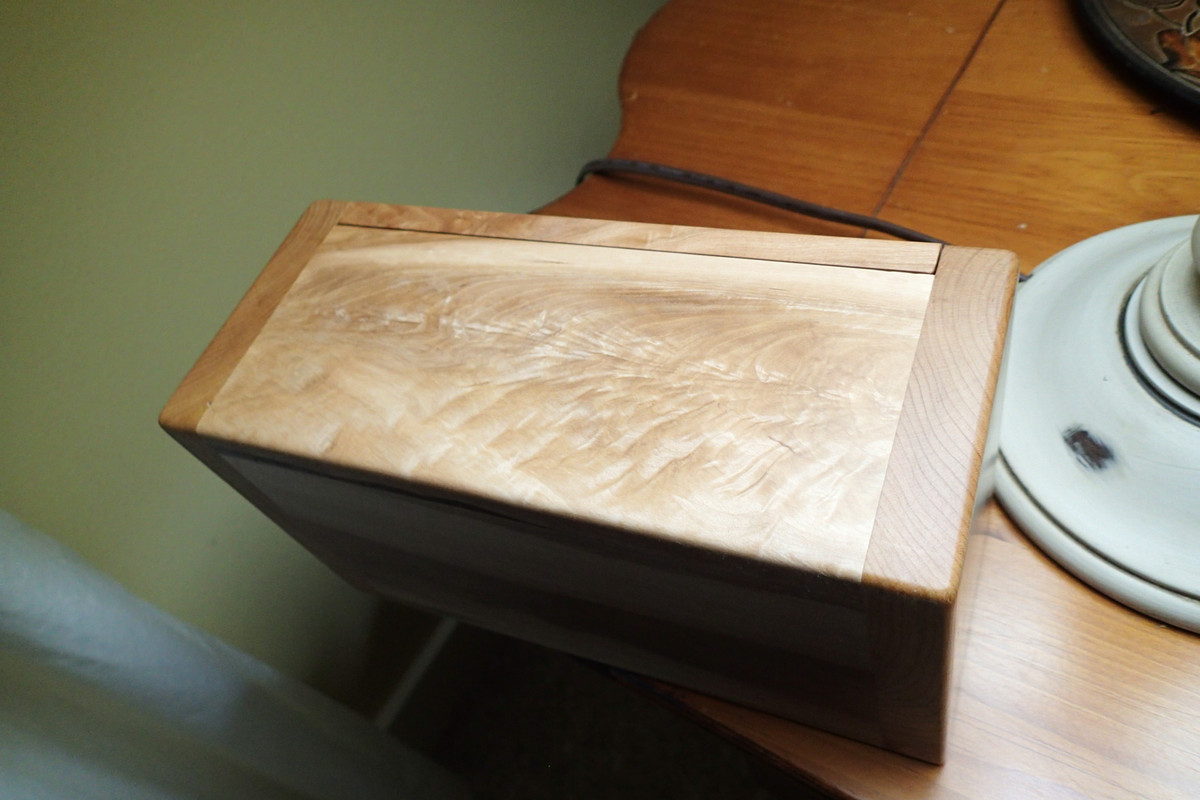 the ends are cherry |

|
Originally Posted By DirtyDirk: The wood is Ironwood. I don't know the hardness of Ironwood, its not on any chart I've ever seen. As its name implies, its pretty hard. Ironwood has a janka hardness of 3660. Hard maple is 1450, ipe is 3490. Most ebonies are in the low 3k range as well. |
|
Originally Posted By Curmudgeon762: I have a Jet open ended one and so far no issues…. I have that as well. It's been great for me. FOr those wanting to take a large bite, just don't. That clogs the blet way fast, especially on Cherry. Planers are for hogging wood, sanders, not so much. |