


Posted: 9/23/2025 2:13:15 PM EDT
[Last Edit: SkiandShoot][Edited]
|
Doing a bit of planning as I have a birthday in March that changes the game for me a little bit. Did you know: If your wages from your employer sponsoring the plan exceeded the threshold ($145,000 in the prior year, adjusted for inflation) ? your catch-ups must be Roth (after-tax). Pre-tax catch-ups will no longer be permitted for those in this category. IRS+1 So you basically can't decrease your tax footprint another tick by that $7,500 value in 2026 and beyond, meaning it has to be classified as ROTH not traditional pre-tax money. There is some odd verbiage on the rules of a grace period, 2026 being an anomaly but it certainly reads it's plan policy driven and will be solid in 2027. Unless I'm living in an alternate timeline. Anyone read, see or plan differently? @FALARK and your new hip, thoughts? Edit: Just contacted our admin/HR. They are in talks with Fidelity, plan sponsor, for options and solutions in 2026. Suspect we'll be forced to 401k-ROTH that catch-up contribution. Buzzkill but does help me with my impending tax bomb of an IRA. They'll have an answer Q4-2025. |

|
At first I said you're crazy, then I said you seem to have a brain so I did some reading: The change to catch-up contribution rules was initially supposed to take effect in 2024, which could've been a problem for those without access to a Roth 401(k). However, the IRS decided to grant a two-year reprieve, giving savers, employers, and retirement plan administrators more time to prepare. As a result, all plan participants 50 and older will be allowed to continue making catch-up contributions to their regular tax-deferred 401(k)s until 2026, regardless of income. ETA: I logged in and checked, last Friday was payday and I filled the regular contribution limit and some was into the catch up range. Fidelity shows that last week was all pre-tax contribution. |
|
Originally Posted By WrightP: I'm a little confused by the "$145,000" number...Is that your total comp? Is that what your employer matches? Originally Posted By WrightP: I'm a little confused by the "$145,000" number...Is that your total comp? Is that what your employer matches? Beginning in 2024, any contributions made by participants “whose FICA wages … for the preceding calendar year from the employer sponsoring the plan exceeded $145,000” must be made on a Roth basis – that is, taxed at regular income tax rates when contributed, with no taxation on distribution. As noted, under IRS Notice 2023-62, this change was effectively delayed until 2026. |
|
Got it, thanks. I just saw the following: "If your wages from your employer sponsoring the plan exceeded the threshold ($145,000 in the prior year, adjusted for inflation) ? your catch-ups must be Roth (after-tax). Pre-tax catch-ups will no longer be permitted for those in this category. IRS+1" And read it as the employer-sponsored matching threshold which is $70k. Got now though. |
|
This is all part of the secure act 2.0. It isn’t new. Last week the IRS gave their final guidance that this goes into effect next year. I’m not sure why you would want to max your 401k and catch up as pre-tax. You need to do long term tax planning. Most good savers end up with significant tax bills in retirement from RMDs, IRMAA, social security tax torpedo and other issues. |

|
Yes, this is well known from Secure Act 2.0. I am not happy about it..... but I cant do anything about it. It was originally supposed to be enforced the following January after the bill became law, but they had to postpone it (and some other measures) due to the fact that many 401k plans at that time had no support for Roth contributions. I'll still do a catchup contribution, but it will no longer help my tax situation. I hope to punch out soon so it wont matter much for me. |
|
Originally Posted By Joe_Blacke: I’m not sure why you would want to max your 401k and catch up as pre-tax. You need to do long term tax planning. Most good savers end up with significant tax bills in retirement from RMDs, IRMAA, social security tax torpedo and other issues. There are many people where it makes more sense to use pretax NOW when incomes are very high, but plan for a lower taxable income during retirement. I am certainly in that case. My retirement income will be one third of my current income. I will be a significantly lower tax bracket. I will have a period of time for Roth conversions where I can move this money from pretax to Roth at a much lower tax rate. Not all cases are the same. |
|
Originally Posted By @Joe_Blacke: I’m not sure why you would want to max your 401k and catch up as pre-tax. You need to do long term tax planning. Most good savers end up with significant tax bills in retirement from RMDs, IRMAA, social security tax torpedo and other issues. 1) we only have 9.48 quarters left until I punch out working and then will NOT be in the 35% bracket any more (37-32 pending a few details). We’ll drop down to her salary being a landscape architect only. If all goes according to 80% of the plan. 2) if we’re in the 35% bracket when we have zero incomes in 2033 and beyond, either I did something completely wrong OR we did it so right, we’re scrooge mcduckin it. Tax strategy planning is all I put my energy in. I lean on experts like Procat and letting picks ride. My energy is on buckets, conversion models, rmd go:nogo scenarios and growth models. Suspect I meet with Root Financial or similar Q4-2026. Playing the game as hard as I can. For some reason I think you’re an accountant or financial background? |

|
Lots of reasons why I think it could be beneficial. Adds tax diversification right out of the gate. I don’t want to make the pre-tax RMD problem bigger than it is. Taxes are still at historically low rates. I already shifted all contributions to Roth when the future of tax cuts and job acts was up in the air. Election results or simply allowed to sunset. Hedge against future rate hikes. Spending flexibility. Roth withdraws do not count toward IRMMA, ACA, or tax against SS. All hedges against future expenses. I’ll pay the man now to enable maneuvering room in the future. PS. Since secure act 2.0 made it legal. I tried to get my employer to offer company match as after tax. I was willing to pay the tax on it as well. |
|
Originally Posted By MtnWest: Lots of reasons why I think it could be beneficial. Adds tax diversification right out of the gate. I don’t want to make the pre-tax RMD problem bigger than it is. Taxes are still at historically low rates. I already shifted all contributions to Roth when the future of tax cuts and job acts was up in the air. Election results or simply allowed to sunset. Hedge against future rate hikes. Spending flexibility. Roth withdraws do not count toward IRMMA, ACA, or tax against SS. All hedges against future expenses. I’ll pay the man now to enable maneuvering room in the future. PS. Since secure act 2.0 made it legal. I tried to get my employer to offer company match as after tax. I was willing to pay the tax on it as well. Having the OPTION for Roth is great. Forcing it - is not great. Not everyone is in the same tax situation. |
|
Certainly fair. Not sure why the option went away. That said. Just considering the insurance tax cliffs One dollar over and you could be $8& per person every month. That’s equivalent to 28% tax on the catch up contribution. Effective tax rate on being 1 dollar over is insane. |
|
Originally Posted By MtnWest: Just considering the insurance tax cliffs One dollar over and you could be $8& per person every month. That’s equivalent to 28% tax on the catch up contribution. Effective tax rate on being 1 dollar over is insane. Huh? Not following you |
|
Originally Posted By Switchback_Arms: I do Roth anyway so I guess that's ok for me, right? We are talking about the 401k catchup contribution, which is an additional $7500 contribution to the 401k plan for people age 50 and up. Do you contribute to that already as Roth? If so, nothing changes for you. |
|
Originally Posted By FALARAK: Huh? Not following you Just saying I would much rather pay the taxes on a Roth catch-up contribution than trip one of the several tax/penalty cliffs later. If my future self must lay my hands on that one extra dollar going over a threshold limit gets crazy expensive. Roth money does not count toward any of those cliffs. |
|
Originally Posted By MtnWest: Just saying I would much rather pay the taxes on a Roth catch-up contribution than trip one of the several tax/penalty cliffs later. ........one extra dollar going over a threshold limit gets crazy expensive. |
|
Originally Posted By Morgan321: Please elaborate on these cliffs you are so concerned about so that others can educate themselves. Pretty sure he is just talking about IRMAA brackets. 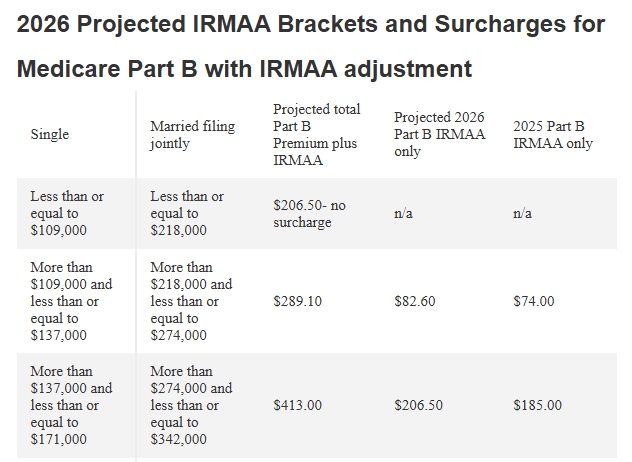 This is a non-issue for 95% of Americans, because they will not have more than $218,000 income during retirement (MFJ). If you DO have $218k-$274k income during retirement - is paying an extra $98 per month, or $1200 per year really that big of a deal for your health insurance costs (Medicare) ? This is not even close to a big concern of mine. Sure, if you are right on the cliff.... and your RMD increases push you just over the cliff, you "lost" $1200 per year in income for your Medicare premiums...... but this is really small potatoes to me. If you have a $1,000,000 in your IRA at age 73.... your RMD is only $38k. If you have 2 million, only $75k. Not even CLOSE to the IRMAA threshold. But if you have a large taxable account as well or a taxable pension, plus SS, it can encroach these numbers. Still, not the mountain that people make it out to be. I am all for paying a LITTLE tax as possible, and IRMAA is a "tax" or a penalty against large income earners to help subsidize low income earners..... but not a big concern of mine. |
|
Originally Posted By bugs: I'm pretty much f'd on taxes when I retire. My current 401k estimated retirement income is at 290%. And that number doesn't include my other investments. The problem with being wealthy, is there are very few people you can complain to. |
|
Originally Posted By FALARAK: Pretty sure he is just talking about IRMAA brackets. In the former, I'm OK with paying an extra $74 per month if my retirement income is over $212k annually! In the latter, if your RMDs are more cash than you need to live then just invest the distributions. I've noticed people get all hung up on things like this and some people wind up tripping over dollars to save pennies. |

|
Originally Posted By ARHank: Don't forget that they have relaxed the requirements for health savings accounts. A lot more plans qualfy now. You can put pre tax money in an HSA and it basically turns into a regular 401k in retirement. Age 65. So not ad advantageous as 401k/IRA which is 59.5. But still a thing. The trick with HSA is to keep ALL your receipts and pay out of pocket for medical care. Enjoy all the tax-free growth. Then, in early stage retirement, start reimbursing yourself from it, supplementing your "income" with no tax consequences. Exhaust the self-reimbursement by age 65, then you can use what is left to continue to pay medical care costs, or draw it down as a typical pre-tax IRA. The biggest thing I'd like to see change with HSA is the ability to use it to pay for marketplace health insurance premiums. That would be REALLY beneficial and would really help retired people who aren't Medicare age yet. |
|
Great thread and I've learned a few things. Last year i sketched out our plan. Based on evolution of information, vision and growth, I did an update to our plan. Feel free to post yours or start a new thread. I'm open to questions or even updates to my plan. Original plan 1.0, 4-24-2024 Revision 2.0, 9-25-2025 Ages 52-55 Still full time or part time employed but eyeing an exit sooner rather than later Goal is hitting the Freedom Number within 18 months of 55 +/- 1)Focusing on paying off the house 2)If not paying off the debt, fully understanding monthly/biweekly expenses of household burn rate and demands. Use real data, a must. 3)Prepare the two buckets of the three bucket strategy. 4)Fully understand current spending plan, historical data and sketching out spending plan at 55 or hitting the freedom number 5)Spouse 1 could still be working so the three buckets will be softer on cash demands. 55-59.5 Sun-setted career, not working, or working but having fun in the game 1)Finish setting up “3 Bucket strategy” a.Start focusing on the first bucket and understanding tax implications 2)Tapping bridge accounts. Composed of individual stocks and S&P500 mutual funds 3)Doing ROTH Conversions. a.Key is spouse 1 and spouse 2 have little to no income via W-2 or other. 59.5-62 Enjoying Life 3) Tapping various retirement accounts Evaluate based on tax implications for future Required Minimum Distributions (RMDS). ROTH accounts and Traditional accounts 6)Use bridge account sparingly 7)Filling up Bucket “2” as needed 8)Evaluate taking Social at 62+ 62+ 1) Tapping various retirement accounts Evaluate based on tax implications for future Required Minimum Distributions (RMDS). ROTH accounts and Traditional accounts 2)Use bridge account sparingly 3)Filling up Bucket “2” as needed 4)Evaluate taking Social at 62+ OR waiting. 70+, 1)Tapping RMD’s as needed and required 2)Setting up future money for future generations or giving to Charities a.Fully comprehend Qualified Charitable Contributions. Hence why our play is heavy S&P500 funds and winners which we are letting run for the next 7+ years, subject to change and evaluation. I don’t have the time, energy and distraction to try and constantly move money around for an edge. We’ve got ~9.38 Quarters until my freedom number so I invest my energy in the 80% of what I can control to maximize the machine. The 3 Bucket Strategy completely trumps the 4% rule due to 1 thing: emotion vs volatility! |
|
@SkiandShoot One thing I’m not seeing in your plan is healthcare prior to being eligible for Medicare. I’m assuming you have that figured out. In the next week I’ll hit the first anniversary of retiring early not counting a few weeks of part time work. It’s amazing how the things I worried about haven’t been an issue yet unforeseen things have become hurdles. |
|
As for IRMAA: 1. It’s per person. You have to account for the cost of both spouses, not just an individual, if you are married. 2. It’s a 2 year lookback. The income you had two years ago determines the IRMAA calculations for today. People doing Roth conversions at 63 would be creating the income calculated for IRMAA when they are 65. 3. About 10% of Medicare recipients pay IRMAA. This has grown from just 7-8% a couple years ago and is expected to increase over time. 4. The IRS sets the brackets. Not Congress. 5. IRMAA is used to offset the upcoming issue of Medicare being impossible to support financially. Right now Medicare is 14% of the entire federal budget. It and social security alone are over 1/3 of the federal budget. By its very nature, IRMAA is looked at by Congress as an income source to pay for social services. They have been looking at ways to expand it. 6. Single filers hit the first IRMAA level at $106K. You have to consider the potential tax rate of the surviving spouse. Many good savers don’t really reduce income once one spouse dies, but they loose a much bigger portion of their income to taxes. 7. Income that is looked at for IRMAA includes dividends, taxable portion of social security, rental income, pre-tax savings withdrawals such as 401k/IRA, Roth conversions, etc. IRMAA is just one of the added taxes. While you may look at it as just a couple thousand a year (today’s rates) you should look at it also over the length of time you are paying it. Over 10 years, that could be $30K in taxes for IRMAA alone. Over a 25 year retirement, you’re talking close to $100K. Also don’t forget the social security tax torpedo. It is different for everyone. Many people forget how that works. Many assume if I take $1 from my IRA, I pay the tax on that $1. And that is incorrect. When you take that $1 from the IRA, you also pull in $1 from your social security into being taxed. Taking $1 from your IRA means you are paying the tax on $2 not $1. That continues until 85% of your social security is brought into being taxable. Usually this is a big bump up in taxes. Often taking peoples tax rate into the high 40% range until they hit the 85% of social security max. Much like IRMAA this can be several hundred thousands of extra dollars taken out in taxes in retirement. The tax thresholds for social security haven’t changed since the Clinton era. The new tax bill Trump passed has some good deductions built it doesn’t eliminate social security taxes and it expires in just a few years. As long as you’re comfortable with your approach. Someone at today’s top rate makes the most sense to stay pre-tax on its face. It all comes down to the numbers. Also, we know what the tax rates are today. When you are retired, they could be much higher (nobody knows for sure). |
Joined:
Jul 2024
Posts:
193
EE: 0% (0)
 USA
USA
|
Originally Posted By FALARAK: Age 65. So not ad advantageous as 401k/IRA which is 59.5. But still a thing. The trick with HSA is to keep ALL your receipts and pay out of pocket for medical care. Enjoy all the tax-free growth. Then, in early stage retirement, start reimbursing yourself from it, supplementing your "income" with no tax consequences. Exhaust the self-reimbursement by age 65, then you can use what is left to continue to pay medical care costs, or draw it down as a typical pre-tax IRA. The biggest thing I'd like to see change with HSA is the ability to use it to pay for marketplace health insurance premiums. That would be REALLY beneficial and would really help retired people who aren't Medicare age yet. I would like to see health insurance premiums deductible above the line for people who pay for their own coverage. W2 employees pay their premiums (or their share of the premiums) with pre tax money. The rest of us should be able to. |

|
Originally Posted By @Procat: @SkiandShoot One thing I’m not seeing in your plan is healthcare prior to being eligible for Medicare. I’m assuming you have that figured out. In the next week I’ll hit the first anniversary of retiring early not counting a few weeks of part time work. It’s amazing how the things I worried about haven’t been an issue yet unforeseen things have become hurdles. Valid question as I had that topic sketched in my fathead so I put pen to paper. Medical: A few points, perspective and options. February 11, 2028 is my target date for exiting required employment. I’ll be 52 while my wife will be 47. She, in theory, will have another 5 years employed as a Landscape Architect, 2028-2033 based on her career blossoming. If she sees how much fun I am having playing poker, shooting guns, waterskiing, traveling and she decides to punch out early, we’ll adjust. A few options: I go on COBRA for 18 months OR during 2028 only as I have an HSA and the monthly premium is like $49 dollars. Inflate that to be $75, so be it. Then in 2029, get on whatever insurance she is under through her employer. OR in 2028, go on her employers, December 2027 set it up. Run under her insurance 2029-2033 as a dependent. I’ll be 57 and she’ll be 52 If she is enjoying her career and still wants to be involved in her field, still keep employment with options for minimum full-time and health care options. If she wants to setup shop again and open a L.A. firm and basically be a “free-lancer” LLC, she can provide health insurance for herself and a dependent. The goal would be to cover some expenses in life, health insurance, make a small profit to break even etc. 2033: If we need to go open market and pay for private health care, I’ve got it budgeted, ~$16,000 -$22,000 in our plan to pay out of pocket health insurance. Cash flow monthly: $1,800. Basically swap our mortgage for health insurance. If we need to run 2033 – 2038 or so before Medicare or whatever is available, so be it. If that needs to happen sooner, so be it. As a Gen-Xer, I’ve always been pounded on “there will be no social security when you retire”. I’ve built everything having that as a $0. So any money, benefits, IRMAA, taxes on S.S., are inconsequential. To the point of if social zeroes out due to taxes OR we are repaying our selves using SS when I take it at 62, that is just fine. Right now the estimate shows I would be at $2,700 or so for SS income. We are not modeling that and keeping those at $0, for now. Maybe in 2028 and beyond, we’ll sketch that in to understand taxes etc. Especially when it comes time to plan for the Roth Conversions, Irmaa impacts and the 2 year look back. Edit1: Building basically cash flow demands model, needs from a monthly perspective/annual basis from 2028 until 2060, using Excel. That deserves it's own thread!! For 2028-2033, I've got Spouse 1 having a salary, then I calculate take home pay. Then Spouse 2 is supplemental from Bucket 1. After 2033, Spouse 1 drops to zero and then the demands on the buckets goes up quite a bit and that's ok. |

|
Originally Posted By SkiandShoot: Doing a bit of planning as I have a birthday in March that changes the game for me a little bit. Did you know: If your wages from your employer sponsoring the plan exceeded the threshold ($145,000 in the prior year, adjusted for inflation) ? your catch-ups must be Roth (after-tax). Pre-tax catch-ups will no longer be permitted for those in this category. IRS+1 So you basically can't decrease your tax footprint another tick by that $7,500 value in 2026 and beyond, meaning it has to be classified as ROTH not traditional pre-tax money. There is some odd verbiage on the rules of a grace period, 2026 being an anomaly but it certainly reads it's plan policy driven and will be solid in 2027. Unless I'm living in an alternate timeline. Anyone read, see or plan differently? @FALARK and your new hip, thoughts? Edit: Just contacted our admin/HR. They are in talks with Fidelity, plan sponsor, for options and solutions in 2026. Suspect we'll be forced to 401k-ROTH that catch-up contribution. Buzzkill but does help me with my impending tax bomb of an IRA. They'll have an answer Q4-2025. I just read about this when looking to see if they've set 2026 limits yet. What fucking bullshit. I'll read the thread for more information after being mad about it for a minute. ETA read thread, I'm less mad, but need to adjust plan accordingly. |
If buying isn't owning, piracy isn't stealing.
|
Originally Posted By JustinU235: ETA read thread, I'm less mad, but need to adjust plan accordingly. I'm leaning towards doing it so that when I quit working it rolls over into my roth. It's locked up for 5 years from that point but that doesn't matter to me. |
|
Originally Posted By Morgan321: Ditto. I'm debating whether to do the catch-up or not in 2026. I'm leaning towards doing it so that when I quit working it rolls over into my roth. It's locked up for 5 years from that point but that doesn't matter to me. Originally Posted By Morgan321: Originally Posted By JustinU235: ETA read thread, I'm less mad, but need to adjust plan accordingly. I'm leaning towards doing it so that when I quit working it rolls over into my roth. It's locked up for 5 years from that point but that doesn't matter to me. I'm still doing it. I already stuff a little over $40k per year into my Roth, so if I have no other choice, I'll still direct the catchup contribution to Roth, even if I would prefer pre-tax. I only plan on working another year anyway. 
|
|
Originally Posted By Joe_Blacke: As for IRMAA: 1. It’s per person. You have to account for the cost of both spouses, not just an individual, if you are married. 2. It’s a 2 year lookback. The income you had two years ago determines the IRMAA calculations for today. People doing Roth conversions at 63 would be creating the income calculated for IRMAA when they are 65. 3. About 10% of Medicare recipients pay IRMAA. This has grown from just 7-8% a couple years ago and is expected to increase over time. 4. The IRS sets the brackets. Not Congress. 5. IRMAA is used to offset the upcoming issue of Medicare being impossible to support financially. Right now Medicare is 14% of the entire federal budget. It and social security alone are over 1/3 of the federal budget. By its very nature, IRMAA is looked at by Congress as an income source to pay for social services. They have been looking at ways to expand it. 6. Single filers hit the first IRMAA level at $106K. You have to consider the potential tax rate of the surviving spouse. Many good savers don’t really reduce income once one spouse dies, but they loose a much bigger portion of their income to taxes. 7. Income that is looked at for IRMAA includes dividends, taxable portion of social security, rental income, pre-tax savings withdrawals such as 401k/IRA, Roth conversions, etc. IRMAA is just one of the added taxes. While you may look at it as just a couple thousand a year (today’s rates) you should look at it also over the length of time you are paying it. Over 10 years, that could be $30K in taxes for IRMAA alone. Over a 25 year retirement, you’re talking close to $100K. Also don’t forget the social security tax torpedo. It is different for everyone. Many people forget how that works. Many assume if I take $1 from my IRA, I pay the tax on that $1. And that is incorrect. When you take that $1 from the IRA, you also pull in $1 from your social security into being taxed. Taking $1 from your IRA means you are paying the tax on $2 not $1. That continues until 85% of your social security is brought into being taxable. Usually this is a big bump up in taxes. Often taking peoples tax rate into the high 40% range until they hit the 85% of social security max. Much like IRMAA this can be several hundred thousands of extra dollars taken out in taxes in retirement. The tax thresholds for social security haven’t changed since the Clinton era. The new tax bill Trump passed has some good deductions built it doesn’t eliminate social security taxes and it expires in just a few years. As long as you’re comfortable with your approach. Someone at today’s top rate makes the most sense to stay pre-tax on its face. It all comes down to the numbers. Also, we know what the tax rates are today. When you are retired, they could be much higher (nobody knows for sure). Thank you. Sorry my shift had started and could not follow up. IRMAA, SS tax torpedo, widows tax trap, uncertainty in future tax rates all rolled up into one. All reasons to diversify tax withholdings Add in the changes to ACA “subsidies” for those hoping to retire early and I think you have all the reasons why Roth catch up might make sense. |
|
I was reading up this and other changes and discovered that another change is that your employer is allowed to put their contribution via roth rather than pretax. Employers are not required to provide this option. You will have to pay income tax on the amount obviously, but it is an added option that may be useful for some people. |
|
Originally Posted By Morgan321: I was reading up this and other changes and discovered that another change is that your employer is allowed to put their contribution via roth rather than pretax. Employers are not required to provide this option. You will have to pay income tax on the amount obviously, but it is an added option that may be useful for some people. If anyone has any luck convincing your employer to offer Roth match let me know. I sent them all the secure act 2.0 info and got a canned reply. Blah blah blah. Reply just rattled off crap that everyone knows. We offer a Roth option etc. HR clearly didn’t look into it. |
|
Update. Getting conflicting information on this topic. Allegedly in September the topic was punted to 2027. HIGHLY recommend contacting your plan sponsor for their direction. We use Fidelity and our lead person said Fidelity was still "working on this concept and decisions for 2026". This affects lots of folks tax planning on ordinary income, STCG, LTCG and carry forwards on deductions. Do your due diligence. |
|
Originally Posted By SkiandShoot: Update. Getting conflicting information on this topic. Allegedly in September the topic was punted to 2027. HIGHLY recommend contacting your plan sponsor for their direction. We use Fidelity and our lead person said Fidelity was still "working on this concept and decisions for 2026". This affects lots of folks tax planning on ordinary income, STCG, LTCG and carry forwards on deductions. Do your due diligence. My benefits portal shows this: SECURE 2.0 changes to the 401(k) effective Jan. 1, 2026 If you earned $145,000+ last year and are age 50 or older, your Microsoft 401(k) catch-up contributions effective January 1, 2026 must be Roth (after-tax) contributions under federal law (the “SECURE 2.0” legislation. Also, if you’ll be between the ages of 60–63 by December 31, 2026, you qualify for higher catch-up limits. |
|
Originally Posted By MtnWest: Certainly fair. Not sure why the option went away. That said. Just considering the insurance tax cliffs One dollar over and you could be $8& per person every month. That’s equivalent to 28% tax on the catch up contribution. Effective tax rate on being 1 dollar over is insane. Woops. Didnt read far enough. Thanks for the explanation |

| Don’t forget about that strange notch in 401(k) catch up contributions: 60-63 have an $11,250 limit. |
I wanted a mission, and for my sins, they gave me one.
No rules today, sport…just orders.
It’s not about how many people you kill, it’s about how many you save.
No rules today, sport…just orders.
It’s not about how many people you kill, it’s about how many you save.
|
I dont think my balances are enough to worry with this. I am 8 years from my planned exit. House and farm will be paid for. I don’t plan to have any debt at all. I have a few different accounts and dont plant to pull SSI till 69 or 70. Main reason is if my wife outlives me she will need that maximized. My main account is under management and I don’t plan to touch it for 10 years after retirement. I plan to exit at 65-66 and live off my 401k and pension and ssi when I hit 69, for the first 10 years. My main account should be healthy enough at that point to keep us comfortable. Currently doing half roth half traditional in 401 and thinking of switching to all traditional for tax break and then rolling some over to roth in first few years of retirement. Health care and taxes are bigges expenses that I for see. Switching over to HSA account this coming year to try to stack 40-50 k in HSA before retirement |
|
Originally Posted By WoodChuckDad: I dont think my balances are enough to worry with this…. The difference in taxes can be enormous when talking about minor changes like this in your retirement process. Tax brackets are near historic lows now, it may be worth taking income now rather than later depending on your situation. You say work until 65 which is when you have to start Medicare…. Those roth conversions will up your income and you might have to pay Irmaa. It’s not a huge amount, but if you do conversions for 3 years and Irmaa looks back two then you’re locking yourself into Irmaa for 5 years. When you start SS that adds income also and the conversion income means that a higher fraction of your SS will be taxed. If one of you dies during that timeframe then the surviving spouse will be filing all that income in the single tax brackets. It all adds up, and adds up fast. Make a plan because the tax implications for an average person is easily well into the 6 figure range just in the few years that spans retiring and starting SS and Medicare. |

|
Anyone who: 1. Lives to age 73 and 2. Has RMDs as their biggest annoyance… Has already won. You don’t need to leave millions of dollars to your kids. Better to leave stability and good memories and enough to bury yourself and maybe pay off their mortgages. It’s fun calculating different options and definitely good to figure out how to minimize taxes. But I’ll take the 2026 Roth catch up mandate as some forced tax diversification because in the past I’ve been biased to pre-tax. |
AMDG
At this point everybody can suck it! -Dru
At this point everybody can suck it! -Dru
|
Update: Check your plan as some are deploying this concept in 2026 and some are waiting in 2027. Ours is going to it in 2026, just got the confirmation. Attached File But based on looking at RMD's for the bigger picture, it makes sense to go ROTH from here until the end of my career (49 years old). Highly recommend everyone running their own numbers @JustinU235 and this thread Evaluation of why we're going ROTH |
|
Originally Posted By SkiandShoot: Update: Check your plan as some are deploying this concept in 2026 and some are waiting in 2027. Ours is going to it in 2026, just got the confirmation. https://www.ar15.com/media/mediaFiles/32390/Capture356hg_JPG-3674056.JPG But based on looking at RMD's for the bigger picture, it makes sense to go ROTH from here until the end of my career (49 years old). Highly recommend everyone running their own numbers @JustinU235 and this thread Evaluation of why we're going ROTH |
If buying isn't owning, piracy isn't stealing.
|
Originally Posted By SkiandShoot: Update: Check your plan as some are deploying this concept in 2026 and some are waiting in 2027. I don't see how any plans are "waiting" until 2027 to implement, as the implementation for compliance is required in 2026. The only way a plan could delay this, is to simply not allow any catchup contributions. |