


DGRVP- Filipinos in the Guerilla Movement 1942-45 with Desiree Benipayo – Episode 617 (Page 20 of 60)


|
Questions answers by Brian Cox on a couple of subjects. Brian Cox: Why black holes could hold the secret to time and space | Full Interview  Brian Cox: Why black holes could hold the secret to time and space | Full Interview 00:00:00 Black holes and the edge of physics 00:01:44 Hawking’s work 00:02:47 Historical roots 00:13:18 The “end of time” inside black holes 00:20:26 The black hole information paradox 00:24:31 Black holes and quantum computing 00:26:04 Supermassive black holes and galaxy formation 00:52:37 Alien life and the Fermi paradox 00:56:10 Rare Earth hypothesis 01:00:30 Von Neumann probes 01:02:13 The Dark Forest Hypothesis 01:06:32 The Great Filter 01:09:09 Earth’s near-destruction 01:10:11 The Great Silence 01:14:38 Preserving intelligence |
|
Interesting short video on the invention of the wheel. Resources are in the video description. We Were Wrong About How and When The Wheel Was Invented  We Were Wrong About How and When The Wheel Was Invented 0:00 History of the wheel 2:10 Previous assumptions 3:20 How early humans probably came up with this - rollers 4:20 Bolarez culture may have invented this 5:00 Link to mining 5:50 Modifications to rollers and how this evolved 7:10 Study tests this with models 8:10 Gradual process and not eureka 8:45 Ball bearings and NASA wheels 10:15 Conclusions |
|
Short video on the Mustangs in Korea. The channel has some interesting ones. https://www.youtube.com/@notapound/videos THE LAST BATTLE: F-51D Mustangs In Korea  THE LAST BATTLE: F-51D Mustangs In Korea |
|
Good video on the F6F Hellcat. F6F Hellcat, Best Naval Fighter of WW2!  F6F Hellcat, Best Naval Fighter of WW2! |
|
Good short video on the Tiger 2. Tiger II: What was the Point?  Tiger II: What was the Point? 00:00 | Introduction 00:55 | Durchbruchswagen 06:15 | Tiger I vs Tiger II 12:52 | The Numbers Game 17:34 | Was Tiger II a Success? |
|
Good short video on the Tortoise. Would have loved to see one slug it out with a Tiger 2. A39 Tortoise: The Forgotten Super Heavy  A39 Tortoise: The Forgotten Super Heavy 00:00 | Introduction 00:39 | What is a Heavy Assault Tank? 03:45 | Why a Heavy Assault Tank? 09:24 | The A39: As Good as it Gets? 17:55 | A Solution Without a Problem |
|
Documentary on Chesty Puller. Chesty Puller: The Marine's Marine | Full Documentary | Biography  Failed To Load Title |
|
Interesting video on another invasion of France after Operation Overlord. Operation Dragoon  Operation Dragoon You know all about Operation Overlord, D-Day, the Allied invasion of western France. But how about Operation Dragoon, a similar invasion of southern France? Overlord got more headlines than Dragoon, but together -- Overlord in June 1944 and Dragoon in August 1944 -- they formed a giant pincer that destroyed German forces in France. You'll get the full story in this video. Dragoon was initially planned for the same time as Overlord, but lack of resources delayed it. On August 15, 1944, preceded by a massive air and naval bombardment and commando raids on coastal defenses, three American infantry divisions landed on the French Riviera -- today some of Europe's priciest real estate. Mediterranean ports of Marseille and Toulon by August 28, and the speed with which they were put back in working order, meant the Allied forces streaming into Normandy could more quickly be supplied for their final push into Germany. Museum Docent and retired Army Colonel Nick Cressy tells all about Operation Dragoon, how it came to be, how it was executed, and the important results of this second invasion of France. |
|
Hadn't heard the full story of how the supply lines from India to China were made. Operation Thursday  Operation Thursday A top priority of today's U.S. Air Force Special Operations Command is “Any Place, Any Time, Anywhere” for the delivery of unconventional airpower. But did you know that the roots of air special ops lie deep in WWII history? This video tells you all about it. Watch as museum curator and historian Gene Pfeffer tells the story of the British Army Chindits, the U.S. Army Air Forces 1st Air Commando Group—and Operation Thursday, the first special operation conducted entirely by air. Allied resources were stretched thin in the China-Burma-India theater, but British General Orde Wingate proposed a special campaign behind Japanese lines in Burma that caught the imagination of Winston Churchill and Franklin Roosevelt. Roosevelt instructed U.S. Army Air Forces General “Hap” Arnold to provide air support for Wingate’s plan. Arnold saw it as an opportunity to demonstrate that airpower could support sizable units for an extended time behind enemy lines. He selected two experienced officers, Phil Cochran and John Alison, to lead a new unconventional warfare unit. Their mission was to airlift Wingate’s troops 200 miles behind enemy lines, supply them by air, conduct medical evacuations, and provide air cover and airstrikes. |
|
New paper on the White Sands footprints. Paleolake geochronology supports Last Glacial Maximum (LGM) age for human tracks at White Sands, New Mexico Paper: Paleolake geochronology supports Last Glacial Maximum (LGM) age for human tracks at White Sands, New Mexico |

|
Originally Posted By DaGoose: New paper on the White Sands footprints. Paleolake geochronology supports Last Glacial Maximum (LGM) age for human tracks at White Sands, New Mexico Paper: Paleolake geochronology supports Last Glacial Maximum (LGM) age for human tracks at White Sands, New Mexico Link doesn't work for me. Subscription only? |
Originally Posted By FLAL1A:
"Pretty much the only thing that keeps me paying my taxes and not turning my house into a chickenshit particle board and stucco compound is the fact that the police occasionally kill douchebag criminals in comical ways.
"Pretty much the only thing that keeps me paying my taxes and not turning my house into a chickenshit particle board and stucco compound is the fact that the police occasionally kill douchebag criminals in comical ways.
|
Originally Posted By DaGoose: New paper on the White Sands footprints. Paleolake geochronology supports Last Glacial Maximum (LGM) age for human tracks at White Sands, New Mexico Paper: Paleolake geochronology supports Last Glacial Maximum (LGM) age for human tracks at White Sands, New Mexico Here is a fossilized trackway you won’t find on any map, ancient footprints left in soft mud somewhere between 32,000 and 35,000 years ago. This wasn't the widely publicized site from the nearby national park. It’s an entirely separate area. There are tracks of humans, mammoths, mastodons, ancient camels or horses, dire wolves, saber-tooth cats, and giant ground sloths, all who once walked across this same stretch. There’s even evidence of a very old hearth, an ancient campfire likely 5,000 to 10,000 years old. Over time, it sank through the layers and now rests among these Ice Age footprints, offering another glimpse into early human presence. Most of these prints will be naturally erased by this year’s seasonal rains. Teams are working quickly to document everything before nature reclaims it. Ancient Hearth Looks like just a dark patch, but this is where someone built a fire thousands of years ago — long after the big animals passed through. 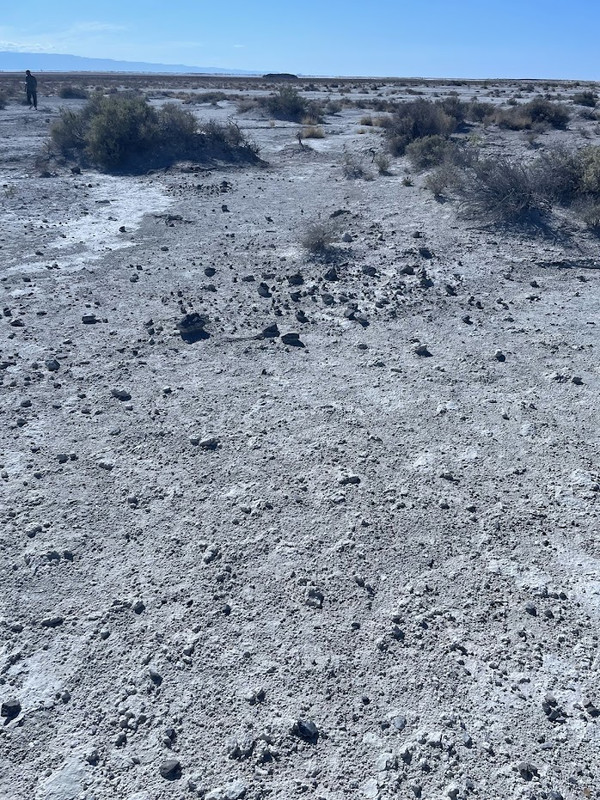 Camel or Horse Track Hard to say for sure, but definitely one of the large hoofed animals that used to roam this area. 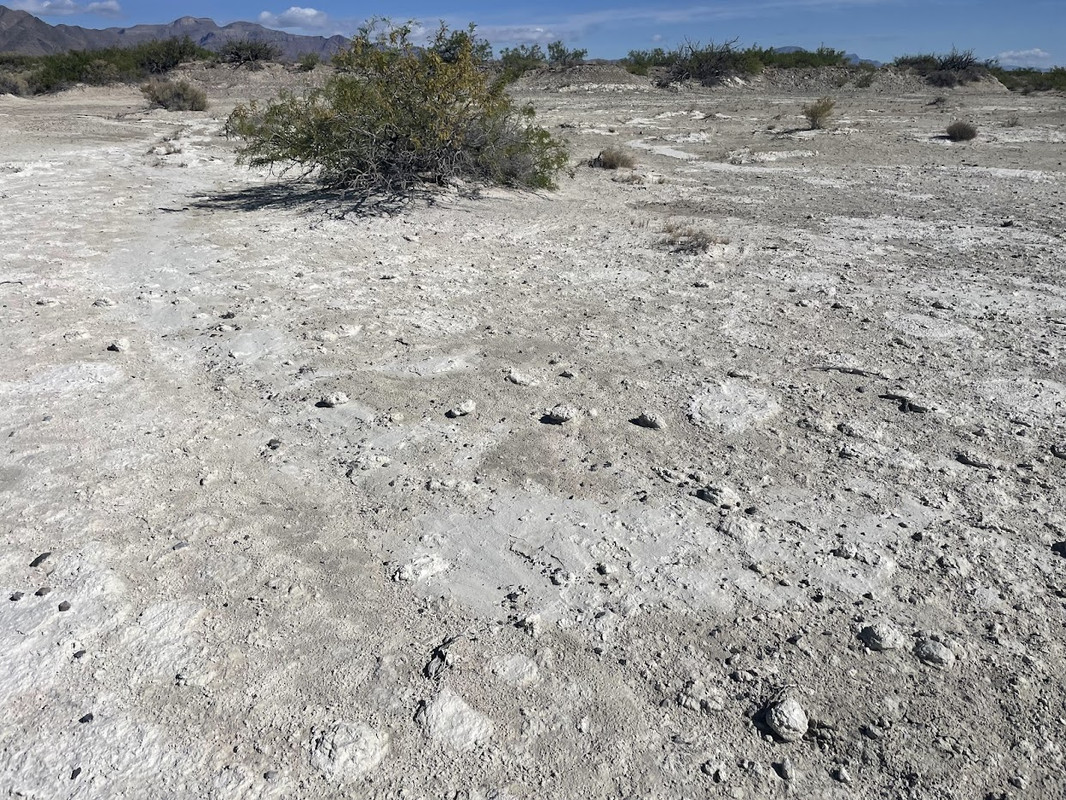 Giant Ground Sloth Tracks & Pathway Massive Ice Age creature — these prints follow its path along an old lakeshore. 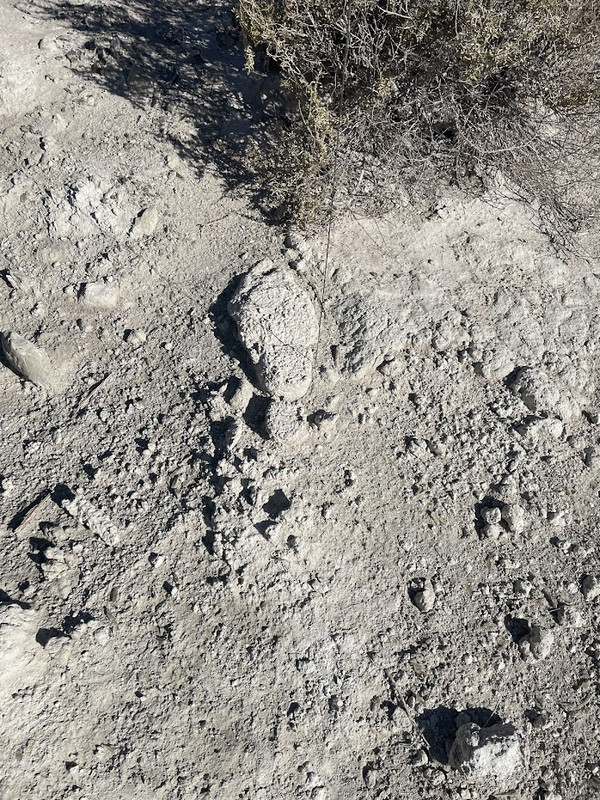 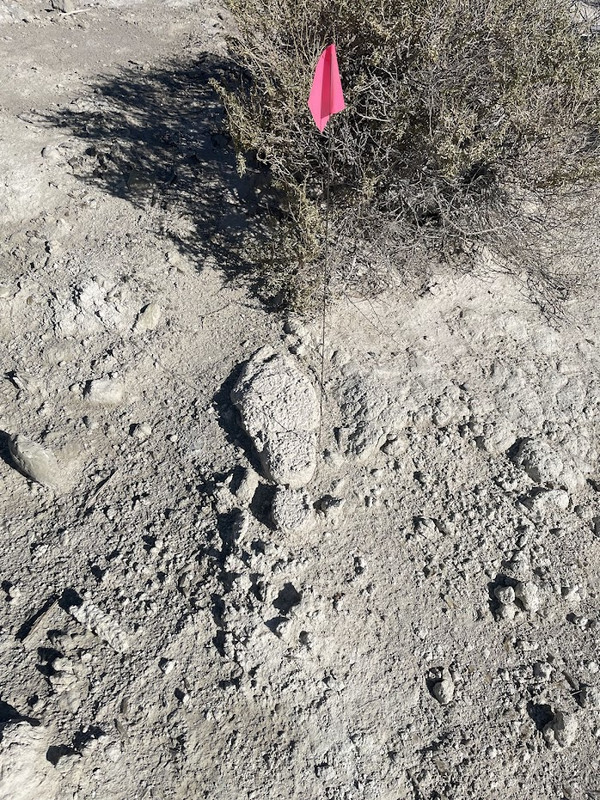  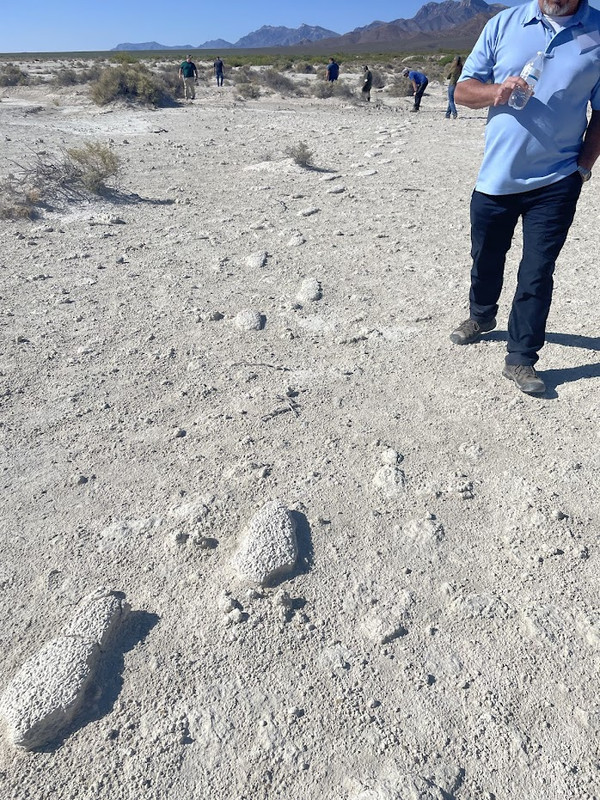 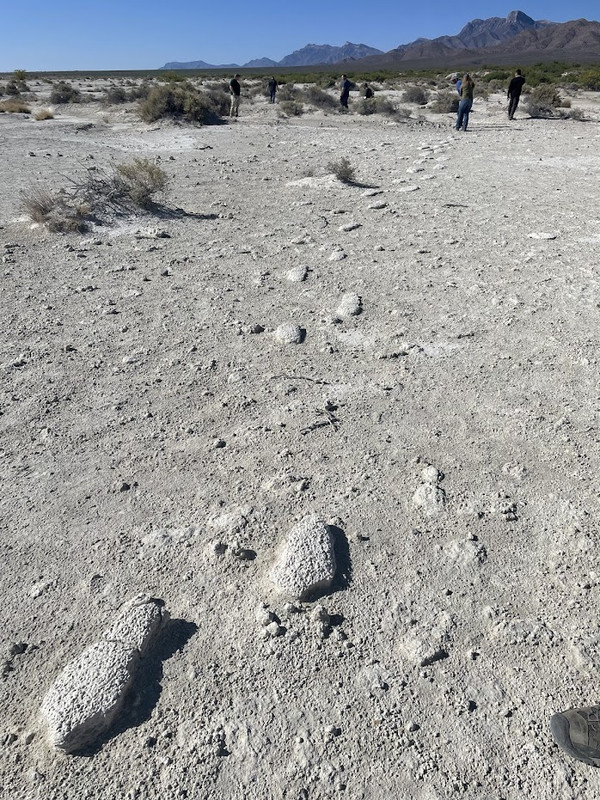 Gypsum Crystals These are the raw form of what eventually becomes white sand dunes. They break down and blow across the basin over time. 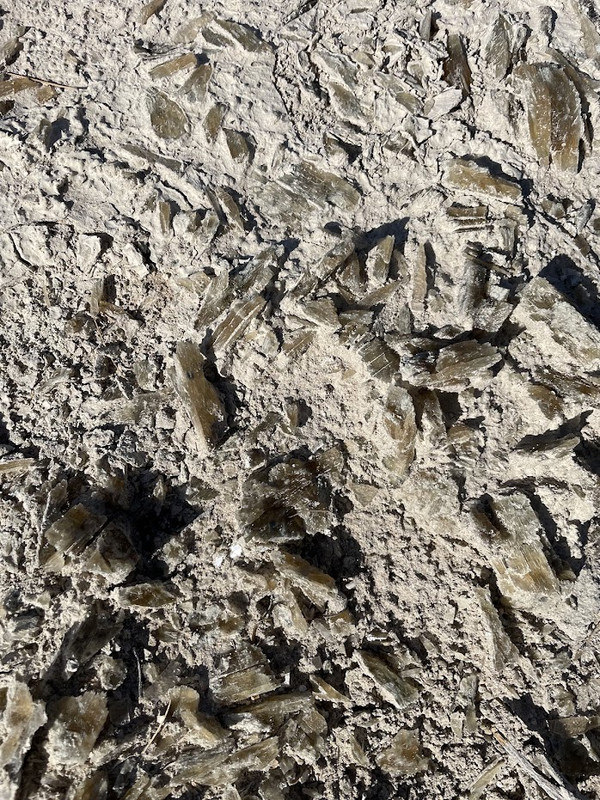 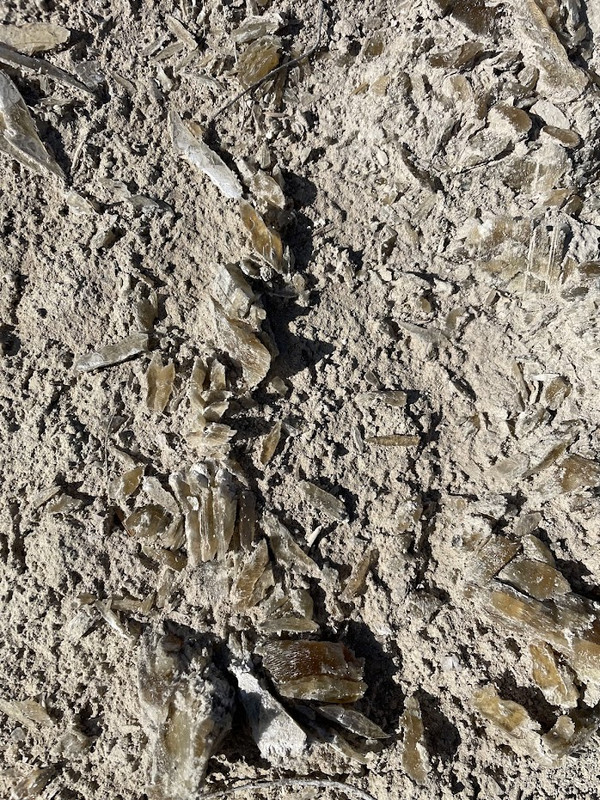 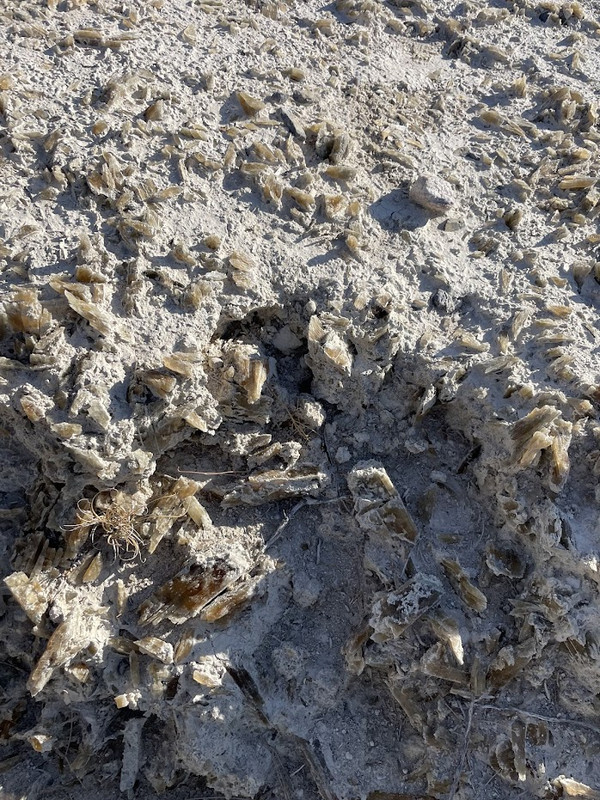 Human Footprints These could be among the oldest known human tracks in North America. 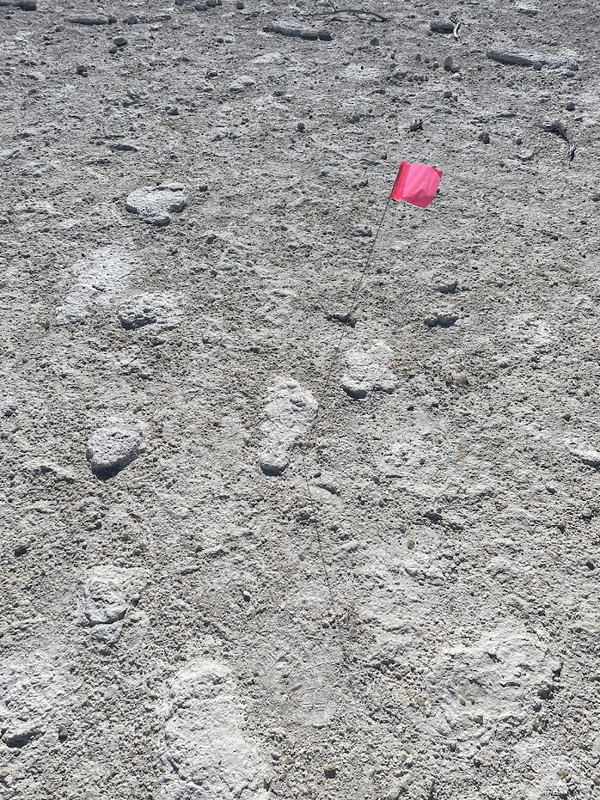 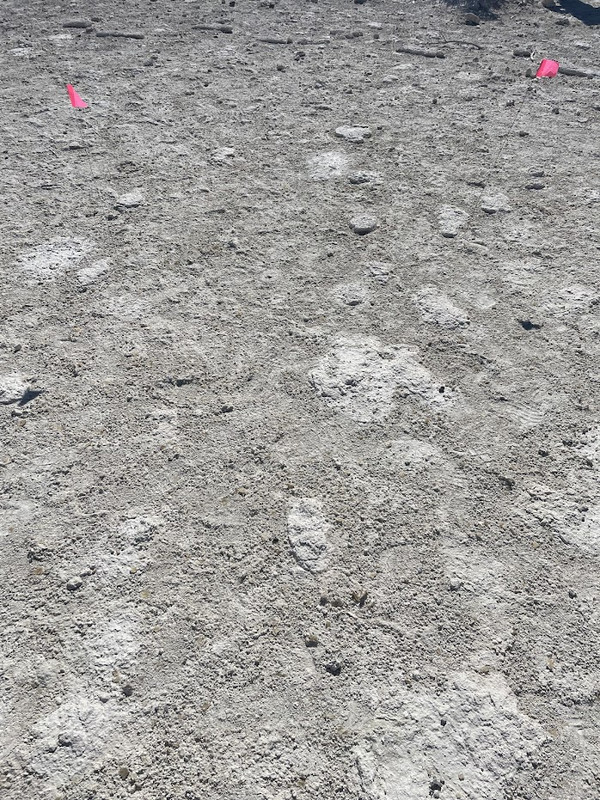 Wide View of Track Area 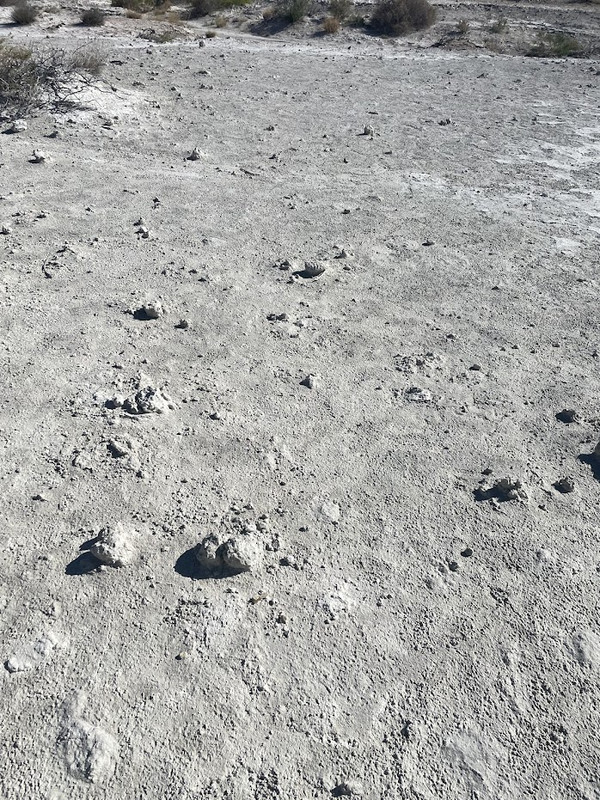 Mammoth or Mastodon Tracks The size of these prints is hard to grasp until you're standing next to one — some are nearly a yard across. 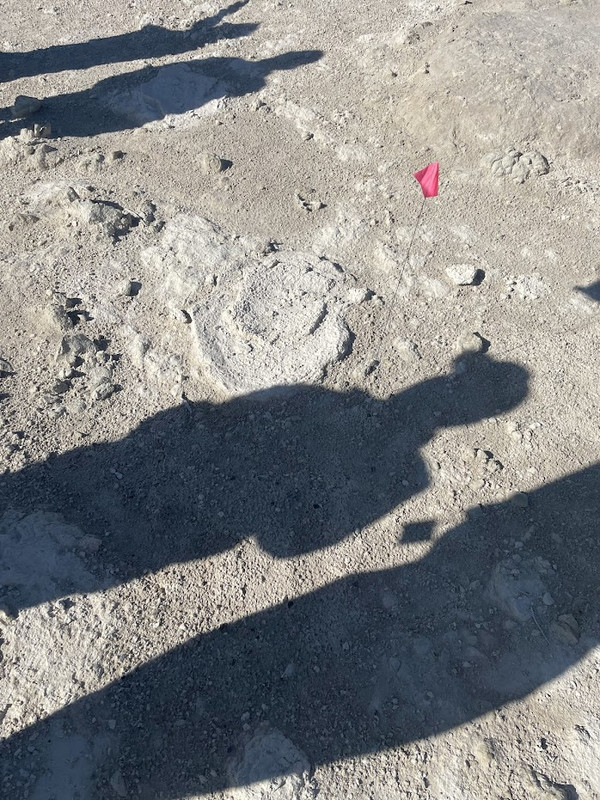 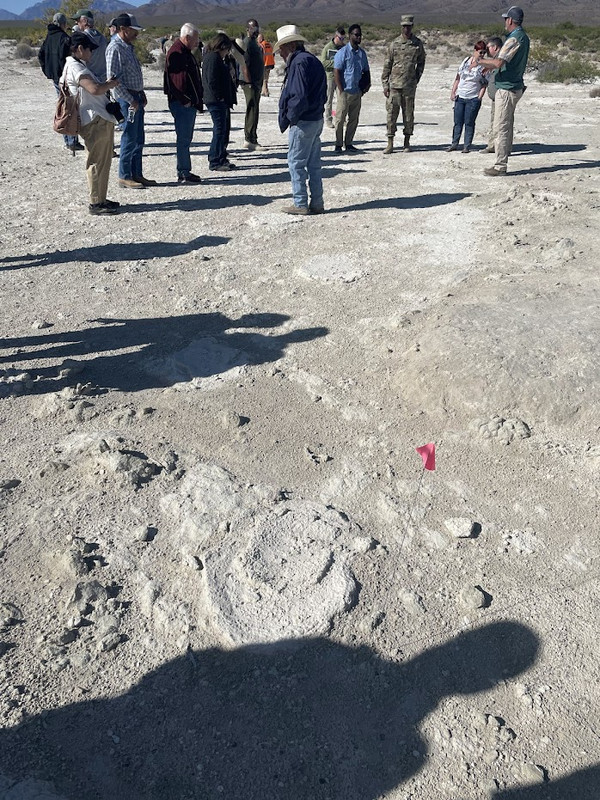 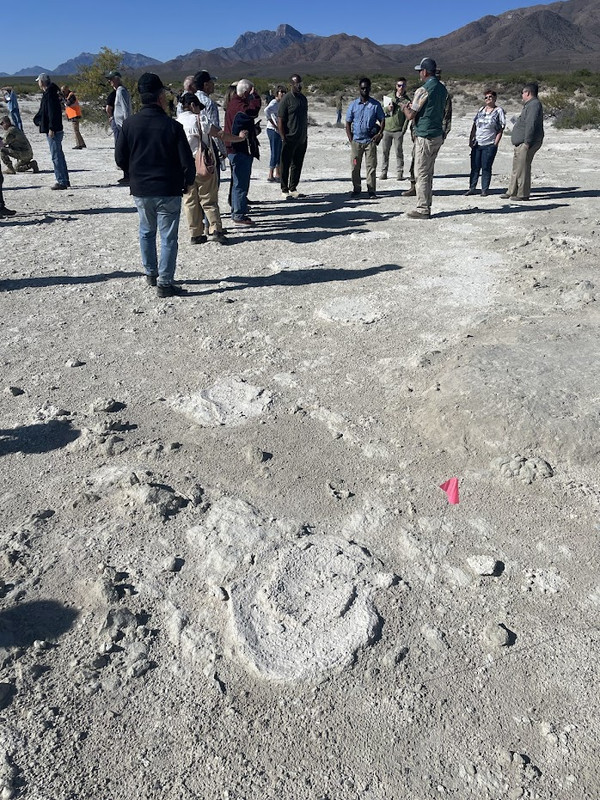 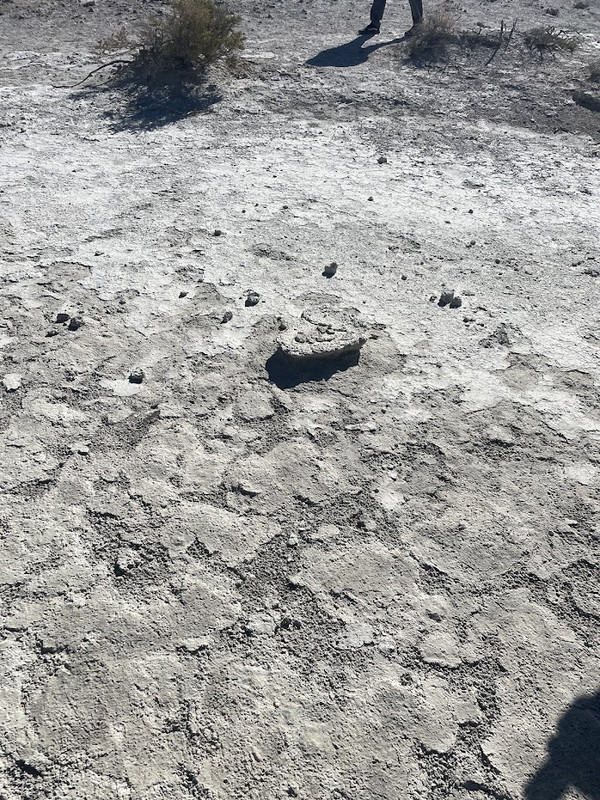 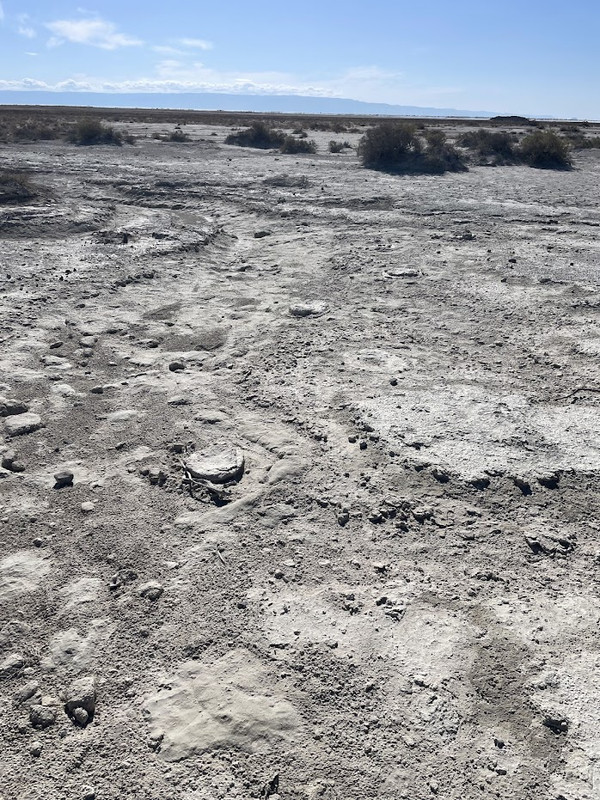 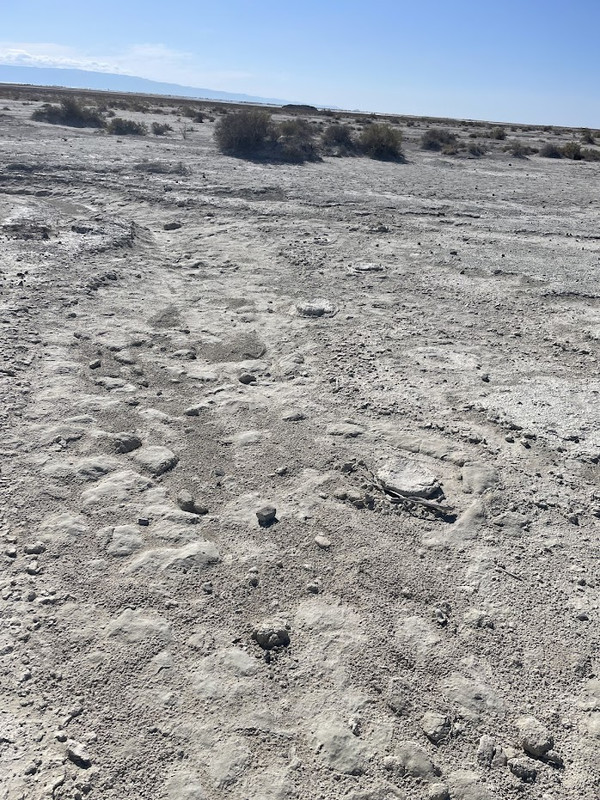 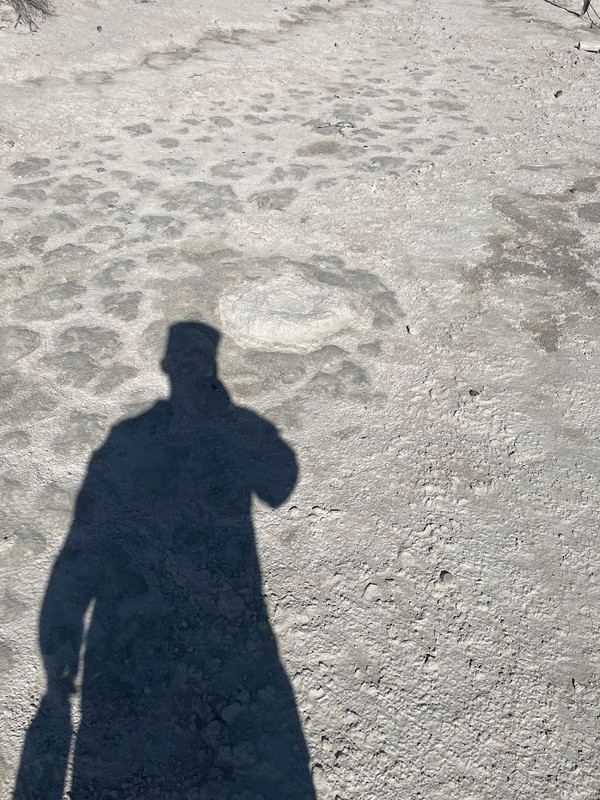 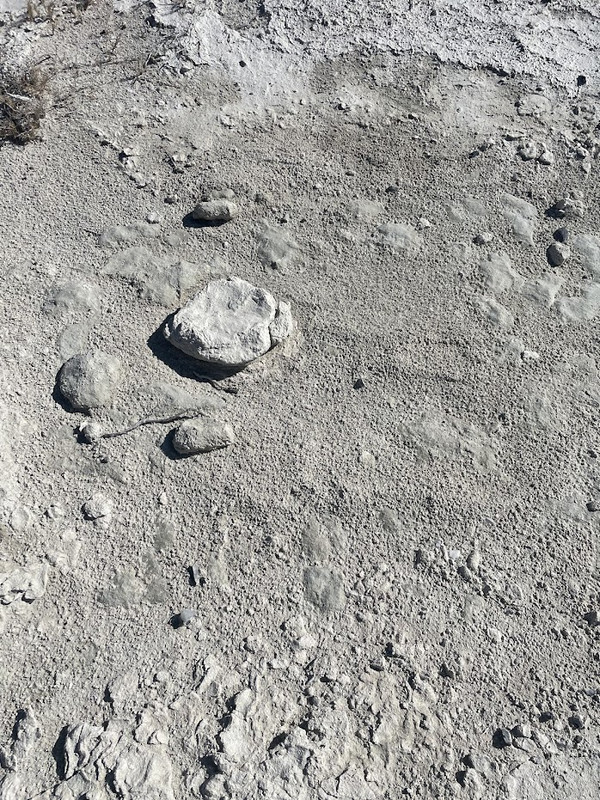 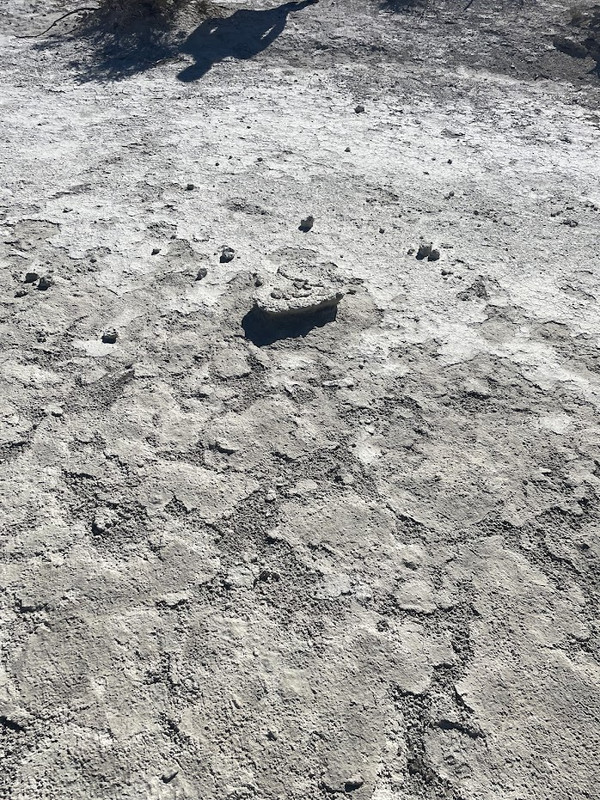 Unknown Track Still a mystery — no one’s sure what made this one. 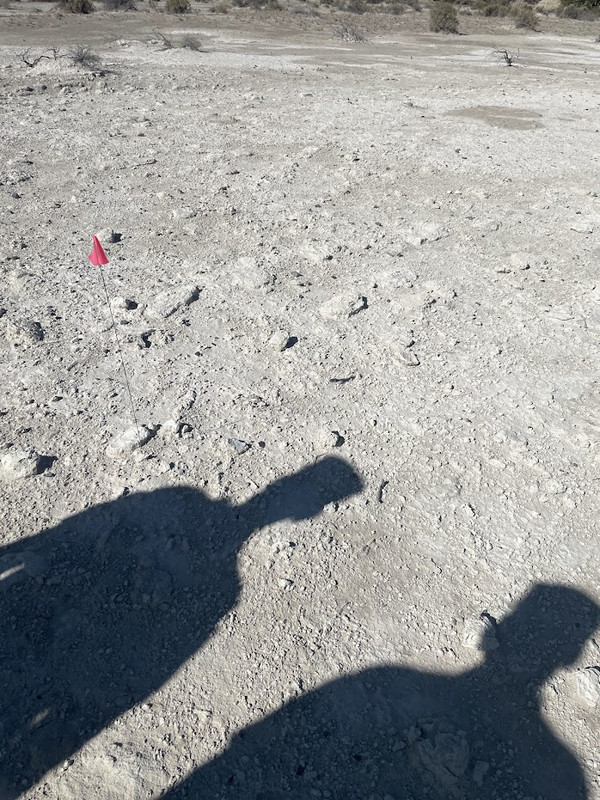 Sabertooth or Dire Wolf Track Could be from a large cat or massive prehistoric wolf — either way, not something you’d want to run into back then.  Another Giant Sloth Print Big, deep, and unmistakable. 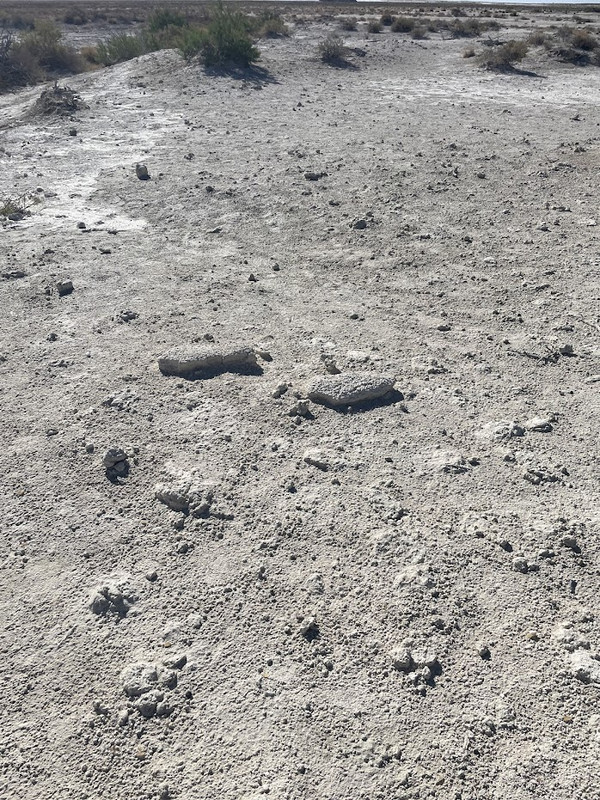 Mixed Trackway: Sloth + Camel/Horse Two very different animals walked the same ground — possibly at the same time.  Background Roughly 30,000 to 10,000 years ago, this region was part of a vast Ice Age environment. What is now arid desert was once covered by a large freshwater lake surrounded by wetlands. This ancient landscape attracted a variety of Ice Age creatures — mammoths, mastodons, camels, dire wolves, saber-tooth cats, giant ground sloths — along with the earliest known humans in North America. The soft lakebed preserved thousands of footprints that were later buried under sediment. Today, erosion and seasonal weather events expose some of these prints, giving researchers a rare glimpse into daily life during the late Pleistocene. This fossilized tracksite is one of the oldest of its kind anywhere — a remarkable link to the past hidden in plain sight. |
|
Originally Posted By mcculver5: Link doesn't work for me. Subscription only? Originally Posted By mcculver5: Originally Posted By DaGoose: New paper on the White Sands footprints. Paleolake geochronology supports Last Glacial Maximum (LGM) age for human tracks at White Sands, New Mexico Paper: Paleolake geochronology supports Last Glacial Maximum (LGM) age for human tracks at White Sands, New Mexico Link doesn't work for me. Subscription only? Works for me. Using Edge with no addons. Which browser/addons you using? Try this one too. It's to the main page. The other was to the PDF. https://www.science.org/doi/full/10.1126/sciadv.adv4951 |
|
Originally Posted By DaGoose: Works for me. Using Edge with no addons. Which browser/addons you using? Try this one too. It's to the main page. The other was to the PDF. https://www.science.org/doi/full/10.1126/sciadv.adv4951 That worked. Thanks to you and raccoonbagshispants for he assist.  Oh, I just use whatever bullshit comes with my Samsung phone. I'll probably be kilt in that streets. |
Originally Posted By FLAL1A:
"Pretty much the only thing that keeps me paying my taxes and not turning my house into a chickenshit particle board and stucco compound is the fact that the police occasionally kill douchebag criminals in comical ways.
"Pretty much the only thing that keeps me paying my taxes and not turning my house into a chickenshit particle board and stucco compound is the fact that the police occasionally kill douchebag criminals in comical ways.
|
Originally Posted By RakkinBaggyPants: Here is a fossilized trackway you won’t find on any map, ancient footprints left in soft mud somewhere between 32,000 and 35,000 years ago. This wasn't the widely publicized site from the nearby national park. It’s an entirely separate area. There are tracks of humans, mammoths, mastodons, ancient camels or horses, dire wolves, saber-tooth cats, and giant ground sloths, all who once walked across this same stretch. There’s even evidence of a very old hearth, an ancient campfire likely 5,000 to 10,000 years old. Over time, it sank through the layers and now rests among these Ice Age footprints, offering another glimpse into early human presence. Most of these prints will be naturally erased by this year’s seasonal rains. Teams are working quickly to document everything before nature reclaims it. Ancient Hearth Looks like just a dark patch, but this is where someone built a fire thousands of years ago — long after the big animals passed through. https://i.postimg.cc/5NBkhQDF/Ancient-Hearth.jpg Camel or Horse Track Hard to say for sure, but definitely one of the large hoofed animals that used to roam this area. https://i.postimg.cc/N0MJ2JF1/Camel-Horse.jpg Giant Ground Sloth Tracks & Pathway Massive Ice Age creature — these prints follow its path along an old lakeshore. https://i.postimg.cc/pLkcTbWW/Giant-Sloth-1.jpg https://i.postimg.cc/4xXFsNT2/Giant-Sloth-2.jpg https://i.postimg.cc/MGFs77fg/Giant-Sloth-Path-1.jpg https://i.postimg.cc/yd3LvDFx/Giant-Sloth-Path-2.jpg https://i.postimg.cc/zvm0Mqjj/Giant-Sloth-Path-3.jpg Gypsum Crystals These are the raw form of what eventually becomes white sand dunes. They break down and blow across the basin over time. https://i.postimg.cc/j2zZYB3r/Gypsum-1.jpg https://i.postimg.cc/9FhLYFzX/Gypsum-2.jpg https://i.postimg.cc/QN567W8n/Gypsum-3.jpg Human Footprints These could be among the oldest known human tracks in North America. https://i.postimg.cc/XYNxtHwT/Human.jpg https://i.postimg.cc/pXJqGbnf/Human-2.jpg Wide View of Track Area https://i.postimg.cc/2SHTYQG3/IMG-7906.jpg Mammoth or Mastodon Tracks The size of these prints is hard to grasp until you're standing next to one — some are nearly a yard across. https://i.postimg.cc/g0ns2xts/Mammoth-1.jpg https://i.postimg.cc/d0pBkJzY/Mammoth-2.jpg https://i.postimg.cc/0QSC7LsJ/Mammoth-3.jpg https://i.postimg.cc/8khHcQ42/Mammoth-4.jpg https://i.postimg.cc/prtJCqWc/Mammoth-5.jpg https://i.postimg.cc/QCkky1V8/Mammoth-6.jpg https://i.postimg.cc/WbT7JWfh/Mammoth-7.jpg https://i.postimg.cc/jSjQMWTT/Mammoth-8.jpg https://i.postimg.cc/K8s7wZcM/Mammoth-9.jpg Unknown Track Still a mystery — no one’s sure what made this one. https://i.postimg.cc/CKBCVWd6/No-Clue.jpg Sabertooth or Dire Wolf Track Could be from a large cat or massive prehistoric wolf — either way, not something you’d want to run into back then. https://i.postimg.cc/yNMm6vZ6/Sabertooth-Dire-Wolf.jpg Another Giant Sloth Print Big, deep, and unmistakable. https://i.postimg.cc/7Y8Wtntk/Sloth.jpg Mixed Trackway: Sloth + Camel/Horse Two very different animals walked the same ground — possibly at the same time. https://i.postimg.cc/xCLKXMvv/Sloth-and-Horse-Camel.jpg Background Roughly 30,000 to 10,000 years ago, this region was part of a vast Ice Age environment. What is now arid desert was once covered by a large freshwater lake surrounded by wetlands. This ancient landscape attracted a variety of Ice Age creatures — mammoths, mastodons, camels, dire wolves, saber-tooth cats, giant ground sloths — along with the earliest known humans in North America. The soft lakebed preserved thousands of footprints that were later buried under sediment. Today, erosion and seasonal weather events expose some of these prints, giving researchers a rare glimpse into daily life during the late Pleistocene. This fossilized tracksite is one of the oldest of its kind anywhere — a remarkable link to the past hidden in plain sight. Originally Posted By RakkinBaggyPants: Originally Posted By DaGoose: New paper on the White Sands footprints. Paleolake geochronology supports Last Glacial Maximum (LGM) age for human tracks at White Sands, New Mexico Paper: Paleolake geochronology supports Last Glacial Maximum (LGM) age for human tracks at White Sands, New Mexico Here is a fossilized trackway you won’t find on any map, ancient footprints left in soft mud somewhere between 32,000 and 35,000 years ago. This wasn't the widely publicized site from the nearby national park. It’s an entirely separate area. There are tracks of humans, mammoths, mastodons, ancient camels or horses, dire wolves, saber-tooth cats, and giant ground sloths, all who once walked across this same stretch. There’s even evidence of a very old hearth, an ancient campfire likely 5,000 to 10,000 years old. Over time, it sank through the layers and now rests among these Ice Age footprints, offering another glimpse into early human presence. Most of these prints will be naturally erased by this year’s seasonal rains. Teams are working quickly to document everything before nature reclaims it. Ancient Hearth Looks like just a dark patch, but this is where someone built a fire thousands of years ago — long after the big animals passed through. https://i.postimg.cc/5NBkhQDF/Ancient-Hearth.jpg Camel or Horse Track Hard to say for sure, but definitely one of the large hoofed animals that used to roam this area. https://i.postimg.cc/N0MJ2JF1/Camel-Horse.jpg Giant Ground Sloth Tracks & Pathway Massive Ice Age creature — these prints follow its path along an old lakeshore. https://i.postimg.cc/pLkcTbWW/Giant-Sloth-1.jpg https://i.postimg.cc/4xXFsNT2/Giant-Sloth-2.jpg https://i.postimg.cc/MGFs77fg/Giant-Sloth-Path-1.jpg https://i.postimg.cc/yd3LvDFx/Giant-Sloth-Path-2.jpg https://i.postimg.cc/zvm0Mqjj/Giant-Sloth-Path-3.jpg Gypsum Crystals These are the raw form of what eventually becomes white sand dunes. They break down and blow across the basin over time. https://i.postimg.cc/j2zZYB3r/Gypsum-1.jpg https://i.postimg.cc/9FhLYFzX/Gypsum-2.jpg https://i.postimg.cc/QN567W8n/Gypsum-3.jpg Human Footprints These could be among the oldest known human tracks in North America. https://i.postimg.cc/XYNxtHwT/Human.jpg https://i.postimg.cc/pXJqGbnf/Human-2.jpg Wide View of Track Area https://i.postimg.cc/2SHTYQG3/IMG-7906.jpg Mammoth or Mastodon Tracks The size of these prints is hard to grasp until you're standing next to one — some are nearly a yard across. https://i.postimg.cc/g0ns2xts/Mammoth-1.jpg https://i.postimg.cc/d0pBkJzY/Mammoth-2.jpg https://i.postimg.cc/0QSC7LsJ/Mammoth-3.jpg https://i.postimg.cc/8khHcQ42/Mammoth-4.jpg https://i.postimg.cc/prtJCqWc/Mammoth-5.jpg https://i.postimg.cc/QCkky1V8/Mammoth-6.jpg https://i.postimg.cc/WbT7JWfh/Mammoth-7.jpg https://i.postimg.cc/jSjQMWTT/Mammoth-8.jpg https://i.postimg.cc/K8s7wZcM/Mammoth-9.jpg Unknown Track Still a mystery — no one’s sure what made this one. https://i.postimg.cc/CKBCVWd6/No-Clue.jpg Sabertooth or Dire Wolf Track Could be from a large cat or massive prehistoric wolf — either way, not something you’d want to run into back then. https://i.postimg.cc/yNMm6vZ6/Sabertooth-Dire-Wolf.jpg Another Giant Sloth Print Big, deep, and unmistakable. https://i.postimg.cc/7Y8Wtntk/Sloth.jpg Mixed Trackway: Sloth + Camel/Horse Two very different animals walked the same ground — possibly at the same time. https://i.postimg.cc/xCLKXMvv/Sloth-and-Horse-Camel.jpg Background Roughly 30,000 to 10,000 years ago, this region was part of a vast Ice Age environment. What is now arid desert was once covered by a large freshwater lake surrounded by wetlands. This ancient landscape attracted a variety of Ice Age creatures — mammoths, mastodons, camels, dire wolves, saber-tooth cats, giant ground sloths — along with the earliest known humans in North America. The soft lakebed preserved thousands of footprints that were later buried under sediment. Today, erosion and seasonal weather events expose some of these prints, giving researchers a rare glimpse into daily life during the late Pleistocene. This fossilized tracksite is one of the oldest of its kind anywhere — a remarkable link to the past hidden in plain sight. @RakkinBaggyPants Where were those pictures from (article/self taken)? |
|
Overview of the Aircraft carriers of WW2. Aircraft Carriers of World War II - The Navy's Strong Arm  Aircraft Carriers of World War II - The Navy's Strong Arm |
|
Originally Posted By RakkinBaggyPants: I took them when we were hosting a Rancher Appreciation Day. Originally Posted By RakkinBaggyPants: Originally Posted By DaGoose: @RakkinBaggyPants Where were those pictures from (article/self taken)? I took them when we were hosting a Rancher Appreciation Day. Nice! Thanks for sharing. |
|
Short presentation on escort carriers in WW2. Escort Carriers  Escort Carriers |
|
Presentation on the A-1 Skyraider over it's career. The Douglas A-1 Skyraider: A Historical Presentation  The Douglas A-1 Skyraider: A Historical Presentation |
|
Originally Posted By RakkinBaggyPants: I took them when we were hosting a Rancher Appreciation Day. Originally Posted By RakkinBaggyPants: Originally Posted By DaGoose: @RakkinBaggyPants Where were those pictures from (article/self taken)? I took them when we were hosting a Rancher Appreciation Day. That's awesome. |
Originally Posted By FLAL1A:
"Pretty much the only thing that keeps me paying my taxes and not turning my house into a chickenshit particle board and stucco compound is the fact that the police occasionally kill douchebag criminals in comical ways.
"Pretty much the only thing that keeps me paying my taxes and not turning my house into a chickenshit particle board and stucco compound is the fact that the police occasionally kill douchebag criminals in comical ways.
|
Presentation on the American industrial might in WW2. Arsenal of Democracy  Arsenal of Democracy "The U.S. built 300,000 airplanes in World War II, 50 percent more than Germany, Japan and Italy combined. Watch this video to see how this and other American wartime manufacturing miracles were performed. Lead museum docent Les Doggrell starts by telling us that while the Great Depression had slowed many American industries, they weren't dead. Even in 1938, with war clouds gathering in the Pacific and Europe, the U.S. produced more steel than Germany and mined almost double the amount of coal. On the other hand, with many factories still idle there was a big reserve of industrial equipment and unemployed citizens available for immediate work. By May 1940, Les says, President Roosevelt called for a reinvigoration of manufacturing for what he saw as the coming war. He urged Congress to increase military funding from $24 million to $700 million, saying, “I should like to see this nation geared up to the ability to turn out at least 50,000 planes a year.” Roosevelt knew businesses would have to transform to meet his goals so he recruited business leaders who knew how to build complex products quickly and in large numbers. He started with William Knudsen, President of General Motors. Knudsen assembled a team of industrialists to work out the problems of mass-producing aircraft and other military goods. Knudsen also promoted policies that would make companies more willing to do business with the government. He and his team were able to get companies like automaker Chrysler to invest millions in new facilities to produce tanks and anti-aircraft guns. Ford built a mile-long assembly line to manufacture B-24 bombers. Henry Kaiser set up a series of shipyards on the Pacific coast that turned out cargo ships at a record rate. But before all that, around the time of Pearl Harbor in 1941, it was a challenge to find enough workers to do the job. Many young men were drafted. Two key groups, women and African Americans, helped close the gap. “Rosie the Riveter” was popularized in songs and illustrations. Many African Americans took jobs in manufacturing. By the end of the war in 1945, the U.S. had turned out 300,000 aircraft, including 96,000 bombers, and billions of dollars’ worth of equipment and supplies to field a truly global fighting force. American society had also changed in remarkable ways. In short, Les tells us how U.S. industry, in cooperation with the federal government, supplied not only the largest American fighting force of the war but those of many U.S. Allies as well." |
|
Short video on Gesher Benot Ya’aqov. Isn't real in-depth, but he has a lot of links in the video description if you want to go down the rabbit hole. This Discovery Rewrites Human History Forever - Gesher Benot Ya’aqov  This Discovery Rewrites Human History Forever |
|
Short video on comet/asteroid impacts. Isn't real in-depth, but he has a lot of links in the video description if you want to go down the rabbit hole. The Terrifying Reason Ancient People Feared the Sky  The Terrifying Reason Ancient People Feared the Sky |
|
Short video on the Green Sahara. Isn't real in-depth, but he has a lot of links in the video description if you want to go down the rabbit hole. An Entire Civilization Might Be Buried Under the Sahara  An Entire Civilization Might Be Buried Under the Sahara |
|
Biography of Audie Murphy. Audie Murphy: Great American Hero | Full Documentary | Biography  Audie Murphy: Great American Hero | Full Documentary | Biography |
|
Presentation on the SPHEREx telescope. PSW 2514 SPHEREx | Jamie Bock  PSW 2514 SPHEREx | Jamie Bock April 25, 2025 SPHEREx: An All-sky Infrared Spectral Survey Explorer Satellite James J. Bock Marvin L. Goldberger Professor of Physics Jet Propulsion Laboratory Senior Research Scientist Caltech The Spectro-Photometer for the History of the universe, Epoch of Reionization, and Ices Explorer (“SPHEREx”) is an all-sky survey satellite launching in early 2025. A mission in NASA’s Medium Explorer (MIDEX) program, it will probe the physics of cosmic inflation, chart the origin and history of galaxy formation, and study the origin of water and biogenic molecules in ices in interstellar space. As a new member of a tradition of all sky missions, SPHEREx will be the first near-infrared survey. It will produce four complete all-sky maps that will serve as a rich archive for the astronomy community, containing spectra of over a billion galaxies, hundreds of millions of high-quality stellar and galactic spectra, and over a million ice absorption spectra. The archive will enable a wide range of investigations that will inform and expand many aspects of astronomical and cosmological knowledge and understanding. James (Jamie) Bock is an experimental cosmologist and the Principal Investigator of the SPHEREx mission (Spectro-Photometer for the History of the universe, Epoch of Reionization, and Ices Explorer). His research focuses on pioneering new technologies and instruments designed for fundamental measurements of the state of the universe. Prior to SPHEREx, Jamie developed an instrument architecture with wide-field telescopes and superconducting bolometer arrays to search for a telltale polarization signal in the Cosmic Microwave Background (CMB) associated with a background of gravitational waves from cosmic inflation. It is central to the BICEP-Keck experiment based at the South Pole observations from which have led to constraints on inflation. He also led the development of an earlier generation of focal plane detectors for the Planck and Herschel satellites. These devices arose from detectors he pioneered as a graduate student for the BOOMERANG CMB project that provided initial evidence that the universe has a flat geometry. Finally, he developed a novel sounding rocket project to study the near-infrared extragalactic background light with small, specialized imaging and spectroscopic telescopes. Many of these methods were later incorporated into the design of SPHEREx. Jamie is an author on over 800 scientific papers, mainly focused on technology, astronomy, and cosmology. Among other honors and awards, he received the Gruber Cosmology Prize as a member of the Planck team, the AAS Weber Award for Astronomical Instrumentation, and the SPIE Goddard Award. Jamie earned a BS in Physics and Mathematics at Duke and a PhD in Physics at UC Berkeley. |
|
Interesting presentation on planetary/solar system formation. PSW 2515 Real Time Observations of Early Solar System Evolution | Carey Lisse  PSW 2515 Real Time Observations of Early Solar System Evolution | Carey Lisse Real-Time Observations of Early Solar System Evolution: The Case of ~1 Myr Old Sun-like RW Aurigae A Carey Lisse Senior Scientist Johns Hopkins University Applied Physics Laboratory The RW Auriga T-Tauri System (“RW Aur A”) is a special laboratory for studying processes occurring in very young T Tauri stars, like the Sun was at ~1 Myr age. This lecture will discuss recent evidence for destructive accretion of migrating differentiated asteroids in the evolution of the solar system in the RW AurA system. These observations start with a tremendous drop in RW Aur A’s normal visible and soft XUV emission reported from Chandra in 2017. This, coupled with an observed concomitant large increase in Fe K-shell X-rays, suggested that huge amounts of obscuring gaseous Fe and fine “neutral” refractory rocky dust able to withstand temperatures greater than 1600 K was quickly created around a central protostar. Subsequent near-infrared spectrophotometric observations exhibited evidence for a highly excited system with a bright, hot, asymmetric accretion disk, numerous hot atomic emission lines from the protostar’s atmosphere, and a new stochastic emission event in its high-speed focused outflow jets moving away at 100 – 200 km/s. The hot (T~20,000K) bifurcated jet spectral signature a few years later was seen to decay back to its normal pre-event level, suggesting that Vesta-sized amounts of excess hot Fe and S, from a disrupted object’s core had been blown out of the system’s jets in ~7 years. Conspicuously absent in the jet spectral signatures were any traces of rock forming elements like Ca, Mg, Na, K, or Al that occur planetesimal lithospheres. These species must have remained in the solid phase, producing the large amounts of reported new “neutral extinctors” in the protostar’s atmosphere and the signatures of refractory inclusions and chondrules found in Spitzer IRS spectra of the system. Overall, we believe these observations are explained by the catastrophic disruption of a primordial, differentiated, migrating planetesimal, of ~250 km radius, similar in size to the largest asteroids in our solar system, ejecting its iron core material, and the reprocessing and redistribution of its rocky components into materials akin to the first solids found in our own solar system. This processing, which appears to be starting again now, is consistent with theories that all the solar system’s asteroids were first formed big with liquid metal cores, then disrupted and re-accreted into the bodies seen today. Carey M. Lisse is Principal Staff Scientist in the Applied Physics Laboratory at Johns Hopkins University. Prior to assuming his current position he held a variety of posts at APL and NASA. Carey has been active in the fields of astronomy and physics for four decades. He began his career as an instrument scientist at NASA/Goddard and worked on the Nobel prize-winning COBE project. He later turned his attention to planetary studies, writing his dissertation on comets detected in the COBE all sky survey. Since then he has focused primarily on solar system relic fossils, like comets, making important discoveries about their X-ray emissions and working from start to finish on the NASA Deep Impact (DI) mission, including using the Spitzer Space Telescope to observe dust excavated from the comet 9P/Tempel 1 by the DI Impactor. He also studies asteroids and x-ray emission from planets, and searches for the presence of asteroids and comets around other stars. He has also served as a member of the New Horizons and SPHEREx science teams. He last spoke at PSW in 2016. Among other honors, Carey received awards as part of the COBE team, the JPL Stardust flight team, the EPOXI flight team, and the New Horizons Science Team. He is the recipient of a Space Telescope Science Institute Science Merit Award, a Space Foundation Space Achievement Award, a Johns Hopkins Applied Physics Laboratory Special Achievement Award, and he was awarded the Isaac Newton Institute Visiting Fellowship at Cambridge University. Carey is a AAAS Fellow, and The Asteroid 12226 Caseylisse is named for him. Carey also has appeared in numerous documentaries about planetary science and cosmology. Carey earned a BA in Chemistry at Princeton, an MS in Chemistry at UC-Berkeley, and an MS and a PhD in Physics at U. Maryland – College Park. |
|
Interesting presentation on a Muon collider. PSW 2516 The Path to an Energy Frontier Muon Collider | Mark Palmer  PSW 2516 The Path to an Energy Frontier Muon Collider | Mark Palmer The Path to an Energy Frontier Muon Collider A US Muon Shot to Explore the Fundamental Forces and Constituents of the Universe Mark Palmer Chair, Accelerator Facilities Division Brookhaven National Laboratory A Muon Collider offers a unique path to multi-TeV, high-luminosity lepton collisions. Muon collisions with a center-of-mass energy of 10 TeV or above would offer tremendous discovery potential where the constituent collision energies exceed those of the Large Hadron Collider physics program by an order of magnitude. Successful development of this concept would enable systematic exploration of the highest energy scales and smallest distance scales accessible with terrestrial devices. Significant progress on the fundamental R&D and design concepts for the required technologies along with the continued evolution of the high energy physics landscape has led to significant support in Europe and the US to further develop the Muon Collider concept. An international effort to prepare a full conceptual design and assess the viability of such a machine aims to evaluate this option for a future collider within the next few years. The physics challenges and the R&D program required to deliver this machine will be described. The aspiration of many US high energy physicists is to reinvigorate US leadership in the exploration of the particle physics “energy frontier.” The Muon Collider concept provides a pathway that could be executed on US soil and would enable multiple generations of researchers in their quest for understanding the fundamental laws that govern our universe. Mark Palmer is Chair of the Accelerator Science and Technology Department at Brookhaven National Laboratory. He also is Chair-Elect of the American Physical Society’s Division of Physics of Beams. Previously, he was Director of Brookhaven’s Accelerator Test Facility (ATF), a DOE Office of Science User Facility that provides high brightness electron beams, near infrared laser beams, and long-wave infrared beams to users for accelerator science and technology development;. From 2012-2016, he headed the US Muon Accelerator Program (MAP) at Fermilab, which conducted research into muon accelerator technologies for future neutrino beam and lepton collider facilities. And from 2008-2012, he was the project director of the CESR Test Accelerator (CesrTA) research program at Cornell University, which carried out R&D for linear collider damping ring efforts. He is author or co-author on over 200 scholarly articles and book contributions. Among other service to science and the nation, Mark served as a member of the 2023 Particle Physics Project Prioritization Panel that advised the Department of Energy and the National Science Foundation, and he served on numerous advisory and review panels for the US DOE, NSF, and other international research organizations. Mark earned an AB, MA and PhD in Physics at Princeton University. His doctoral advisor was Val Fitch. |
|
Interesting presentation on commercial fusion power. PSW 2517 Commercial Fusion Power | Alex Creely  PSW 2517 Commercial Fusion Power | Alex Creely June 13, 2025 Commercial Fusion Power High Temperature Superconducting Magnets and Compact Tokamak Power Plants Alex Creely Director of Tokamak Operations Chief Engineer for ARC Conceptual Design Commonwealth Fusion Systems Fusion energy has the potential to provide large quantities of firm, clean, carbon-free energy in the near term and to continue doing so for the foreseeable future. Commonwealth Fusion Systems (“CFS”) is building on decades of fusion research from around the world, focusing on a type of fusion plant called a tokamak. Having demonstrated a new type of high field superconducting magnet in 2021, CFS is now building a high-field tokamak called SPARC, aiming to achieve net fusion energy production in 2027 in a compact, economical facility. In parallel, CFS is also in the early stages of designing a 400 MW electric fusion power plant called ARC, with a site recently announced outside of Richmond, Virginia. This talk will describe the Commonwealth Fusion Systems path to a fusion power plant, where the SPARC and ARC tokamaks sit on this path, and the broader fusion energy ecosystem. Alex Creely is the Chief Engineer at Commonwealth Fusion Systems (“CFS”) for the ARC conceptual design project, leading technical aspects of the design of the world’s first fusion power plant. He also leads the Tokamak Operations groups within the SPARC project, preparing the tools and team for operation of SPARC, and optimizing the path to net energy production. Alex joined CFS in 2019 with the goal of putting fusion energy on the grid quickly enough to make a difference to climate change. He was the lead author on the physics basis for the SPARC tokamak and has played a key role in building several functions within the company. Alex’s PhD work at MIT focused on building and operating specialized instrumentation on tokamaks at both MIT and at the Max Planck Institute for Plasma Physics in Germany. This instrumentation measured small fluctuations in plasma temperature to determine how turbulence in fusion plasmas transported heat out of the tokamak. These measurements informed large simulation tools that have aided the design of both SPARC and ARC. In addition to his thesis work, Creely also led parts of early ARC design as part of a graduate student class at MIT, and he spent time working on a stellarator at the National Institute for Fusion Science in Japan. Creely earned a Bachelor of Science and Engineering in Mechanical Engineering at Princeton University and a PhD in Applied Plasma Physics at MIT. |
|
Interesting presentation about the samples returned from Bennu. PSW 2518 OSIRIS-Rex Brings Samples of Bennu to Earth | Jason Dworkin  PSW 2518 OSIRIS-Rex Brings Samples of Bennu to Earth | Jason Dworkin June 27, 2025 The 94th Joseph Henry Lecture OSIRIS-Rex Brings Samples of Bennu to Earth An Adventure of Planning, Luck and Unlikely Events Jason P. Dworkin Senior Scientist for Astrobiology Project Scientist, OSIRIS-REx NASA Goddard Space Flight Center NASA’s robotic Origins, Spectral Interpretation, Resource Identification, Security – Regolith Explorer (“OSIRIS-REx”) steroid sample return mission was designed to gather clues to answering a number of questions central to human experience: Where did we come from? What is our destiny? Asteroids are leftover remnants of the solar system formation process that can help address these questions and inform us about the history of the solar system. OSIRIS-REx was designed and operated by a partnership of science and engineering necessary to overcome the formidable challenges of reaching an asteroid, taking samples there and returning the samples securely and safely to earth. OSIRIS-REx launched in September 2016 and arrived at the asteroid Bennu two years later, in December 2018. After arriving it studied this carbonaceous B-type near-Earth asteroid asteroid and collected more than 120g of surface rocks. It returned the samples to Earth five years after arriving at Bennu, in September 2023. The samples have been intensely studied by an international science team They have revealed much about the history of the solar system and have provided tantalizing clues to the origin of life in ways, results that could not have been obtained without them. In particular, the samples have provided a pristine record of chemical processes that occurred in the early solar system prior to the origin of life and they have a provided a glimpse into processes that preceded the emergence of life. Jason Dworkin is the project scientist for the OSIRIS-REx asteroid sample return mission, and senior scientist for astrobiology at NASA Goddard Space Flight Center (GSFC). His research is on the organic species that were available for the origin and early evolution of life. He has focused particularly on extraterrestrial inputs and origin of molecules relevant for life. Over the last 40 years, Jason’s focus has been on increasingly documented and constrained systems, from plausibly early Earth chemistry, chemistry of astrophysically relevant laboratory ices, organic and chiral analysis of meteorites, analysis of samples returned from extra-terrestrial bodies, and how to protect that material from contamination. His research employs modern analytical methods to examine authentic samples of the early solar system as well as laboratory models of ancient environments. This involves both directing research in the Astrobiology Analytical Lab at GSFC and scientific leadership in NASA sample return and in situ missions. He has studied soluble organic compounds (with an emphasis on amino acids) formed from laboratory ices simulating astrophysical environments, in sample by returned by JAXA’s Hayabusa and Hayabusa2 missions and those returned by NASA’s Apollo, Stardust, and OSIRIS-REx missions. He is also now a participating scientist on JAXA’s MMX mission to return samples from Phobos and he serves as sample integrity scientist for the Mars Sample Return mission. Jason is an author on over 190 peer reviewed publications related to astrobiology. Among other honors and awards Jason has received a NASA Outstanding Leadership Medal, Maryland Chemist of the Year Award, Robert H. Goddard Center Director’s Award, numerous NASA team awards, including NASA Silver Achievement Medals, two Guinness World Records and, most recently, the Michael Collins National Air and Space Museum Trophy for Current Achievement. Asteroid (27347) Dworkin is named in his honor. Jason earned an AB in Biochemistry at Occidental College and a PhD in Biochemistry UC – San Diego. |
|
Good video on his tours with the Rangers in Iraq and Afghanistan. Official “Ranger” Documentary  Official “Ranger” Documentary Ranger is a true tale of war told by Sergeant David Waterhouse recalling his service in Iraq and Afghanistan. Seen through the eyes of a Special Operations soldier, this first hand account documents the brutality of combat, and the raw nature of killing and death. It's a journey of innocence lost and the scars of war etched into the minds of service members. An untold account everyone should hear. |
|
New data on 3I/ATLAS Paper: From a Different Star: 3I/ATLAS in the context of the Ōtautahi-Oxford interstellar object population model Exciting Updates About the 3rd Interstellar Comet 3I/ATLAS  Exciting Updates About the 3rd Interstellar Comet 3I/ATLAS 0:00 3I/ATLAS interstellar comet update 1:01 How this was found 2:45 Origins revealed! It's super weird 3:40 Thick disk and why it matters 4:50 It's ancient 6:20 What this implies 7:00 Best image so far - size and composition 8:00 Future observations 9:00 Hubble and JWST and also Mars 9:45 Conclusions and what's next? |
|
Interesting video on the planes captured by the Allies and sent back via escort carrier and cargo ship. The Reaper Was A Carrier Full Of The Luftwaffe's Secret Weapons  The Reaper Was A Carrier Full Of The Luftwaffe's Secret Weapons |
|
Interesting footage of the Pearl Harbor and Hong Kong attacks in WW2. Pearl Harbor Attack Archival Footage Inspection - Episode 504  Pearl Harbor Attack Archival Footage Inspection - Episode 504 |
|
Interesting short video on a water powered sawmill. Water Powered Mill: Historic Sawmill in Operation  Water Powered Mill: Historic Sawmill in Operation |
|
Heard of a few. 10 Math Facts That Will Blow Your Mind  10 Math Facts That Will Blow Your Mind 00:00-00:14 Intro 00:15-01:44 10: P-adic numbers 01:45-02:03 9: Gabriel’s Horn 02:04-02:41 8: The most optimal packing for 17 squares 02:42-03:49 7: Meta-logical contradictions 03:50-05:01 6: The monster group 05:02-06:32 5: The logistic map 06:33-07:03 4: Wild Singular Limits 07:04-07:32 3: The Birthday Problem 07:33-08:36 2: We can’t know most numbers 08:37-09:00 1: The Banach–Tarski paradox |
|
Good discussion around the war in China from 1937-1940. The War in China 1937-1940 - Episode 506  The War in China 1937-1940 - Episode 506 |
|
Interesting discussion around the battle of Nomonhan/Khalkhin Gol. The Battle of Nomonhan/Khalkhin Gol - Episode 507  The Battle of Nomonhan/Khalkhin Gol - Episode 507 This week Seth Paridon and co-host Jon Parshall dig into a little-known event that had massive implications on the future progression of the Pacific War. In 1939, the renegade Japanese Kwangtung Army decided, on their own, to launch an offensive against Soviet and Mongolian forces near the small village of Nomonhan. Initial Japanese successes were later destroyed when the Soviets launched a massive counter-offensive led by the one and only Georgy Zhukov. In a series of battles that lasted over several weeks in July and August 1939, Japan and the Soviet Union came incredibly close to outright war against one another. The crushing defeat that the Soviets threw on the Japanese forced a complete change in the IJA's future plans and led directly to the path to war with the United States, Great Britain and the Netherlands. |
|
Interesting discussion and videos of the Pearl Harbor salvage operations. Pearl Harbor Salvage Operations January-May 1942 Archival Footage - Episode 508  Pearl Harbor Salvage Operations January-May 1942 Archival Footage - Episode 508 This week Seth Paridon and Jon Parshall take a look at some really, really cool National Archives archival footage. The guys dig into the records of Hollywood director John Ford's Field Photographic Unit that operated on Oahu, mainly at Kaneohe and Pearl Harbor from February-May 1942. In a startling, but super cool, discovery, the guys find footage of VB6's SBD B-15 in flight, one of two SBDs still in Yorktown's hangar to this day. A major portion of this episode focuses on footage that Ford shot of the resurrection, repair, and refloating of the US Navy's battleships at Pearl Harbor. USS California (BB-44), USS West Virginia (BB-48) and USS Nevada (BB-35) are all shown in various stages of having water pumped out, refloated, repaired and put in dry dock. The shots of West Virginia's torpedo damage is stark to say the least. Views of USS Arizona (BB-39), as well as the Big E, USS Enterprise (CV-6) in all her glory are also seen. Give this one a view--you won't be disappointed. National Archives Reel Numbers: 428npc47614, 47615, 47616, and 47617 428npc47620, 47621 428npc47623 428npc47625, 47626, 47627, 47628, and 47629 428npc47631 428npc47634, 47635, 47636 |
|
Has some nice pictures/video of the quarries. Inside Egypt’s Granite Quarries  How the Ancient Egyptians Quarried Granite: The Inside Scoop |

|
Originally Posted By RakkinBaggyPants: Here is a fossilized trackway you won’t find on any map, ancient footprints left in soft mud somewhere between 32,000 and 35,000 years ago. This wasn't the widely publicized site from the nearby national park. It’s an entirely separate area. There are tracks of humans, mammoths, mastodons, ancient camels or horses, dire wolves, saber-tooth cats, and giant ground sloths, all who once walked across this same stretch. There’s even evidence of a very old hearth, an ancient campfire likely 5,000 to 10,000 years old. Over time, it sank through the layers and now rests among these Ice Age footprints, offering another glimpse into early human presence. Most of these prints will be naturally erased by this year’s seasonal rains. Teams are working quickly to document everything before nature reclaims it. Ancient Hearth Looks like just a dark patch, but this is where someone built a fire thousands of years ago — long after the big animals passed through. https://i.postimg.cc/5NBkhQDF/Ancient-Hearth.jpg Camel or Horse Track Hard to say for sure, but definitely one of the large hoofed animals that used to roam this area. https://i.postimg.cc/N0MJ2JF1/Camel-Horse.jpg Giant Ground Sloth Tracks & Pathway Massive Ice Age creature — these prints follow its path along an old lakeshore. https://i.postimg.cc/pLkcTbWW/Giant-Sloth-1.jpg https://i.postimg.cc/4xXFsNT2/Giant-Sloth-2.jpg https://i.postimg.cc/MGFs77fg/Giant-Sloth-Path-1.jpg https://i.postimg.cc/yd3LvDFx/Giant-Sloth-Path-2.jpg https://i.postimg.cc/zvm0Mqjj/Giant-Sloth-Path-3.jpg Gypsum Crystals These are the raw form of what eventually becomes white sand dunes. They break down and blow across the basin over time. https://i.postimg.cc/j2zZYB3r/Gypsum-1.jpg https://i.postimg.cc/9FhLYFzX/Gypsum-2.jpg https://i.postimg.cc/QN567W8n/Gypsum-3.jpg Human Footprints These could be among the oldest known human tracks in North America. https://i.postimg.cc/XYNxtHwT/Human.jpg https://i.postimg.cc/pXJqGbnf/Human-2.jpg Wide View of Track Area https://i.postimg.cc/2SHTYQG3/IMG-7906.jpg Mammoth or Mastodon Tracks The size of these prints is hard to grasp until you're standing next to one — some are nearly a yard across. https://i.postimg.cc/g0ns2xts/Mammoth-1.jpg https://i.postimg.cc/d0pBkJzY/Mammoth-2.jpg https://i.postimg.cc/0QSC7LsJ/Mammoth-3.jpg https://i.postimg.cc/8khHcQ42/Mammoth-4.jpg https://i.postimg.cc/prtJCqWc/Mammoth-5.jpg https://i.postimg.cc/QCkky1V8/Mammoth-6.jpg https://i.postimg.cc/WbT7JWfh/Mammoth-7.jpg https://i.postimg.cc/jSjQMWTT/Mammoth-8.jpg https://i.postimg.cc/K8s7wZcM/Mammoth-9.jpg Unknown Track Still a mystery — no one’s sure what made this one. https://i.postimg.cc/CKBCVWd6/No-Clue.jpg Sabertooth or Dire Wolf Track Could be from a large cat or massive prehistoric wolf — either way, not something you’d want to run into back then. https://i.postimg.cc/yNMm6vZ6/Sabertooth-Dire-Wolf.jpg Another Giant Sloth Print Big, deep, and unmistakable. https://i.postimg.cc/7Y8Wtntk/Sloth.jpg Mixed Trackway: Sloth + Camel/Horse Two very different animals walked the same ground — possibly at the same time. https://i.postimg.cc/xCLKXMvv/Sloth-and-Horse-Camel.jpg Background Roughly 30,000 to 10,000 years ago, this region was part of a vast Ice Age environment. What is now arid desert was once covered by a large freshwater lake surrounded by wetlands. This ancient landscape attracted a variety of Ice Age creatures — mammoths, mastodons, camels, dire wolves, saber-tooth cats, giant ground sloths — along with the earliest known humans in North America. The soft lakebed preserved thousands of footprints that were later buried under sediment. Today, erosion and seasonal weather events expose some of these prints, giving researchers a rare glimpse into daily life during the late Pleistocene. This fossilized tracksite is one of the oldest of its kind anywhere — a remarkable link to the past hidden in plain sight. Endangered Dirt, that's a new one. |
The person who complains most, and is the most critical of others has the most to hide.
All truth passes through three stages. First, it is ridiculed. Second, it is violently opposed. Third, it is accepted as being self-evident.
All truth passes through three stages. First, it is ridiculed. Second, it is violently opposed. Third, it is accepted as being self-evident.
|
Interesting documentary around Kokera-buki. They have an interesting method to climbing trees. Inside Japan’s Unique Wooden Shingle Roofing Technique - Part 1  Inside Japan’s Unique Wooden Shingle Roofing Technique - Part 1 Inside Japan’s Unique Wooden Shingle Roofing Technique - Part 2  Inside Japan’s Unique Wooden Shingle Roofing Technique - Part 2 |
|
Interesting video on Wolf Rayet stars and them introducing dust to the galaxy. Paper: Carbon-rich Dust Injected into the Interstellar Medium by Galactic WC Binaries Survives for Hundreds of Years Bizarre Spiderweb Objects In the Milky Way Could Be Why We Exist  Bizarre Spiderweb Objects In the Milky Way Could Be Why We Exist 0:00 Iconic JWST image showing WR 140 1:20 Original discovery of WR140 and Wolf Rayet stars 5:10 How does this influence the galaxy? 6:15 More objects found in the Milky Way 8:15 Major effects of the dust 9:10 Proplyds found! and why it matters 11:00 Conclusions and what's next? |
|
Interesting video on a possible ball lightning. Papers are linked in the video description. Was Ball Lightning Phenomenon Captured on Video in Canada?  Was Ball Lightning Phenomenon Captured on Video in Canada? 0:00 Is this a ball lightning in Canada? 1:30 Previous observations and colors 3:10 Explanations and propositions on how this works - silicon hypothesis 5:30 Could this be microwave radiation? 6:20 Breakthrough from China - first video ever? 8:10 Frequencies and oscillations 9:30 Could this be fake? 10:20 Not ball lightning? Then what? 12:10 Why this is important and how this affects technology 14:05 Conclusions |
|
Good discussion around the build-up before WW2 started for the USA. FDR and the Preparation for War 1933-1940 - Episode 509  FDR and the Preparation for War 1933-1940 - Episode 509 This week Seth Paridon and Jon Parshall take a really deep dive into the preparation for the war that no one in the US wanted to fight. We have always said that it isn't like flipping on a light switch--the build-up had to start somewhere. Where did the US Naval and US Army build-up begin? In the heart of the Great Depression of all places. Seth and Jon get into an absolutely fascinating conversation about how American President Franklin Delano Roosevelt got his country ready to fight the war that he could see coming as far away as 1933. With a series of Naval acts proposed by the "Father of the Modern American Navy", Carl Vinson, FDR's government got shipbuilding, and the economy, back on track with a flurry of warship builds from 33-38. The guys get into the Vinson-Trammel Act of 1934, the Naval Act of 1938, the Two Ocean Navy Bill, the Peacetime Draft of 1940, and the massive uptick in aircraft production--all pointing to the effort to gear-up as the world deteriorated before our very eyes from 33-40. Check this one out...it is vitally important as to how we got where we eventually would in 1945. |
| Day Of Deceit: The Truth About FDR and Pearl Harbor and Last Hero: Wild Bill Donovan both show that FDR in fact was actively working to get America into WW2 and was not at all surprised about the attack on Pearl Harbor. |
per aspera ad astra
|
Some interesting footage that I hadn't seen before. Doolittle Raid Archival Footage Review - Episode 511  The Doolittle Raid Footage- Episode 511 |
|
Interesting discussion around the diplomacy before the Pearl Harbor attack. Diplomatic Warfare on the Road to Pearl Harbor Part 1 with Rich Frank - Episode 512  Diplomatic Warfare Before Pearl Harbor Part 1 with Rich Frank - Episode 512 This week Seth Paridon and Jon Parshall welcome their good friend, the "Grand Poo-Bah" of Pacific war historians, Rich Frank to the show to discuss the actions of Japan and the United States between the years 1938 and early 1941. Incidents such as the sinking of the USS Panay, FDR moving the fleet to Pearl Harbor, the Japanese move into Indochina, as well as, the Japanese siding with Hitler and Germany by signing the Tripartite Pact all equally led down the road to Pearl Harbor. The guys discuss each specific episode deeply and relay how they weigh in on the eventual decision by Japan to attack the United States at Pearl Harbor. The string of events that led to Pearl Harbor are all fascinating and of vital importance to the overall history of the Pacific War. This episode is the first in a series of several episodes where we trace the route from negotiations, through the attack and all the way to its aftermath. This is the beginning of THE ULTIMATE Pearl Harbor history series available anywhere. |