


|
Quoted:
If anyone needs an excuse to buy one of these... https://www.AR15.Com/media/mediaFiles/270037/k9pnb7mcr5141_jpg-1179009.JPG |
|
Next up is the bolt group:
Front 3/4 view: 
Rear view: 
It looks like Eric Cartman. Oblique top view showing the locking lever: 
Disassembled: 
If you are familiar with an HK91 or HK93, this will immediately look familiar to you because, while NONE of the parts will interchange, the mechanics themselves are absolutely identical and they disassemble in exactly the same way. If you hare or are familiar with a CETME L, something might look a little off. There's a reason for that..... Below is a comparison of CETME L (top) and LC (bottom) bolt groups: 
They are different because, on the L, the recoil assembly is housed in the stock. The collapsible stock on the LC precludes such placement of the recoil assembly and so it (the recoil assembly) had to be redesigned. This also meant that the "tail" at the back of the standard L bolt had to go and the resulting loss of mass was compensated for by lengthening the nose. The longer nose necessitated a shorter cocking tube support. In short, lots of stuff had to be redesigned. However, the trigger group remained unchanged. Now, you might say, "Wouldn't it have been simpler to just omit the cavity in the fixed stock and use the LC design in the L?" Wellllllll…...yes and no. Yes, it would have been logistically simpler to do so because both models would then use common internal parts. But the much beefier recoil assembly on the L model makes for a significantly more controllable rifle in full-automatic mode. Having shot both a CETME L and an HK33 (select fire version of the civilian HK93) in both full auto and semi-auto modes, I can tell you from experience that there is a marked difference in both recoil and controllability between the two rifles with a definite slant towards the CETME. Although I haven't shot the LC, I expect it to feel pretty much identical to the HK93. Here we see the stock, recoil assembly and bolt from both an L and LC laid out in approximately the same position they would rest if the rifle were assembled: 
The LC recoil assembly is longer than we see here but part of it is hidden within the bolt carrier. Notice that the L has two springs, a long recoil spring and a short (and very stout) buffer spring. The LC has a buffer spring too but it's built into the stock and not visible unless the stock is disassembled; something we are not going to do. I mentioned earlier that the cocking tube support is not interchangeable between the two rifles. That part is not normally removed from the rifle unless a repair is necessary so, in order to show you those bits, I'm going to recycle a picture of a pre-production MCM LC I took a while back when I visited their factory: 
Starting from the top left, we have an LC cocking tube support, bolt group and recoil assembly. Then we have the same parts from an L. The receivers are identical between the two rifles with only the internal parts varying. SO, you CAN convert one rifle to the other if you have the right parts but sourcing the parts might be a bit of a challenge. I think it far easier to just buy the one you want preassembled or, better yet, buy one of each! Here is a comparison of just the two recoil assemblies:  The white part at each end is some sort of polymer/pvc/plain ol' plastic of some sort: 
One of my ends was a bit chewed up. Consequently, the assembly will only fit into the bolt carrier one way but I believe it's supposed to be able to fit in either way. No biggie so long as it works. Earlier, I briefly explained that MCM has executed some changes to the rifles since they were first introduced. Reliability wasn't the issue but rather magazine fitment. As a result, MCM refers to rifles before the changes as "GEN 1" and rifles after the changes as "GEN 2". So how do you know which one you have? That's easy. All GEN 2 models have relief cuts in the bottom of the bolt carrier: 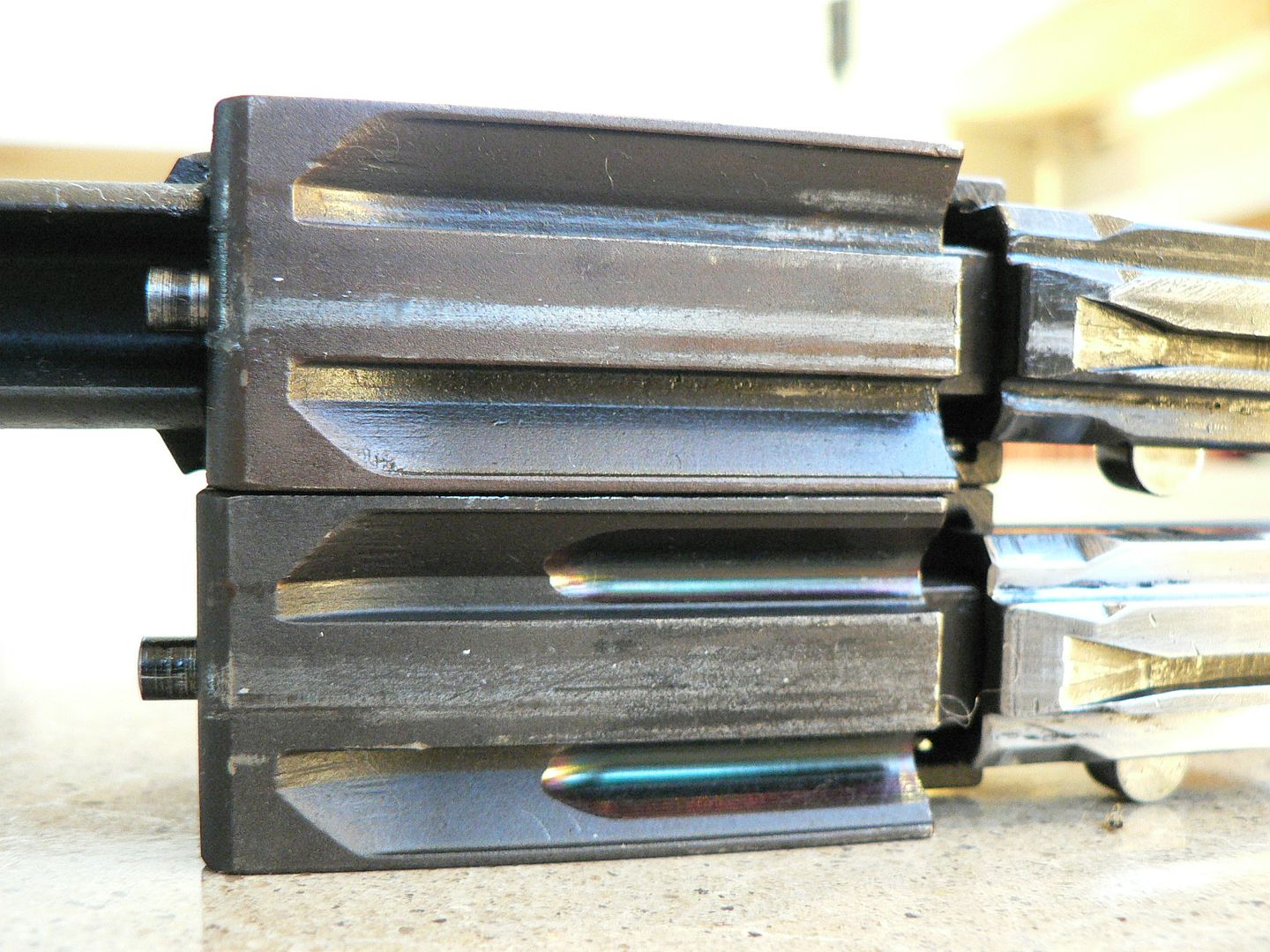
That's the GEN 2 on the bottom. This was necessary because, on a GEN 2, MCM has raised by a few thousandths of an inch where the magazine sits in the magazine well. I should point out here that on both GEN 1 and GEN 2 rifles, you will most likely notice over time that the finish near the front of the feed lips is worn away. This is normal. Here is a more detailed shot of the recesses on a GEN 2 bolt carrier:  A full bottom view of just the bolt carrier: 
Notice the marks on the bottom of the nose. Let's take a closer look at those: 
These are brass kisses form when the rifle was test fired. I don't know why but I like stuff like this. The front of the carrier after disassembly of the bolt group: 
Many will say that all of this is copied from HK. The fact is that, while I have no doubt the Spanish evaluated an HK33 during the design phase of this rifle, you have to remember that the original 7.62 HK was developed from the CETME C which preceded it. While this may seem blasphemy to some, I find that the CETME L/LC/L is, in many subtle ways more refined than the HK33. While HK chose to simply scale down the 7.62 rifle to create the 5.56 one, Spain decided design the 5.56 from the ground up AS a 5.56 rifle. While exploration of exactly why this may actually be the better solution is beyond the scope of this article, I recommend that you keep an open mind and do some research of your own to arrive at an unbiased conclusion. You should also keep in mind that the 5.56 CETME was also designed exclusively for Spanish government forces with no eye to export. The locking wedge: 
 Firing pin and spring:  Just the tip: 
Get your mind out of the gutter please. And the bolt head: 
Usually, you see these with a phosphate finish but, according to Dave Bane, almost all of the LC kits came with this part in the white and almost all of the LC kits appeared to be unissued. He has also found that some of the standard kits also have bolt heads with no finish. This has led him to believe (but he cannot prove) that a phosphate bolt head denotes a refurbished part. If that is true, then ALL 5.56 CETME rifles had bare steel bolt heads when they initially left the factory. Normally, MCM refinishes all of the steel parts including this part but it was decided to leave it unfinished on the LV model for the sake of originality. Front showing the bolt face and extractor: 
Just as MCM replaces all of the other springs during the rebuild process, they replace the extractor spring as well. For this part, chrome silicon which I am told is the best available in the industry. Rear:  Top:  Bottom: 
The machining leaves something to be desired but it works just fine. My L model runs like a top. While I didn't take a picture of them, the rollers are smooth and finely machined. And that's it for now. The last thing we need to look at for now is the stock so I'll leave it to you to figure out what we'll be looking at next time. See ya then! |
|
Great posts and photos.
MCM did an amazing job with these rifles. This is what a labor of love looks like. I'm very happy to have the opportunity to own them, a rifle I never thought I would be able to put hands on, let alone own. Attached File |
|
Mmmmm CETME-L and LC. I want an LV  4DCDE7E2-6D84-4DCF-853D-98A3F2868733 by Austin Scott, on Flickr 4DCDE7E2-6D84-4DCF-853D-98A3F2868733 by Austin Scott, on Flickr
|
They did a magnificent job 7DD9C74B-D74D-4441-8335-0A35B890E314_1_201_a by Austin Scott, on Flickr 7DD9C74B-D74D-4441-8335-0A35B890E314_1_201_a by Austin Scott, on Flickr
|
|
The only thing we haven't looked at yet is the stock so that's what we're gonna do now. Here, it's shown in the extended position alongside an HK93 stock for dimensional comparison:  And retracted:  The butt pad is steel wrapped in rubber and is the same one used on both the L and LV. As mentioned earlier, it's manufactured by MCM and is identical to an original when mounted: 
It's held on by two hex screws (originals were probably slotted) and, because the stock itself is of original Spanish manufacture, the screws are metric threaded. They are also NOT interchangeable with those found on the L and LV, both of which use a screw that is longer and has standard threads because their stocks are US made: 
That's the LC screw on the left in case you were wondering. A close-up of the butt with the pad removed showing the forge line:  The other side has a reinforcement rib:  The top mounted sling swivel is a separate welded on part that is either cast or forged:  The stock arms are attached bar stock with nicely dressed welds:  There is a cavity molded into the butt allowing it to telescope around the buffer tube when the stock is closed providing a more compact package: 
The circle seen in the middle of the cavity is a raised reinforced area that rides against the open-assist plunger built into the backplate. The who that rides against the what?? Keep reading and all will be revealed in the next picture. Here is the backplate: 
The large round bit houses the buffer spring and the little round rod sticking out of it is the spring loaded extension-assist plunger. If you're familiar with an HK A3 stock, it has one too. When you close the stock, the raised reinforced area we saw in the butt cavity pushes against the this rod and forces it into the buffer housing compressing its spring (NOT the buffer spring but a separate spring). Then, when you press the ribbed lock button on top the back plate to extend the stock, that little spring loaded rod pushes the butt plate back a few millimeters to assist you. The point of this is to allow you to extend the stock with one hand. If it wasn't on there, you would have to depress the lock button with one hand while pulling the stock to the rear with the other hand. This way, you press the button, the assist rod pushes the butt back a bit, you release the button and then you extend the stock...all with one hand. Nifty thrifty!! Here's a detail shot showing the rear of the buffer housing: 
I assume all the guts are held in by a threaded cap. The four holes are most likely for a special tool to fit into for unscrewing it. While I'd just LOVE to rip this thing apart, my better judgement tells me to just leave it alone so that's what I'm going to do...….I mean, it should be pretty obvious what makes this thing tick but I still realllly want to disassemble it and see.....we'd better move on now. Going back to this picture:
You can see a vertical line running down from the lock button. That's nothing more than where the two stamped sheet metal parts that comprise the main body of the backplate meet. Then the buffer tube is welded on. You can see this weld and it's very nicely done. A bottom view showing the weld: 
Note the reinforcement where the stock pins fit. A bottom three quarter view showing again how neat and clean the buffer tube weld is:  A closeup of the lock button: 
If you ask me, this setup is more ergonomic than the paddle arrangement on an HK stock. A view inside the backplate: 
The hollow tube in the center is the buffer plunger. When the bolt carrier nears the limit of its rearward movement during recoil, it contacts this plunger and through it compresses the buffer spring. The round hole at the top of the backplate is where the rear of the recoil spring assembly nests. Here, we see a cutout in the right side stock arm just forward of the butt: 
The left side stock arm has one too: 
These are engaged by magical lugs hidden deep inside the back plate, securing the stock in the closed position until the lock button is pressed. MAN....I wanna tear this thing apart so bad. Logic would dictate that if you have cutouts in the arms used to keep the stock closed, then you also must have cutouts that are used to secure it open. As Spock has shown again and again (or will show...you know...in the future), logic is almost always correct:  
I forget which is which above but one is the right side arm and the other is the left side arm. The CETME LC stock only has two positions, open and closed. There are no multiple tacticool positions for the use of body armor. Open and closed......a simpler stock for a simpler time. This last stock picture shows a CETME LC stock arm on the left and an HK93 on the right: 
Now, I'd be lying if I said the LC stock felt as sturdy as an HK. When removed from the rifle it actually feels pretty wobbly and rickety. But when assembled onto the rifle, the wobble goes away and it's actually plenty rigid for any use you or I are ever going to put it through. And frankly, the HK stock is overbuilt. Not that that's a bad thing but it is a fact. If you squeeze the stock arms on the HK, they don't move at all. On the LC, there is some slight flex (a study of the above picture and it should be obvious why) but it's minimal. Again, it's more than adequate for normal use. Just don't use it to bash doors in and you'll be fine. One last picture before signing off showing the MarColMar CETME LC with it's siblings, the L (in the middle) and the LV (at top): 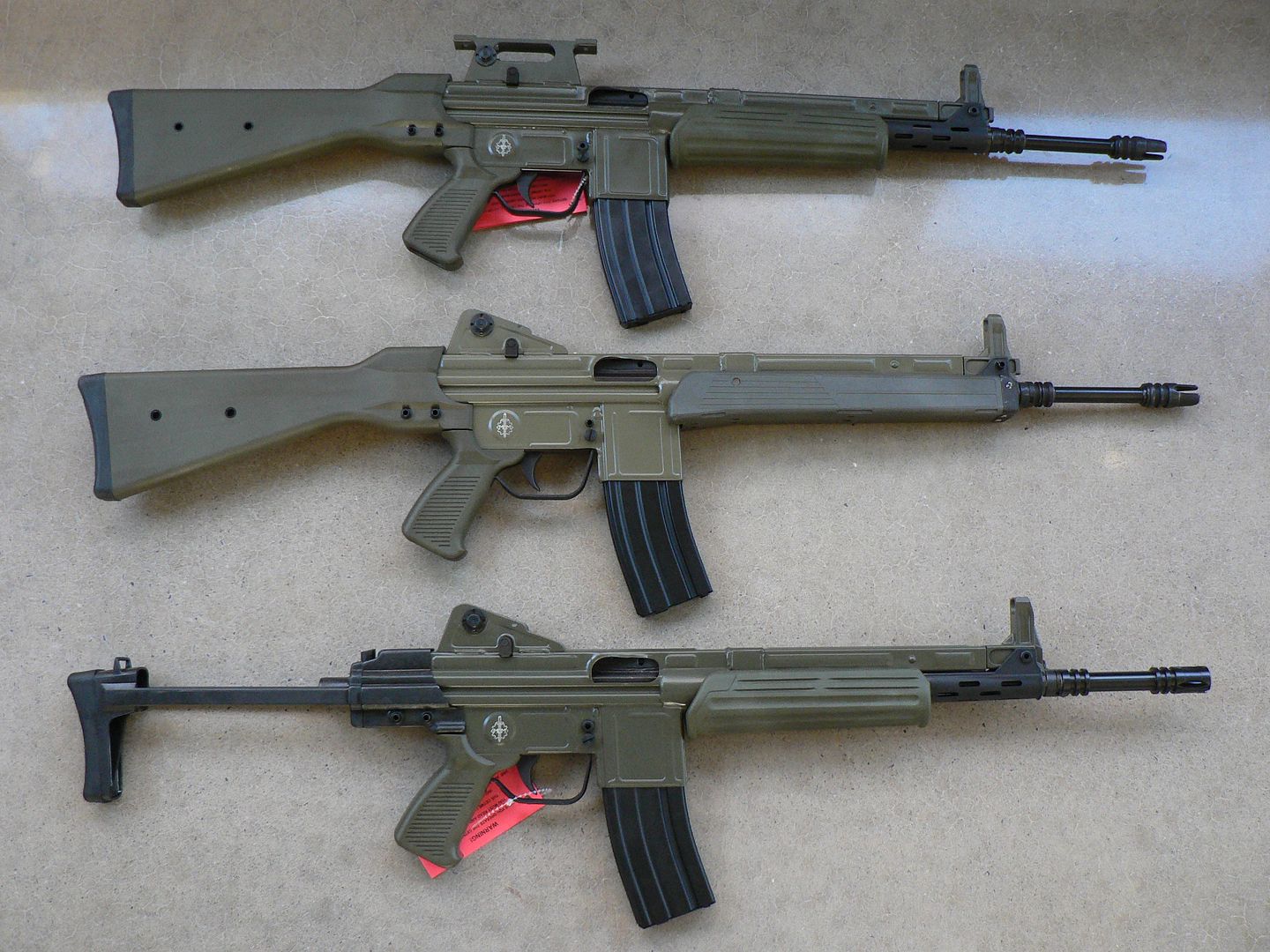
I haven't taken this to the range yet and, truth be told, I may not. With only 640 or so being manufactured by MCM, it's sure to skyrocket in value as the years go by so new in box is a nice way to have one and, judging by the serial numbers I've seen, I think mine just might be the first series production example. Besides, my eyes are getting older and my iron sights days are numbered. But if I do end up taking it out for a spin, I'll post the results here. In the meantime, my recommendation to you is that you buy one now, while they are available. My MCM CETME L runs like a singer sewing machine. After disassembling the LC and carefully scrutinizing every little detail, I can honestly say that it's at least as well built as my L so I would expect it to perform as well too. Buy one.....you won't regret it. Thank you for your time, God bless you and may you have a wonderful Christmas! Bye!! I love you and I miss you mom. Please keep lighting my path; you're doing great. |
|
I'd like to add a short addendum to this. While researching the 5.56 CETME, I often come across information about the original magazines for these rifles referring to them as being designed by the Spanish specifically for the CETME but that's not correct. What they actually are is a carbon copy of an early design FNC magazine. Let me illustrate. NOTE....If you're bored easily or really don't care about magazine minutia, now might be a good time to make your escape. You have been warned. In the pictures that follow, a CETME Magazine is in the middle, an early FNC is on the right and a later FNC/STANAG 5.56 magazine is on the left. For identification purposes, I've marked the later one with a "-" using a white china marker. Right side: 
The feed lip contour is a little different on the later FN. We'll get to that in a bit. All are steel. Front: 
That's not an illusion you're seeing. The later one is taller and is the exact same height as a standard STANAG magazine. Left side:  Rear:  Top: 
Notice that the newer magazine has a plastic follower designed to actuate the bolt holt open on a SCAR 16. Whether this magazine is an FNC that was upgraded or it was for a SCAR from the outset, I cannot say. What I can say is that both FN's are exactly as they were when they left Belgian service. Bottom:  Closeup of the top rear: 
Notice that the newer follower is designed to actuate the bolt stop on a SCAR 16. It will also work just fine in an M16/M4/AR-15 . The CETME and early FNC will work in those rifles as well but your bolt won't lock back automatically. The FNC never had a bolt hold open feature. Also of note is that the bolt carrier clearance notch is the exact same width on all three magazines. A STANAG magazine has a more narrow notch. For that reason alone, I suspect that the magazine on the left is an FNC that was updated for use in a SCAR 16. In this picture, I have added a Colt STANAG magazine on the extreme left for comparison:  Here's a detail shot of the top of the earlier FNC magazine: 
The CETME is identical. And here is the same area on the newer design: 
The distance between the feed lips is the same on both magazines but the overall shape and geometry is different. I assume this schtuff was changed for reliability reasons. That's a guess but I think it's a pretty safe one. A comparison between the Colt (top) and the later FNC (bottom): 
In every way that matters, they are identical. And here is the Colt compared to the early FNC (which is identical to the CETME: 
There are so many differences, I'm not even going to attempt to point them all out because I'll probably get it wrong anyways. Cut me a break Francis....I'm not an engineer you know! But if you study them closely, you'll see the differences. You're probably smarter than me anyways! Alrighty...I'm done. Be honest;that was mind-numbingly dull wasn't it? Now you know more than you probably ever cared to know about FNC and CETME L magazines. YaY!!! |
|
Quoted:
@ProbableColtAddict Sadly none of your photos in this thread are showing up for me any more. Outstanding review though and much appreciated! Sadly it effected someone like OP that is trying to put up very useful/rare stuff. |
| I have more images on there than I care to count so I'm rather committed at this point. If I move, it's only going to be once and to my own site. I'm new here but I've been writing this stuff for a long time. I'm sure PB will have everything sorted out in a day or two and I can get back to work. |