


Armory Sponsor

Wet Tumbling (Page 1 of 2)

Posted: 7/6/2026 5:16:30 PM EDT
[Last Edit: Trollslayer][Edited]
|
I've had this wet tumbler for 2-3 years and used it once when it was first gifted to me. I decided to wet tumble my recently-fired brass. It had already been dry tumbled in walnut media but was still tarnished, especially so for the range pick ups. None of the brass had their primers punched out. I used an approximation of the various cleaning solution recipes found in the recent wet cleaning thread - Dawn dish liquid and citric acid. I did NOT use pins. I ran the cases for about an hour. The cases were very clean on the outside. Many/most were not cleaned inside. Because they still had primers, none of the primer pockets got cleaned and all the pockets are wet inside right now. THAT was a mistake. Putting mixed brass types in the barrel was mistake number two. As it turns out, 9mm cases fit very nicely and tightly over the mouth end of 223 cases ensuring neither gets cleaned. Of the numerous 9mm cases in the barrel, half were wedged over a 223 case mouth. Lastly, I lost all my Sharpie markings indication which cases had been fully prep'd. Not punching the primers was not so much laziness as needing to do so was unusual for me (I always dry tumble). That mistake hit pretty hard. Now I have to go and punch wet primers all before they corrode into their cases. The other issues are a consequence of having many different case types needing to be cleaned. All types were too few in number (50-100) to run by themselves, so I put them all in there together. I was trying to be "efficient". Having run two batches probably took about 50 gallons of water. Pfft! 
|

|
Ouch. Ya you really can't mix certain brass in any tumbler wet or dry. PRO tip: Never leave wet tumbled brass in the drum after it is shut off. I forgot some 50 bmg brass once and it turned black from the citric in jist s few days. Had to retumble it twice to get it to shine again. Live and learn. |
|
If you are going to run without pins, run longer, it will clean the insides just takes longer, also flush the water when it gets dirty..I fill my FART to the brim, with almost zero air space, I rarely use pins, I punch primers and I use FARTs cleaner and dawn along with HOT water, dirty brass may run 2-3 hrs, normally gets clean water/chemicals once or twice in that timeframe... Attached File |
|
Originally Posted By AKSnowRider: If you are going to run without pins, run longer, it will clean the insides just takes longer, also flush the water when it gets dirty..I fill my FART to the brim, with almost zero air space, I rarely use pins, I punch primers and I use FARTs cleaner and dawn along with HOT water, dirty brass may run 2-3 hrs, normally gets clean water/chemicals once or twice in that timeframe... https://www.ar15.com/media/mediaFiles/404934/IMG_6358_jpeg-3790809.JPG Makes me want to punch primers and go back in the tumbler. I ran for one hour on previously dry tumbled brass (clean). So a couple more hours would do it. The packet of FA cleaner that was supposed to come with the unit broke open in transit and its contents were lost, so I never got to try it. |

|
Over the last ten or so years I've made incremental changes to my brass cleaning process. First is dry-tumbling in fine 20-40 grit corn media. Second (for rifle brass) is annealing. Third is lubing with 12-1 HEET/lanolin mix (brass in plastic grocery bags and spritzed with an industrial spray bottle from Lowe's or Home Depot). Fourth is sizing-decapping, then dry-tumbling off the case lube. Fifth is wet-tumbling with pins in a Frankford Armory Rotary Tumbler using 50-50 Dawn and light wax car wash (to prevent tarnishing) and a .40 S&W case of Lemishine. Sixth is rinsing and tumbling out the pins in a Dillon cage, then laying them out on a painter's drop cloth to dry. Seventh is trimming in a Giraud trimmer and storing until needed. A lot of work but I'm pleased with the results. |
|
I punched primers out of a couple hundred 223 cases. Doing so left me with a wet, sloppy mess - both the press, itself, and the primer catcher. It's a LOT more work than dry tumbling and what do you get other than bling? <-- Serious question, there. I get plenty of bling from my dry tumbler. |

|
Wet or dry comes down to some details at the ground level, but at the very high level it really is a personal choice because there is very much good overlap between the two methods. One reason for wet, is to be able to have a very good view of the inside of the cases for visual inspection. Dry just doesn't match here. Another reason is that some folks really want the brass sterile going into their annealing machines or other places where they want zero carbon or dust. You can also say that wet tumble does a better job on primer pockets without starting up many debates. Only warnings are not to over do the process to the point where the mouths are beat to the point of causing a big mash or burr, and to be careful about the bullet seating friction on nascent brass. Everyone develops a set of steps and music to handle their wet processing until the whole thing becomes a ballet. It does take a little art and kitchen skill to make the whole operation smooth. Good Luck on your journey, stay with it and you will work out your own way and have wet tumble as another tool in your toolbox for when you think you need it. |
|
Originally Posted By Trollslayer: I've had this wet tumbler for 2-3 years and used it once when it was first gifted to me. I decided to wet tumble my recently-fired brass. It had already been dry tumbled in walnut media but was still tarnished, especially so for the range pick ups. None of the brass had their primers punched out. I used an approximation of the various cleaning solution recipes found in the recent wet cleaning thread - Dawn dish liquid and citric acid. I did NOT use pins. I ran the cases for about an hour. The cases were very clean on the outside. Many/most were not cleaned inside. Because they still had primers, none of the primer pockets got cleaned and all the pockets are wet inside right now. THAT was a mistake. Putting mixed brass types in the barrel was mistake number two. As it turns out, 9mm cases fit very nicely and tightly over the mouth end of 223 cases ensuring neither gets cleaned. Of the numerous 9mm cases in the barrel, half were wedged over a 223 case mouth. Lastly, I lost all my Sharpie markings indication which cases had been fully prep'd. Not punching the primers was not so much laziness as needing to do so was unusual for me (I always dry tumble). That mistake hit pretty hard. Now I have to go and punch wet primers all before they corrode into their cases. The other issues are a consequence of having many different case types needing to be cleaned. All types were too few in number (50-100) to run by themselves, so I put them all in there together. I was trying to be "efficient". Having run two batches probably took about 50 gallons of water. Pfft! Heh  Have fun OP. And yes, never put 9mm brass in the wet tumbler with 223! Learned that one the hard way as well! FWIW, you can run .45 ACP. And you can run 9mm with 6.5CM and 6.5 Grendel And yea, punch primers, and run pins. Enjoy! |
|
50 gallons of water How big is your tumbler I wet tumble with the primers in, dry, lube then run them thru a dedicated tool head with a resizing die. Then wet tumble them again to get the lube Cleans the primer pockets, plus if I’m going to run them thru my press to decap the primers, I might as well resize them at the same time |
|
Originally Posted By Trollslayer: It's a LOT more work than dry tumbling and what do you get other than bling? <-- Serious question, there. Powder fouling is powder fouling whether it's in your bore or cartridge case. Carbon is abrasive. Blingy cases are easier to inspect for cracks. I'm with you in that I think dry-tumbling is probably sufficient so long as you're not using red-rouge tinted Lyman corn or walnut media (which I think helped destroy an older Douglas barrel). |
|
Originally Posted By supercomp: 50 gallons of water How big is your tumbler I wet tumble with the primers in, dry, lube then run them thru a dedicated tool head with a resizing die. Then wet tumble them again to get the lube Cleans the primer pockets, plus if I’m going to run them thru my press to decap the primers, I might as well resize them at the same time The tumbler holds about 2 gallons. The 5 gallon bucket used for rinsing holds, well,... 5 gallons. It took 3 rinse cycles to get clean, clear, soap bubble-free water. I ran two batches, so at least 34 gallons, total and likely a bit more. I hope the lawn appreciates the extra water. That first load of wash water was absolutely FILTHY and had a lot of Detergent and citric acid in it, so it went down the toilet, not on the lawn. Next time, I will size, de-prime and trim, before wet tumbling. I have ~100 cases for my long range ammo ready for those processes. If I can get clean primer pockets without using pins, that would be good (I'm not sure what it does for me but it sounds good). Long range ammo usually gets a quick swipe with a primer pocket uniformer to clean them out. I don't foresee buying any other pin type. I simply do not trust I can remove 100% of them, the water is too tenacious, too "sticky". |


|
I live in a dry climate with a hot sun. I have never had issues with a corroded primer, as I dry brass on a towel in the sun. Even in colder months, I put my brass on a towel under a ceiling fan to dry for a few hours. (spare bedroom on a bed) I use pins. No need to be a pin hater. I use the standard method of Lemishine and Dawn. I have a countdown timer on a FART and tumble for one hour. I set my Siri timer to keep track, but sometimes they sit until I get to the empty/rinse thing. Amazon sells a nice screen to put on the FART for draining, maybe they come with this now....... 
|
Preferred pronoun: MARINE


|
I've always decapped, then cleaned. I started with a cheap Lee universal decapper, then moved up to the basic Mighty Armory decapper then finally got the XMS decapper. That is the only one to get IMO. It has a centering sleeve like a benchrest seater die. It holds the mouth of the case and centers it before the decapper stem even goes into the case. With other decapper dies, you risk messing up the case mouth if you are not careful about feeding the case into the die. I always used to lose a few cases by messing up the case mouth. Now, that never happens. I use to use pins when wet tumbling, but someone on here responded to one of my posts and recommended stainless steel chips. Those work way better than pins. They have some weight so they fall out the cases easily when I'm rinsing them off. So far I have only used them on .30 cal cases, but I suspect they should work well on 223 cases. |

|
Originally Posted By Trollslayer: I punched primers out of a couple hundred 223 cases. Doing so left me with a wet, sloppy mess - both the press, itself, and the primer catcher. It's a LOT more work than dry tumbling and what do you get other than bling? <-- Serious question, there. I get plenty of bling from my dry tumbler. To speed up the depriming process added a Lee APP. Much faster than the single stage I was using. Added media separator for ss pin separation. Sped up the process more. Filling the wet tumbler to the top stopped case mouths from getting dinged up. After tumbling, dump the dirty water out and add clean water then run another 10-15 minutes. Repeat that again. Reduces the amount of water required to remove the remaining soap from the cases. separating pins and rinsing off cases is the worst part of wet tumbling. I end up dry tumbling fully processed cases to get the sizing lube off. Adding some car wax to the media really cut down on the brass tarnishing when stored. |
|
Originally Posted By wildearp: I live in a dry climate with a hot sun. I have never had issues with a corroded primer, as I dry brass on a towel in the sun. I had hundreds of 223 cases in the direct sun for several hours. The primer pockets were still full of water. What a mess they made when decapped. I have about a thousand 45ACP cases awaiting decapping. They were in the sun about 8 hours. I hope they prove to be dry or at least drier. While drinking my coffee, I made a list comparing the two types of cleaning - the operations, the equipment and the materials. Let's just say, you have to REALLY appreciate bling to use wet cleaning. |
|
Originally Posted By Trollslayer: I had hundreds of 223 cases in the direct sun for several hours. The primer pockets were still full of water. What a mess they made when decapped. I have about a thousand 45ACP cases awaiting decapping. They were in the sun about 8 hours. I hope they prove to be dry or at least drier. While drinking my coffee, I made a list comparing the two types of cleaning - the operations, the equipment and the materials. Let's just say, you have to REALLY appreciate bling to use wet cleaning. Originally Posted By Trollslayer: Originally Posted By wildearp: I live in a dry climate with a hot sun. I have never had issues with a corroded primer, as I dry brass on a towel in the sun. I had hundreds of 223 cases in the direct sun for several hours. The primer pockets were still full of water. What a mess they made when decapped. I have about a thousand 45ACP cases awaiting decapping. They were in the sun about 8 hours. I hope they prove to be dry or at least drier. While drinking my coffee, I made a list comparing the two types of cleaning - the operations, the equipment and the materials. Let's just say, you have to REALLY appreciate bling to use wet cleaning. The bling isnt important at all. Wet tumbling with media will scour cases inside and out and will clean primer pockets. This is particularly useful with range pickups that could contain mud, dead bugs, etc. This is much of my brass, and I value the clean pockets. The real reason is I hate dry tumble media sticking in flash holes, and adhering to wet case lube stuck inside the shoulder. Wet tumble with SS chips doesn't do that. And I hate breathing dry media dust. Also, with a media tumbler, ss chips don't stick or adhere to the brass, This a non-item with a media separation tumbler. |

|
I punched a bunch of 45ACP primers out. Even though they sat out in the sun for about 8 hours, there was still some water trapped in the primer pockets. It was a lot less than for the 223 cases but it was still there. Also, all the primers and pockets were covered in a white coating/residue rather than the normal black appearance. Whether it was corrosion of the metals or a reaction with the combustion residues or just soap residue or... I do not know. When I have punched all the primers, I will return them all for another tumble to clean the primer pockets. Will use hot water this time. I may oven dry them to see how that goes. I do like being able to see the metal sides and bottoms in all the 45 cases. I may bore scope a few of the 223's to see if they are equally clean deep inside. I have a batch of 6mm cases that I will process once I get this process worked out. The Process (as it stands now) Dry tumble (to remove dirt) Lube, size & decap, trim & deburr Wet tumble for 2-3 hours (without pins) Allow to dry |
|
I use a brass separator to spin out all the water. Takes all of 1-2 minutes, and then pour the brass out on a towel, get most of the water off, and then pour it out on baking sheets or pizza pans. If it's summer and it's hot out, I set them out in the sun to dry. Depending on how hot and sunny it is, 1-2 hours to dry. If it's cold out, I put them in the oven at it's lowest setting, I think it's 165, for about 30 minutes. Here's a link to a separator: RCBS media separator. Can't imagine even starting without a separator to spin out the water and pins. I also don't fill the drum over half full. There is a weight limit so want to make sure I stay way under that with water and pins added. I use liquid car wash and lemi-shine and don't tumble for over an hour. I prefer Armor-All but imagine any brand with detergent and polish should work. I've only changed out the water once and that was because of so much caked on dirt and mud. I rinse them in the spinner several times. Just use the hose and spray while you're spinning the separator. I think you're wasting water and soap if you're unnecessarily dumping them out before you're done. The soap is still working if you can see suds in the drum. If no suds present after washing, the detergent is depleted and you should probably run it a second time. When doing multiple batches, after I dump the brass onto a towel, I go ahead and refill and get another batch started. While it's tumbling, I run them around the towel and then put them on the trays for drying. Usually takes less than an hour to dry so the timing works out with a batch tumbling ready about the same time the previous batch of brass is dry. I leave the lids off the brass storage containers and leave them out in the sun just to make sure they're isn't any moisture left in the container. I use dog treat containers, dish soap pod containers, large nut jars or whatever else I have handy. I can do 5 to 7 thousand rounds in a day and have everything cleaned, dried, and put away before dinner time. For 9mm, the car wash/wax helps to delay tarnish and acts as a lubricant during the sizing process. For rifle cartridges, still need to use lube for sizing. I run those a second timefor about 30 minutes to remove the lube. |
|
I’m not joking. Run them for a couple of hours in the Fart, usually change the water 1/2 way if they’re range pickups. Then dump them into a strainer that’s submerged in a 5 gal bucket. Rinse, tumble, strain, more rinsing. Once I’m confident I have the pins clear and they are well rinsed I tumble in the strainer to shed the excess water. Dump them onto a dry towel and then load them into the Ugly Annealer. |
|
Originally Posted By GimpyPaw: I’m not joking. Run them for a couple of hours in the Fart, usually change the water 1/2 way if they’re range pickups. Then dump them into a strainer that’s submerged in a 5 gal bucket. Rinse, tumble, strain, more rinsing. Once I’m confident I have the pins clear and they are well rinsed I tumble in the strainer to shed the excess water. Dump them onto a dry towel and then load them into the Ugly Annealer. I was kidding around because, over the years, I have been so vociferously anti-annealing. I'm not too enamoured of this wet tumbling yet, either, especially so using pins. What a disaster that was when I tried it, even using a media separator. I will re-run cases after punching all the primers but run without pins. Supposedly, the primer pockets and inner case walls will come clean. |
|
Originally Posted By Piratepast40: I can do 5 to 7 thousand rounds in a day and have everything cleaned, dried, and put away before dinner time. What is the context for doing 5k - 7k per day? Does that include punching primers? Why are so many needed? ETA - I am a little concerned about tarnishing of cases that are chemically clean (no wax, lanolin or anything on the brass). |
|
Originally Posted By Trollslayer: What is the context for doing 5k - 7k per day? Does that include punching primers? Why are so many needed? ETA - I am a little concerned about tarnishing of cases that are chemically clean (no wax, lanolin or anything on the brass). The 5-7k doesn't include sizing or decapping. For me, that'a 3 to 5 years worth of 9mm and .223. Once all the cases are cleaned, I can take my time with other steps. The Armor-All has wax in it so does provide quite a bit of protection from tarnishing. That's why I use it and don't bother with dishwashing detergent. Obviously, 9mm cases don't require the same amount of prep as bottleneck rifle cartridges. The rifle cases get another trip through the wash and wax process after lubing with One Shot, sizing and decapping. For the second wash, you're just removing the case lube so only need a half hour of tumbling with the wash & wax. This type of batch process works well for me. I like to have everything cleaned up and put away before starting another step. |
|
Originally Posted By Piratepast40: The Armor-All has wax in it so does provide quite a bit of protection from tarnishing. So you use the car wash that has some wax instead of somthing like Dawn? I might have to give that a try. I've been pretty happy with the citric acid in the wash and then a cold water rinse. I used hot water a few times and the results were not as good as cold water. I think the citric acid passivates the brass, but you have to be careful not to add too much, or tumble too long. |
|
Originally Posted By Piratepast40: The Armor-All has wax in it so does provide quite a bit of protection from tarnishing. That's why I use it and don't bother with dishwashing detergent. I may have a bottle of that or something similar. One thing I came to appreciate about dry tumbling was the super thin film of lanolin left on the cleaned cases. You can't see it or feel it but it's there and it inhibits corrosion. |

Global Warming Hoax Skeptic before it was cool
Joined:
Jun 2007
Posts:
72854
EE: 100% (1)
 WA, USA
|
I will share my methods learned after 14 years of wet tumbling. First, no sink or magnet is used. Hot water is never needed. I use what I call the 2 bucket method. Dirty cases deprimed on progressive Lee APP press. The only manual part is loading cases into the bowl, shaking the tubes that fill with cases. When finished you have 4 tubes of cases, when one runs out you rotate tubes to the next tube. I use the classic 45 ACP case full of Lemishine, 2 second squeeze of Dawn to 1 gallon of water. If your tumbler is larger, increase these amounts slightly. Water chemistry varies through out the country, so you have to experiment with the amount of Lemishine. Cases not clean, not enough Lemishine. Cases pink colored, too much Lemishine. 2 BUCKET METHOD Dump wet tumbler drum into a bucket with a dry tumbler separator. Rotate until pins stop dropping out. Note 95% of pins removed. Second bucket has 3 inches of clean water, into this dump the brass separator. Mix water and pins around, and dump this bucket back into bucket 1. All pins removed, dump separator full of wet brass on towel to dry. First bucket with dirty water and pins; Go outside and slowly dump bucket of water out. This mixture will kill grass. I dump on my driveway. The suds will disperse and you will see the pins working their way to the buckets edge. You stop dumping just before pins escape. Now add about 2 inches of water to bucket to rinse pins. Do the controlled pour again and dump the wet pins back into tumbler barrel. So you are left with clean wet brass to dry and rinsed pins for the next tumbler load.  eta Bling pic. |
Selling agent for Algores carbon credit scam.
Shooting and Reloading, one hobby feeds the other.
Shooting and Reloading, one hobby feeds the other.
|
Originally Posted By coldblue: Just never, never, neven let SS pins come even close to a kitchen sink with a garbage disposal... That reminds me…. In my thread about which 9mm bullet weight for Steel Challenge, I think I mentioned something about getting the special screen caps that let the dirty water drain out. Dryflash talked me out of it. Then I noticed something on those little grocery store “hooks” at multiple places inside the grocery store: Attached File So I picked one up. It might have been 5 bucks. It does kinda fit, and the cap still threads on, tightly. It does a fairly good job of keeping the SS pins inside the tumbler as I drain it (into the bath tub…in a bathroom I rarely use). |
|
Originally Posted By Trollslayer: I punched primers out of a couple hundred 223 cases. Doing so left me with a wet, sloppy mess - both the press, itself, and the primer catcher. It's a LOT more work than dry tumbling and what do you get other than bling? <-- Serious question, there. I get plenty of bling from my dry tumbler. WWWWWWwweeweeeeeelllllll…. I have one 650 toolhead…a dedicated toolhead for loading 9mm… for the 650 that is set up kinda screwy. Station #1: RCBS resizing die with decapping rod removed Station #2: EGW/Lee undersize die, also with decapping rod removed Station #3: Dillon powder measure with the tension springs Station #4: Redding micrometer adjustable bullet seating die Station #5: Lee FCD I am running two re-sizing dies back to back to save the strain on my right elbow, that I noticed just running the EGW/Lee undersize die just by itself. So the shiny brass inside the case allows me to better see the level of the powder before I seat the bullet. (Which is kinda important, because with the PM at station #3, there is no failsafe rod that makes sure the powder charge bar returns fully back to its start position. That’s why I bought a bunch of the old skool Dillon PM return springs.) And now that I am going through buckets of 9mm brass that I “whored up” about 15 years ago, de-priming them first and Swage-It’ing them kicks out the .380’s, takes care of the primer crimps, finds the Berdan primed cases, and lets me find the .38 Supers. So that when a batch of brass makes it into the FART, I can rest assured that it is strictly 9mm brass. And once it it is dry, I know it is ready to be fed into the load toolhead. EDIT: any other load toolhead for any other caliber that I have, station #3 is empty. The Dillon powder measure is in station #2, like normal. I have a HF mechanic’s inspection mirror zip tied to to the casefeeder support tube. It is angled just so, so that I can see the powder level in the case as it comes up through the empty hole at station #3. I blame the Open guys shooting 9mm Major and the Glock 17 and Glock 34 shooters with their guppy bellied brass. |
|
Originally Posted By Trollslayer: I was kidding around because, over the years, I have been so vociferously anti-annealing. I'm not too enamoured of this wet tumbling yet, either, especially so using pins. What a disaster that was when I tried it, even using a media separator. I will re-run cases after punching all the primers but run without pins. Supposedly, the primer pockets and inner case walls will come clean. Punching primers is all part of the process, once you figure out a proper process wet tumbling works far better, you just have to commit to it and get a process that works, it is why so many say, punch primers, try different chemicals/amounts/time until the process works for you and your conditions....It's not rocket science, just cleaning brass and making the brass better/easier..... Originally Posted By Trollslayer: What is the context for doing 5k - 7k per day? Does that include punching primers? Why are so many needed? ETA - I am a little concerned about tarnishing of cases that are chemically clean (no wax, lanolin or anything on the brass). This brass has been wet tumbled with pins (back when I used pins every time) and dried and nothing else to protect it...before being stuck in an MTM ammo box and sitting under my bench for at least 8 years...wet tumbled brass at least for me has not had a tarnish issue..This is fully prepped brass, that I do my full process on, including necks turned..Still looks pristine after 8 years, even though its not as shiny and todays wet tumbled brass, which I think comes out shinier without pins, its still great brass with zero signs of tarnish...The process matters, get the process right and its worth doing if you want your brass as good as it can be..or just reload it as is and always wonder if its the best reloads they can be...It's America, it's your choice how your brass looks and performs...  Attached File |

|
Originally Posted By wildearp: I live in a dry climate with a hot sun. I have never had issues with a corroded primer, as I dry brass on a towel in the sun. Even in colder months, I put my brass on a towel under a ceiling fan to dry for a few hours. (spare bedroom on a bed) I use pins. No need to be a pin hater. I use the standard method of Lemishine and Dawn. I have a countdown timer on a FART and tumble for one hour. I set my Siri timer to keep track, but sometimes they sit until I get to the empty/rinse thing. Amazon sells a nice screen to put on the FART for draining, maybe they come with this now....... https://www.ar15.com/media/mediaFiles/41996/IMG_0944_JPG-2821005.jpg I used to deprime everything before wet tumbling. But lately I haven't deprimed anything before wet tumbling. Lemishine, armor all wash and wax, tumble for 1 hour. Dump out the dirty water into a bucket. Then rinse once or twice depending on how much suds are left. Then spin the brass in a media seperator to get most of the water out. I've been putting the brass in a colander and putting it on top of the AC fan to dry. Haven't had any issues with ringers yet. But this will likely vary based on where you live. |
|
Good day all. Been wet tumbling for about 8 years now. Here's my process: Various shooting ranges can yield large amounts of reloadable brass cartridges, and in very different conditions from nice shinny to full of dirt. Gravel pits in Maine are usually a mix of sandy mud and I sift brass on site to get most of the dirt off/out. 1.) Range brass gets deprimed with a hand-held Frankford Arsenal deprimer tool. This tool uses plastic collets that centers the cartridge. The collet centers the shell and holds it in place in a steel cylider that rocks up and to push cartridge into the collet. Push down and sqeeze the handle and the base of the cartridge pushed forward into a anvil face with a hole and channel to let the primer pop out and the decapper pin pivot up quickly to be ready for the next shell. A plastic tube catches the spent primers. Total cycle time is about 3 seconds. Can depend greatly on how you position your brass piles. I like to plop into my comfy recliner and watch the boob-tube with a box of range pick-ups to my right and an empty box to my left to plunk the deprimed brass into. Used to use a unversal Lee die on the bench. 2.) Dirty deprimed range pick-ups (usually about 200 pieces 223REM) go into standard FART with a few pounds of pins, a squirt of dish soap and sprinkle of Lemi-Shine. Full 3 hour cycle. 3.) I use the slotted seperator/strainer that came with the FART to sift out the pins. This strainer goes where the clear plastic window cover is used during tumbling. Does a fair job but not as thurough as a rotating basket type, but the FART strainer is a bit more efficient. 4.) Spread the loot onto a towel and quick visual inspection for obvious defects. Let dry and usally not in any hurry so just let air dry. 5.) Quick inspection for dryness and primer pocket crimps and defects. Then lubed with homebrew lanolin/iso. 6.) Sized in a RCBS small-base sizer. I know I know I know; just like it. 7.) Checked for length with a caliper and trimmed as needed. Primer pockets reamed if needed. Case-mouths chamfered. 8.) Back into the FART with same pins, warm water, longer squirt of soap and no citric acid. Not experienced any lube residue so far. I use probably what many would consider an over-dose of lube, but, this is just my personal preference to use with the small-base sizing die. This works for me and my firearms. I have never annealed. Never invested that much time, effort and equipment into free rage pick-up brass. Also don't keep close tabs on free brass of how many firings I get. I just look for defects like split necks or seperation signs. My reloading process will evolve as I settle into retirement and dive into more target oriented shooting. |
|
I finished decapping the brass and the 45ACP cases are back outside rattling around inside the tumbler. The need to decap before wet tumbling means that next time I will be sizing/decapping and trimming before getting wet for the very first time. Lesson learned - decap primers before getting wet. Another lesson learned - if you see brand new, shiny 45ACP brass on the ground, it's likely small primer brass. Beware! I think we should form a posse and go arrest the pin head who thought it was a good idea to make 45 ACP cases with small primers. <-- Out here in the west, we cowboys do stuff like that. |
|
I borescoped inside the 223 cases processed the other day. The interiors were not perfect but they were clean. They're going back for more cleaning to get the primer pockets, so the insides will end up more than good enough. Photos are after the first day's cleaning (2+ hours tumbling). Along the Sidewall - 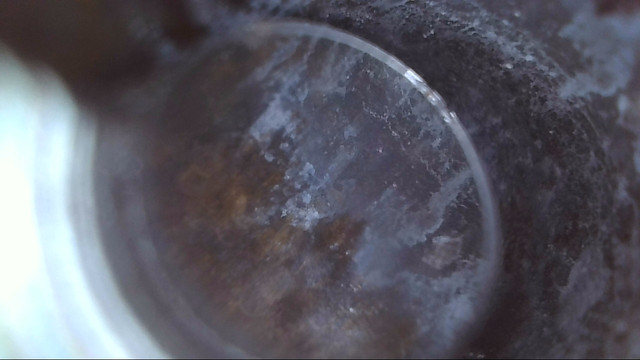 Base of Case -  |
|
I ran the 45ACP cases for anothr 3 hours. The outsides are as clean as you can hope for - bright and shiny. The insides are still not super clean, nothing like you guys are showing above. Combined time is well over 5 hoours and still not pristine. Yes, both times, the water was still sudsy when I stopped the tumbler. The primer pockets were barely improved at all. This is disappointing, to say the least, especially after 3 more hours. Overall, a disappointment. Photo is after tumbling for 3 hours, note the case mouths are dinged up - 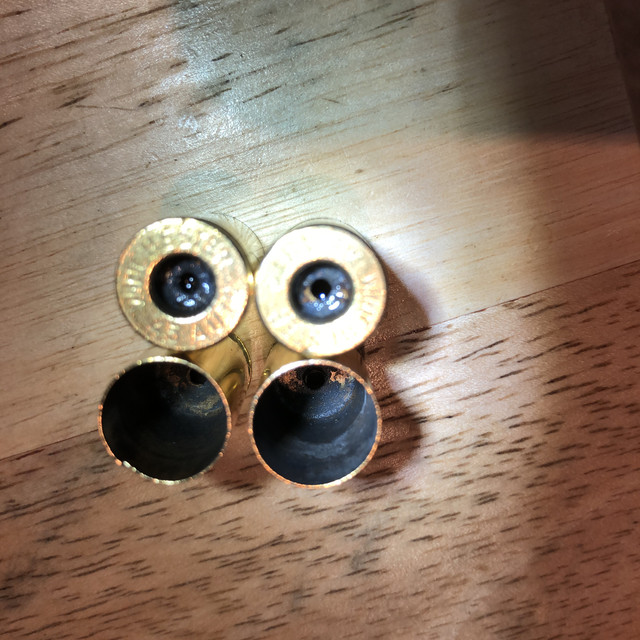 Sorry for the fuzzy photos but the blackness inside the case and pockets tells the tale. |
|
Originally Posted By snackle: I don't think it matters at all if the inside of the case and the primer pocket is clean. I agree, but I was given this tumbler, I bought the citric acid and Dawn, so I thought I'd give it a whirl. I have spent too much time on this. Had I done my standard reloading, I'd have a massive quantity of loaded rounds already. I'm wondering - if you wet tumble brass after every firing, do the residues come off more easily. If there have been multiple firings, does it take longer? |
|
t-slayer -- do you have hard water? How much brass are you putting in the drum? Are you crowding so much that the brass can't roll and agitate? The soap and water slurry do the work, while the pin scrubbing helps wash the yuckies off the outsides, interiors, and primer pockets. You should be getting a decent cleaning in only an hour (let alone the three or five you are noting). Try filling the drum no more than half-full of cases. Humor us and try it with pins. Maybe two squirts of Dawn and a 40 S&W case of Lemishine. Fill the drum with water to maybe four inches of the top. Run it for an hour. If you have a rotary media separator (Frankford, Dillon, RCBS, etc.) keep the bucket full of water to break the capillary action between cases and pins. It is not supposed to be hard or take long. |
|
Originally Posted By Trollslayer: I ran the 45ACP cases for anothr 3 hours. The outsides are as clean as you can hope for - bright and shiny. The insides are still not super clean, nothing like you guys are showing above. Combined time is well over 5 hoours and still not pristine. Yes, both times, the water was still sudsy when I stopped the tumbler. The primer pockets were barely improved at all. This is disappointing, to say the least, especially after 3 more hours. Overall, a disappointment. Photo is after tumbling for 3 hours, note the case mouths are dinged up - https://i.ibb.co/CTf9pTb/IMG-1133.jpg Sorry for the fuzzy photos but the blackness inside the case and pockets tells the tale. Here is my latest batch to come out of the FART: Attached File That is with the SS steel pins, a few second squirt of Dawn, a splash of Armor All wash and wax, a .45ACP case filled with Lemishine crystals. The FART was standing upright with the brass and the SS pins when I added cool tap water to about the halfway point. Then I added the Dawn, Armor All Wash and Wax, and the Lemishine. As far as brass goes, I dump in a full Akrobin’s worth. This is what the primer pockets look like: Attached File The FART ran about 2 hours. |
|
Originally Posted By Sinister: t-slayer -- do you have hard water? How much brass are you putting in the drum? Are you crowding so much that the brass can't roll and agitate? The soap and water slurry do the work, while the pin scrubbing helps wash the yuckies off the outsides, interiors, and primer pockets. You should be getting a decent cleaning in only an hour (let alone the three or five you are noting). Try filling the drum no more than half-full of cases. Humor us and try it with pins. Maybe two squirts of Dawn and a 40 S&W base of Lemishine. Fill the drum with water to maybe four inches of the top. Run it for an hour. If you have a rotary media separator (Frankford, Dillon, RCBS, etc.) keep the bucket full of water to break the capillary action between cases and pins. It is not supposed to be hard or take long. Do we have hard water? Drinking it will turn you to stone if you don't keep moving. I used MUCH more citric acid than you guys mention. The large FART is just over half full of cases. FA says not more than 30 pounds, I am nowhere near that. I fill to the top shoulder with water, as shown in the FA instructions. There is plenty of space for tumbling, as you can see thru the end cap port hole. I could try pins for the 45's because you can see the interior of every case but won't do that for my bottlenecked cases. I have a Dillon media separator and used it as described when I first ran with pins. It was NOT 100% effective (that thread has slipped into the archives). Relative to dry tumbling, it has been hard, and long and had a disappointing outcome. I put another hour on the 45 cases with fresh water, lots of Dawn and lots of citric acid. Dryflash3 said, if the cases aren't clean, add Lemishine (citric acid). They were a little better with this more concentrated solution but that's now a total of six hours tumblng. We use Lemishine in our dishwasher. Maybe I should try that instead of the food grade citric acid. Maybe I should try deionized water for the wash water. |
Global Warming Hoax Skeptic before it was cool
Joined:
Jun 2007
Posts:
72865
EE: 100% (1)
WA, USA
|
Originally Posted By Trollslayer: I ran the 45ACP cases for anothr 3 hours. The outsides are as clean as you can hope for - bright and shiny. The insides are still not super clean, nothing like you guys are showing above. Combined time is well over 5 hoours and still not pristine. Yes, both times, the water was still sudsy when I stopped the tumbler. The primer pockets were barely improved at all. This is disappointing, to say the least, especially after 3 more hours. Overall, a disappointment. Photo is after tumbling for 3 hours, note the case mouths are dinged up - https://i.ibb.co/CTf9pTb/IMG-1133.jpg Sorry for the fuzzy photos but the blackness inside the case and pockets tells the tale. Don't size dirty cases. You can get results like I do, but no shortcuts. |
Selling agent for Algores carbon credit scam.
Shooting and Reloading, one hobby feeds the other.
Shooting and Reloading, one hobby feeds the other.
Wet Tumbling (Page 1 of 2)
Armory Sponsor