


Armory Sponsor

Thermal riflescopes HT-C8 dropped below AUD$1000 -(Approx USD$650) What does the forum already know?

Posted: 6/16/2024 6:54:39 AM EDT
[Last Edit: cj7hawk][Edited]
|
Hi All, It's been a while since I posted - I've been busy looking after my family for a few years, and when I did get involved in the industry, it wanted the skills that led me to understanding night vision technology rather than the knowledge itself. Life is full or ironies like that. Anyway, a long time ago I think I said something along the lines of thermals being cheaper than other night vision by a long shot due to progress made in silicon factories where thermals were being made, market forces, and so on. A war in Ukraine also accelerated low-cost availability significantly. It was 15 years ago, but I think around 2025 was the estimate I made and I'm pretty close. I can't locate my original post so anyone who knows where it is, feel free to call me out if I remember it wrong. So one day I look and there it is, a thermal riflescope for $980 or so... 25mm Objective lens, not much other information. The few reviews I can find are all paid, clearly faked where any real value is concerned, and a single thread on a UK forum suggests they are actually OK... For a little more AU$1066 Maybe just a touch under USD $700, I see a 35mm Objective lens option, very germanium looking in the image, and very few specs. I had told myself I'd buy the first thermal riflescope that comes up under AUD$1000, and it's a touch over, but not much and it's an option so I justify paying the $50 or so more for the bigger lens, because you should normally always choose the biggest lens. Sales also show this lens is the most popular size for the cost. Specs online are interesting. 384*288 res ( now a little low, but was once the entry point for $10K thermals just a decade ago ). 1024x768 ocular res ( because that's pretty normal for a few years ). USB Interface ( For what? And Where? ) No pictures of any rifle mount rail. And what *looks* like an inbuilt rail seems to be the USB port. Nearly no instructions. Manuals all over the world suggest no rifle function. 16x magnification. ( really... It says 1x to 16x with a 384x288 pixel sensor, which is something like 24 pixels across by 18 pixels deep. About the resolution of a smiley  ). ).It takes pictures. Available in 25, 35, 54 and 75mm objective. All the images show *exactly* the same scope, except the text on the side changes... Regardless of lens choice. I'm concerned it's a fake ad, because everyone knows that is pretty common on Aliexpress, and the lack of images while mentioning high end scopes is concerning, and things don't seem to match up in the description so well, especially so for a company that specialises in thermal scopes. I'm concerned I might get a digital visible light scope, because the vis camera scopes are all around that price. Also not a single review anywhere that mentions whether this thing will mount to a rifle, though the vague UK based post suggests they do, and there are no reviews on the sale page. And I'm concerned because Russian forum posts suggest it doesn't like high recoil ( though I only found one post anywhere, good or bad ) and may not handle higher calibers too well. Though I am planning on putting it on a 17HMR, so that's no issue for me. Clearly there's a significant risk at this point that I am going to lose my money, and there is no certainty it will do what I want, so like an idiot I hit buy and wait for it to arrive. And a week later, it arrives. I open it up and find it's a A-BF RX-108 which they say is the same as a HT-C8, which IS a thermal. All versions of this scope online have zero reviews, and a vague advertisement on Amazon that looks like they pulled the ad... But what comes out of the box looks like a bona-fide thermal riflescope. So what did I end up with? Well, I'll get around to a full review if anyone is interested, but I was hoping anyone who has links to existing reviews, when mounted, could point them out to me. In the mean time, it comes in a nice case, which is a plus for chinese stuff, which normally comes in a cardboard box. It has a riflemount and the mechanism seems reasonable. The thing that looked like a riflemount is actually a USB C port, and the focus knob is the battery cover. It's a lithium rechargeable, and seems to work OK. Initial impressions? Well, what looked like a plastic housing is some kind of anodized aluminium at a guess. All screw holes are sealed with silicon, and it looks water resistant. The battery was fully charged ( they did say they'd check it before shipping ) and it came right up in green/blue that would match what people on the MK-Ultra program likely saw the world looking like, and it had a 35mm thermal lens. So far so good. The logo picture is blurry as heck, then suddenly gets sharper when the image from the front comes on, and I realize the logo itself is actually blurry. As in, some artist said "Lets make a blurry looking boot screen" because, I don't know, they probably don't use optics. It's got some chromatic aberation in the ocular which is much worse when off-axis, but the objective seems good. Very good. I move it around and it feels solid, and unlike most cheap thermals get a razor sharp focus from 2 ft distance to infinity, which makes this very useful for other applications - and I realize that if it doesn't break, it's cheap enough for that purpose alone ( I repair old computers, and this focuses up tight on them to find bad chips. ). Even my wife notices this is quite a sharp image inside - much sharper than my quality-Dahua 640x480 imager. And the controls all work well, except for the convoluted menu system if you want anything more serious. I'm starting to be seriously impressed when I realized I have no control over the NUC process, and it's a two second freeze screen, which is going to interfere with some uses quite a bit. I check with the seller and they confirm there's no way to address this. As a result, it's possibly fine for general pest control once you're aware of that, but completely unsuited to any situations where the target may fire back, even as an observation scope. A choice of reticles ( and it DOES hold the reticle position on power off ) and it has preset ranges for other,10,30,60,100,300,600 meters to allow for drop. The magnification is just made up - it's around 1.8x or so at unity, and maybe 3x that at the 16x setting, but a 2x to 6x digital zoom is actually much better than a 1 to 16x zoom for this size thermal sensor and I can set up the distance of the reticle without going into the menu system. So I haven't checked this thing out on my rifle yet, but hope to do so next weekend and see how it performs, zero it in and set it up. It doesn't have a profile for different rifles, but does display it's zero for each range so that you can manually move between rifles when the zero is known ( I have no idea how repeatable this is yet ). Also I have no idea how it handles recoil, but they do have a very larue-like hammer smacking a sled on which one is mounted to test for shock when I found the factory videos, and they claim it can handle it - though it's clearly small screws so I doubt it would sit on any calibers over .223 ( 5.56 ) without serious risk of damage. Happy to fully review and document how it went and what it's real capabilities are, but as mentioned, I haven't been around for a while so maybe everyone already knows about this? So what does the forum already know about the RX-108 or the HT-C8 models? |

|
The specs are a little strange, but the manufacturer has them down correctly. It's claimed as a 17umx17um pitch FPA, which when I do the maths, is about 10.6 degrees by 8.0 degrees in image size at 1x (really about 1.8x to 2x ) which is pretty reasonable for a riflescope, though don't expect any long distance accurate shooting. So far that aligns with what I got with a 35mm lens which appears to align with the manufacturers claims. The full specs are here: https://hti-instrument.com/products/ht-c8-outdoor-thermal-monocular?variant=32156593717363 And the manual is online here: https://tidio-files.s3.amazonaws.com/aujtw7zu0brolliuxqyryya5mojvqw8f/conversation/l083ywvtunx5783qifs52qukbdhcpaqy/120fdbbb-afe1-4175-8e5a-aab62e116106.pdf I think the range for detection well past 1km is a bit fantastic to believe though. I did some calculations based on Johnson's Criteria, for a 50% detection on a person at around 600 yds and reasonable chance of hitting an 8" group on target at about 183m, or 200yds. Which is pretty reasonable for most shooting applications even if not pinpoint precision but the identification range for a human would be around 171m or 190 yds, so some other form of identification would be reasonably needed - eg, Image Intensifier - at ranges beyond 50m. It's a little worrying that you will definitely hit something human sized just past the range you can tell whether it's a human or a profile on an animal, but that's always been a functional issue with thermal and the absolute human range of identification is only 50 yds! The manufacturer claim 800g shock rating, which would be OK for 7.62 or .308 but nothing larger and maybe some slower pistol cartridges. I'd take that with a grain of salt though because the bolts holding the face on are pretty small, and there's not a lot of thread, so you can calculate the weight (approx) of the lens on 4 small bolts, I don't think it will handle that... Maybe 400g at most, and even then I think the lens choice will be a significant factor, but for a smaller caliber, up close - Maybe rabbits to 50yds and foxes to 100yds, it's within reasonable. And for air rifles, I think it would be fine. Given the design, I imagine it might even handle spring air rifles OK since they tend to recoil in the forward direction when the shock hits. The four retaining bolts for the lens fit into 4mm recesses, so would likely me M2 bolts... Which probably handle around 500N each reliably, and it's around 500g for a standard scope, so let's reasonably assume the lens won't be more than 200g for a 35mm dia. That means at 100G, it's 200Kg force, which is around 2000N, which fits those values, so If we assume high tensile bolts, or something close to M3 performance, that's 200G max. It's still not enough to safely put on an AR15 without risking plastic deformation, but should handle all rimfires and should handle even a 17 centerfire, which is still a pretty powerful round. But I'd be nervous to stick it onto an AR15. Generally I'd think that if I changed that calculation to the ultimate load for M2s or maybe they use M2.2 or M2.5 - In those cases, yeah, I can see how you get 800G acceleration, because even M2 will handle that with the right bolts, but this *is* a chinese scope, and I bet it has the very best quality bolts that chinese manufacturers can make out of recycled papeclips. In those cases, I think it would survive an AR15 for a while, but slowly the bolts would fail through plastic deformation. Also how shock dissipates in this will be a little different to how it dissipates in NV intensified optics, so maybe it would just handle an AR15... So the manufacturer vs my back-of-napkin calculations. Manufacturer vs (my estimates) Detect (person) Range: 2000yds, (500yds). Max recoil: 800G, (200G). I'm seeing a pattern there. I work it out to be roughly a quarter of what the manufacturer claims. I'm going to go with 200G acceleration, which I should be well under for my application and it will seem more than reasonable if it can hold zero. My little 17HMR should be around 120G weapon-shock. About a third of an AR15's. |
|
Originally Posted By xjronx: Hasn't been mentioned here really, and I've haven't seen any hands on with it yet. $650 seems to be the cheapest for the 25mm, about $700 for the 35mm. I'm very curious about these. Looking forward to your review. Looks like this is the unit But from the sound of it, I think you've found the same sellers and same scopes. |
|
Test went OK but got cut short as I was cracking cartridges and the cases were splitting around the neck sufficient to jam the action, so stopped shooting soon after boresighting and initial alignment. Fortunately, my boresighting exercise and initial adjustment of the crosshairs by eye before taking a shot got me not only on-target but onto the thermal pad itself. The thermal recalibration (NUC) didn't bother me as much as I anticipated, mind you, the target wasn't moving either. Though I did notice it and didn't feel the need to wait for it and time, as my normal shooting habits seemed to identify when it wasn't time to shoot OK. Not sure how others will go there, and not enough shooting to be certain myself either way. The range of brightness and contrast adjustment was more than adequate for target distinguishing. Many times, it was just the target against a sea of black ( or white / orange / purple etc ). I'll post some pics later and do some calculations, but I'm upgraded my opinion of this thermal sight from toy to functionally useful. I was shooting at a heating pad at 70m, after boresighting, removing, restoring, lining up and finally aiming without zero. The pad was about 4" x 3"... Maybe closer to 5" x 4". Not very large. I'll measure one up later. It gave good contrast and I stuck it on the side of an 18"x18" box so I could find the POI... Two rounds went through before my case jammed up and wouldn't extract so I went back and had a look at the target. Two POI just down and to the right, but through the heating pad, and little more than a 1/2" group at 70m, which is pretty good given the thermal. It seems to have some image enhancement, but no details on how it works, and I found shooting at 16x magnification ( around 6x IRL ) was quite adequate for shot placement on the small thermal pad, with shot placement affected perhaps by as little as 1/2" at 75 yds due to resolution loss. I had to drop the cursor a long way to converge - about to the lower 1/3 line, as it was way too high and would have never converged. So the crosshair is very low in the screen when set up. Also the sight sits about 1/2" too high IMO, and they should have kept the mount flat, so I'd need a cheek riser to make the shooting position comfortable, but generally it performed as it was supposed to, grouped well and I'm impressed enough that I want to test this further. When I get back to civilisation, I'll take some measurements on the adjustment range, granularity and function, and upload some basic pics and more of a review. Overall, image compared well to my Dahua 640x480 and much better up close. Generally though I think this is fine for rabbits out to about 50m and foxes to 100m. It did well detecting kangaroos at well past 250m and let me count them through the grass. For the price, the performance seems reasonable. I had some images with stability though with the scope requiring far more recalibrations than normal once, and losing functionality once. Also had to restart once during the test. Though the problem didn't persist I definitely noticed it. |
|
OK, so I've brought it home and done some more calculations. I'm still not sure what to think about this, but I think that the money I paid was value. Negatives. First thing - this is *not* a professional scope. It's not going to handle heavy recoil. It's interface is badly designed. The USB only works with some cables ( USB C ) and maybe I just have collected a lot of charging cables, but only one cable I have works realiably with it. The screen only photographs, and does not video record, and even then, only in the lowest (x1) resolution. It can enhance the image, because I know when I take photos I saw a lot more and I think this is like the microwave door effect - Try to see something while still and it looks terrible. Move your head from side to side, and you can see everything in much more detail. Also the cursor has some serious issues. The user interface is terrible too. I still don't know what some of the settings are, and they've never provided an update. I might try reading some of the menu items in Chinese via Google Translate to try to figure out what they do. Postiives. It works. For a smaller rifle, eg, Rimfire, Air Rifle, it's perfect. Maybe some smaller cartridges too. I'm not sure I'd put it onto a 5.56 but it would likely handle it for a while before failing. I'm not feeling ripped off at all - in fact, I feel like I spent my money well. This scope is like the "Airsoft" of Thermals. Like most airsoft, it's not designed to be used in tactical situations, but often it works OK. This scope is like that. Except that the quality actually looks pretty good. In terms of appearance, it's pretty good. I did some calculations on the adjustment, which is important, because this is a pain to adjust. You need to sight once, know your ballistic trajectories, then preset in each range, test, and adjust as required. Interestingly, horizontal is pretty close to zero, which means that the internals are either very lucky on mine, or the construction is more careful than I would have imagined. The vertical though is pretty poor, and I'm 2/3 of the way to the bottom to get a zero, though magnification modes seems to magnify around the cursor which is very fortunate ( I've heard of some that do not ). The granularity of windage is approximately 1.42" at 100m. More than reasonable for a 384x288 thermal. Surprisingly though the vertical drop is around 0.74" per division at the same range - so it's sad that this isn't swapped around since the vertical does not usually require this improvement in granularity.. You're going to need to know this, and that the vertical is different from the horizontal, because otherwise you'll find zeroing a pain. Some pics. 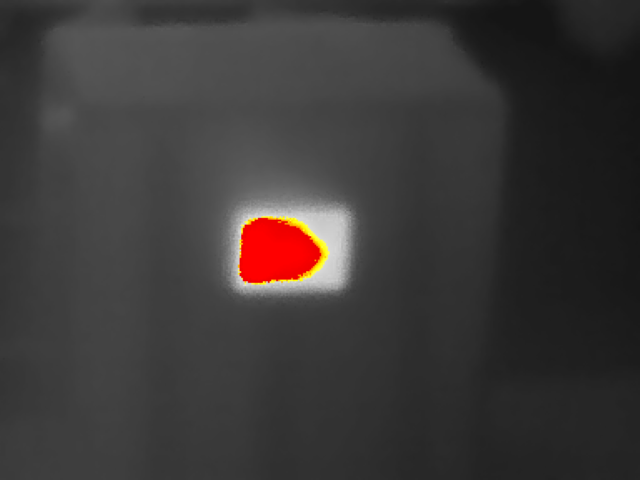 Thermal pads make good targets. 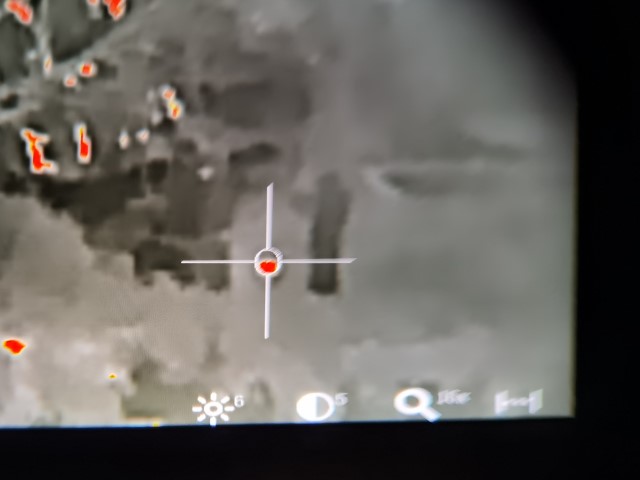 Easily picked out at 70yds. That's about 4-5" across to get an idea of the circle size ( There are a LOT of reticle choices ). 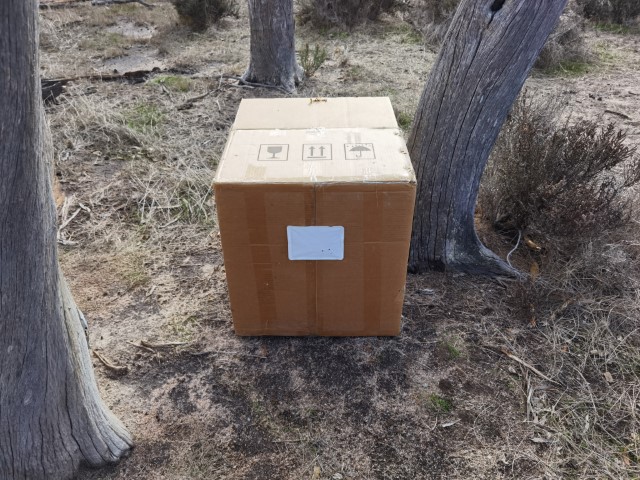 The target was easy to hit. I used a box because I only boresighted. Looks like I was close. 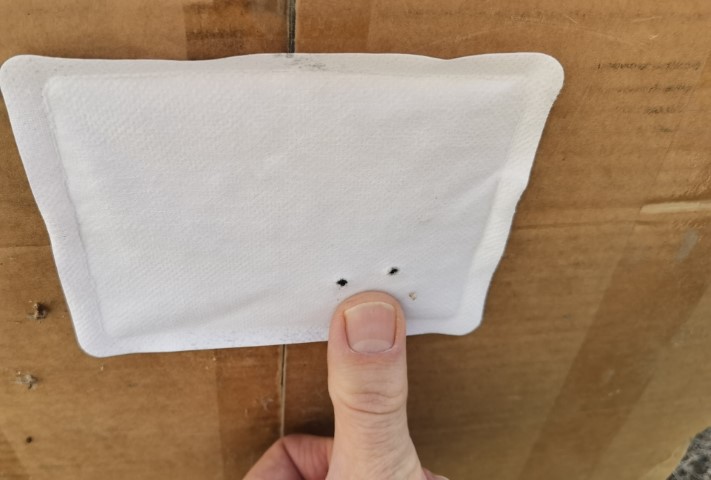 A thumbnail (1/2") group on the pad... Then my cartridge split and wouldn't extract. I'll put that down to good luck - who knows where the third 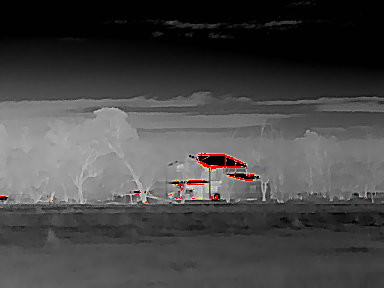 My house at 360m... Spot the person standing there... While my wife was moving around ( scope in hand, not mounted ) I could see her clearly. She's about 2 pixels wide and about 7 pixels high. There's also a diesel heater and a diesel generator in the image, and some heat loss through the house. The columns that support the roof and balcony are 20cm x 15cm... Less than a foot cross-section, and show up reasonably well, even in a still. 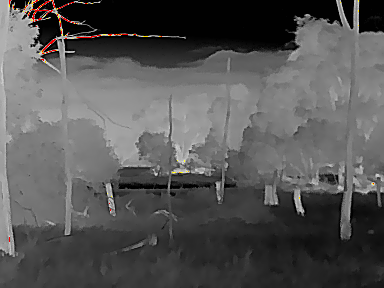 The view through trees is reasonably good. The focus is accurate and sharp. I was looking for rabbits and am reasonably confident none cross my path this evening. 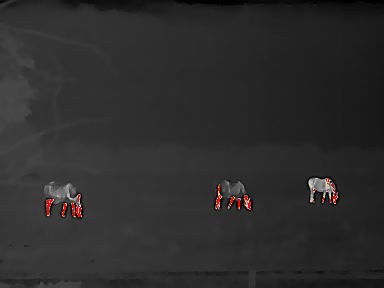 Some horses at around 100m... Maybe a bit further. I didn't range them. |
Two more pics. Feel free to any any questions and if I can I'll answer them or measure/look and see what I can observe.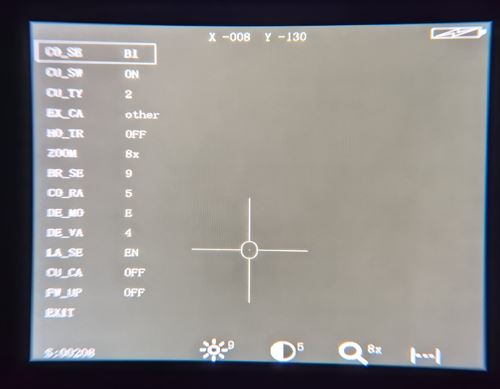 Display through the ocular - With the menu on the left turned on. Not very user friendly. 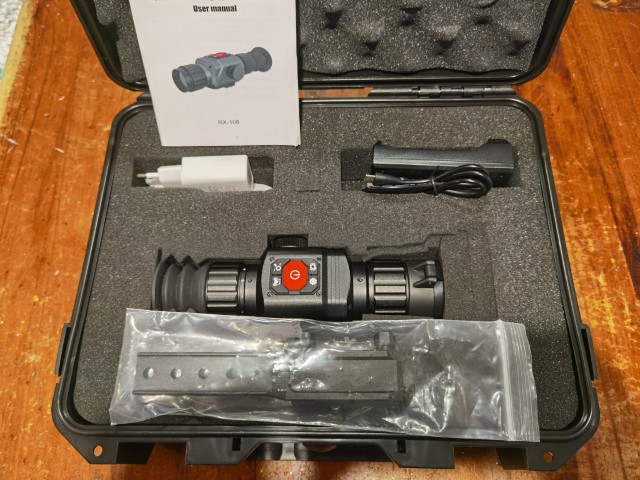 Comes in a box - well mine did. USB charger, Battery charger ( the batteries are 16500 type lithium ion ). And of course the rifle mount. |
|
I think you'll struggle with that for foxes e.g. 17um pixel pitch, 35mm lens, CD 0.7 and I (90%) ~ 70m (21.4 pixels) and R (90%) ~ 140m (10.7 pixels). Probably ok for 22LR. Keep in mind there are detectors in the civilian market with 1280 x 1024, 12um (and indeed 8 um) with NETD <20mK. I've generally found for pest management 640x512, 12um, <20mK and 35mm lens is a nice sweet spot with base magnification 2x e.g. foxes I (90%) ~ 100m and R (90%) ~ 190m. Ideal for 223 Rem. You still have a decent field of view ~ 12.5 by 10 degrees which in my view is important from a safety perspective. 
|
|
Originally Posted By GroundhogOZ: I've generally found for pest management 640x512, 12um, <20mK and 35mm lens is a nice sweet spot with base magnification 2x e.g. foxes I (90%) ~ 100m and R (90%) ~ 190m. Ideal for 223 Rem. I think I may end up waiting a bit for that one though. Interestingly, I do have a 640x480 Dahua with a 25mm lens, and this generally outperforms it by a significant amount - mainly because the dahua optics are very cheap. It's notable that there are some poorly made lenses on some of the cheaper stuff that greatly reduces their capabilities far more than the pixel pitch would suggest. I've been happy with the lens on this one - in fact, that's the main reason I like this one. So it's a shame it's not going to handle something like a 223 rem reliably and that the UI is so poor. |
|
Agreed, also I think prices will drop quite quickly on the 640x units as more and more 1280x units come on to the market. When a short form factor unit is released with 1280x, I'll switch up to a 60mm focal length with 14.5 x 12 degrees FOV - it will be interesting to see the power usage on the PRC 1280x units - as long as there is an option to use 18650s it wont be an issue. I note SiOnyx are working on a quality fusion system, if this is based around their XQE9950/51 architecture (4208 x 2364, 4.75um, 350nm to 1200nm) detector paired with 640x LWIR detector it will be a game changer for the civilian market place. There is nothing like the xqe9950/51 coming out of PRC, the best they have is lower NL2 unaided and even thats a stretch, having said that, PRC cos are making fusion devices, they're just not very good.........yet.  Imagine, 2 mated with 3 in one simple monocular/scope with 4k resolution from the XQE9950 (4.75um pp close to the best analogue which are pushing down to lower 4 um MCP pore diameter). An 18mm lens would give a FOV of ~ 50 x 28 degrees for the IR component with RI human 710m and 360m paired with 24 x 19 degrees FOV for the thermal component and a human DRI of 950m, 240m, 120m. A 35mm scope would be very good. Great field of view 25 x 14 degrees for the IR, RI Human out to 1390m and 690m for the IR and 12.5 x 10 degree FOV for the thermal component and human DRI of ~ 1850m, 460m and 230m. |
|
Originally Posted By Smokehouse_83: I’m liking what Dnt is doing putting 21700’s in their thermnight. You step up to 5000mah and they are pretty much the same price as the 18650’s. True, but 18650s are a bit like the CR123 of the modern world. The DNT is a good example of the PRC not having a good low light detector, they end up using the Starvis or Starvis 2 which has a 2 um pixel pitch but without the quantum efficiency and spectral range of the SiOnyx latest detector. The consequence is they end up having a terrible field of view (a smaller pixel pitch reduces FOV and sensitivity - thus if you have smaller pixel pitch you have to have a larger detector) for the IR, something like 5 or 6 degrees with a 35mm FL and relatively ordinary low light detection. |
|
Originally Posted By GroundhogOZ: True, but 18650s are a bit like the CR123 of the modern world. The DNT is a good example of the PRC not having a good low light detector, they end up using the Starvis or Starvis 2 which has a 2 um pixel pitch but without the quantum efficiency and spectral range of the SiOnyx latest detector. The consequence is they end up having a terrible field of view (a smaller pixel pitch reduces FOV and sensitivity - thus if you have smaller pixel pitch you have to have a larger detector) for the IR, something like 5 or 6 degrees with a 35mm FL and relatively ordinary low light detection. It would be very, very cool to see a fusion device from Sionyx. Probably cost an arm and a leg, but their digital NV solution is genuinely class-leading, and marrying the digital NV and thermal together in a true overlay (vs PiP) would be awesome. |
Its all been done before e.g. IVAS and others  The technical how to part is very easy, its the other stuff that is more tricky e.g. ecosystem. In my view, Army went the wrong way with microsoft and holosens, likely explaining why the next phase of IVAS is likely going to go to open bidding. Its not about the technology its about the effectiveness of the outcome. Anyhow, it will be cool to see these types of technology become more available to a broader market. |

|
Originally Posted By cj7hawk: Maybe they should have gone Facebook and Quest3 ;) @CJ7HAWK It felt like the "hololens" was going to be the next great thing and big Army tried to build an ecosystem around it - cart before the horse. In terms of Quest 3, that made me laugh and all I will say is, ANDURIL likely be right and that was probably a little more than a LUCKEY guess on your part Needs to be more mission set driven e.g. form follows function |

|
Originally Posted By GroundhogOZ: The DNT is a good example of the PRC not having a good low light detector, they end up using the Starvis or Starvis 2 which has a 2 um pixel pitch but without the quantum efficiency and spectral range of the SiOnyx latest detector. GHOz - you look at the ADNV G14P2 yet? According to Carpe Nocturnum (compasscall on IG) it has the OPSIN beat. ADNV G14P2 |
|
Originally Posted By mickdonaldson: GHOz - you look at the ADNV G14P2 yet? According to Carpe Nocturnum (compasscall on IG) it has the OPSIN beat. ADNV G14P2 @mickdonaldson God is in the detail, you will likely find they are using 17 micron pixel pitch and massive detectors (1.5 to 2 inches to get the low light sensitivity). SiOnyx use 9.7 micron and 1 inch detectors - why does this matter, PID. The reason SiOnyx use a lower focal length is to get a larger field of view and the reason they use a higher F stop is to limit depth flattening. At this point in time there is nothing of note coming out of PRC, thermal is a different kettle of fish. Anything from PRC, don't trust and definitely verify. PS SiOnyx published their QE and spectral range curves - everyone else ducks this, why? Recognition and identification distances - 25mm focal length, 1280 x 1024 pixel detector, human, 50% probability 17 micron pixel pitch Recognition distance, 230m Identification distance, 120m 9.7 micron pixel pitch (OPSIN) Recognition distance, 440m Identification distance, 220m Note the demos will almost certainly be short range or with some background/ street lighting. |
Thermal riflescopes HT-C8 dropped below AUD$1000 -(Approx USD$650) What does the forum already know?
Armory Sponsor