


Armory Sponsor


Posted: 8/26/2026 2:03:14 PM EDT
|
I just saw a Guns America video posted and it looks pretty wild. An old neighbor was big into noise cancelling technology years and years ago and I always wondered if it could be applied to cans. Videos are notoriously difficult to judge shot noise from, but that appears to be a pretty good sounding setup. IF (big IF) it sounds as good in person, my next question would be just how sensitive the performance is to caliber, barrel length, erosion of internal geometry, etc. Either way, it seems interesting at least. I would definitely want tool features on the exterior of the can, ideally at the base (maybe the structure with the logo is flat and has an opposite flat?). Nothing came up in my search, but if this has already been discussed please nuke this thread. gunsamerica youtube video link |

|
The granddaddy of noise cancellation would spin in his grave. Phil Seberger always claimed his “billiard ball” baffles were like the sound waves conking into each other, cancelling each other out. At least that’s how he explained it to me. The guys at my office thought that was incorrect, but all agreed the OPS was a good can. Just didn’t believe that’s what it was actually DOING. DUNNO. From his interview many years ago, concerning his patent #4576083 issued on March 18, 1986: “An OPS Inc. silencer works by different principles than most silencers on the market that try to slow or trap the escaping gas. OPS Inc. cans work by capturing the sound waves of a gunshot as they exit the muzzle. Through a series of baffles inside the can the suppressors redirects the sound waves causing them to ricochet back into themselves canceling themselves. It’s called the “out of phase” principle of sound reduction. Seberger, 76, explained the principle this way: “I got the bright idea that if I could go and hold the first sound pulse back in time, and insert it back when the second pulse came along, I’d have sound cancellation and I’d have nothing left but heat. I’d change the sound energy into heat energy. You can’t get rid of energy, you know. “In a gunshot, the first positive pulse occurs as the sine wave goes up then down. It has considerably more amplitude than the negative pulse. We take that pulse and it dissipates a lot of energy as it hits the back of the chamber. What’s left will then be out of phase with the negative pulse, so they cancel each other out. They’re out of phase.” 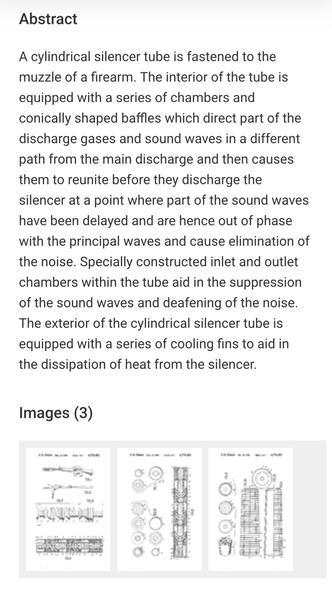 |


|
The concept is relevant but the execution difficult or more like impossible in practice, because the gunshot has mixed frequency content over like 500-6000hz or more, so to use it to drop sound you need an exceptional assortment of different frequencies to be targeted and it is at best a “catch some, not all” concept. The lower frequencies need large distances to create pre-conditions so they should be the toughest to target. The can in question is really big, so no doubt a lot of the performance is volume related too. Pretty much every suppressor is doing some phase cancelation, so the major difference in one attempting to heavily rely on it, would be the shape of parts, and distances targeting different frequencies. I saw the video suggesting it was similar to airpod noise cancellation but thats a comparison of low volume active cancellation versus high impulse passive cancellation. Two very different approaches. |
Austin, Managing Partner - www.GriffinArmament.com


Husher of boomsticks
Joined:
May 2023
Posts:
861
EE: 0% (0)
 CO, USA
|
Snake oil. It may well be a good performing can, but... The highest frequency sounds we can hear, 20khz, have a wave length of about .7". Most of us in here are adult men and top out closer to 15 or 16 kHz even if our ears are good, so now were talking waves from from .85" to several feet at the lower frequencies. There's simply insufficient space inside a can to get it done even if you could incorporate the geometry to make it happen with dozens or hundreds of frequencies. And no matter what you do with phase cancellation inside the can, it's the escaping pressure that makes the loud noise. That's brand new sound waves propagating outside the suppressor. So, yeah, turns out that over a century worth of development doesn't fundamentally change how suppressors work. Must temporarily trap, recirculate, recompress and cool gasses to reduce pressure and attenuate their release to atmosphere. For the record, the idea of phase cancellation in mufflers has it's origins in engine mufflers, but that's such a fundamentally different system that it's truly apples and oranges. Pulsed but constant subsonic flow, MUCH lower pressures, and don't need a straight through hole from source to exit. A single 5.56 round produces as much gas volume as a full cycle of a 400 cubic inch gas engine, and it does so almost instantaneously. |
Suppress all the things!
|
Originally Posted By ECCO_Machine: Snake oil. The highest frequency sounds we can hear, 20khz, have a wave length of about .7". Most of us in here are adult men and top out closer to 15 or 16 kHz even if our ears are good, so now were talking waves from from .85" to several feet at the lower frequencies. There's simply insufficient space inside a can to get it done even if you could incorporate the geometry to make it happen with dozens or hundreds of frequencies. The lower frequencies definitely require several inches for 1/4 sine cancellation- like maybe 5" and that space is an incredible luxury you don't really have in a firearms sound suppressor. |
Austin, Managing Partner - www.GriffinArmament.com
Armory Sponsor