


Armory Sponsor

Posted: 8/27/2024 3:34:30 PM EDT
| I was recently looking on McMaster Carr at 17-4 stainless material prices and noticed a couple of alloys I’ve never heard of, 330 and 309/310. They are both listed under “high temp”. Says the 330 can withstand temps of up to 2100*F. Nothing specific lkst3 for the 309/310, just says high levels of chromium and nickel. I know high nickel is good for heat resistance, and that it’s the base for a lot of superalloys. The bad thing is they both had low yield strengths, both in the 30k psi range, hardened 17-4 is 105000. Is that too low for suppressor use? Maybe some trade off value for heat resistance? Anyone ever messed with either of these alloys? Should I just stick to 17-4? The 330 is pretty pricey and not available from McMaster bigger than 1” p, the 309/310 was about the same cost as 17-4 |

|
Originally Posted By User55645: You absolutely want to start at the highest strength possible. 300 series SS fall off pretty quickly, when heat is applied. Stick w/ the 17-4. There are other metals out there, but 17-4, IMHO, is "cheap" and easy to work with. Both of the 300 series I mentioned are alloyed specifically for high heat resistance. Some quick googling says the upper end of 17-4’s operating range is around 600*. The 330 maintains good physical properties up to 2000*. But like I said the trade off is in yield strength. Around 30-39k psi for 330 and well over 100000k psi for 17-4. I’m not looking for something cheaper, I’m simply inquiring about weather or not anyone has used the stuff. I’m well aware that 17-4 is the “standard “ but that doesn’t necessarily mean it’s the end all be all. I’m not sure what kind of pressures suppressor baffles are subjected to nor how that equates to a materials yield strength |
|
You're misinterpreting the charts. You need to look at elevated temp properties. At 1000f, 17-4 H1025 has a yield of >100k, which is 3x that of 310 at room temp. Also, 17-4 can be subjected up to its treated temp. That's when fatigue will really start to cause problems. You'd have to get the suppressor to glowing red and hold it there. Further, it allows you to make a much thinner wall, saving weight, than what would be needed from a weaker material. 310 is great for things like shielding. We'll typically weld the last 2ft or so to the end of our guide pipes. These would hold an inner set of tubes carrying gas, oil, etc., for industrial boilers. They'll see temps well over 2000F. Here, strength doesn't matter so much as resisting erosion. In a suppressor, however, you need to retain structural integrity while dealing with heat, pressure, and erosion. |
|
Originally Posted By User55645: You're misinterpreting the charts. You need to look at elevated temp properties. At 1000f, 17-4 H1025 has a yield of >100k, which is 3x that of 310 at room temp. Also, 17-4 can be subjected up to its treated temp. That's when fatigue will really start to cause problems. You'd have to get the suppressor to glowing red and hold it there. Further, it allows you to make a much thinner wall, saving weight, than what would be needed from a weaker material. 310 is great for things like shielding. We'll typically weld the last 2ft or so to the end of our guide pipes. These would hold an inner set of tubes carrying gas, oil, etc., for industrial boilers. They'll see temps well over 2000F. Here, strength doesn't matter so much as resisting erosion. In a suppressor, however, you need to retain structural integrity while dealing with heat, pressure, and erosion. That’s the kind of answer I was looking for. Thank you sir |

|
MIL-HDBK-5 is a good reference for elevated temp properties of metals. I don't have mine handy at the moment though I think it's available online. 17-4 machines really nice IME. It can be heat treated to something approximating H900 using the cleaning cycle of most kitchen ovens. It welds nicely too. I keep an eye on ebay for the shops selling drops, I try to find it in the non-HT state. I recently picked up an 16" chunk of 1.75 dia stuff for $48 shipped. I've never machined much on it after heat treating so can't really comment on that. |
| It does machine very nice. The baffles in my f1 can on my ar is a ti tube and 17-4 baffles, except the last two are 7075. The f1 I just finished up for my krink is all 17-4 except the last 2 baffles and the end cap are 7075. Did my own muzzle device/adapter for that one too. With the little short krink barrel that thing gets HOT quick, probably need to try some inconel for it in all reality. I’m going to buy some hardened 17-4 pretty soon to do a can for my other ak. |
| The yield strength for 17-4ph at condition H900 is more like 170,000 or 180,000psi (something like that). Guys who get their suppressors glowing red hot are irreparably reducing that strength - to what, I can't say for certain, but I would run with the assumption that its basically reverted back to Condition A strength levels (whatever that is). |
Husher of boomsticks
Joined:
May 2023
Posts:
520
EE: 0% (0)
 CO, USA
|
Originally Posted By brownbomber: The yield strength for 17-4ph at condition H900 is more like 170,000 or 180,000psi (something like that). Guys who get their suppressors glowing red hot are irreparably reducing that strength - to what, I can't say for certain, but I would run with the assumption that its basically reverted back to Condition A strength levels (whatever that is). 17-4 is still 145 KSI yield strength in annealed condition. Very high strength in all states. Decent hardness in H900 condition. Very easy to heat treat. Minimal distortion in heat treatment. Tough. Excellent welding properties, including to dissimilar alloys. Very corrosion resistant (about the same as 304SS). It is an industry standard material for good reason. There's no reason to mess about with 300 series unless you lack the ability to bore blast chambers/tubes from 17-4 (or 15-5). |
Suppress all the things!
|
Originally Posted By ECCO_Machine: 17-4 is still 145 KSI yield strength in annealed condition. Very high strength in all states. Decent hardness in H900 condition. Very easy to heat treat. Minimal distortion in heat treatment. Tough. Excellent welding properties, including to dissimilar alloys. Very corrosion resistant (about the same as 304SS). It is an industry standard material for good reason. There's no reason to mess about with 300 series unless you lack the ability to bore blast chambers/tubes from 17-4 (or 15-5). Originally Posted By ECCO_Machine: Originally Posted By brownbomber: The yield strength for 17-4ph at condition H900 is more like 170,000 or 180,000psi (something like that). Guys who get their suppressors glowing red hot are irreparably reducing that strength - to what, I can't say for certain, but I would run with the assumption that its basically reverted back to Condition A strength levels (whatever that is). 17-4 is still 145 KSI yield strength in annealed condition. Very high strength in all states. Decent hardness in H900 condition. Very easy to heat treat. Minimal distortion in heat treatment. Tough. Excellent welding properties, including to dissimilar alloys. Very corrosion resistant (about the same as 304SS). It is an industry standard material for good reason. There's no reason to mess about with 300 series unless you lack the ability to bore blast chambers/tubes from 17-4 (or 15-5). 17-4 has a very low Charpy V-Notch toughness in Condition A. It isn't supposed to be used in that condition at all. |
|
Originally Posted By brownbomber:Guys who get their suppressors glowing red hot are irreparably reducing that strength - to what, I can't say for certain, but I would run with the assumption that its basically reverted back to Condition A strength levels (whatever that is). I wouldn't assume this at all. To solution anneal 17-4, it must be held ~1900-1950F for 30-60min. Outside of destructive testing, I don't believe anyone is running their suppressor this hot. Especially not someone who took the time and effort to build one. For reference, that range of temp in real life would look a yellowish-orange color. I would say this silencer is coming into that range around the 0:25sec mark. Unfortunately, it quickly moves beyond this and well into the point of failure. 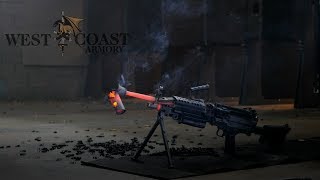 Suppressor Meltdown! 700 round burst through an M249 SAW! |
| Yeah I don't think that would be a good assumption at all. I have tried to pry more info out of my metals M&P types at work but I really don't think they know what welding or shooting until the can glows does to it. It's been shown to work really well in any case. I don't think you will find a more durable material for form 1 suppressors anyway. |
|
Originally Posted By User55645: I wouldn't assume this at all. To solution anneal 17-4, it must be held ~1900-1950F for 30-60min. Outside of destructive testing, I don't believe anyone is running their suppressor this hot. Especially not someone who took the time and effort to build one. For reference, that range of temp in real life would look a yellowish-orange color. I would say this silencer is coming into that range around the 0:25sec mark. Unfortunately, it quickly moves beyond this and well into the point of failure.  https://www.youtube.com/watch?v=BczhT1ByrXA https://www.youtube.com/watch?v=BczhT1ByrXAOriginally Posted By User55645: Originally Posted By brownbomber:Guys who get their suppressors glowing red hot are irreparably reducing that strength - to what, I can't say for certain, but I would run with the assumption that its basically reverted back to Condition A strength levels (whatever that is). I wouldn't assume this at all. To solution anneal 17-4, it must be held ~1900-1950F for 30-60min. Outside of destructive testing, I don't believe anyone is running their suppressor this hot. Especially not someone who took the time and effort to build one. For reference, that range of temp in real life would look a yellowish-orange color. I would say this silencer is coming into that range around the 0:25sec mark. Unfortunately, it quickly moves beyond this and well into the point of failure. https://www.youtube.com/watch?v=BczhT1ByrXALOL! I looked up the solution-treating temperature after I made that post, and I think you're right - seems unlikely you would ever get it that hot in any kind of realistic scenario. |
|
Originally Posted By BASE: Yeah I don't think that would be a good assumption at all. I have tried to pry more info out of my metals M&P types at work but I really don't think they know what welding or shooting until the can glows does to it. It's been shown to work really well in any case. I don't think you will find a more durable material for form 1 suppressors anyway. The Physical Metallurgy of Precipitation-Hardenable Stainleds Steels I've referred to this when welding 17-4PH comes up. If you weld it using 17-4PH filler metal with one pass, you can simply age the assembly after welding - no resolution treating required. |
|
17-4 SS is probably the best all around material for suppressor use short of extended full auto rifle fire. It has good machinability, weldability, corrosion resistance and an easy none distorting heat treatment. It's reasonably priced and readily available. Titanium will get you less weight but costs more and it's mechanical properties derate faster under heat than 17-4. The 300 series SS are far inferior to 17-4 as they are more difficult to machine, are softer and much weaker. 316 SS room temp yield strength is in the range of 35kpsi. In comparison 17-4 H900 is ~90kpsi at 1000o F. As for the Charpy notch toughness it is plenty tough in the H900 state for suppressor use. It is not recommended for cryogenic use in the H900 condition. If you want to step up to better alloys your choices are maraging steel, inconel and steelite. These are very expensive and with the exception of maraging steel very tough to machine and heat treat. Realistically unless your end use is a belt fed machine gun these alloys are overkill. Here is a chart of yield strength vs temperature for common alloys from Energetic Arms 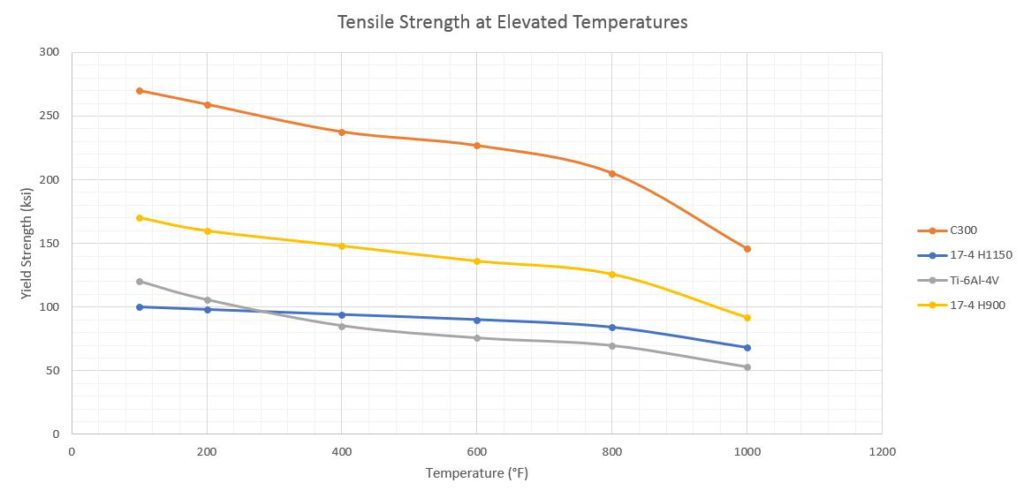 For those looking for a reference on material properties this link is a 1700 page material property treatise by the defense dept on materials used in aerospace. https://drive.google.com/file/d/0B_UkBk_gtKytcTFLUXM1VkFiNVk/view?resourcekey=0-S1-UXc_66CXQJaG1fUXh2Q |
Husher of boomsticks
Joined:
May 2023
Posts:
521
EE: 0% (0)
CO, USA
|
Originally Posted By brownbomber: 17-4 has a very low Charpy V-Notch toughness in Condition A. It isn't supposed to be used in that condition at all. Originally Posted By brownbomber: 17-4 has a very low Charpy V-Notch toughness in Condition A. It isn't supposed to be used in that condition at all. I didn't suggest anyone does that. You said: Originally Posted By brownbomber: the assumption that its basically reverted back to Condition A strength levels (whatever that is). I answered with a number. |
Suppress all the things!
|
Originally Posted By Rich_V: 17-4 SS is probably the best all around material for suppressor use short of extended full auto rifle fire. It has good machinability, weldability, corrosion resistance and an easy none distorting heat treatment. It's reasonably priced and readily available. Titanium will get you less weight but costs more and it's mechanical properties derate faster under heat than 17-4. The 300 series SS are far inferior to 17-4 as they are more difficult to machine, are softer and much weaker. 316 SS room temp yield strength is in the range of 35kpsi. In comparison 17-4 H900 is ~90kpsi at 1000o F. As for the Charpy notch toughness it is plenty tough in the H900 state for suppressor use. It is not recommended for cryogenic use in the H900 condition. If you want to step up to better alloys your choices are maraging steel, inconel and steelite. These are very expensive and with the exception of maraging steel very tough to machine and heat treat. Realistically unless your end use is a belt fed machine gun these alloys are overkill. Here is a chart of yield strength vs temperature for common alloys from Energetic Arms https://energeticarms.com/wp-content/uploads/2022/02/Material-comparisons.jpg For those looking for a reference on material properties this link is a 1700 page material property treatise by the defense dept on materials used in aerospace. https://drive.google.com/file/d/0B_UkBk_gtKytcTFLUXM1VkFiNVk/view?resourcekey=0-S1-UXc_66CXQJaG1fUXh2Q That is awesome info, thanks |
Armory Sponsor