


Armory Sponsor
Posted: 7/18/2026 11:12:47 AM EDT
|
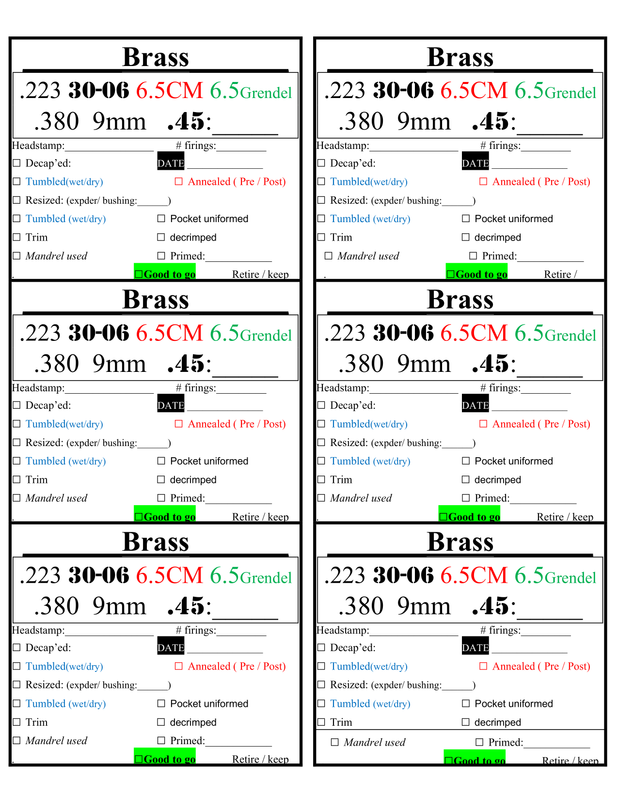
.308 in an AR10 with a crazy tight chamber, so using small-based dies on LC brass. I've tracked four reloads on some cases. They look fine--no signs of neck splitting imminent, the web by the case head doesn't appear to be thinning at all. I'm a cheap bastard (  ) so obviously I'd like to get as many reloads as possible out of them, but I've also had to deal with a case head separation once and once only, and that convinced me I don't ever want to deal with it again. ) so obviously I'd like to get as many reloads as possible out of them, but I've also had to deal with a case head separation once and once only, and that convinced me I don't ever want to deal with it again.So, what's your average? |
"Three, two, one, keyturn."
"If there must be trouble let it be in my day, that my child may have peace." - Thomas Paine
I know the voices aren't real, but MAN do they have some good ideas!
"If there must be trouble let it be in my day, that my child may have peace." - Thomas Paine
I know the voices aren't real, but MAN do they have some good ideas!


| A lot of variables to consider. Annealing will extend case life but is an extra step. The only brass I anneal is 375 Ruger because it is not common and cost $1.50 each new, I do it the cheap way with a drill and socket. There are videos on YT showing how to do it. LC brass isn't hard to come by and I use it myself but I get a lot of free brass so in a bolt gun I fire 5 times and scrap, in an autoloader, 3 times but they will definately go more times than that. Make a tool from a paperclip to check for case head separation. When you can feel the line near the bottom of the case, it's time to discard. JMO. |
|
I never fire brass more than five times through a semi-auto rifle. If it's purchased as once fired, that leaves me four times. Lake City 7.62x51mm brass, and any other military surplus needs dramatically reduced powder charges when used. Brass is cheap, fingers and eyesight, not so much. Brass dedicated to a single bolt action rifle and never sized with no more than .002" of headspace clearance will last a very long time. Semi-autos need at least .003" of clearance and they get rough treatment through the entire feeding and ejection cycle. Five firings is a lot. |
|
I have a dental pick I use to check for case head separation. All of them after three have zero line forming inside or out (visually or by feel). I like the idea of going by trimming. I've just heard that small base dies work the brass pretty hard, so to be wary of it. I'd rather sacrifice a piece of brass than the rifle, but OTOH, brass isn't THAT cheap. I think I'm going to push it to five reloads and see what happens. (I've never had a good way to keep track of reloads until now, so this has never been a concern, I've always just shot the brass until a neck split. But my rifles have now gotten way more expensive, so I figure I need to take better care.) |
"Three, two, one, keyturn."
"If there must be trouble let it be in my day, that my child may have peace." - Thomas Paine
I know the voices aren't real, but MAN do they have some good ideas!
"If there must be trouble let it be in my day, that my child may have peace." - Thomas Paine
I know the voices aren't real, but MAN do they have some good ideas!

|
I'm a fan of the trim method for .30-06 and down . After the second trimming, it's tossed. I will say though, that I usually get 5-6 loads from them before the need for a second trim. The belted magnum rifle calibers I load all get scrapped after the 4th load, regardless of trim need due to flowing into the belt even with using the Larry Willis sizer; the 26 and 28 Nosler's are scrapped after the 3rd load. |
<placeholder for something good in the future></placeholder>

| I have 300rum brass that I use in one bolt action rifle that is currently on its 16th loading...It only gets the shoulder bumped .002", and its annealed every loading, it also gets checked for internal signs of cracks, normally the primer pockets are what gets them..as far as semi auto, got a 6.5cm that has 8 loadings on ADG brass, again minimum shoulder bump and annealing... |
|
Not trying to sound difficult but "How many times?" isn't something I can answer... The variables are too extreme. It depends ... 280 Ackley Improved. I get three or four, but I anneal between firings .. it's too expensive to loose more than necessary. My model Seven in 308 is hard on brass . .although my loads are mild, the rifle works it a fair bit. .I get 3 or 4 times and it's done.. 303 Brit brass in a SMLE? That's reloaded ONCE and tossed after the second firing...it's worked too dang hard Other stuff? I've got mystery source .38 special cases head stamped 1922 and are still going strong . Magazine article from the late 70's ( I think) sought to answer this question...iirc, they reloaded and fired a 38 Spl case something like 133 or 138 times before it split. The other thing I'm starting to see is something I don't truly understand: age hardening (?) . Brass that's been loaded once ( often commerical new ammo) but has been sitting since 1994.. it's often splitting on first firing.. on the other hand, I've fired a 5 gallon bucket load of Lake City M2 Ball dated 1968 and never lost a case... My usual question. Isn't so much "how many times". It's more " how hard am I working this brass"... |
|
I have a simpler method. I take a spring punch and chuck it into my drill press. Attached File I put a dot in the web between the rim and the case body after cleaning. # of dots = # of times fired. Attached File Takes a little time lining it up, but I spent about 15 minutes yesterday doing 200 cases. If it has more than three dots, it gets a fourth and thrown in another bucket (debating about switching those to bolt-gun use only). |
"Three, two, one, keyturn."
"If there must be trouble let it be in my day, that my child may have peace." - Thomas Paine
I know the voices aren't real, but MAN do they have some good ideas!
"If there must be trouble let it be in my day, that my child may have peace." - Thomas Paine
I know the voices aren't real, but MAN do they have some good ideas!
|
Originally Posted By FB41: After the second trimming, it's tossed. Clarification question--after the NEED for a second trimming it's tossed, or do you trim it, reload it, and if it needs a third it's tossed? (Sort of like the old "do we go ON three, or AFTER three" question... )
|
"Three, two, one, keyturn."
"If there must be trouble let it be in my day, that my child may have peace." - Thomas Paine
I know the voices aren't real, but MAN do they have some good ideas!
"If there must be trouble let it be in my day, that my child may have peace." - Thomas Paine
I know the voices aren't real, but MAN do they have some good ideas!

| I shoot them until the primer pocket gets loose. I anneal after every firing on an Ugly Annealer, so the necks are rarely a failure point for me. For my 300 WM load I usually get 6 out of them, maybe 7. If the pressure is kept reasonable a case can go for a long time. I know some bench rest shooters will get 15 - 20 loads out of their brass. |
"I Find Your Lack of Faith Disturbing"
Joined:
Jul 2006
Posts:
8460
EE: 100% (334)
 OH, USA
| I had some 6.5CM Norma brass that were once fired and then necked down to 22 CM. I started having lose primer pocket around firing # 9 and dumped them all at # 12. These were annealed every other firing, no neck issues just the PP. |
“If liberty means anything at all it means the right to tell people what they do not want to hear.”
George Orwell, Animal Farm
George Orwell, Animal Farm
|
Originally Posted By limaxray: Clarification question--after the NEED for a second trimming it's tossed, or do you trim it, reload it, and if it needs a third it's tossed? (Sort of like the old "do we go ON three, or AFTER three" question... )Trimmed twice and used; scrapped if it needs a third. |
<placeholder for something good in the future></placeholder>
|
I have some 44Mag brass that's been in use since the late 80s. Was given to me by a late friend who got out of reloading and it's still going. I don't run max loads in it, though - 27.3gr of H110 seems to be the sweet spot for the bullets I'm using. Some 454 Casull and 45 Colt cases in my stash also have a number of reloads on them. Re: the Ugly Annealer - thanks for spending more of my money, folks. There's a couple buckets full of once fired 223/556 brass in my stash, and the other bottlenecked cartridge I need to immediately load for is 22-250 in an Encore pistol. Those will be annealed and neck sized every trip across the bench. Not sure how many loadings my AR cases will be good for. But they'll be annealed each time and full length resized. |
|
Until I get a neck split or the primer pocket gets loose. I have brass with over a dozen firings on it, and it's still fine. I've had exactly one partial case head separation in 100s of thousands of rounds loaded and fired, and I was able to poke mine out with a cleaning rod from the muzzle. Even if you had a full separation, the only thing that will happen will be the next round cannot chamber this not causing any safety issues. If you are getting case head separation it's caused by excessive sizing bumping the shoulders too much or a rifle with excessive head space/long chamber or a combination of both. When you have one or both of the aforementioned problems, everytime you fire the brass has to expand from somewhere, and that somewhere is the web to base junction of the case. For these reasons I bump bolt gun brass 2-3 thou, and autoloading brass at 4-5 thou. I don't like small base dies. If you absolutely have to use a small base die, that means your rifles chamber is cut too small. Small based dies likely accelerate web fatigue in the brass as you work harden that junction every time you size you brass. Solution? Fix the problem with the rifle. |
|
I assume you use the small base dies because your chamber is so tight that you need the extra sizing for the brass to fit. Even if these do work the brass more, they work the thickest and hardest part of the case, so I don’t think (and I might be wrong) that this would affect case life. More to the point though, going by number of trims tells you something about how the brass is being worked by firing. Cases “grow” by the chamber pressure forcing the brass to flow forward. This (it should be obvious) makes the brass in the body of the case thinner. What is important here is deciding when to trim; when the case hits max length, when it hits an arbitrary length below max, or “other”. It’s also important to think about how much you trim. Using loading manuals’ “trim to” length seems to be aimed at reducing the amount you trim, while trimming to SAAMI minimum length should reduce the number of times your case gets long enough to trim. But…. The happy medium could be different for different people. I personally think that waiting until the case is at (or almost at) max length, then trimming to manual-advised “trim to” length reduces the number of times you have to trim AND preserves case life. As for annealing, yes, it’s another step, and the equipment to do this could cost anything from a few bucks to thousands of dollars. Annealing definitely helps maintain case neck tension, and it definitely helps prevent neck splitting. Unfortunately, that’s the limit of what I know about the proven benefits of annealing. But I’d like to know from people who’ve looked at this seriously, if annealing has an impact on how much cases “grow” in firing. It seems like making the shoulder and neck springier might make that part of the case more resistant to stretch, but it also seems that it’s the case body that stretches, so…I dunno. |
|
Originally Posted By frozenny: Not trying to sound difficult but "How many times?" isn't something I can answer... The variables are too extreme. It depends ... 280 Ackley Improved. I get three or four, but I anneal between firings .. it's too expensive to loose more than necessary. My model Seven in 308 is hard on brass . .although my loads are mild, the rifle works it a fair bit. .I get 3 or 4 times and it's done.. 303 Brit brass in a SMLE? That's reloaded ONCE and tossed after the second firing...it's worked too dang hard Other stuff? I've got mystery source .38 special cases head stamped 1922 and are still going strong . Magazine article from the late 70's ( I think) sought to answer this question...iirc, they reloaded and fired a 38 Spl case something like 133 or 138 times before it split. The other thing I'm starting to see is something I don't truly understand: age hardening (?) . Brass that's been loaded once ( often commerical new ammo) but has been sitting since 1994.. it's often splitting on first firing.. on the other hand, I've fired a 5 gallon bucket load of Lake City M2 Ball dated 1968 and never lost a case... My usual question. Isn't so much "how many times". It's more " how hard am I working this brass"... I had some Federal from the early 90’s in .300 Win mag. Factory. It split when I shot last summer or the summer before. All I could think of is age embrittlement. Stored in ammo cans in a wall locker in a temp stable dry basement. Another big factor is the degree that your chamber and dies are close in dimension. All dimensions not just the shoulder bump. I have also seen brass such as winchester run small at the web. That lets it lay in the bottom of the chamber depending on other contact points, it gets expanded unevenly. Then there is the timing and violence of the extraction. Different firearm but the M14 was notorious for ripping brass out before all the pressure was relieved. 4 reloads or less depending on wear and tear is reasonable. That said RP commercial .308 was showing partial case head separations in my M1a after a reload or two. I stick to LC there. |
|
Originally Posted By cruze5: loose primer pocket or cracked necks for 308 and 223 in a bolt gun semi autos tear the snot out of the brass. 4-5 seems like the max In 5.56 for me it’s the rim damage. They seem to pick up edge dings and burrs. I notice them when gaging. .303 Brit is about three loads and I have two guns with very similar headspace and shoulders. I use a FL die but I’m partial sizing the neck avoiding the shoulder. The war time guns were sometimes cavernous in the chamber dimensions and the groove depth. A .317-318 groove diameter isn’t all that unusual. Fine for jacketed but truly blows for casting unless you get a mold to fit. Iirc my groove diameters are about .313-.314 where they should be. My smith does a little dremmel mark on the rim edge on his match brass, a wait, that may not be for times fire but he indexes that mark at 12 o’clock in the chamber. I think his times fired are spring punched on the headstamps. |
|
Originally Posted By ravinluna: Depends on a lot of factors. I've had once fired nickel brass split neck on the first reload and a case out of the same box get reloaded so many times the brass is showing. I hate nickel brass due to more splits, and screeching in some dies if you bought factory brass and not ammo. It is reported the pickling acid that they etch the underlying brass case with to get the plating to adhere can damage the alloy if left too long. Winchester nickel .357 brass was my splittingest brass ever. I had bought a case of JHP ammo back in the day and ecpvery loading session would have several split. Sometimes they split on the factory load from the get go. |

|
Autoloader 308 is 5 firings and scrapped Autoloader 300 Blackout is 4 firings and scrapped Non Precision 223 is 5 firings and scrapped Precision 308 with annealing and bushing and mandrel treatment way over 10 reloads and still going strong Precision 6.5 CM see 308 I have 45 ACP brass you can not read the headstamp on. I have a few pieces of IMI TZZ match 45 ACP from late 80s still in the mix. Same for some Midway State Headstamped brass from the 80's 38 till it splits 357 till it splits 38 Super till it splits or lost 9MM till it splits or lost 357 Sig splits or lost 44 Magnum till splits I shoot plinking loads for most parf |
jme and I am a NRA Endowment Member
Don't be too timid and squeamish about your actions. All life is an experiment. The more experiments you make the better.
R W Emerson
Don't be too timid and squeamish about your actions. All life is an experiment. The more experiments you make the better.
R W Emerson
|
Originally Posted By SteelonSteel: I hate nickel brass due to more splits, and screeching in some dies if you bought factory brass and not ammo. It is reported the pickling acid that they etch the underlying brass case with to get the plating to adhere can damage the alloy if left too long. Winchester nickel .357 brass was my splittingest brass ever. I had bought a case of JHP ammo back in the day and ecpvery loading session would have several split. Sometimes they split on the factory load from the get go. I have read that "hydrogen embrittlement" occurs during plating. Brittle means hard and strong but it also means it cannot stretch as far without breakage. The mechanism is different but the net effect is the same as the "work hardening" of the brass that occurs during resizing and firing. I like nickel-plated cases but I save them for limited-use ammo. Unlike many above, I do not simply throw away brass after X firings. I do inspect every case as part of the cleaning and reloading process. I do throw away anything that is - Cracked , no matter how small the crack or Cases that you can tell will crack in the next firing; Showing incipient case head separation; Deeply scratched; Creased cases - dented to the point of having a crease I'm sure that list is incomplete. I'm in the better safe than sorry camp. |

Global Warming Hoax Skeptic before it was cool
Joined:
Jun 2007
Posts:
73025
EE: 100% (1)
WA, USA
|
Originally Posted By SteelonSteel: I hate nickel brass due to more splits, and screeching in some dies if you bought factory brass and not ammo. It is reported the pickling acid that they etch the underlying brass case with to get the plating to adhere can damage the alloy if left too long. Winchester nickel .357 brass was my splittingest brass ever. I had bought a case of JHP ammo back in the day and ecpvery loading session would have several split. Sometimes they split on the factory load from the get go. Back in the 80's I did have a couple boxes of nickel cases that did split. I figured it was a bad lot and didn't let that poison me on nickel brass. |
Selling agent for Algores carbon credit scam.
Shooting and Reloading, one hobby feeds the other.
Shooting and Reloading, one hobby feeds the other.
|
I generally expect 4-6 firings from rifle brass that is sized with a full length die with an expander ball. I'm hoping for around 2x that number with match grade brass used in a bolt gun that is sized with a bushing die and annealed every 2-3 firings. The bushing dies can theoretically extend the life of the brass quite a bit because you can size the necks to the correct size in one pass instead of sizing them too small and then opening them back up with the expander. |
|
I have never like nickle plated rifle brass. I remember when Federal Match Brass was nickel plated back in the 80's. When I lived in Bismarck I use see a guy at the Missouri Bottoms Range. He had a heavy barreled the 308 and nickel plating was sort of worn off the cases. Back in the 80s I took what handgun brass a fellow could get. Remember it was not till May of 1986 and FOPA 0f 86 went into effect you could buy ammo, components, and primers etc and have it delivered directly to your home. I used to scour The Gun List or Shotgun news to find brass. Then have a FFL buddy send the FFL with the money order. Brass is brass and handgun brass is plentiful. I like the way nickle plated brass looks with Acme coated bullets. But sorting brass by color is painful |
jme and I am a NRA Endowment Member
Don't be too timid and squeamish about your actions. All life is an experiment. The more experiments you make the better.
R W Emerson
Don't be too timid and squeamish about your actions. All life is an experiment. The more experiments you make the better.
R W Emerson
Armory Sponsor