


Armory Sponsor

Bulge busting (BB) (Page 1 of 2)

Posted: 5/7/2025 11:35:49 PM EDT
[Last Edit: Blowout][Edited]
|
Some folks were asking about bulge busting in another thread so thought I'd sharing my experience with bulge busting (AKA push through sizing) while providing some of the advantages and potential disadvantages of the process. Purpose: The reason for BB (bulge busting) is to size the base of a rimless case (380, 10mm, 40SW, 41AE, 45acp, 45 GAP, 45 Win Mag, etc) that a sizing die can't reach, because the shell holder limits travel of the sizing die. Rimless rifle cases can also be pushed through sized if you find the correct die for it. These are examples of bulged cases that can be corrected with BB: Attached File I've been using the Lee method of bulge busting 40SW and 45acp for close to 20 years. Around 6-7 years ago, began push through sizing 223 with the LG Outdoors die (also made by Lee) and 9mm using the Lee Makarov FCD. Redding also makes several push through sizing dies (G-Rx). I have the G-Rx 40SW die, but haven't yet tried it to compare to the Lee made die. Still on my to-do list. Some folks have reported using bullet sizing dies of the correct dimension to push through size as well. I personally haven't tried a bullet sizing die for this purpose so I'll skip over that possibility. Lee will custom make a die for you if you give them the desired dimensions. This is an old style 40SW G-Rx. They've now added a spring to the push rod to help pop the case off the rod. Can't recall why it has the large collet, but there was a purpose I'd read about in the past. No internal parts to remove in this die like the Lee. Attached File Process with Lee FCD: The inside crimping mechanism is removed from a Lee factory crimp die and only the die body with the carbide ring insert at the base is used to size the OD of the base of the case. Lee FCD die in 40SW: Attached File LG Outdoors 223 push through die: No internal components come with the die. Attached File Attached File A different process for sizing the base of the case is using a rollsizer. These machines start at around $700 for a manual hand crank version and $1300 for a motor driven, then go up in price from there. With these machines the case is rollsized first, then FL sized in a second process which works well with a progressive press. BB on the other hand is relatively inexpensive and requires only a special die, a ram/punch, lube and your press. A Lee APP can also be used to BB and speeds up the process substantially. Advantages of BB: -Sizing the base of the case back to within SAMMI spec helps reduce chambering issues in an auto loader. -Tightens the primer pockets on brass that may be slightly loose. I've checked numerous 223 cases that had a loose pocket and after they were squeezed through the die, primers became within spec again when measuring with a Ballistic Tools primer pocket gauge. I've also done this exercise with 9mm cases. I don't like waiting until seating primers to find out whether the primer pocket is loose. Gaging every primer pocket takes too long when doing large batches. BB has just about eliminated experiencing loose primer pockets when seating primers. I have seen where it wasn't enough to tighten a primer pocket in 40SW. Not sure why the difference, but I've observed this. -Finding the occasional case that wasn't sized. Kinda works as an in-process case gauge. If a case can be easily pushed through the die, it was most likely FL sized. If it gets stuck and needs a lot of force, it wasn't sized yet. It can be very difficult to BB a case if it's not first sized. If your using a Lee APP to BB it could be near impossible to size because the press doesn't have as much mechanical advantage as a typical single stage press, like a rock chucker. When using the APP for full length case sizing, inevitably a few unsized cases will end up in the sized case bin as brass pops out from the shuttle. I'm usually sizing cases quickly when this occurs so slowing the process would help, if not eliminate this from occurring. A second pass through the APP for BB'ing catches those missed cases for the most part. -Nicked and out of round rims from either extractor claw damage or being stepped on can be cleaned up many times with BB. The defects get ironed out as the case is pushed through the die. This is also one area a roll sizer is unable to reach. Maybe there's a newer version that can, but I haven't personally seen one yet. Maybe @Hoser can confirm this. Potential disadvantages: -Additional step in processing. -It can't be done on a progressive press. -I've wondered if pressing the case through a die might open up a crack at the base. I suppose this can be good thing too catch it before it gets reloaded. I've come across cases where the base showed a defect after BB. I don't know if the BB process fractured an already damaged area making it more noticeable or perhaps BB numerous times squeezing the base where it's less malleable is what caused the fracture to occur? I have had a few ruptured bases in unsupported Glock chambers with hotter 40SW/45acp loads, but not in non-glock pistols. It's hard to say definitively what caused the rupture. What I can confirm is when the ruptured case was fit back into the glock barrel, the rupture was outlined exactly at the unsupported area of the chamber. -Lee states BB can be done on a finished round. The potential problem with that is the bullet can be swaged and undersized where it's seated in the case. It can also theoretically tear through powder coating or copper coat on a bullet. It's typically thought not a good idea to BB finished rounds because of this. BB the right way: I've contacted Lee and ran through my BB process with them and was told I had the process correct. I figured they would enlighten me if I was doing something wrong. -Lube cases and FL size first. Then with lube still on the case run it through the BB die as a second step. I've tried BB first and stuck cases in the die multiple times. Lee has talked about cracking the carbon rings on the Mak die used when BB a 9mm Luger and told me they no longer support the 9mm BB procedure. I believe it's because folks didn't FL size first. I've BB'd at least 6k 9mm using the FL 9mm sizing die first, then BB afterwards with a MAK FCD and the carbon ring hasn't yet been damaged. -Using a single stage press: Attached File Use this kit https://leeprecision.com/case-conditioning-tools-lee-bulge-buster-kit for pistol cases along with a factory crimp die in the desired caliber. I would do hundreds in a sitting using an RCBS Partner press. Instead of using the red catch container that comes with the kit, I attached a garbage disposal hose (slick type hose, not butyl rubber) to the top of the die in place of the red container to catch cases. The slick hose allows cases to slide inside whereas butyl rubber causes cases to log jam inside. Attached File -Using the Lee APP requires a different BB kit that has a longer ram and includes inserts in 380, 40SW and 45acp that direct cases into the BB die. For 9mm the 380 insert and a 308 bullet sizing ram can be used. I had a longer ram machined for me so I can also do 223 on the APP with the LG-Outdoors die. Attached File Attached File Punch design for 9mm through the APP: Attached File See #17 in the first post on this thread for more details on using the APP to BB: https://www.ar15.com/forums/armory/Lee-APP-tips-and-tricks/42-510869/ -To BB in combination with a progressive press: I always FL size pistol cases on the Lee APP first, then BB on the APP prior to dry tumbling the cases to remove the lube. It's definitely extra work, but doesn't take very long to size a thousand cases through the APP and then BB those cases again. BB won't correct a severely bulged case shot from a Glock or other firearm with an unsupported chamber. These need to be discarded. Below is an example: Attached File Hopefully this helps answer some questions folks have on bulge busting... |



|
Originally Posted By Blowout:-Nicked and out of round rims from either extractor claw damage or being stepped on can be cleaned up many times with BB. The defects get ironed out as the case is pushed through the die. This is also one area a roll sizer is unable to reach. Maybe there's a newer version that can, but I haven't personally seen one yet. Maybe @Hoser can confirm this. The CasePro is an awesome machine and it corrects any problems in the rim but it is much slower than the current generation rollsizers. |


Global Warming Hoax Skeptic before it was cool
Joined:
Jun 2007
Posts:
71051
EE: 100% (1)
 WA, USA

|
Originally Posted By Hoser: Correct. The RollSizer from Australia does not touch rims. I dont know about the RollSizer out of Poland which seems to be an even better mousetrap than its Australian brother. Rollsizers can work with rimed calibers like 38/357, 45 Colt, etc. The CasePro is an awesome machine and it corrects any problems in the rim but it is much slower than the current generation rollsizers. Is CasePro even around any more? In some respects, they were kinda hit and miss when they were in business. If my memory is correct about a few of the Brian Enos threads over the years. |
|
Originally Posted By JoeDevola: Thank you for this awesome post, dude. Very informative! I've been reloading for about 20 years, and am not ashamed to admit I didn't really know this was a thing. Fascinating. As best as I can recall, with the Evolution Gun Works / Lee Undersize Die (in 9mm, .40, and .45ACP), I never had an issue with the Glock guppy-belly’ed brass. Besides all of the miscellaneous range brass I picked up at matches, there were a few cops that shot with us that would bring a box of police range brass with them to a match every now and then. That was back when .40 was still popular with police departments. I’d give the cop (s) a $5 bill or a $10 bill for a box of .40 brass. I am assuming their departments used Glock 22’s. That EGW/Lee U die plus the Lee FCD never gave me any issues with my reloads NOT dropping right into and right out of the Dillon case gauge. |
|
Originally Posted By JoeDevola: Thank you for this awesome post, dude. Very informative! I've been reloading for about 20 years, and am not ashamed to admit I didn't really know this was a thing. Fascinating Originally Posted By RWEIII: Indeed, great post and summary sir. Originally Posted By DVCER: Sir, that is a great post on how to. |
|
Originally Posted By Hoser: Correct. The RollSizer from Australia does not touch rims. I dont know about the RollSizer out of Poland which seems to be an even better mousetrap than its Australian brother. Rollsizers can work with rimed calibers like 38/357, 45 Colt, etc. The CasePro is an awesome machine and it corrects any problems in the rim but it is much slower than the current generation rollsizers. Just watched a vid on the Casepro... that thing would take up my whole bench.  BB/push through sizing is an inexpensive method for sizing the base. A rollsizer/casepro would really be a time and energy saver if you had large volumes to process. |
|
Originally Posted By WeimaranerDad: As best as I can recall, with the Evolution Gun Works / Lee Undersize Die (in 9mm, .40, and .45ACP), I never had an issue with the Glock guppy-belly'ed brass. Besides all of the miscellaneous range brass I picked up at matches, there were a few cops that shot with us that would bring a box of police range brass with them to a match every now and then. That was back when .40 was still popular with police departments. I'd give the cop (s) a $5 bill or a $10 bill for a box of .40 brass. I am assuming their departments used Glock 22's. That EGW/Lee U die plus the Lee FCD never gave me any issues with my reloads NOT dropping right into and right out of the Dillon case gauge. With fast burning Nitro100NF we've had more than one case blow out before I dropped the charge to 0.5gr below published max load. Might have been the PM throwing a wider range than the normal 0.1gr that it typically does. After that, I'm not taking any chances with that powder and now QC weigh a lot more often. The case on the left looks like it was possibly compromised with a vertical crack at the base before it was loaded and I just missed it. Attached File |
|
Welllll….. At the time, when I first started shooting USPSA production division , it was with a Beretta 96 (the .40 cal version of the 92)….180 grain Berry’s plated bullets….and….here’s the kicker….at minor power factor.. See? The Beretta mags at the time, would only let you stuff about 13 to maybe 15 rounds of forty in them. So shooting Limited at major power factor really only made sense in my mind if you could stuff 20 rounds of the forty in a mag. My car pool/match shooting buddy would shoot an STI Edge in .40 at major. He used the Redding G-RX push through die for his .40 brass. He was using Winchester Super Target with a black moly/poly coated 180gr bullet. He never had any issues with a .40 case letting go. |
| I have been doing this with 380 brass for many years. I have a flat disc on threaded rod that I put in any shellholder I then push the case into a Lee Speed die carbide sizer for 38 special. It takes the case down to .375 all the way to the rim. I use a1/4" carriage bolt to drive case back out. Got the disc and die from an estate sale for $1. |
|
Any truly straight-wall case (.380, .45 Auto, .40 S&W, 10mm, etc.) is a candidate for bulge busting with caliber-specific tools. Your work-around for other calibers is pretty slick. I might just have to get Lee’s APP bulge buster now - that twice through, single-stage press step with .40s was awfully slow. What I hadn’t really considered was how a push-through sizer can fix goobered rims. Probably not all of them, but a lot of them, I’m sure. |
|
How common is getting a stuck case or cracking something? I don't try to save a massively bulged case like your final pic but I've been doing the BB first on my .40 and 10mm. I don't even lube them when I come across stuff in your first pic. I haven't run into any problems yet. But yet is why I'm asking, not trying to be smartass. I didn't realize I was doing it wrong. I'll BB after tumbling using my single stage press then everything just gets fed into the progressive press. |
|
Originally Posted By Gixxersixxer: How common is getting a stuck case or cracking something? I don't try to save a massively bulged case like your final pic but I've been doing the BB first on my .40 and 10mm. I don't even lube them when I come across stuff in your first pic. I haven't run into any problems yet. But yet is why I'm asking, not trying to be smartass. I didn't realize I was doing it wrong. I'll BB after tumbling using my single stage press then everything just gets fed into the progressive press. If your press has a lot of leverage you could BB first, but it's slow going and your putting a lot of work into a process that can be made much easier by FL sizing first. If you plan to use an APP, you'll need to FL size first. It doesn't have much leverage. |
|
If you use the old steel sizing dies it takes care of most of the brass issues. They don't have the carbide ring sitting up inside the die. I use steel dies for certain things. And if I have brass that is a little large I use the steel dies on them. But most of the time the carbide will do for 99.9% of the people. The brass I have been running into with the so called glock belly is 38 spec and 357mag fired out of a Rossi lever actions. I just throw it away. It looks just like the huge bulge on the bottom of the chamber in regular pistol brass in an unsupported chamber. Rossi is known for feeding a huge chambers. So any brass I find that looks like that are in the scrap buckets. |

|
Neat! I will say, in my own practice the bulging goes away per normal and I'm happy with it. This may be similar to OP but a different route- though I think not as rigorous or useful in all cases. I only run 9mm. And do it all unlubbed in a progressive. I just am not willing to do single-stage steps for pistol ammo. I run a 5 position Hornady LnL, with Hornady sizing die bottomed out. and at the last stage, run the Lee FCD, also bottomed out. That last stage takes care of any residual bulging on the fully loaded round, since as noted, the Lee FCD is also a final carbide sizing die too. As noted, that may be spotty for coated bullets, but I only ever run jacketed any more. |
Global Warming Hoax Skeptic before it was cool
Joined:
Jun 2007
Posts:
71055
EE: 100% (1)
WA, USA
|
In 9mm, I load mostly range brass. Run into 6-8 per K that the FCD will not fix to allow round to gauge. The FCD does fix about 90% of them. I normally crimp with a Hornady taper crimp die after seating. The FCD is just the first step in fixing problem rounds. When I get my BB kit, I will see if it fixes (round doesn't gauge) the rounds the FCD won't. |
Selling agent for Algores carbon credit scam.
Shooting and Reloading, one hobby feeds the other.
Shooting and Reloading, one hobby feeds the other.
|
I guess the reason I never heard of this is because I've never actually had a problem with any pistol brass having a "bulge", or any problem that normal resizing with carbide does wouldn't correct. That includes Glocks, including a G23 barrel, made in 1/06. Just never had any issues. This is still fascinating though. |
Global Warming Hoax Skeptic before it was cool
Joined:
Jun 2007
Posts:
71058
EE: 100% (1)
WA, USA
|
Originally Posted By JoeDevola: I guess the reason I never heard of this is because I've never actually had a problem with any pistol brass having a "bulge", or any problem that normal resizing with carbide does wouldn't correct. That includes Glocks, including a G23 barrel, made in 1/06. Just never had any issues. This is still fascinating though. |
Selling agent for Algores carbon credit scam.
Shooting and Reloading, one hobby feeds the other.
Shooting and Reloading, one hobby feeds the other.
|
Originally Posted By dryflash3: Your source of 9mm brass is better than mine I guess. Or the other folks that use his range don’t “push the envelope with 9mm” as much your range folks…  When I have 9mm issues, it’s more things like loose pockets or “isn’t commercial brass supposed to have legible headstamps?” Yeah, whoever is doing whatever to their ammo around here, it seems that they iron out the headstamps way more often than they bulge cases. I should note that I hand-deprime almost everything with a Harvey Deprimer, which almost makes me examine case heads. This practice lets me just wade through everything I bring home from the range and sort it while I’m depriming it. I have had bulged 9s, but usually it’s only one or two per thousand, and given my current backstock of 9mm brass, I don’t fool with it. I’ve tinkered with bulged .380s - which are less common in my range pickups - and done well using Lee’s setup. Of course I started out with .40s because I was trying to build my stocks of that brass. If one of these doesn’t “bulge bust” smoothly and easily on an RCBS Rock Chucker, typically because it’s way too bulged, it gets scrapped. This isn’t common - probably in part because of that visual inspection I do on every case, where I might have taken one look at a case, said “no way!” and chucked it. I don’t know if anyone has access to detailed drawings of various pistol cases, but by observation I believe that there isn’t enough “beef” in pistol case walls to tolerate being substantially bulged then squished back into shape. I strongly recommend that my fellow handloaders think about this when deciding whether or not to try to resuscitate a bulged case. |
|
Originally Posted By dryflash3: Your source of 9mm brass is better than mine I guess. Originally Posted By dryflash3: Originally Posted By JoeDevola: I guess the reason I never heard of this is because I've never actually had a problem with any pistol brass having a "bulge", or any problem that normal resizing with carbide does wouldn't correct. That includes Glocks, including a G23 barrel, made in 1/06. Just never had any issues. This is still fascinating though. I find most case gages are overly conservative. I don't bother with 9mm at all. USPSCA match MAJOR pickups , all of it. Lee FCD and it runs every time. |
|
Originally Posted By JoeDevola: I guess the reason I never heard of this is because I've never actually had a problem with any pistol brass having a "bulge", or any problem that normal resizing with carbide does wouldn't correct. That includes Glocks, including a G23 barrel, made in 1/06. Just never had any issues. This is still fascinating though. Ditto, probably loaded 60K of 9mm as well as 40 and 45ACP without an issue. All my brass are range pickups. 1911, HK, Glock, Sig and a few other pistols. Almost all of it was loaded with Dillon dies, so maybe they do a better job of sizing. I am intrigued with the 223 sizer as I have one rifle with a super tight match chamber. It is sensitive to brass that has been fired in an AR and then reloaded. |
|
When cases are FL sized first, sometimes the case just falls through the Lee die or whatever die your using to set maximum diameter of your cases. I want to know the case OD is not over SAMMI spec before seating a bullet. You can measure each case, use a case guage, or just run cases through the bulge bust die using the APP. It can be a really fast process. Example using 223: The LG Outdoors die sizes the OD of the case at 0.376". This includes the rim which SAMMI specs at 0.378" -0.010 or 0.378 to 0.368". Taking 0.002" off the case rim isn't a problem since the bottom spec is 0.368". SAMMI spec for the case head diameter is 0.03759" and you'll know cases are never over that dimension when run through the die first. To me it's much better to confirm desired dimensions prior to dropping powder and seating a bullet. Attached File ETA: case head sizing 223 on APP 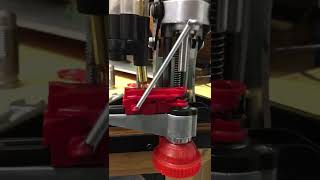 Case head sizing 556/223 with LG Outdoors die on APP I should have used the taller insert on the shuttle to better hold the cases upright. |

|
Originally Posted By JoeDevola: I guess the reason I never heard of this is because I've never actually had a problem with any pistol brass having a "bulge", or any problem that normal resizing with carbide does wouldn't correct. That includes Glocks, including a G23 barrel, made in 1/06. Just never had any issues. This is still fascinating though. Most factory barrels have GENEROUS CHAMBERS. Those generous chambers will usually accept slightly-bulged handloads without resistance. However, several AFTERMARKET barrel makers cut their chambers tight, because “match grade” is essentially defined as “tight chamber.” You’ll need to iron out any small bulge if you want ammo to chamber in those “match grade” aftermarket barrels. |
---------------
They who can give up essential liberty to obtain a little temporary safety, deserve neither liberty nor safety. - Benjamin Franklin, 1775
They who can give up essential liberty to obtain a little temporary safety, deserve neither liberty nor safety. - Benjamin Franklin, 1775
|
Where do you draw the line with a bulge? I have a Rossie R-92 that will put a bulge in my .357 hand loads near the head that aren't max loads but won't bulge .38 Special. The bulge in the .357 cases is not quite as bad as the bulge in the above picture but it's enough that it will not allow chambering and FL resizing would not remove it until I shaved down the shell holder enough to iron it out. I like the Rossi carbine too much to get rid of, it's just so much fun but that bulged brass is an annoyance. I guess my question is, how bad does a slight bulge weaken the brass? |
|
Originally Posted By dryflash3: Your source of 9mm brass is better than mine I guess. I guess so. Mine comes from factory ammo I, and others in the circle have shot, as well as range/pit pickups. Brass that gets culled is split necks, or loose primer pocket, 5.56 brass same, or after 5 loadings. Only case gauges I've ever used over the last 20 years are my barrels. For our Glocks, we've got a few aftermarket as well. ETA: seeing the OP state that some FL sized brass just goes right through the bulge buster, makes me think of this step mainly an "assurance", a way to absolutely guarantee that the round is 106% in-spec. It's good to know the process, and the dies/devices, are available. |
|
Originally Posted By CRNUMBER: Where do you draw the line with a bulge? I have a Rossie R-92 that will put a bulge in my .357 hand loads near the head that aren't max loads but won't bulge .38 Special. The bulge in the .357 cases is not quite as bad as the bulge in the above picture but it's enough that it will not allow chambering and FL resizing would not remove it until I shaved down the shell holder enough to iron it out. I like the Rossi carbine too much to get rid of, it's just so much fun but that bulged brass is an annoyance. I guess my question is, how bad does a slight bulge weaken the brass? I've never tried to bulge bust a rimmed cartridge since it can't be pushed through. I have a 38/357 Lyman FL sizing die that leaves a bulge at the base that wasn't there before sizing. Maybe Lyman undersized the die to cause that. I haven't sized many cases with it and frankly haven't done a deep dive into what's going on. I'll post a pic of a sized case later... Hoser mentioned there's a rollsizer that can do rimmed cases but that's an expensive solution. |
|
Originally Posted By JoeDevola: I guess so. Mine comes from factory ammo I, and others in the circle have shot, as well as range/pit pickups. Brass that gets culled is split necks, or loose primer pocket, 5.56 brass same, or after 5 loadings. Only case gauges I've ever used over the last 20 years are my barrels. For our Glocks, we've got a few aftermarket as well. ETA: seeing the OP state that some FL sized brass just goes right through the bulge buster, makes me think of this step mainly an "assurance", a way to absolutely guarantee that the round is 106% in-spec. It's good to know the process, and the dies/devices, are available. |
|
Originally Posted By Blowout: My Dad had a low cost (cheap) single action frontier style 357 revolver that he mail ordered and picked up at the post office. It had one chamber in the cylinder that even a 38spl load would expand enough to stick and require tapping the extractor rod with something to eject the spent cases. He figured that one chamber was cut too large and got rid of it after fighting it for years. I've never tried to bulge bust a rimmed cartridge since it can't be pushed through. I have a 38/357 Lyman FL sizing die that leaves a bulge at the base that wasn't there before sizing. Maybe Lyman undersized the die to cause that. I haven't sized many cases with it and frankly haven't done a deep dive into what's going on. I'll post a pic of a sized case later... Hoser mentioned there's a rollsizer that can do rimmed cases but that's an expensive solution. Even more expensive if you don’t already have a Dillon progressive reloader with a casefeeder (or case collator). EDIT: and if you have to buy a Dillon case feeder separately. |
| Pretty much on topic: Blowout, how do you feed your APP? I built a stand that I put my Hornady LnL case feeder on, and it drops brass into a 3D printed adapter (sort of a descendent of Lee’s 6-tube feeder). It works well (not perfect - I still need to get the drop tube length and such dialed in), but I’m interested in how you do it. ANYTHING that speeds up a process on the APP makes the press even better. |
Joined:
Apr 2025
Posts:
122
EE: 0% (0)
ND, USA
|
You can find The Lee Bulge busting kit for a lot less than on the Lee site. I got mine from Titan years ago, but you can find them on Amazon too. Doing a search on ammoseek shows them for as low as 12 1/2 bucks right now. I cut off the bottom of a 2 liter bottle to use as my catch tray since the little red one gets filled so fast. There's an adapter for that too, but I can't remember right now where I found it, could probably get someone to 3D print one for fairly cheap too. I also noticed that you really don't need the kit itself for bulge busting, the FCD does all the work, the main piece you would need it the part that goes in the shell holder to push the round through the FCD, I imagine a frugal person especially could find something that would work as good, but I didn't figure that out till AFTER I'd used it & besides for something you can find easily in the $12-$20 range, you're not going to break the bank since you only really need to buy it once. Edited to clarify I cut what is normally the bottom of a 2 Liter bottle, but is now the top of the collection bin for the de-bulged brass. |
Joined:
Apr 2025
Posts:
123
EE: 0% (0)
ND, USA
|
Originally Posted By Blowout: Before I figured out to FL size first, had a couple cases get stuck in the die where they had to be pounded out with a dowel and hammer. Those cases were lubed too. If your press has a lot of leverage you could BB first, but it's slow going and your putting a lot of work into a process that can be made much easier by FL sizing first. If you plan to use an APP, you'll need to FL size first. It doesn't have much leverage. As soon as I'm done sizing, I run them through the BB, usually there's plenty of lube left on the case that I've never felt the need to add more. I haven't had to use much leverage, also though I only use a single stage & don't have worry about how stuff is feeding from one station to the next , a case getting crushed or breaking a part. I would think a turret press might be work good going from de-capping/sizing to de-bulging. I polish the brass after that anyway so de-bulging for me if I had a progressive, wouldn't probably make a lot of sense anyway. |
Global Warming Hoax Skeptic before it was cool
Joined:
Jun 2007
Posts:
71063
EE: 100% (1)
WA, USA
|
Originally Posted By GHPorter: Pretty much on topic: Blowout, how do you feed your APP? I built a stand that I put my Hornady LnL case feeder on, and it drops brass into a 3D printed adapter (sort of a descendent of Lee's 6-tube feeder). It works well (not perfect - I still need to get the drop tube length and such dialed in), but I'm interested in how you do it. ANYTHING that speeds up a process on the APP makes the press even better. Worked well together we did about 15K. |
Selling agent for Algores carbon credit scam.
Shooting and Reloading, one hobby feeds the other.
Shooting and Reloading, one hobby feeds the other.
|
Originally Posted By GHPorter: Pretty much on topic: Blowout, how do you feed your APP? I built a stand that I put my Hornady LnL case feeder on, and it drops brass into a 3D printed adapter (sort of a descendent of Lee's 6-tube feeder). It works well (not perfect - I still need to get the drop tube length and such dialed in), but I'm interested in how you do it. ANYTHING that speeds up a process on the APP makes the press even better. For normal sizing I'm using a collator bought off ebay. It orients the case head down better than the red collator that comes with the APP. Attached File The red collator works better with pistol cases in my experience... Attached File Thought about a Dillon feeder, but these collators don't take up very much room and I'm space constrained unfortunately. |
|
Originally Posted By NEW-N-IMPROVED: You can find The Lee Bulge busting kit for a lot less than on the Lee site. I got mine from Titan years ago, but you can find them on Amazon too. Doing a search on ammoseek shows them for as low as 12 1/2 bucks right now. I cut off the bottom of a 2 liter bottle to use as my catch tray since the little red one gets filled so fast. There's an adapter for that too, but I can't remember right now where I found it, could probably get someone to 3D print one for fairly cheap too. I also noticed that you really don't need the kit itself for bulge busting, the FCD does all the work, the main piece you would need it the part that goes in the shell holder to push the round through the FCD, I imagine a frugal person especially could find something that would work as good, but I didn't figure that out till AFTER I'd used it & besides for something you can find easily in the $12-$20 range, you're not going to break the bank since you only really need to buy it once. Edited to clarify I cut what is normally the bottom of a 2 Liter bottle, but is now the top of the collection bin for the de-bulged brass. I position a plastic ice cream bucket under the FCD to catch cases as they drop. Each bucket holds about 2,200 cases. Fill from one bucket and empties into another. |
|
Originally Posted By NEW-N-IMPROVED: As soon as I'm done sizing, I run them through the BB, usually there's plenty of lube left on the case that I've never felt the need to add more. I haven't had to use much leverage, also though I only use a single stage & don't have worry about how stuff is feeding from one station to the next , a case getting crushed or breaking a part. I would think a turret press might be work good going from de-capping/sizing to de-bulging. I polish the brass after that anyway so de-bulging for me if I had a progressive, wouldn't probably make a lot of sense anyway. |
|
Originally Posted By CRNUMBER: Where do you draw the line with a bulge? I have a Rossie R-92 that will put a bulge in my .357 hand loads near the head that aren't max loads but won't bulge .38 Special. The bulge in the .357 cases is not quite as bad as the bulge in the above picture but it's enough that it will not allow chambering and FL resizing would not remove it until I shaved down the shell holder enough to iron it out. I like the Rossi carbine too much to get rid of, it's just so much fun but that bulged brass is an annoyance. I guess my question is, how bad does a slight bulge weaken the brass? Attached File Attached File Attached File Attached File |
|
Originally Posted By GHPorter: Any truly straight-wall case (.380, .45 Auto, .40 S&W, 10mm, etc.) is a candidate for bulge busting with caliber-specific tools. Your work-around for other calibers is pretty slick. I might just have to get Lee’s APP bulge buster now - that twice through, single-stage press step with .40s was awfully slow. What I hadn’t really considered was how a push-through sizer can fix goobered rims. Probably not all of them, but a lot of them, I’m sure. Yep, and you don’t even have to always use a specific tool: I quite often will have .223 reloads that hang up in my Dillon cartridge gage because the rim had dings in it. I literally turn the casing around, and push it backwards into the gage, and that fixes it good enough for plinking loads usually, it will probably now gage fine. If it was a serious use loading it then goes into the training pile instead though. Anyhow- most .40 bulged casings came from Gen 2 G22’s, which have not been the majority of fired brass in since the late 90’s. I blew up a gen 2 G22 once myself. But we really stopped seeing the problem with the fired brass long ago, after Gen 3 came out. The problem is that I stopped worrying about it long ago, then was later given some decades old 1x brass, lots was fired in those gen 2 models. Unfortunately it all got mixed in with my gigantic supply of cleaned .40 brass before I actually went to load some and remembered about the bulge issue. What a headache… |
a loaded gun won’t set you free, so you say…
|
Originally Posted By JoeDevola: I guess the reason I never heard of this is because I've never actually had a problem with any pistol brass having a "bulge", or any problem that normal resizing with carbide does wouldn't correct. That includes Glocks, including a G23 barrel, made in 1/06. Just never had any issues. This is still fascinating though. Glock fixed the issue around ‘97. |
a loaded gun won’t set you free, so you say…
Joined:
Apr 2025
Posts:
144
EE: 0% (0)
ND, USA
|
Originally Posted By CRNUMBER: I guess my question is, how bad does a slight bulge weaken the brass? Oh it weakens it. I definitely have had case blowout at the feed ramp in .40 1911. It blows the base pad off the mag. Not sure how it would go in a lever gun. What I can’t say is how many reloads it takes to blow out. In my case, I was picking up a lot of range brass with unknown history for USPSA spec loading. Anything with a bad bulge got trashed, minor ones were resized, and the Dillon dies knocked it in to chamber spec. In your case, you are probably just getting all your own brass. Really no definitive answer even there, but I will say I shot over 60k .40 in the day. One case failed. |
If life was easy nobody would quit.
|
Originally Posted By NEW-N-IMPROVED: I've got all gen 3's the first one I bought wasn't till around 2005, I've always had bulging on my cases fired through my Glocks. Not sure what caliber or what loads you are shooting, but the problem would have been far worse in the earlier .40 models than anything you have seen with yours. People complained a lot, and kaboom’d enough pistols, that they supported the base better- it still has less support than a lot of other manufacturers though. I owned Gen 2, and still own early Gen 3, and late Gen 3 (there is a significant change between the early 3 and late 3 on the locking blocks), and the one I kaboom’d was the Gen 2 (with a hot reload). Actually the only kaboom I ever saw was my own reload. Winchester casings had no issue, but a Starline did not hack it though. I saw literally millions of rounds of .40 fired, and factory ammo never blew up when I was watching (though I know it can happen). Glock designed it to function well, with factory ammo, and it did, but reloading cases with those bad bulge issues left a potential problem. I know of a couple G21 .45 kabooms, that were blamed on the gun, but everyone I know was of the opinion it was a bad lot of factory ammo. I didn’t see those in person. So whatever you have seen, just envision it a lot worse basically with those earlier models, leading to case ruptures. That is what I am talking about when I say they fixed the issue- it used to be far more common than it is now, and the bulging issue was a lot worse. It isn’t like they have a really well supported chamber even today though, so if you push things you likely want to use aftermarket barrels with better support. |
a loaded gun won’t set you free, so you say…
Global Warming Hoax Skeptic before it was cool
Joined:
Jun 2007
Posts:
71070
EE: 100% (1)
WA, USA
|
Originally Posted By Blowout: It's a 0.0055" bulge on 357/38 from the Lyman sizing die. It's a lot easier to see in person. https://www.ar15.com/media/mediaFiles/375214/357_base_bulge4_jpg-3538201.JPG https://www.ar15.com/media/mediaFiles/375214/357_base_bulge3_jpg-3538198.JPG https://www.ar15.com/media/mediaFiles/375214/357_base_bulge2_jpg-3538199.JPG https://www.ar15.com/media/mediaFiles/375214/357_base_bulge1_jpg-3538200.JPG It's a carbide die thing. Die is straight sided and not tapered like a steel sizing die. Hasn't caused me any grief in loading 357 for 40+ years. |
Selling agent for Algores carbon credit scam.
Shooting and Reloading, one hobby feeds the other.
Shooting and Reloading, one hobby feeds the other.
|
Originally Posted By dryflash3: That's a normal bulge, it's where the die quit sizing as it's the point where the solid head meets the case sides. It's a carbide die thing. Die is straight sided and not tapered like a steel sizing die. Hasn't caused me any grief in loading 357 for 40+ years. |
Global Warming Hoax Skeptic before it was cool
Joined:
Jun 2007
Posts:
71074
EE: 100% (1)
WA, USA
|
Originally Posted By Blowout: I didn't think about the carbide ring as the cause for this bulge, but it makes sense. Always used a steel sizing die in the past. Thanks for the insight! Originally Posted By Blowout: Originally Posted By dryflash3: That's a normal bulge, it's where the die quit sizing as it's the point where the solid head meets the case sides. It's a carbide die thing. Die is straight sided and not tapered like a steel sizing die. Hasn't caused me any grief in loading 357 for 40+ years.
|
Selling agent for Algores carbon credit scam.
Shooting and Reloading, one hobby feeds the other.
Shooting and Reloading, one hobby feeds the other.
|
Regarding the 357 cases How hard would it be to modify a pair of vise grip pliers to give the bulge a little squeeze? |
---------------
They who can give up essential liberty to obtain a little temporary safety, deserve neither liberty nor safety. - Benjamin Franklin, 1775
They who can give up essential liberty to obtain a little temporary safety, deserve neither liberty nor safety. - Benjamin Franklin, 1775
Joined:
Apr 2025
Posts:
197
EE: 0% (0)
ND, USA
|
Originally Posted By W_E_G: Regarding the 357 cases How hard would it be to modify a pair of vise grip pliers to give the bulge a little squeeze? You wanna use a pair of vise grips to squeeze it back into shape?  I guess you could also save money not buying a press & dies by resizing using the same methods. I guess you could also save money not buying a press & dies by resizing using the same methods.
|
Bulge busting (BB) (Page 1 of 2)
Armory Sponsor