


Armory Sponsor
[ARCHIVED THREAD] - Annealing for Reloaders (Page 1 of 2)
Posted: 3/18/2019 4:55:00 PM EDT
|
I'm creating this thread to avoid further hijack of someone else's thread.
Here's a recap of my thoughts on this subject (reposted here but removed from the other thread, edits added for clarity). REPOSTING - My case life is fine without annealing. Accuracy without annealing is as good or better than I can shoot (<1/2 MOA). I don't make bad ammo and I don't do "mag dumps", ever. This is about making ammo with the best practical accuracy possible but it's not about competitive benchrest shooting with their need to get ~0.1 MOA groups. IMO, annealing is a modern day 'snake oil". The only quantitative data I have seen comparing annealed to non-annealed cases showed no significant improvement in case life. I'd like someone to come forward with some quantitative proof of the benefits of annealing. It would be nice to be able to simply buy a piece of gear that improves accuracy AND case life with no real effort on the part of the shooter. To date, I haven't seen it. Perhaps those selling annealers should do this. after all, they are the ones selling the product. Show me what benefit(s) it offers. Show me it makes financial sense. Please! (snip) Case manufacturing is not reloading. Case manufacturing involves super deep drawing and the associated huge amount of strain and fatigue in the metal. I've seen no proof of benefits. As stated, I hope there is a benefit but I've not seen it either online or during my own work with 30-06, 223 and 6XC. Neither have I seen any quantitative evidence of benefits from anyone else. I wish there was evidence. (snip) I was researching annealing of cartridge brass and came across these two tidbits. 1. Below 900 C (1600 F), there is only one phase in 70/30:Cu/Zn cartridge brass (the alpha phase) 2. Annealing temperature* - 800 F minimum, 1400 maximum The first is good because there is no possibility of getting a weird (alternate, undesirable) morphology during annealing. The latter is troubling for me. It was recommended on this board that I use 750 F Tempilaq during annealing as an indicator of reaching the proper temperature. The thing is, 750 F is too low. This would explain why 'annealing' my cases did nothing to stress relieve them. Perhaps another pass thru the annealer would allow me to rescue those formed but as-yet unfired cases. * Courtesy of Copper.org and link to reference data (snip) As I mentioned above, I annealed about 150 wildcat cases after forming them. I used 750 F Tempilaq as my temperature indicator. The annealed brass split as did un-annealed brass with the same failure mode (tensile fracture) and the same failure rate (~75%). The Copper.org information says to anneal cartridge brass at 800 to 1400 F. If I 'annealed' to lower than 800 F, perhaps they were not actually annealed but just got really hot. |
|
@AKSnowman, Please note, the article you linked shows cases being annealed at 1,000 F, consistent with the Copper.org engineering data I posted. It appears the temperature commonly recommended on ARFCOM (750 F) is too low to actually anneal cases. To me, this is important information. It is not meant as an insult to you. It would be very nice if using the higher temperature was required, as it holds an explanation for all the annealing failures I've seen (my own and those published online). The 750 F Tempilaq could be used to ensure the case head is NOT annealed but it may not ensure case necks and walls are annealed (temp is too low). |
|
For others interested in what he is talking about...
Part 1... https://www.ampannealing.com/articles/40/annealing-under-the-microscope/ Part 2... https://www.ampannealing.com/articles/42/annealing-under-the-microscope/ As for the actual temp.. Attached File This is the part that really sticks out to me... "It is extremely difficult to accurately measure the peak temperature of flash annealing. As noted above, the required temperature also varies with time. That is why AMP focuses on the end result – neck and shoulder hardness – rather than temperature." With that said, If you are using say a 18,000 BTU torch, and you hold the case into it until you observe the 750 degree templaq melt what is the actual temp of the case neck/shoulder? I don't know, what, I do know is my current process is producing better ammo then before... |
|
Here is another article with more good reading..of interest is the introduction thru 1.2...Of interest to me is the recovery stage just into the recrystallization stage..And that very narrow window is where I believe reloaders are aiming for, enough heat to start the annealing process, but not so much heat to destroy the hardness or strength of the cartridge case...We don't want the cases to end up dead soft..we still want spring in it..but we want the spring to be consistent from firing to firing and case to case... "The recrystallization temperature is the temperature where a signi?cant drop in hardness or strength is just detected for a ?xed annealing time. Correspondingly, the recrystallization time occurs when a sharp drop in hardness or strength occurs for a ?xed annealing temperature." This study talks about raw material being prepped for use in cartridge manufacture... https://www.academia.edu/21283133/Recrystallization_Behavior_of_70_30_Brass |
|
1. I noticed the first two articles are authored by the AMP people who sell annealing gear.
2. They make no representations that annealing does anything for accuracy or case life - their data is about hardness. Is this a legal position? They do not want the ramifications of making claims about improved accuracy? If so, they could contract with an independat tester to do the tests. 3. They make no comparisons to unannealed cases in their beck tension/bullet retention data - they are comparing 4X to 10 X annealed. I'll have to read and study it some more but I remain unconvinced that annealing is anything other than 'snake oil' for reloaders. |
|
I don't remember the exact source, but when I was first learning of the need to anneal I read about the time/temperature relationship. Years past I do remember having to learn a little bit of this for our metallurgy class in engineering undergraduate.
I think the old propane torch methods took longer annealing times relative to quick instant heat from induction methods. The longer the heating time the more prone to heat sink affecting the body and base. The propane methods take what, 10-15s depending on the flame? Some older semi-fudd advice showed guys recommending just hand torching the case neck until it glows bright red. From what I remember, brass should start to glow red at about 900deg. Some of my brass starts to with my induction annealer, and it ends up taking 2-3s. So in short, quicker anneal times require higher temperatures. Of course the end result is to reduce the Young's modulus, i.e. increase ductility and decrease brittleness (less cracked case necks, and more uniform neck tension). But of course I'm here to learn, and it is fascinating to me. |
|
As for case life I remember some guys doing some nice analysis, in a non layman way.
I think one was this thread: https://www.ar15.com/forums/armory/-/42-422324/? Another here https://www.ar15.com/forums/armory/Brass-Annealing-Experiment-does-it-improve-muzzle-velocity-variation-/42-484392/ |
|
Quoted:
... I think the old propane torch methods took longer annealing times relative to quick instant heat from induction methods. The longer the heating time the more prone to heat sink affecting the body and base. The propane methods take what, 10-15s depending on the flame? Some older semi-fudd advice showed guys recommending just hand torching the case neck until it glows bright red. From what I remember, brass should start to glow red at about 900deg. Some of my brass starts to with my induction annealer, and it ends up taking 2-3s. .. From my own experience, I had a batch of NIB Rem 25-20 brass that split regularly on the first firing (like 50%). I annealed the survivors plus the remaining NIB cases (torch and 750 tempilaq); and they've fired a good 5+ times now with no cracks. I think annealing has a minuscule impact to accuracy, but no data either way. |
|
By all means, if you find no benefit, don’t anneal.
Regarding the suggestion that 1000 degrees is needed to soften brass....if you were in my shop I could easily prove that assertion wrong while you watched.......by intentionally taking 223 brass to 900 for 4 seconds/overheating it. Take a pliars and squeeze the neck on the overcooked neck and compare that to the grip you need to squeeze the neck on a work hardened piece. One is softer than the other (ruined actually)....even I can feel it. 1000 degrees requirement debunked! So I would suggest not using that as a cornerstone argument against. I realize this is not the scientifically significant test or sample size that you are asking for, but one case in my shop proves that 1000 degree assurtion wrong in my world. I have tested and have enough experience with annealing to know that it benefits me. Having been on this topic with you before and realize my tests are meaningless to you, so am not getting on that merry go round again. The tests that matter the most for your purposes are yours (as are mine)......you saw no benefits, so don’t anneal. |
|
Meh. Maybe someday I'll feel the need. Honestly I'm not too worried about it. Brass is just part of the equation. I'll spend far more in powder and projectiles than I will brass. For a competitive shooter, maybe things are different. I just don't see the need This is 4x Winchester brass. Rear bag and a bipod. I don't obsess over reloading 
|
|
Quoted:
They make 850 degree temiplaq. I wonder why the 750 is what is popular. That's GTG in my world as I view LC brass as the gold standard for a 5.56 cases. Here is my low budget annealing method. https://www.ar15.com/forums/armory/Low-budget-Annealing/42-439440/ |

|
Quoted:
They make 850 degree temiplaq. I wonder why the 750 is what is popular. |
|
One thing that I think is very important with 750* tempilaq/torch annealing is to put the tempilaq INSIDE of the case mouth.
I have seen pictures on here where the outside of the neck is covered in it. I think with it on the outside, you'd get a false reading of the actual temp of the brass, due to the flame coming in direct contact with the tempilaq. With it applied on the inside, the heat has to transfer through the brass to melt the stuff. That is the process I use and have had amazing results. Keep in mind, I'm not reforming brass like some do, to make wildcats etc. But I have helped a buddy do some that he was reforming and he said it worked great. |
|
Quoted:
One thing that I think is very important with 750* tempilaq/torch annealing is to put the tempilaq INSIDE of the case mouth. I have seen pictures on here where the outside of the neck is covered in it. I think with it on the outside, you'd get a false reading of the actual temp of the brass, due to the flame coming in direct contact with the tempilaq. With it applied on the inside, the heat has to transfer through the brass to melt the stuff. That is the process I use and have had amazing results. Keep in mind, I'm not reforming brass like some do, to make wildcats etc. But I have helped a buddy do some that he was reforming and he said it worked great. |
| Not accessible without logging in, which I don't do. |
|
Quoted:
Meh. Maybe someday I'll feel the need. Honestly I'm not too worried about it. Brass is just part of the equation. I'll spend far more in powder and projectiles than I will brass. For a competitive shooter, maybe things are different. I just don't see the need This is 4x Winchester brass. Rear bag and a bipod. I don't obsess over reloading https://i.imgur.com/SSa1cIP.jpg |
|
Quoted: That is the process I use and have had amazing results. P.S. - I agree about keeping the Tempilaq out of the flame. If nothing else, it represents a layer of thermal insulation on the outside of the case. Now, if it was only a dot on a spinning case,... |
|
Quoted:
They make 850 degree temiplaq. I wonder why the 750 is what is popular. When I last annealed the necks and shoulders of some wildcat cases, I had several dots along the length of the case (on the outside). They did not see the flame directly and showed me where along the length the temperature dropped below 750 F. |
|
Trollslayer,
I prefer to make data driven decisions so I'm glad you started this thread. I can't agree that 750 deg Tempilaq is too low, however. There is a very clear difference in the force required to seat bullets or resize necks after annealing. So something is getting done to the brass. I put the 750 Tempilaq on the inside of the case mouth to calibrate my Bench Source annealer. It melts, so the temperature at exceeds 750. The heat also has to conduct through the case neck, so the outside of the neck is definitely hotter than the inside. And after removal from the flame, the inside continues to heat up a little as the hotter outer neck heat conducts inward and things equilibrate. So my guess is that using 750 Tempilaq results in actual temps a fair bit higher. All the way to 1000? Probably not. I don't anneal for case life. My primer pockets usually go before necks split. I anneal for consistent neck tension, which is important for consistent velocities at long range. Unfortunately I don't have hard data to post. I did some testing years back comparing velocity SD for annealed and unannealed brass from the same lot and although the effect wasn't huge, it was enough that I've kept doing it. Another benefit - annealing also doubles as a brass drying stage. Out of the wet tumbler into a towel, quick roll to dry the outsides, into the annealer. Faster than an oven or food dehydrator. |
|
Quoted: Not accessible without logging in, which I don't do. notice the read more at the bottom... Attached File |
|
Quoted: Please post the results in which you compare them to unannealed cartridges. P.S. - I agree about keeping the Tempilaq out of the flame. If nothing else, it represents a layer of thermal insulation on the outside of the case. Now, if it was only a dot on a spinning case,... So, when I started reloading .308 it was for a rifle I built up specifically for shooting long range. I had 100 pieces of brand new lapua brass to work up my loads. During the load workup process, I think I got to 4 firings then noted the groups were less consistent. The load went from consistent bug holes, to 3/4"up to around 1". Thinking back, I remembered how seating the bullets felt less consistent. These are fairly hot loads. 308 - 175gr - 2720fps When I went to reload that same batch of brass after firing, the neck tension was terrible. I had 1 piece that the bullet fell into the case. That's when I looked into annealing. Learned how to do it on a budget here on ARF, via the 750* tempilaq method. I annealed that whole batch of lapua. Seating pressure was very consistent and my groups went back to what they were during load workup. I believe this was back in 2014? Gosh, time flies. Fast forward a few years and that same batch of brass is on 12 firings, annealing every 4. Just a couple months ago, we went out to our long range spot. The 3 of us made a gentleman's bet on who could make a cold bore first round hit on the 1165 yard plate. I was the only one that did. Going against my buddies JP 6.5cm with US Optics glass. My rifle is a budget savage axis build with a fixed 10x SWFA SS. So for me, the process works. |
|
Quoted:
All you need to do is scroll down...nothing more... notice the read more at the bottom... https://www.AR15.Com/media/mediaFiles/404934/Screen_Shot_2019-03-19_at_12_53_55_PM_png-883576.JPG I tried the Download with Google and download with email options, then gave up. I never saw the faint text at the bottom. One would think that should be the primary option held up proudly. P.S. - That is a really good paper. I love it. Thanks for posting the link. This is a very generic study of annealing in cartridge brass. That annealing works in not really the issue. I am willing to stipulate that an annealing process can reduce the case neck work hardening that occurs with repeated sizing. The questions are what is the process and of what value is this to the reloader? I would assert the answer is, none. My challenge is to the annealing industry to prove otherwise with quantitative, verifiable case life and accuracy data. Also, the results support the need to go to at least 800 F (400 C). The thing is, the recrystalization reported in the article required MINUTES at temperature (>2 minutes), not seconds and not instantaneous exposure. To get annealing fast, the report confirms the need to go to 1000 F (550 C). Still nothing about shooting accuracy or case life for reloaders. |
|
Quoted: I'm sure I have some targets around somewhere from when I went down that rabbit hole. So, when I started reloading .308 it was for a rifle I built up specifically for shooting long range. I had 100 pieces of brand new lapua brass to work up my loads. During the load workup process, I think I got to 4 firings then noted the groups were less consistent. The load went from consistent bug holes, to 3/4"up to around 1". Thinking back, I remembered how seating the bullets felt less consistent. These are fairly hot loads. 308 - 175gr - 2720fps When I went to reload that same batch of brass after firing, the neck tension was terrible. I had 1 piece that the bullet fell into the case. That's when I looked into annealing. Learned how to do it on a budget here on ARF, via the 750* tempilaq method. I annealed that whole batch of lapua. Seating pressure was very consistent and my groups went back to what they were during load workup. I believe this was back in 2014? Gosh, time flies. Fast forward a few years and that same batch of brass is on 12 firings, annealing every 4. Just a couple months ago, we went out to our long range spot. The 3 of us made a gentleman's bet on who could make a cold bore first round hit on the 1165 yard plate. I was the only one that did. Going against my buddies JP 6.5cm with US Optics glass. My rifle is a budget savage axis build with a fixed 10x SWFA SS. So for me, the process works. Yours is a good story but is hardly justification for reloaders to literally 'buy into' annealing. Whether that was a lucky shot, or the result of your wind doping skills or directly traceable to your annealing is anything but clear. I don't think you intended it exactly this way, but rescuing one anomalously hard case is hardly justification for annealing. P.S. - I am not intending to push back or 'call BS' on any of you individually. Mine is a challenge to anyone and everyone who promotes annealing as an important step in reloading - show me some accuracy data that justifies spending the time and money on an annealer. |
|
I anneal for one simple reason: neck tension Less neck splitting is just a good side effect.
As brass work hardens over time it loses its ability to hold a specific neck tension. For example you are sizing 223 brass and you want 2 thou neck tension. When you size the case the expander ball is .222 in diameter, so everything should be good right? On virgin brass, the neck tension will stay right at 2 thou or .222. However on work hardened brass, your expander might be .222, but the case will spring back post sizing to say .223, .224, or even .225. Consistent neck tension = greater accuracy. This is why savagemann had the issues with bullets dropping into the case after the 4th firing, it was due to high levels of spring back. Ive also seen this issue over time as well in my 223. I cycle thru my 223 brass for blammo loads and was starting to see more and more cases where the bullet would drop into the case when seating. In turn with this I was seeing bulk loads that are good solid 1' group performers, suddenly open up to 1.5-2". So I bought an annealer and annealed 500 pieces of 223 brass from my bulk bucket. I loaded these to what my known decent blammo load was and my accuracy came back, and I didnt have issues dropping bullets into cases. Its not like Im loading 50 rounds and calling it a good test. Ive loaded over 10000 rounds with this load. I know how its supposed to shoot. Annealing brought the accuracy back. Next example is SDs at the chrono. In 308 my SDs with fully prepped LC brass were generally in the teens. When I started annealing my SDs immediately dropped into the single digits, with one loading I tested this winter having and average SD of 3 across 20 shots fired. Consistent neck tension = consistent SDs = greater accuracy. What do I used for an annealer? Annealeez running from a 20# tank. Kicked around adding a regulator to it, but the larger bottle size seems to have solved some of the issues I was seeing early on using a camp sized bottle. |
|
Quoted: That annealing works in not really the issue. I am willing to stipulate that an annealing process can reduce the case neck work hardening that occurs with repeated sizing. The questions are what is the process and of what value is this to the reloader? I would assert the answer is, none. My challenge is to the annealing industry to prove otherwise with quantitative, verifiable case life and accuracy data. ANNEAL - RITE by Enterprise Services Contact Info Bench Source Contact Information Giraud Tool contact information AMP Annealing Contact Information Annealeez contact form If the above aren't some examples of Annealing Industry players you are seeking test results from, who are? That being typed, doubt the Annealing Industry you target is going to be very responsive to your request beyond the data some of them have already put out there, but you never know. You have tested and found no benefits in your stuff, so logically you don't anneal. Many others (myself included) find value in annealing and anneal. There are apparently enough folks who see value in doing it, to apparently support machine sellers at some level. With much of reloading, results do vary.....what works for some doesn't work for others .....this shouldn't surprise anybody. It certainly doesn't surprise me. I am not sure at this point, how any one test (or challenge for that matter) is going to definitively prove your assertion that the sales of annealing machines is akin to the sale of modern day snake oil........any more than one test (or challenge) is going to prove the alternative to you. One mans opinion. It's relatively easy for an individual to inexpensively test and determine for themselves if annealing provides sufficient value to warrant their time and/or addition expense. To me, this is the test that matters. Last I checked, nobody is forcing anybody to buy a machine......folks in my neck of the woods typically test the cheap way first for themselves to see if they see a benefit (benefit as defined and determined by them, not you, or I, or anyone else) before spending more money to aid production. It isn’t hard. |
|
It's not about me. It is about a cottage industry that is promoting an expensive product whose benefits to the reloader are, as yet, unsubstantiated.
It is incumbent upon them to substantiate the benefit(s) of the product they sell. So far, I remain unconvinced. Benefit is not defined as being able to reduce the hardness of the brass in the case neck. Benefit means demonstrably longer case life. Benefit means demonstrably better smaller group sizes at all distances, not just medium and long ranges (but this would be nice to have). A test run by a competent shooter would suffice for accuracy testing. Case life results would also be nice and could be had as part of the shooting test. Someone else being able to reproduce both those results would also be nice (read that as 'important'). Also, I don't think individuals should tout the benefits of a $500 - $1400 machine without proof of benefit (which borders on schilling). In my experience, there was no benefit but I honestly wish there had been. I may try again at a higher temperature (~1000 F) with the torch setup I used previously. <-- I learned about this as part of this thread. |
|
Quoted:
Benefit is not defined as being able to reduce the hardness of the brass in the case neck. Benefit means demonstrably longer case life. Benefit means demonstrably better smaller group sizes at all distances, not just medium and long ranges (but this would be nice to have). Youre missing the point. Reducing the hardness is what actually increases accuracy due to more consistent neck tension due to less or no neck spring back post sizing. Accuracy doesnt magically get better at longer or short ranges. A bullet fired that creates a 1" group at 100 yards, creates a 10" group at 1000. Group sizes dont magically change as you are suggesting, a bullet, once fired will only change it course if an outside force such as wind acts on it. Pretty simple physics. When you anneal brass you reduce the hardness, work hardening is what causes cases to crack, so annealed brass is less likely to crack. As I stated before, I consider extended brass life to be a positive side effect, but not the most important one. A test run by a competent shooter would suffice for accuracy testing. Case life results would also be nice and could be had as part of the shooting test. Someone else being able to reproduce both those results would also be nice (read that as 'important'). I might be competent, maybe, I dunno. Maybe nobody in this thread is competent? But Ive already proven this. Id say watching accuracy diminish over 10000 rounds over the last couple of years as my brass picks up more firings, and seeing it return, changing nothing but adding annealing, is a pretty good test is it not? Also, I don't think individuals should tout the benefits of a $500 - $1400 machine without proof of benefit (which borders on schilling). I paid $270 for my Annealeez and I mentioned a brand, so I must be a schill? Yes, there are more expensive solutions out there, but this machine works pretty damn well. I will add this caveat, I do think induction annealing is faster and probably more accurate, and is pretty easy to automate as well due to no flame. I may try again at a higher temperature (~1000 F) with the torch setup I used previously. <-- I learned about this as part of this thread. And you will ruin your brass. Anything over just starting to turn a dull red and youve over cooked it. Thats why we use 750 degree Tempilaq. |
|
Trollslayer,
As mentioned several times here, the main reason many of us anneal is for consistent neck tension. If you're convinced this is worthless, and you really want to pursue this "education" crusade  , then what you should do is prove your null hypothesis that there's no difference in the velocity SD between annealed brass and un-annealed 2x, 3x, 4x etc brass. , then what you should do is prove your null hypothesis that there's no difference in the velocity SD between annealed brass and un-annealed 2x, 3x, 4x etc brass.Do the experiment. Show your data. Prove me wrong. I welcome having my beliefs and assumptions challenged. |
|
Quoted:
Its like you havent read a single constructive point that has been brought up in this thread... Quoted:
Quoted:
Benefit is not defined as being able to reduce the hardness of the brass in the case neck. Benefit means demonstrably longer case life. Benefit means demonstrably better smaller group sizes at all distances, not just medium and long ranges (but this would be nice to have). Youre missing the point. Reducing the hardness is what actually increases accuracy due to more consistent neck tension due to less or no neck spring back post sizing. Accuracy doesnt magically get better at longer or short ranges. A bullet fired that creates a 1" group at 100 yards, creates a 10" group at 1000. Group sizes dont magically change as you are suggesting, a bullet, once fired will only change it course if an outside force such as wind acts on it. Pretty simple physics. When you anneal brass you reduce the hardness, work hardening is what causes cases to crack, so annealed brass is less likely to crack. As I stated before, I consider extended brass life to be a positive side effect, but not the most important one. A test run by a competent shooter would suffice for accuracy testing. Case life results would also be nice and could be had as part of the shooting test. Someone else being able to reproduce both those results would also be nice (read that as 'important'). I might be competent, maybe, I dunno. Maybe nobody in this thread is competent? But Ive already proven this. Id say watching accuracy diminish over 10000 rounds over the last couple of years as my brass picks up more firings, and seeing it return, changing nothing but adding annealing, is a pretty good test is it not? Also, I don't think individuals should tout the benefits of a $500 - $1400 machine without proof of benefit (which borders on schilling). I paid $270 for my Annealeez and I mentioned a brand, so I must be a schill? Yes, there are more expensive solutions out there, but this machine works pretty damn well. I will add this caveat, I do think induction annealing is faster and probably more accurate, and is pretty easy to automate as well due to no flame. I may try again at a higher temperature (~1000 F) with the torch setup I used previously. <-- I learned about this as part of this thread. And you will ruin your brass. Anything over just starting to turn a dull red and youve over cooked it. Thats why we use 750 degree Tempilaq. Your little anecdote about a bazillion cases is meaningless to me. I've read many such stories but none match what I've experienced with annealing. Did you see the AMP annealing data, see the Copper.org annealing temperature data I posted and read John Klein's report? 800 F is where annealing starts not stops. I've been to 750 F and it did NOTHING! As it turns out, it shouldn't have done anything, The temperature was too low. I will not attempt to fend off all those who are invested and vested in annealing. That is why I want to see something from the suppliers of the gear. IMO, they owe it to their potential customers to prove they have a valuable product. |
|
There is better data available then the Copper group provides.
It shows things like dwell times at temperature to anneal Cartridge Brass. It will take longer at 750 F than at 1,000 F. At 1,000 F it is almost instant. And if you allow the temp to spread you will soften the case head. At 750 F it takes a few seconds. This gives you a little more leeway in heating and cooling. When I wasted a bunch of lab time using x-rays to measure brass composition I rarely found anything that was more than the uncertainty in my measurements. A very few percent off of 70-30 copper-zinc. It took many years to settle into this composition trading off stregnth and malleability to allow for the extensive drawing that makes cartilage cases. Even the simple process of punching brass disks to form primer cups alters the hardness of the brass. The multiple draw-form and annealing steps to turn a brass disk into a bottle necked rifle shell with a hardened case head at production speeds is incredible. Brass strips go into the forming machine to be punched into disks and then repeatedly drawn and annealed to produce usable cartridge cases. Even more astounding is that we now use carbide dies to perform this task now at very high speed. The original guys only had hardened steel alloys (with incredible surface finishes) for their cup/form/draw dies. |
|
Quoted:
Trollslayer, As mentioned several times here, the main reason many of us anneal is for consistent neck tension. If you're convinced this is worthless, and you really want to pursue this "education" crusade , then what you should do is prove your null hypothesis that there's no difference in the velocity SD between annealed brass and un-annealed 2x, 3x, 4x etc brass.Do the experiment. Show your data. Prove me wrong. I welcome having my beliefs and assumptions challenged. |
|
Quoted: Kaldor, it is you who seem to be missing my point. I want to see quantitative results. I want to see group sizes NOT hardness test results. Show me the accuracy data! Do you not understand the difference? Your little anecdote about a bazillion cases is meaningless to me. I've read many such stories but none match what I've experienced with annealing. Did you see the AMP annealing data, see the Copper.org annealing temperature data I posted and read John Klein's report? 800 F is where annealing starts not stops. I've been to 750 F and it did NOTHING! I will not attempt to fend off all those who are invested and vested in annealing. That is why I want to see something from the suppliers of the gear. IMO, they owe it to their potential customers to prove they have a valuable product. As for the annealing machine manufacturers owing you proof...good luck... |
|
This is an example of what I mean when I say quantitative data. It shows case life for two different annealing schedules and compares that to non-annealed cases.
The net effect of annealing is an 11% increase in the total number of firings out of a batch of cases before the last case is lost (2010 versus 1812). The two annealing schedules were identical in this 11% overall increase. Most of the 11% extra life occurs after 13 firings at which point all batches had lost 50% of their populations. I do not consider these results to justify buying an annealer. 11% gain after losing 50% of my cases just doesn't cut it for me. 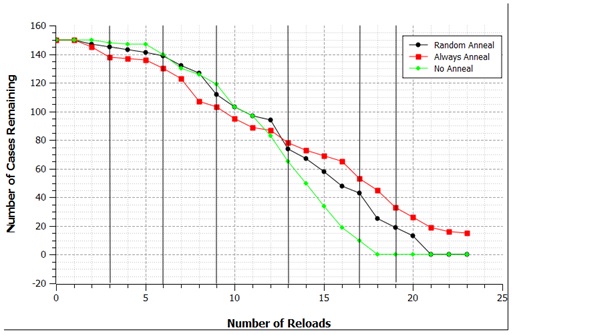
|
|
Quoted:
There is better data available then the Copper group provides. Their data is consistent with the Copper.org data and John Klein's report. It shows things like dwell times at temperature to anneal Cartridge Brass. It will take longer at 750 F than at 1,000 F. At 750 F, it takes over ten minutes. That long of a dwell would anneal the whole case - this is useless/dangerous for use by a reloader. At 1,000 F it is almost instant (a few seconds). This is exactly what the AMP annealer does - 1000 F in seconds. And if you allow the temp to spread you will soften the case head. I plan to use dots of 750 Tempilaq along the length of the case body to ensure the case walls and case head do not go over-temp. At 750 F it takes a few seconds. This gives you a little more leeway in heating and cooling. When I wasted a bunch of lab time using x-rays to measure brass composition I rarely found anything that was more than the uncertainty in my measurements. That's good, we wouldn't want to alter the alloy's composition. Super! A very few percent off of 70-30 copper-zinc. It took many years to settle into this composition trading off stregnth and malleability to allow for the extensive drawing that makes cartilage cases. Even the simple process of punching brass disks to form primer cups alters the hardness of the brass. The multiple draw-form and annealing steps to turn a brass disk into a bottle necked rifle shell with a hardened case head at production speeds is incredible. Brass strips go into the forming machine to be punched into disks and then repeatedly drawn and annealed to produce usable cartridge cases. Even more astounding is that we now use carbide dies to perform this task now at very high speed. The original guys only had hardened steel alloys (with incredible surface finishes) for their cup/form/draw dies. Sounds good but I am not making cases, just trying to soften the shoulder and neck after forming some wildcat 6XC cases. |
|
Quoted:
This is an example of what I mean when I say quantitative data. It shows case life for two different annealing schedules and compares that to non-annealed cases. The net effect of annealing is an 11% increase in the total number of firings out of a batch of cases before the last case is lost (2010 versus 1812). The two annealing schedules were identical in this 11% overall increase. Most of the 11% extra life occurs after 13 firings at which point all batches had lost 50% of their populations. I do not consider these results to justify buying an annealer. 11% gain after losing 50% of my cases just doesn't cut it for me. https://i.ibb.co/kB67Cy0/Annealing.jpg I anneal with a BenchSource Annealer and I don't loose cases nearly this fast, not even close. Makes me wonder if whoever put this together was annealing them properly, or potentially over working/sizing the heck out of them, hot loads....or something else going on. |
|
Quoted:
Kaldor, it is you who seem to be missing my point. I want to see quantitative results. I want to see group sizes NOT hardness test results. Show me the accuracy data! Do you not understand the difference? Your little anecdote about a bazillion cases is meaningless to me. I've read many such stories but none match what I've experienced with annealing. Did you see the AMP annealing data, see the Copper.org annealing temperature data I posted and read John Klein's report? 800 F is where annealing starts not stops. I've been to 750 F and it did NOTHING! As it turns out, it shouldn't have done anything, The temperature was too low. I will not attempt to fend off all those who are invested and vested in annealing. That is why I want to see something from the suppliers of the gear. IMO, they owe it to their potential customers to prove they have a valuable product. Quoted:
Quoted:
Quoted:
Benefit is not defined as being able to reduce the hardness of the brass in the case neck. Benefit means demonstrably longer case life. Benefit means demonstrably better smaller group sizes at all distances, not just medium and long ranges (but this would be nice to have). Youre missing the point. Reducing the hardness is what actually increases accuracy due to more consistent neck tension due to less or no neck spring back post sizing. Accuracy doesnt magically get better at longer or short ranges. A bullet fired that creates a 1" group at 100 yards, creates a 10" group at 1000. Group sizes dont magically change as you are suggesting, a bullet, once fired will only change it course if an outside force such as wind acts on it. Pretty simple physics. When you anneal brass you reduce the hardness, work hardening is what causes cases to crack, so annealed brass is less likely to crack. As I stated before, I consider extended brass life to be a positive side effect, but not the most important one. A test run by a competent shooter would suffice for accuracy testing. Case life results would also be nice and could be had as part of the shooting test. Someone else being able to reproduce both those results would also be nice (read that as 'important'). I might be competent, maybe, I dunno. Maybe nobody in this thread is competent? But Ive already proven this. Id say watching accuracy diminish over 10000 rounds over the last couple of years as my brass picks up more firings, and seeing it return, changing nothing but adding annealing, is a pretty good test is it not? Also, I don't think individuals should tout the benefits of a $500 - $1400 machine without proof of benefit (which borders on schilling). I paid $270 for my Annealeez and I mentioned a brand, so I must be a schill? Yes, there are more expensive solutions out there, but this machine works pretty damn well. I will add this caveat, I do think induction annealing is faster and probably more accurate, and is pretty easy to automate as well due to no flame. I may try again at a higher temperature (~1000 F) with the torch setup I used previously. <-- I learned about this as part of this thread. And you will ruin your brass. Anything over just starting to turn a dull red and youve over cooked it. Thats why we use 750 degree Tempilaq. Your little anecdote about a bazillion cases is meaningless to me. I've read many such stories but none match what I've experienced with annealing. Did you see the AMP annealing data, see the Copper.org annealing temperature data I posted and read John Klein's report? 800 F is where annealing starts not stops. I've been to 750 F and it did NOTHING! As it turns out, it shouldn't have done anything, The temperature was too low. I will not attempt to fend off all those who are invested and vested in annealing. That is why I want to see something from the suppliers of the gear. IMO, they owe it to their potential customers to prove they have a valuable product. |
|
Quoted:
Show me your quantitative data, please. 500 pieces of brass, on their 7th reload, they've been together for their life with this rifle, treated equally ...... they all passed my inspection when reloaded last, and I am missing 2 out of the 500. The missing two were either lost in the weeds on their round trips, or got culled by me. So again, my annealed brass does much better than whoever put that chart together as it relates to case life with my annealed brass. According to my records on the 5-100 round boxes, they have been annealed each reload by me with a BenchSource Annealer. Trollslayer, you could easily add this annealed brass data to your chart as a pretty straight line beginning at the 500 mark on the left and running to 498 and currently ending on the 7th reload, and I could let you know if need to cull any of this batch this season, and you can update chart upon subsequent reloads. Let me know if you are interested so I don't forget. However, I am not a "supplier of gear" (your words) in my judgement. I have other brass with more use. Like others have stated, I use my Benchsource Annealer for a number of reasons, potential case life benefits being but one. |
|
Quoted:
Trollslayer, you could easily add this annealed brass data to your chart... Please recall it was only posted as an example of what quantitative data is. This example also happens to be about annealing, so it seemed like a good example. It is the only quantitative data on annealing that I have other than my own very limited data set. In my case (pun?), I fired about 100 rounds and had a 75% failure rate due to cases splitting in the cold worked region. <-- I could get more accurate numbers were I out in the reloading area (garage). |
|
Quoted:
Why do you insist on ignoring its effects on neck tension? Case life is (maybe) a fringe benefit. |
|
Trollslayer
It (being reloading) of course depends on what your goals are. I'm am no competitor but my friends who are chase super low SDs. So in one ballistic calculator, for 6.5cm, a 40fps ES causes over a 9in change in vertical impact at 1,000yd. But if you only shoot 200yds, like you said your rifle is capable of 1/2moa at, then that ES is below 0.1in change. So, the big question you're not buying, is if annealing will reduce your SD enough to be worth the hassle. The guy I know who wins at PRS, would probably say practice would be most important, but he also definitely anneals. So instead of needing group sizes as data, you could just see what the SD does, which would be more important for long range stuff. Group sizes as "quantitative" data will result in junk data since there are just so many variables at play. I'd be interested in seeing quantitative data on SD changes, but not group size. |
|
Quoted:
Trollslayer It (being reloading) of course depends on what your goals are. I'm am no competitor but my friends who are chase super low SDs. So in one ballistic calculator, for 6.5cm, a 40fps ES causes over a 9in change in vertical impact at 1,000yd. But if you only shoot 200yds, like you said your rifle is capable of 1/2moa at, then that ES is below 0.1in change. So, the big question you're not buying, is if annealing will reduce your SD enough to be worth the hassle. The guy I know who wins at PRS, would probably say practice would be most important, but he also definitely anneals. So instead of needing group sizes as data, you could just see what the SD does, which would be more important for long range stuff. Group sizes as "quantitative" data will result in junk data since there are just so many variables at play. I'd be interested in seeing quantitative data on SD changes, but not group size. For reference, I do load development testing at 200 yards but also shoot at 600 yards in for recreation and for NRA mid-range matches. We also have a 1,000 yard range about to bring online using electronic targets. <-- Can't wait! I both agree and disagree with your point about group sizes at extended distances. There are a lot of factors at play, aiming error, mirage, wind deflection/doping errors, shooter fatigue,... and dispersion in muzzle velocity. They are all factors. The thing is, individual errors get subsumed into an overall dispersion of the group. No one factor is visible. No one factor dominates group size (unless it is grossly larger than the others, like wind reading errors). Look at what a 1, 2 or 3 mph error in wind reading will do to group lateral dispersion. 3 mph is barely sensible on your face and if it just a change on top of a prevailing 5, 10 or 20 mph fishtailing wind it can be 'difficult' to read. If you don't already know it, look up the "root sum square" method of error analysis. Play with it. You will see what I mean about individual factors not mattering much. Personally, I have done substantial probabilistic modeling of group sizes and related error analysis. |
|
Quoted:
Kaldor, it is you who seem to be missing my point. I want to see quantitative results. I want to see group sizes NOT hardness test results. Show me the accuracy data! Do you not understand the difference? Your little anecdote about a bazillion cases is meaningless to me. I've read many such stories but none match what I've experienced with annealing. Did you see the AMP annealing data, see the Copper.org annealing temperature data I posted and read John Klein's report? 800 F is where annealing starts not stops. I've been to 750 F and it did NOTHING! As it turns out, it shouldn't have done anything, The temperature was too low. I will not attempt to fend off all those who are invested and vested in annealing. That is why I want to see something from the suppliers of the gear. IMO, they owe it to their potential customers to prove they have a valuable product. Quoted:
Quoted:
Quoted:
Benefit is not defined as being able to reduce the hardness of the brass in the case neck. Benefit means demonstrably longer case life. Benefit means demonstrably better smaller group sizes at all distances, not just medium and long ranges (but this would be nice to have). Youre missing the point. Reducing the hardness is what actually increases accuracy due to more consistent neck tension due to less or no neck spring back post sizing. Accuracy doesnt magically get better at longer or short ranges. A bullet fired that creates a 1" group at 100 yards, creates a 10" group at 1000. Group sizes dont magically change as you are suggesting, a bullet, once fired will only change it course if an outside force such as wind acts on it. Pretty simple physics. When you anneal brass you reduce the hardness, work hardening is what causes cases to crack, so annealed brass is less likely to crack. As I stated before, I consider extended brass life to be a positive side effect, but not the most important one. A test run by a competent shooter would suffice for accuracy testing. Case life results would also be nice and could be had as part of the shooting test. Someone else being able to reproduce both those results would also be nice (read that as 'important'). I might be competent, maybe, I dunno. Maybe nobody in this thread is competent? But Ive already proven this. Id say watching accuracy diminish over 10000 rounds over the last couple of years as my brass picks up more firings, and seeing it return, changing nothing but adding annealing, is a pretty good test is it not? Also, I don't think individuals should tout the benefits of a $500 - $1400 machine without proof of benefit (which borders on schilling). I paid $270 for my Annealeez and I mentioned a brand, so I must be a schill? Yes, there are more expensive solutions out there, but this machine works pretty damn well. I will add this caveat, I do think induction annealing is faster and probably more accurate, and is pretty easy to automate as well due to no flame. I may try again at a higher temperature (~1000 F) with the torch setup I used previously. <-- I learned about this as part of this thread. And you will ruin your brass. Anything over just starting to turn a dull red and youve over cooked it. Thats why we use 750 degree Tempilaq. Your little anecdote about a bazillion cases is meaningless to me. I've read many such stories but none match what I've experienced with annealing. Did you see the AMP annealing data, see the Copper.org annealing temperature data I posted and read John Klein's report? 800 F is where annealing starts not stops. I've been to 750 F and it did NOTHING! As it turns out, it shouldn't have done anything, The temperature was too low. I will not attempt to fend off all those who are invested and vested in annealing. That is why I want to see something from the suppliers of the gear. IMO, they owe it to their potential customers to prove they have a valuable product. Id say watching accuracy diminish over 10000 rounds over the last couple of years as my brass picks up more firings, and seeing it return, changing nothing but adding annealing, is a pretty good test is it not? When I started annealing my SDs immediately dropped into the single digits, with one loading I tested this winter having and average SD of 3 across 20 shots fired. Consistent neck tension = consistent SDs = greater accuracy. My reloading process didnt change, the only thing that has was I added annealing into my work flow. If you dont want to anneal, thats fine. Do your thing, but dont ignore evidence to the contrary. |
| For my 260 match loads, I really begin to notice variation in seating depth and tension required to seat a bullet after 4-5 firing cycles, and by 6-7 I begin to have fliers. I don’t anneal, probably should, but I begin using brass at the 3rd firing and typically loose enough by the 5th cycle that I just don’t worry about it and buy another 3-400. If anyone is willing to anneal, I can send out some cases on their 3rd firing, 5th firing and 7th to be processed and then tested to see what impact annealing has compared to non-annealed on the same cycle. The load is good for sub half moa, so dispersion should be apparent if it’s there. |
[ARCHIVED THREAD] - Annealing for Reloaders (Page 1 of 2)
Armory Sponsor