


AR Sponsor

The Trouble With 3-Shot Groups (Page 8 of 12)

|
Well, I started reloading last week and decided to see how everything was working today before I got too carried away. I've been shooting in a Service Rifle league the last few years and have been using American Eagle 55gr ammo. We shoot at 200 yards. Today I went to a 100 yard range and shot off sandbags using the iron sights. The rifle is a Rock River Arms lower with a White Oak upper. The front post is about twice the width of the black on the target. I used a bottom hold so I could see the black. Here's the AE223 target (10 shots, 2.990 MOA):  Here's how my best reloads look (10 shots, 0.938MOA):  I used 69gr Sierra bullets and 23.5grs of Alliant R15 powder. 23.5grs worked the best out of the 4 different amounts I shot. I'm sure it could be a lot better if I used a scope and a better rest instead of sandbags. The On Target program was simple to use and works great. Thanks for the link. Hope the pictures actually show up. Raffi |

 Dude, I didn't do that good with a $2500 scope! Mike |
Train till is it is muscle memory!
"Taking fire, breaking right"
DON'T laugh I only have one AR!
GUN GALLERY 4 LIFE!
"Taking fire, breaking right"
DON'T laugh I only have one AR!
GUN GALLERY 4 LIFE!
I like the short dot a lot! I find myself running it at about 2.5x with the dot on... I think that is "ok" shooting... It was off a soak full of beans with no bunny ear bag in the rear. There was a little wind but not much. I think a little more then 4x is needed to shoot really well... Molon, Thanks for the help! More pics to come soon! Mike |
Train till it is muscle memory!
"Taking fire, breaking right"
DON'T laugh I only have one AR!
GUN GALLERY 4 LIFE!
"Taking fire, breaking right"
DON'T laugh I only have one AR!
GUN GALLERY 4 LIFE!

|
Some long term testing of the Larue stealth 16" upper. Groups were fired over the course of several months.
Methods: 10-shot groups fired at 100 yards. Groups measured end to end the subtracted the bullet diameter (-.224) to find the extreme spread. Fired from a rest with a rear bag using a 2.5-10x NF scope at 10 power. Ammo used: PPU 75gr MATCH factory loads. For a review of this ammo see: http://www.ar15.com/forums/topic.html?b=3&f=16&t=372350 Sample size of 16 10-shot groups averaged: 1.575" (avg extreme spread) Smallest group measured 1.026" (extreme spread) Largest group measured 1.976 (extreme spread) Most common measurements were 1.5-1.6" (extreme spread) The upper: 
The sample size of 16 10-shot groups 

And for all you internet commandos a 5-shot group measuring 0.65" 
I dont have RSI shooting lab or a crazy testing set up like Molon but I hope this review does it justice |


|
Originally Posted By vicious_cb:
Some long term testing of the Larue stealth 16" upper. Groups were fired over the course of several months. Methods: 10-shot groups fired at 100 yards. Groups measured end to end the subtracted the bullet diameter (-.224) to find the extreme spread. Fired from a rest with a rear bag using a 2.5-10x NF scope at 10 power. Ammo used: PPU 75gr MATCH factory loads. For a review of this ammo see: http://www.ar15.com/forums/topic.html?b=3&f=16&t=372350 Sample size of 16 10-shot groups averaged: 1.575" (avg extreme spread) Smallest group measured 1.026" (extreme spread) Largest group measured 1.976 (extreme spread) Most common measurements were 1.5-1.6" (extreme spread) The rifle(usually wears a 2.5-10x scope at the range) http://i232.photobucket.com/albums/ee52/j_rock001/IMG_0072.jpg The sample size of 16 10-shot groups http://i232.photobucket.com/albums/ee52/j_rock001/IMG_0073.jpg And for all you internet commandos a 5-shot group measuring 0.65" http://i232.photobucket.com/albums/ee52/j_rock001/IMG_0074.jpg I dont have RSI shooting lab or a crazy testing set up like Molon but I hope this review does it justice Strong work! 
|
All hail Jeanne Assam!

|
Originally Posted By vicious_cb:
Also something I noticed, alot of my groups tend to string vertically and I'm starting to think theres a barrel harmoics issue going on or is it just me? Anyone have any answers? http://i232.photobucket.com/albums/ee52/j_rock001/IMG_0075.jpg Need to know more about how you were shooting - off of a bench with sandbags, prone or sitting with a sling? Generally vertical stringing is due to inconsistent breathing - not getting your respiratory pause consistent between shots. |
|
Originally Posted By tpelle:
Originally Posted By vicious_cb:
Also something I noticed, alot of my groups tend to string vertically and I'm starting to think theres a barrel harmoics issue going on or is it just me? Anyone have any answers? http://i232.photobucket.com/albums/ee52/j_rock001/IMG_0075.jpg Need to know more about how you were shooting - off of a bench with sandbags, prone or sitting with a sling? Generally vertical stringing is due to inconsistent breathing - not getting your respiratory pause consistent between shots. +1 on the breathing. The best advice I can offer is to create a routine for yourself- mine is inhale, exhale slowly and regulate the length of pause with saying a word in your head and timing your trigger pull to the end of the word; 'pop', 'bang' or any other short word will do. You can also get 3-5 snap caps and do dime drills to work on the trigger control. I don't shoot more than once every two weeks or so, so sometimes I need to re-train myself on the basics. I do this the day before each range trip before I pack up the weapon. |

|
Originally Posted By TACKDRIVER68:
Originally Posted By tpelle:
Originally Posted By vicious_cb:
Also something I noticed, alot of my groups tend to string vertically and I'm starting to think theres a barrel harmoics issue going on or is it just me? Anyone have any answers? http://i232.photobucket.com/albums/ee52/j_rock001/IMG_0075.jpg Need to know more about how you were shooting - off of a bench with sandbags, prone or sitting with a sling? Generally vertical stringing is due to inconsistent breathing - not getting your respiratory pause consistent between shots. +1 on the breathing. The best advice I can offer is to create a routine for yourself- mine is inhale, exhale slowly and regulate the length of pause with saying a word in your head and timing your trigger pull to the end of the word; 'pop', 'bang' or any other short word will do. You can also get 3-5 snap caps and do dime drills to work on the trigger control. I don't shoot more than once every two weeks or so, so sometimes I need to re-train myself on the basics. I do this the day before each range trip before I pack up the weapon. Strangely enough I dont have a vertical stringing problem when shooting my bolt gun. Im well of my aware of breath control when shooting for groups A 10-shot group from my .308 bolt gun 
|
|
Originally Posted By raffi383:
Today I went to a 100 yard range and shot off sandbags using the iron sights. The rifle is a Rock River Arms lower with a White Oak upper. The front post is about twice the width of the black on the target. I used a bottom hold so I could see the black. Here's how my best reloads look (10 shots, 0.938MOA):
I used 69gr Sierra bullets and 23.5grs of Alliant R15 powder. 23.5grs worked the best out of the 4 different amounts I shot. Raffi Outstanding! |
All hail Jeanne Assam!

|
here is some of mine.
Shot at 100 yards off sand bags. Used BLack Hills 77grain red box to compare against my own 77 grain load gun was a Colt 6920 with KAC RAS Optic was a Trijicon ACOG TAO1NSN 2 5 shot groups (10 Total) 
ETA orange dots are 1 inch |
Picking up a Colt 1911 is like shaking hands with an old friend
First smiles, then lies, and last gunfire
"only fear and lack of skill drives men to want bigger calibers." -stormwalker
First smiles, then lies, and last gunfire
"only fear and lack of skill drives men to want bigger calibers." -stormwalker
|
I made a Molon's 10-shot group that is too good to make sense to me and I can not understand it from a scientific point of view.
The first 7 shots averaged less then 0.1 MOA (???), then I was so excited that I start laughing loosing my concentration and I shot 3 fliers. The 10 shot group is still an excellent (for me) 0.3 MOA 
Believe me or not I shot that at 300 meter. I feel like i rolled the dices 10 times and got "twelve" 7 times out of ten. Is the "10 shot group theory" still valid to evalute the rifle+ammo+ a very lucky shooter combination? |
|
Originally Posted By PaoloOrange:
I made a Molon's 10-shot group that is too good to make sense to me and I can not understand it from a scientific point of view. The first 7 shots averaged less then 0.1 MOA (???) (for the mean radius), then I was so excited that I start laughing loosing my concentration and I shot 3 fliers outliers. The 10 shot group is still an excellent (for me) 0.3 MOA (for the mean radius) Believe me or not I shot that at 300 meter. I feel like i rolled the dices 10 times and got "twelve" 7 times out of ten. Is the "10 shot group theory" still valid to evalute the rifle+ammo+ a very lucky shooter combination? Absolutely it is! That’s some damn fine shooting; basically a 1 MOA extreme spread at 300 meters with an outstanding mean radius! Thanks for posting, as it only reinforces the point of shooting 10-shot groups. It’s not uncommon for a single 10-shot group to have 7 to 8 of the shots form a small cluster while the other 2 to 3 shoots open-up the group. That’s why the full 10 shots are so important. Had you stopped shooting after your 7th shot, you would have had a false sense of the accuracy level of your rifle/ammunition combination. Also, I always use a statistically significant sample of at least three, 10-shot groups when evaluating the accuracy of a rifle/ammunition combination. |
All hail Jeanne Assam!
|
Yes, I agree that 3 groups of 10 shots is the ultimate test to really evaluate the rifle+ammo potential. It cuts off the extremes and tells you what you could really expect everyday.
The ingredients of that lucky group were: Colt M4 (MT6400) floated, Leuplod Mk4 @ 9x Berger 73, 23.0 gr of VV N135, OAL max for magazine. 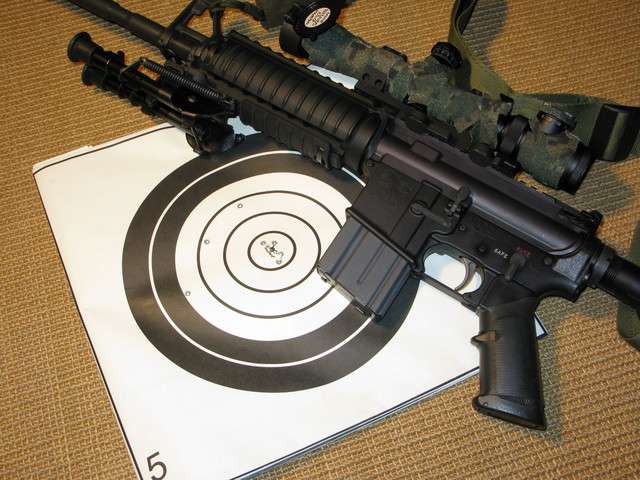
|
|
Originally posted by innocent_bystander:
I will continue to argue for 5 shot groups. With 10 shot groups barrel heat starts to become a factor in accuracy and if you try to slow shooting enough to prevent heat build up then you run the risk of changes in conditions (wind). You can “argue” all you like, but since you failed to present any scientific data to support your position the only thing you’ve actually done is stated your unsupported opinion and therefore your “argument” carries no weight. In the accuracy spectrum involved with semi-automatic AR-15s, barrel heat has no statistically significant effect on the size of groups between 5-shots and 10-shots when using a quality barrel and shooting at a slow, steady pace. In fact, it has no statistically significant effect between “groups” of 1-shot and 10-shots. For those of you interested in some actual facts on the matter see my next post. Also, anyone who wishes to claim that their accuracy testing results have any validity, will use some means to monitor the wind conditions on the range during testing. |
All hail Jeanne Assam!
|
ONE-SHOT “GROUPS”
For this simple, yet effective and illustrative test I compared the results of firing three consecutive 10-shot groups to that of firing thirty 1-shot “groups” in a row. By 1-shot groups, I mean that I fired one single shot on each of thirty different targets. As with my usual method, testing was conducted from a concrete bench-rest at a distance of 100 yards. The test vehicle was my Krieger barreled AR-15. The handguard of the rifle rested in a Sinclair Windage Benchrest and the buttstock rested in a Protektor bunny-ear bag. For sighting, I used a Leupold Competition scope (45X magnification) with a mirage shade attached.The scope was adjusted to be parallax-free at 100 yards. Wind conditions were monitored using a Wind Probe. The ambient temperature during testing was a balmy 72 degrees F. Just prior to the beginning of testing, I fired off a 10-shot control group from 100 yards using handloaded 55 grain Sierra BlitzKings that had an extreme spread of 0.74”. 

Testing was conducted using hand-loaded Hornady 55 grain FMJ bullets. The thirty, 1-shot groups were fired first. In order to mitigate possible effects of barrel heat on the points of impact of the 1-shot groups (and therefore the overall mean radius of the 30-shot composite group that would later be formed from the thirty individual shots) I allowed the barrel to cool between each individual shot. The barrel was allowed to cool for approximately 1.5 minutes between each shot. The barrel remained only slightly warm to the touch during the firing of all thirty 1-shot groups. I was able to wrap my hand around the barrel and hold it before each new shot was fired without the slightest bit of discomfort. Also, to mitigate possible effects of the so-called “heat soak” effect (the cartridge “soaking” heat from hot chamber walls while sitting in the chamber) on the points of impact of the individual shots, I single-loaded each shot just before firing it and left the bolt locked open after each shot to allow the chamber to cool. The thirty, 1-shot groups were overlayed on each other using RSI Shooting Lab to form a 30-shot composite group that had a mean radius of 0.46”. The 1-shot groups 
The three 10-shot groups were fired following the 1-shot groups. I fired at a slow steady pace, but no time was allotted between each shot for the barrel to cool nor was any time allowed for the chamber to cool. Each round was immediately single-loaded into the chamber after firing the previous shot. The three 10-shot groups had extreme spreads of 1.42", 1.22" and 1.27" for an average extreme spread of 1.30”. The three 10-shot groups were also over-layed on each other using RSI Shooting Lab. The mean radius for that 30-shot composite group was 0.42”. One of the 10-shot groups. 
The 30-shot composite groups. 
Next, I measured (by hand) the individual radius of each shot from the statistical center of the 30-shot composite group formed from the 1-shot groups. I repeated the same procedure with the 30-shot composite group formed from the three 10-shot groups. These measurements gave me two sets of data for further comparison, with each set containing 30 data points on the accuracy level of the two different methods of firing a total of 30 shots; that is the three 10-shot groups fired at a steady pace versus the thirty 1-shot groups fired slowly with time for the barrel to cool between each shot. Lastly, I ran a statistical analysis comparing the two data sets obtained in the manner described above using an unpaired, two-tailed t-test. The results showed that there was no “statistically significant” difference in the mean radii (and thus the accuracy) of the two composite groups! (P= 0.49) As an aside, this test further reinforced the point that 55 grain FMJ bullets fired from a semi-automatic AR-15 are simply not capable of consistent MOA accuracy. Also, not forgetting our Internet Commandos in the audience, I fired a 3-shot group using the 55 grain BlitzKings that had an extreme spread of 0.298" 
|
All hail Jeanne Assam!
|
Originally Posted By Molon:
... In the accuracy spectrum involved with semi-automatic AR-15s, barrel heat has no statistically significant effect on the size of groups between 5-shots and 10-shots ... +1 None of the guys shooting AR15 in our National Match (20 rounds in 20 mins) thinks that heat could effect the accuracy of the last shots. Scores confirm this theory. |
|
I will say that this is one of if not "THE" best threads that have been ever posted on any forum at any time!
I have always pushed the 10 shot group evaluation but trying to change peoples minds with "facts" against their small 3/5 shot groups is a losing battle. They want to see small groups and will do what is necessary to get those results. Molon, I really appreciate your time spent in providing all of us with the "facts". I take my hat off to you sir... |
|
This thread is about the bigest load of crap I have ever heard. There is only one "internet commando" here and that is the original poster molon (or is it moron?). I guess you think that just because large groups are what you shoot then that's what everybody should shoot. I've got news for you my friend, there are many nationaly and internationaly sanctioned bench rest shooting associations that would disagree with you. And by bench rest, I mean competition using equipment that is almost unrecognizable as a firearm. Purpose built firing platforms that are designed for pure accuracy. It doesn't take many shots
to determine if the action/barrel/ammo combination is sub moa with these platforms. But then again, I guess I should cut you some slack. After all, this is AR15.com. Maybe you would like to take your theories and pretty target pictures over to some of the bench rest association web sites. Prepare to get spanked sonny boy. |
|
Originally Posted By 700shooter:
This thread is about the bigest load of crap I have ever heard. There is only one "internet commando" here and that is the original poster molon (or is it moron?). I guess you think that just because large groups are what you shoot then that's what everybody should shoot. I've got news for you my friend, there are many nationaly and internationaly sanctioned bench rest shooting associations that would disagree with you. And by bench rest, I mean competition using equipment that is almost unrecognizable as a firearm. Purpose built firing platforms that are designed for pure accuracy. It doesn't take many shots to determine if the action/barrel/ammo combination is sub moa with these platforms. But then again, I guess I should cut you some slack. After all, this is AR15.com. Maybe you would like to take your theories and pretty target pictures over to some of the bench rest association web sites. Prepare to get spanked sonny boy. I think you need to re-read this thread, obviously you didn't understand it the first time... And your comments, well, lets say they're lacking in many ways. Molon is "proving" a point with facts and data, and all that you can come up with is an uncouth post? You can do better than that, can't you? |

|
Originally Posted By 700shooter:
This thread is about the bigest load of crap I have ever heard. There is only one "internet commando" here and that is the original poster molon (or is it moron?). I guess you think that just because large groups are what you shoot then that's what everybody should shoot. I've got news for you my friend, there are many nationaly and internationaly sanctioned bench rest shooting associations that would disagree with you. And by bench rest, I mean competition using equipment that is almost unrecognizable as a firearm. Purpose built firing platforms that are designed for pure accuracy. It doesn't take many shots to determine if the action/barrel/ammo combination is sub moa with these platforms. But then again, I guess I should cut you some slack. After all, this is AR15.com. Maybe you would like to take your theories and pretty target pictures over to some of the bench rest association web sites. Prepare to get spanked sonny boy. lolz |
"I'm egotistical and arrogant because I've earned the right to be." -Dusty_C

|
Originally Posted By Skillshot:
Originally Posted By 700shooter:
This thread is about the bigest load of crap I have ever heard. There is only one "internet commando" here and that is the original poster molon (or is it moron?). I guess you think that just because large groups are what you shoot then that's what everybody should shoot. I've got news for you my friend, there are many nationaly and internationaly sanctioned bench rest shooting associations that would disagree with you. And by bench rest, I mean competition using equipment that is almost unrecognizable as a firearm. Purpose built firing platforms that are designed for pure accuracy. It doesn't take many shots to determine if the action/barrel/ammo combination is sub moa with these platforms. But then again, I guess I should cut you some slack. After all, this is AR15.com. Maybe you would like to take your theories and pretty target pictures over to some of the bench rest association web sites. Prepare to get spanked sonny boy. lolz lol, what is he smoking...? |
If I got a plan for zombies, don't you think I have everything else covered?
Thou shalt not be afraid for the terror by night, Nor for the arrow that flieth by day; Psalms 91:5
Thou shalt not be afraid for the terror by night, Nor for the arrow that flieth by day; Psalms 91:5
|
Thanks Molon for turning us on to this method.
I have a crappy old functional laptop (by today's standards) I was planning to use at the range to obtain quick data about groups. Turns out On Target freeware will work on Windows ME operating system. Forget scanning th target, just take a digital photo of the target with a scale for reference. This can be done at the range. My only roadblock now is my digital camera is a current model with no USB drivers for Windows 98 or ME. So I guess I have to get a newer laptop for range use. A quick comparison of my "manual input from dial caliper to spreadsheet" method versus the On Target freeware software. What is called "extreme spread" is called "maximum spread" and "actual mean spread" is called "average to center" by On Target software. Temperature was in the low 40s and there was wind. Targets were out at 100 yards. Aiming point was dead center of target as best I could. Shot numbers are for measuring purposes, not in the order they were shot. For Hornady .223 75 gr TAP using WOA SS 18" upper, KAC 2 stage trigger, and Nightforce 2.5-10x NSX scope: Maximum spread = 1.90" spreadsheet, 1.915" software Average to center = 0.58" spreadsheet, 0.585" software 
For Portugese surplus 5.56 62 gr FMJ using Operator 16" CL upper, standard single stage trigger, and Aimpoint M3 with 3x magnifier: Maximum spread = 6.75" spreadsheet, 6.780" software Average to center = 2.26" spreadsheet, 2.115" software 
For SSA 6.8 SPC 115 gr OTM using Kotonics 18" CL SPR, KAC 2 stage trigger, and 16x Super Sniper scope: Maximum spread = 3.47" spreadsheet, 3.330" software Average to center = 0.69" spreadsheet, 0.688" software Maximum spread (excluding flyer) = 1.41" spreadsheet, 1.391" software Average to center (excluding flyer) = 0.43" spreadsheet, 0.406" software 
The software certainly was way easier and quicker to use and the results vary only because I rounded up to the nearest 100th by eye ball, and manual shot measurements are subjective. Variations are for the most part less than 1/10 inch. So the software is good to go. More powerful optics on the 5.56 uppers would have improved groups as well. Oh, and since this is AR15.com, gun porn of the hardware: 
|
|
Originally Posted By FALbert:
Thanks Molon for turning us on to this method. I have a crappy old functional laptop (by today's standards) I was planning to use at the range to obtain quick data about groups. Turns out On Target freeware will work on Windows ME operating system. Forget scanning th target, just take a digital photo of the target with a scale for reference. This can be done at the range. My only roadblock now is my digital camera is a current model with no USB drivers for Windows 98 or ME. So I guess I have to get a newer laptop for range use. A quick comparison of my "manual input from dial caliper to spreadsheet" method versus the On Target freeware software. What is called "extreme spread" is called "maximum spread" and "actual mean spread" is called "average to center" by On Target software. Temperature was in the low 40s and there was wind. Targets were out at 100 yards. Aiming point was dead center of target as best I could. Shot numbers are for measuring purposes, not in the order they were shot. For Hornady .223 75 gr TAP using WOA SS 18" upper, KAC 2 stage trigger, and Nightforce 2.5-10x NSX scope: Maximum spread = 1.90" spreadsheet, 1.915" software Average to center = 0.58" spreadsheet, 0.585" software http://img.photobucket.com/albums/v508/FALbert/100%20yard%2010%20shot%20groups/TAP75grBTHP223meanradius58inch.jpg For Portugese surplus 5.56 62 gr FMJ using Operator 16" CL upper, standard single stage trigger, and Aimpoint M3 with 3x magnifier: Maximum spread = 6.75" spreadsheet, 6.780" software Average to center = 2.26" spreadsheet, 2.115" software http://img.photobucket.com/albums/v508/FALbert/100%20yard%2010%20shot%20groups/Portugese62grFMJ556meanradius226inc.jpg For SSA 6.8 SPC 115 gr OTM using Kotonics 18" CL SPR, KAC 2 stage trigger, and 16x Super Sniper scope: Maximum spread = 3.47" spreadsheet, 3.330" software Average to center = 0.69" spreadsheet, 0.688" software Maximum spread (excluding flyer) = 1.41" spreadsheet, 1.391" software Average to center (excluding flyer) = 0.43" spreadsheet, 0.406" software http://img.photobucket.com/albums/v508/FALbert/100%20yard%2010%20shot%20groups/SSA115grOTM68SPCmeanradius69inch.jpg The software certainly was way easier and quicker to use and the results vary only because I rounded up to the nearest 100th by eye ball, and manual shot measurements are subjective. Variations are for the most part less than 1/10 inch. So the software is good to go. More powerful optics on the 5.56 uppers would have improved groups as well. Oh, and since this is AR15.com, gun porn of the hardware: http://img.photobucket.com/albums/v508/FALbert/100%20yard%2010%20shot%20groups/ARsusedfor10shotgroups.jpg 
Excellent validation of the software program! Thanks for positng. (Nice hardware you've got there too.) When using the traditional caliper method to determine extreme spread (outside edge to outside edge, minus bullet diameter), I've noticed my manual readings tend to run a few thousandths of an inch smaller than the software program readings. After a little investigating, I found something interesting (at least to me). When using spitzer type bullets (FMJ, OTM, BT) the bullet "holes" on paper quite often do not measure a full 0.224". After measuring a large sample of bullet holes under high magnification, I found that many of the bullet holes run approximately 0.005" smaller than 0.224". I think it might have something to do with the paper stretching as the bullet passes through it and then relaxing afterwards. Just another one of those "things that make you go hmmm." The bullet holes pictured below were made by 0.224" Sierra MatchKings. The red ring in the picture has a diameter of 0.224". As you can clearly see in the picture, there is a distinct gap between the red ring and the edges of the bullet hole. The blue ring in the picture has a diameter of 0.219" and much more closely approximates the size of the bullet hole. 
|
All hail Jeanne Assam!
|
Originally Posted By 18thcentrury:
At the risk of getting it from all directions I'm going to throw in my two cents. Since I don't know anyone here, I don't have any personal bias for or against any of the posters. I'm no expert on AR's, but I am an expert on statistical data analysis and that is at the root of this whole discussion. (Experience = Ph.D. with, depending on how you count it, about 20 years experience.) Whether you are concerned with testing loads, or barrel condition, or sighting, or trigger control or whatever, when you use target analysis you are trying to use a statistical sample (sample population) to make a prediction about overall behavior of future shots (parent population). Assuming the appropriate calculations are done correctly you can then draw some conclusions about the average behavior of future shots within the statistical uncertainties. However, for this to be valid, there are some key points that have to be satisfied. 1) The sample must be representative. In practice this means a couple of things. First you can't arbitrarily throw out shots as "fliers" because they appear way outside the "group". You can only throw out (and should) shots which you KNOW to be un-representative. For example if someone slaps you on the shoulder just as you pull the trigger. But just because a shot "looks" different does not mean that it can be excluded. Second, the results automatically are representative of all of the statistical variation that goes into the sample. So if, for example, you want compare the performance of two different loads in the same rifle, then you have to get one or more samples (groups or sets of groups) for each of the two loads, with no other differences. In practice can you eliminate every single other variable? No, but you should be able to eliminate the statistically significant ones. Or, at least be aware of and ensure that other variables should contribute equally to the all of the samples for each load. 2) The conclusions are about AVERAGE behavior. There will always be variations from shot to shot, or group to group, but you can make definite quantitative statements about the average behavior within the statistical uncertainties. If these requirements are satisfied, then there are a couple more statements which will be absolutely true, and this gets to the main point of this thread and the apparent dispute: The larger the sample size, the smaller will be the statistical uncertainties in the results. What this means is that on average a 10-shot group will provide a more accurate estimate of the parent group (all future shots) than will a 3-shot group. In fact, the uncertainty in statistical results (for example the group center) can be calculated. It depends on the particulars of the statistic being calculated, but a 10-shot group will result in a decrease in uncertainty over a 3-shot group of roughly a factor of 1.8. Does this mean a 10-shot group is "the" size to use and a 3-shot group is worthless? No, it all depends on what level of uncertainty you can live with and how many shots you are willing to make to get the uncertainty down to an acceptable level. A fundamental, basic result of statistical analysis, whether you are talking about data from a high-energy physics experiment, or data from a set of holes on a target, is that the larger the sample size, the lower the uncertainty in the results. In terms of the accuracy (how close the results are to some absolute reality) a 10-shot group is better than a 3-shot group, and a 50-shot group is better than a 10-shot group. In designing a scientific experiment in which statistical analysis will be a major component of the final analysis, you always trade off practical considerations like expense and time needed to increase the sample size, vs. how much accuracy you need. One other consideration is how much information you want to get out of your target analysis. If you are just trying to get the group center then it turns out that you don't need nearly as large a sample size as if you are calculating the width or shape of the group. There has been some discussion here of group sizes for larger sample sizes being "large". The problem is, that the more shots you fire, the larger the extreme-spread will be. This is a simple fact. This is not something related to shooting, but is simply the nature of the underlying probability distribution function. This is one reason why extreme-spread is not a particularly good statistic for measuring group size. "Mean radius" (average distance from center is a technically more accurate term) is better, but in true scientific work an even better measure is a statistic generally referred to as "width". What you really want to know is how densely shots are (or will be) placed near the center of the group. Extreme-spread is a very crude measure of this. It's popular because it is easy to measure. The mathematically best measure is width, but it requires some fairly sophisticated math to do the calculations. If samples are taken under identical (practically identical in the sense of statistical significance) conditions, then two 3-shot groups, and a 4-shot group are equivalent to a single 10-shot group, provided the raw data is combined BEFORE any calculations are done. But there is nothing otherwise special about sample size. A 10-shot group provides the same KIND of information as a 20-shot group but of different quality (that is, with different uncertainties in the results). The problem is that if you don't know the uncertainties in the results it's impossible to know what the results are telling you without some foreknowledge of what to expect, and even then, without uncertainties your analysis ceases to be purely quantitative and falls back on making what is essentially an educated guess. In discussions of target analysis (a.k.a. group analysis) uncertainties in the results always seems to be left out. But without it you can't know whether the differences you are seeing are real, or whether they are just the result of the natural random variation which will occur from one shot (or group) to the next. In the scientific community, if you don't present the uncertainty component of your results no one would give them any credibility because they would have no way of knowing what your results really mean, if anything. A discussion of the uncertainties has been left out of the discussion in this thread, but that is probably because the software that has been referred to doesn't do uncertainty calculations. I'm speculating now, but the software probably doesn't include it because the software author was probably just implementing a set of statistical formulae from a reference. Interest in the subject lead me to this thread and I thought my expertise justified a comment, but now I'm getting close to a point where I do have some bias in that I'm involved in selling software which does the uncertainty calculations needed for an actual scientific target analysis, so I'll stop here. Bottom line –– it is mathematically correct to say that a 10-shot group yields results which on average are more accurate than a 3-shot group, but there is nothing magical about the numbers 3, 10, or 5. if your still having problems with 10 round groups please reference the above post, and others starting on page 13. would post some pics but still don't have time to figure it out. |
|
Here are the proper test conditions:
1) Obtain Caldwell shooting rest 2) Load 30 rounds in a mag and 5 rounds in a different mag 3) Bore sight upper and optic if not sighted in already 4) Sight in upper with 2 rounds and lock down rifle 5) Attach shoot-n-see target to cover holes 6) Shoot 30 rounds and measure all holes from the same point 7) Load data into Minitab Software 8) Run distribution identification to validate normal distribution or which one is correct 9) Calculate mean and standard deviation using correct distribution 10) Smallest standard deviation rifle is best for same number of rounds. If you have 30 rounds for 3 different uppers and only 27 for fourth, you must use ANOVA to compare, assuming all normal distributions. |
There is iron in your words of death for all to see, and so there is iron in your words of life. No signed paper can hold the iron. It must come from men. It is good that warriors such as we meet in the struggle of life or death. It shall be life.
|
Originally Posted By JoseyWales:
Here are the proper test conditions: 1) Obtain Caldwell shooting rest http://www.midwayusa.com/mediasvr.dll/image?saleitemid=838651 2) Load 30 rounds in a mag and 5 rounds in a different mag 3) Bore sight upper and optic if not sighted in already 4) Sight in upper with 2 rounds and lock down rifle 5) Attach shoot-n-see target to cover holes 6) Shoot 30 rounds and measure all holes from the same point 7) Load data into Minitab Software 8) Run distribution identification to validate normal distribution or which one is correct 9) Calculate mean and standard deviation using correct distribution 10) Smallest standard deviation rifle is best for same number of rounds. If you have 30 rounds for 3 different uppers and only 27 for fourth, you must use ANOVA to compare, assuming all normal distributions. Sweet! So how about showing us some of the results of your method. |
All hail Jeanne Assam!
|
Molon,
I haven't checked in on this thread for some time... good to see it still alive and kickin' 
I'll definitely have to browse back through and take a look at the info on testing for statistical significance... I took an intro stats course last year, and loved it. Not surprisingly, I didn't have to look very much further than my loading bench for lots and lots of data for class projects  I am working on going back and filling in some gaps in what the course had time to teach via self-study - still have lots to learn. I am working on going back and filling in some gaps in what the course had time to teach via self-study - still have lots to learn.
Still trying to find the method to the madness that we call reloading... should make for some harmless entertainment in the mean time, and if I'm lucky, it might help tighten up the groups a bit along the way. My one concern with shooting multiple long strings is that not every cartridge has the extensive barrel life of a .223 Rem or .308 Win, and even then, for some of us that barrel life needs to be conserved for winning matches. Some popular match cartridges such as a 6.5-284 can be burned out (no longer grouping tightly enough to be considered capable of winning matches) in as little as 1000rds (or less!). Speaking of statistical testing and possible methods for reducing the round count necessary to accurately test for a significant change between one component or another... have you seen this site: www.statshooting.com? The short version is they use optical scans combined with some spreadsheet macros and circular error probable calculations (similar to what the military uses to determine target saturation levels for bombs and missiles) to come up with some interesting results. I haven't had time to really field test it just yet - I have a few too many irons in the fire just at the moment - but I thought you might find it of interest. Another thing you might be interested in... I had the briefest exposure to the Minitab statistical software mentioned above... fairly popular at least for university stat classes, but it's hideously expensive for the average person like you or me to get a copy of - $1200 list price for a single-user license. An option, if you do decide you want to start getting into statistical analysis beyond what M$ Excel is capable of, but don't want to break the piggy bank... check out www.r-project.org for a full-on stat program that is completely free to download and use. Learning curve is a little steep, but it looks to be more capable in the long run than Excel, as it's primary focus *is* stats. HTH, Monte |
|
Originally Posted By markm:
Originally Posted By Molon:
He has watched the movie Heat 87 times I just finally finished watching Heat for the first time 2 weeks ago. I rented it several years back but couldn't finish it because it was so bad. Love that flick, 87 times is too many for 10 lifetimes tho... |

|
Originally Posted By vicious_cb:
Originally Posted By TACKDRIVER68:
Originally Posted By tpelle:
Originally Posted By vicious_cb:
Also something I noticed, alot of my groups tend to string vertically and I'm starting to think theres a barrel harmoics issue going on or is it just me? Anyone have any answers? http://i232.photobucket.com/albums/ee52/j_rock001/IMG_0075.jpg Need to know more about how you were shooting - off of a bench with sandbags, prone or sitting with a sling? Generally vertical stringing is due to inconsistent breathing - not getting your respiratory pause consistent between shots. +1 on the breathing. The best advice I can offer is to create a routine for yourself- mine is inhale, exhale slowly and regulate the length of pause with saying a word in your head and timing your trigger pull to the end of the word; 'pop', 'bang' or any other short word will do. You can also get 3-5 snap caps and do dime drills to work on the trigger control. I don't shoot more than once every two weeks or so, so sometimes I need to re-train myself on the basics. I do this the day before each range trip before I pack up the weapon. Strangely enough I dont have a vertical stringing problem when shooting my bolt gun. Im well of my aware of breath control when shooting for groups I have found that I have horizontal stringing when shooting my AR with .223 or 5.56. But with my bolt action Remington 700 7mm Magnum, most all of my shots are vertically strung. Any Comments as to why? I was thinking weight of rifle. AR much lighter than Remington. Trigger pull is also much lighter on the Remington (4 to 4.5 lbs) that it is on my AR (new stock trigger between 7 and 8 lbs) I shoot them both using the same breathing. Could it be pistol grip vs typical wooden stock grip? I shoot both using a bipod. Any input would be interesting. Sorry to sidebar the string with another sidebar....LOL Mutt |
|
Originally Posted By Muttt:
Originally Posted By vicious_cb:
Originally Posted By TACKDRIVER68:
Originally Posted By tpelle:
Originally Posted By vicious_cb:
Also something I noticed, alot of my groups tend to string vertically and I'm starting to think theres a barrel harmoics issue going on or is it just me? Anyone have any answers? http://i232.photobucket.com/albums/ee52/j_rock001/IMG_0075.jpg Need to know more about how you were shooting - off of a bench with sandbags, prone or sitting with a sling? Generally vertical stringing is due to inconsistent breathing - not getting your respiratory pause consistent between shots. +1 on the breathing. The best advice I can offer is to create a routine for yourself- mine is inhale, exhale slowly and regulate the length of pause with saying a word in your head and timing your trigger pull to the end of the word; 'pop', 'bang' or any other short word will do. You can also get 3-5 snap caps and do dime drills to work on the trigger control. I don't shoot more than once every two weeks or so, so sometimes I need to re-train myself on the basics. I do this the day before each range trip before I pack up the weapon. Strangely enough I dont have a vertical stringing problem when shooting my bolt gun. Im well of my aware of breath control when shooting for groups I have found that I have horizontal stringing when shooting my AR with .223 or 5.56. But with my bolt action Remington 700 7mm Magnum, most all of my shots are vertically strung. Any Comments as to why? I was thinking weight of rifle. AR much lighter than Remington. Trigger pull is also much lighter on the Remington (4 to 4.5 lbs) that it is on my AR (new stock trigger between 7 and 8 lbs) I shoot them both using the same breathing. Could it be pistol grip vs typical wooden stock grip? I shoot both using a bipod. Any input would be interesting. Sorry to sidebar the string with another sidebar....LOL Mutt I have no idea what causes it. Considering my 16 10-shot group sample size was taken over months and nearly all of them show the same pattern of vertical dispersion(note in the picture some of the targets are sideways) I think the evidence points to barrel. Again I have shot the upper on different lowers with different triggers and different stocks and wound up with the same result. The main trigger I used was a geissle hi-speed set to around 1lb which is pretty darn light! Ive ruled out the ammo as the problem since I use the same brand on several ARs and they do not exhibit a vertical dispersion pattern as wide as the Larue upper did. Perhaps I may have gotten a bad barrel but I doubt it. Its possibly some kind of barrel harmonics issue but Im not quite sure how to test something like that. |

|
I shoot a .458 Win Mag as my primary hunting rifle, and have found that my groups open up after about the 10th shot of the day due to the effects of recoil upon the shooter. I can hold my discipline for about that long before any subsequent shots off the bench are no longer a measure of the rifle and load, and instead one of how much pain the shooter can endure.
500-grain bullets are flat-out painful after about the 10th shot. So, I'll have to accept the limited technical accuracy of 3-shot groups with that rifle, considering that shooter error is much greater after round 4 than on 1-3. And by round 12 trigger control, breathing discipline, and even not flinching the rifle five feet off target is basically gone entirely. Still, at 100 yards, my 3 or 5 shot groups average about 1.5 - 2.5 inches. The first group of the day is the tightest. Now, with lighter calibers, I love just shooting 20 or more rounds at the target and see what the group looks like. |
|
Originally Posted By vicious_cb:
Originally Posted By Muttt:
Originally Posted By vicious_cb:
Originally Posted By TACKDRIVER68:
Originally Posted By tpelle:
Originally Posted By vicious_cb:
Also something I noticed, alot of my groups tend to string vertically and I'm starting to think theres a barrel harmoics issue going on or is it just me? Anyone have any answers? http://i232.photobucket.com/albums/ee52/j_rock001/IMG_0075.jpg Need to know more about how you were shooting - off of a bench with sandbags, prone or sitting with a sling? Generally vertical stringing is due to inconsistent breathing - not getting your respiratory pause consistent between shots. +1 on the breathing. The best advice I can offer is to create a routine for yourself- mine is inhale, exhale slowly and regulate the length of pause with saying a word in your head and timing your trigger pull to the end of the word; 'pop', 'bang' or any other short word will do. You can also get 3-5 snap caps and do dime drills to work on the trigger control. I don't shoot more than once every two weeks or so, so sometimes I need to re-train myself on the basics. I do this the day before each range trip before I pack up the weapon. Strangely enough I dont have a vertical stringing problem when shooting my bolt gun. Im well of my aware of breath control when shooting for groups I have found that I have horizontal stringing when shooting my AR with .223 or 5.56. But with my bolt action Remington 700 7mm Magnum, most all of my shots are vertically strung. Any Comments as to why? I was thinking weight of rifle. AR much lighter than Remington. Trigger pull is also much lighter on the Remington (4 to 4.5 lbs) that it is on my AR (new stock trigger between 7 and 8 lbs) I shoot them both using the same breathing. Could it be pistol grip vs typical wooden stock grip? I shoot both using a bipod. Any input would be interesting. Sorry to sidebar the string with another sidebar....LOL Mutt I have no idea what causes it. Considering my 16 10-shot group sample size was taken over months and nearly all of them show the same pattern of vertical dispersion(note in the picture some of the targets are sideways) I think the evidence points to barrel. Again I have shot the upper on different lowers with different triggers and different stocks and wound up with the same result. The main trigger I used was a geissle hi-speed set to around 1lb which is pretty darn light! Ive ruled out the ammo as the problem since I use the same brand on several ARs and they do not exhibit a vertical dispersion pattern as wide as the Larue upper did. Perhaps I may have gotten a bad barrel but I doubt it. Its possibly some kind of barrel harmonics issue but Im not quite sure how to test something like that. Thanks, that makes real sense and is not something I really considered up until now. I may try a dampener (rubber ball looking thing you slide onto your barrel) on my Remington and see if that changes the dispersion by dampening the harmonics. If I learn something I will let you know. |

|
OK what the heck.
JP Rifles CTR-02 18" Barrel ACOG TA31 ECOS Sunny 55 degree day Steady 5-7 mph wind moving directly from left to right Seated on my backyard deck at a shaky 36" plastic Wally World table with the handguard resting on a sand bag Black Hills Blue Box 69 gr SMK's 100 yards http://i28.photobucket.com/albums/c245/MarkChambers/DSC_0126-1.jpg Center circle is 11/2" across 18 shot group Put one shot in the lower right and left hand circles just to do a check I love this gun |
The Trouble With 3-Shot Groups (Page 8 of 12)
AR Sponsor